
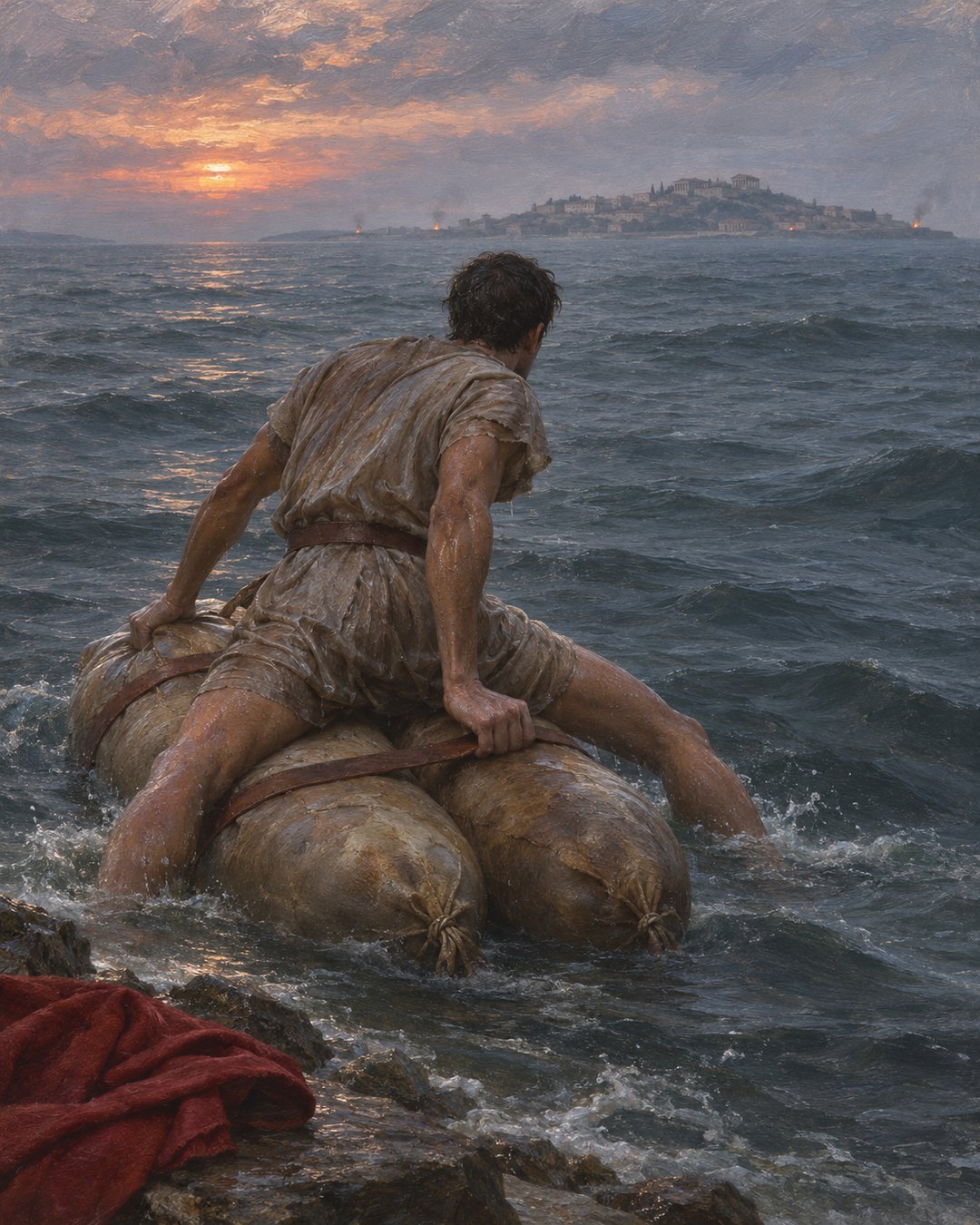
From a distance, the object moving across the water toward besieged Cyzicus did not look like a Roman courier. Frontinus says the enemy watchers took it for a marine creature. That mistake was the final component of a carefully built communications device: two inflated skins, joined underneath by two strips, carrying a soldier who steered with his spread legs.
Lucius Lucullus needed to tell the city that relief was approaching, but Mithridates controlled its narrow landward entrance and watched the surrounding water. The answer was not simply to find a brave swimmer. It was to turn buoyancy, steering and disguise into one system. The seven-mile crossing mattered because the letter had to arrive; the strange silhouette mattered because the courier had to survive long enough to deliver it.
Cyzicus Was Surrounded by More Than a Wall of Men
Plutarch describes the siege as a contest over movement and supply. Cyzicus had already suffered near Chalcedon, where it lost three thousand men and ten ships. Mithridates then moved against the city by land and sea. Ten camps enclosed it on the landward side, while ships completed the blockade from the water.
The geography sharpened the problem. Frontinus calls the approach to the island city a single narrow entrance connected to the mainland by a small bridge. Enemy forces held that bridge. A conventional messenger could not walk through. A visible boat would advertise its purpose. Any attempt to communicate had to cross an observed boundary without looking like communication.
Lucullus was operating outside that ring. Plutarch says he placed his army where it could command the roads and regions from which Mithridates needed supplies. His larger design was patient: let the besieger consume food while the Roman army gathered plenty. Yet patience only worked if the city continued resisting. The people behind the blockade needed some reason to believe that an army they could not see was acting for them.
Frontinus does not preserve the words in the letter. That absence is important. The episode is not evidence for a stirring speech composed after the fact. What survives is the delivery problem and the mechanism built to solve it.
Two Skins Became a One-Man Craft
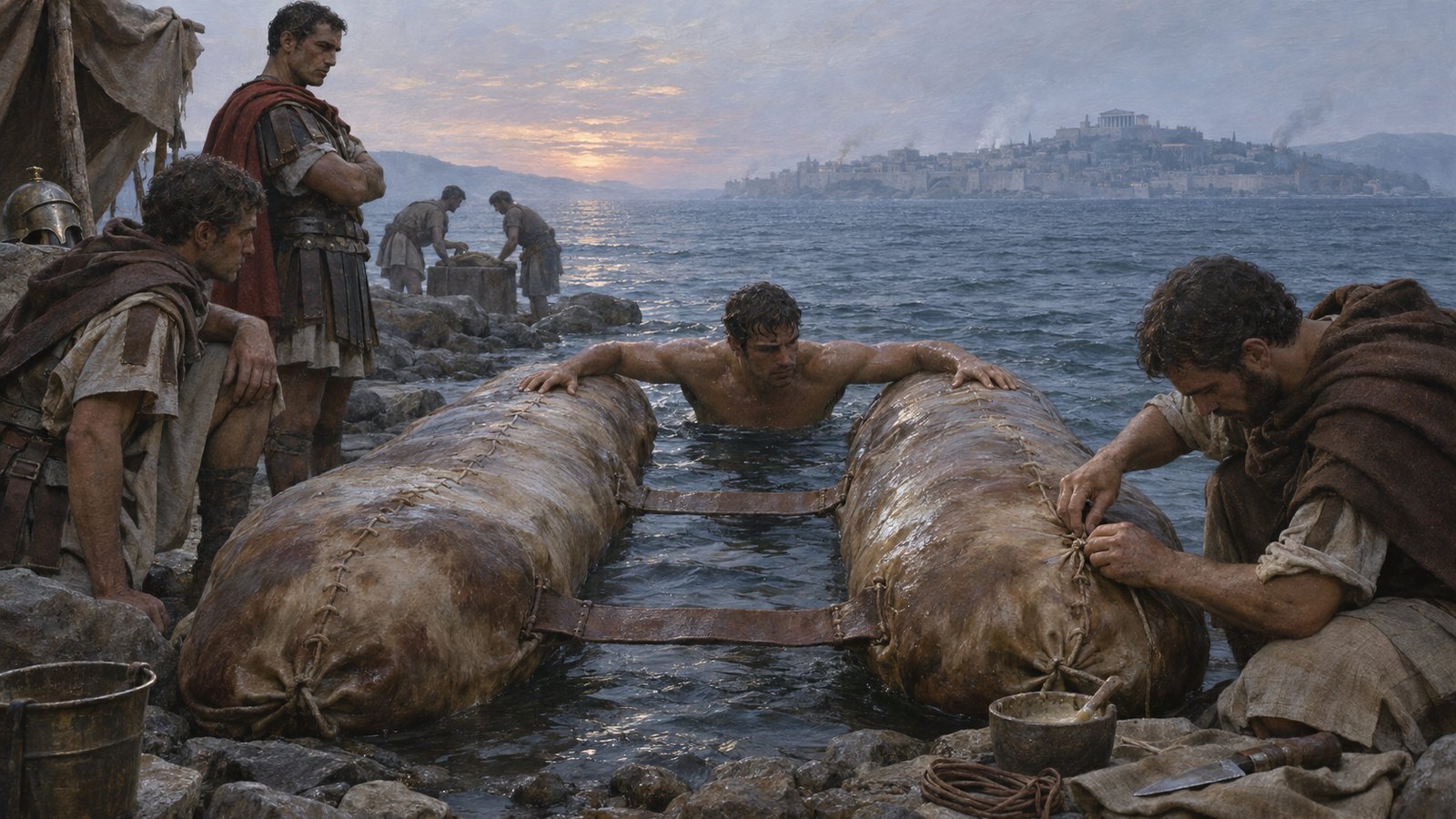
Lucullus had letters sewn inside two inflated skins. Hides filled with air could provide flotation, but Frontinus’s description goes beyond two loose bladders tied to a swimmer. The skins were fastened together along their lower side by two strips placed some distance apart. The spacing produced a stable platform that the courier could mount.
That construction answered several needs at once. The air kept the soldier and protected letters above much of the water. The paired shape resisted rolling better than one skin beneath the chest. The strips held the two floats in relation to each other while leaving a place for the courier’s body. Nothing in the account suggests a full boat with a rigid hull, oars or sail. It was a minimal craft assembled for a single passage.
The courier was chosen for relevant skills. Frontinus calls him adept in swimming and boating. Courage was necessary, but it was not the qualification that made the device controllable. A swimmer understood balance, current and the consequences of an awkward shift. A boatman understood that flotation without directional control could carry a passenger into the wrong part of the blockade.
Roman military ingenuity often appears as a large machine, but this episode works at the scale of one body and two prepared hides. A similarly compact problem shaped the torch system that turned an alphabet into a battlefield signal. Both devices begin with a constraint—distance in one case, watched water in the other—and redesign the message around what the environment will permit.
His Legs Did the Work of a Rudder
Once mounted, the soldier spread his legs and steered “as though by rudder.” That detail prevents the story from becoming a vague anecdote about floating. The paired skins supplied lift, but the courier’s body supplied guidance. Small changes in resistance on either side could change his direction while his hands remained available for balance and propulsion.
The arrangement also avoided the conspicuous rhythm of oars. A boat crossing guarded water announces itself through a recognizable hull, repeated strokes and a deliberate course. The skin craft presented an uncertain profile. Low in the water and controlled by movement beneath or beside the floats, it could be seen without being understood.
Seven miles was not a quick dash beyond a sentry. Frontinus’s distance makes the choice of an experienced swimmer and boatman comprehensible. The courier needed to maintain balance and direction over an extended crossing while preserving the sealed message. Fatigue could turn a clever device into wreckage. Drifting could bring him near enemy positions that the disguise was never meant to survive at close range.
The craft therefore divided the problem between materials and trained flesh. The skins bore weight. The connecting strips maintained geometry. The courier interpreted water and adjusted course. None of those elements alone delivered the letter. Frontinus’s compact paragraph describes a complete human-machine system.
The Best Camouflage Was an Unresolved Shape
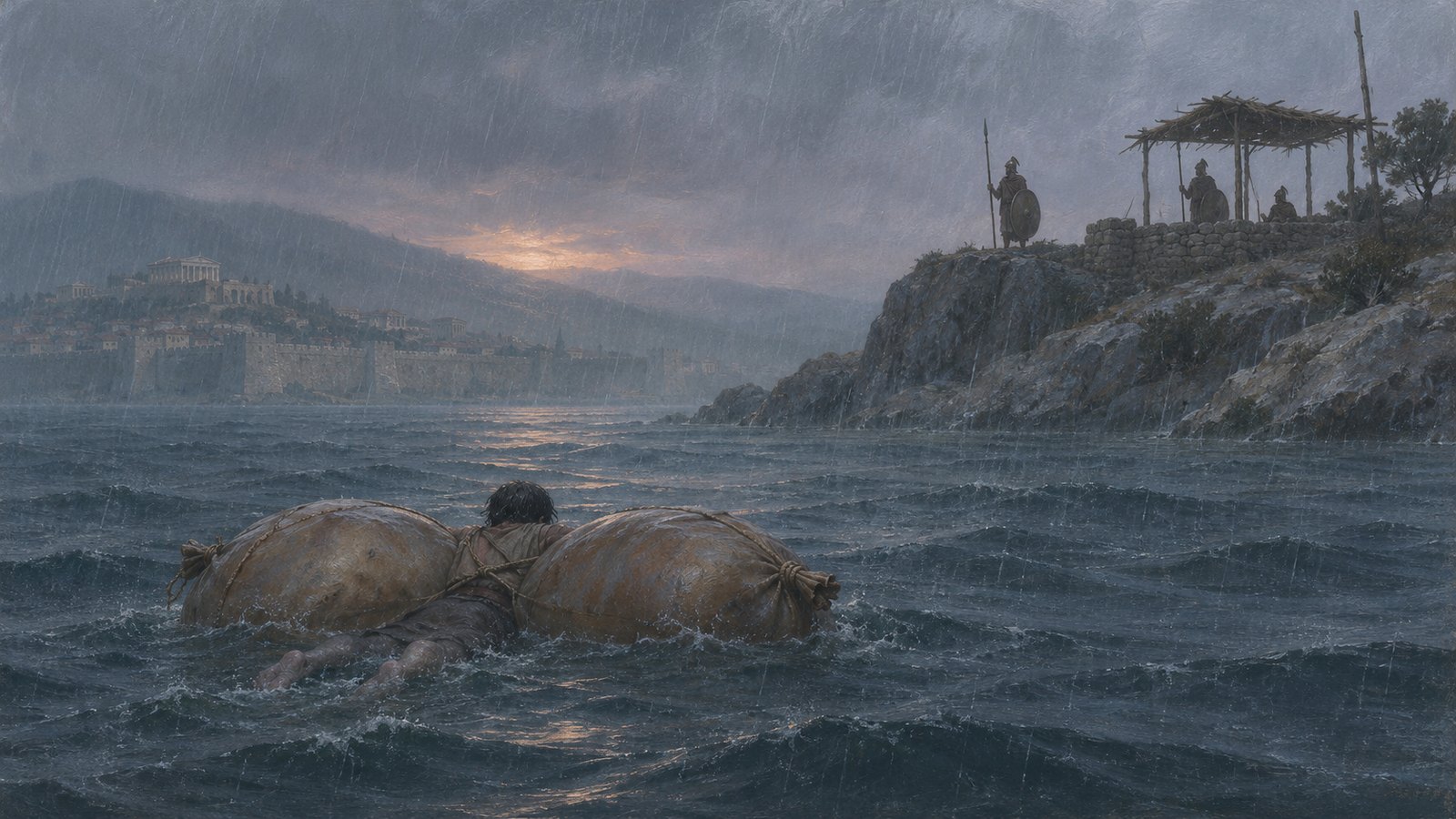
The watchers saw the courier, but Frontinus says they thought he was some marine creature. The deception did not require a realistic sculpture of an animal. It needed only to keep observers from assigning the dangerous category of messenger or boat.
Distance did most of the visual work. Two rounded skins moving low across open water could resemble a back, a pair of humps or an unfamiliar animal breaking the surface. The courier’s steering legs were unlikely to resolve into a clear human outline. For long enough, uncertainty became protection.
This was camouflage through classification rather than invisibility. The device did not erase itself from the landscape. It borrowed an explanation already available to anyone scanning water: living things move there. A guard who saw an ambiguous shape had to decide whether it justified alarm. Every moment spent accepting the harmless explanation carried the letter closer to Cyzicus.
The same principle appears in other stratagems collected by Frontinus. Messages were hidden in belts, game carcasses and the linings of scabbards because an ordinary object could cross a guarded line more easily than an obvious dispatch. Here the container and carrier became one disguised silhouette. Concealment moved from the message itself to the meaning of the whole craft.
A Letter Could Hold a City Inside the Strategy
Lucullus’s broader campaign depended on denying food to the army that was conducting the siege. Plutarch says the Roman general expected Mithridates’s supply difficulties to deliver victory without a costly direct assault. He positioned his own force around the routes the enemy required and waited for scarcity to work.
For Cyzicus, however, waiting looked different. Its inhabitants faced camps, ships and siege works without direct access to Lucullus’s plan. A blockaded community might surrender even while relief was nearby if it believed itself abandoned. Communication was therefore not a decorative addition to strategy. It helped synchronize endurance inside the city with pressure applied outside it.
Frontinus says only that Lucullus wished to inform the Cyzicenes of his approach. Even that limited message could change calculation. The city did not need the full Roman plan or a detailed timetable. It needed credible evidence that the blockade was not the whole world.
Another siege story shows how food itself could become a message about endurance: at Casilinum, a single mouse changed hands at an extraordinary price as hunger tightened. Cyzicus presents the inverse. The crucial object was not nourishment but information carried through the same barrier that kept supplies and people apart.
Plutarch reports that Mithridates’s army eventually suffered extreme famine while the city continued to hold. That outcome should not be credited to one courier alone. Lucullus’s positioning, the Cyzicenes’ resistance and the besiegers’ supply crisis formed the campaign. The letter mattered because it connected one part of that system to another.
Frontinus Preserved the Mechanism, Not a Miracle
Frontinus grouped the episode with practical methods for moving information through siege lines. The examples around it include letters written on lead plates and strapped to swimmers, as well as messages attached to pigeons trained to seek food on high buildings. His interest is procedural: what material carried the words, what route crossed the barrier and what habit or appearance defeated observation?
That framing keeps the inflated skins from becoming a tale of impossible Roman technology. Hide floats were simple materials. Their effectiveness came from adaptation. Lucullus’s men paired them, spaced them, sealed letters inside them and assigned them to someone who knew water. The strange animal seen by the enemy was the by-product of sensible construction.
The episode also gives proper weight to the unnamed soldier. Lucullus selected the method and the message, but execution belonged to a specialist whose name Frontinus did not record. He had to mount an unstable craft, cross seven miles of watched water and steer by feel. The general’s idea could reach Cyzicus only through that embodied skill.
Rome’s military communications were not one standardized network. They were repeated acts of fitting means to obstacles. Torches worked when observers shared a code and line of sight. Pigeons worked when birds had been conditioned to return. Inflated skins worked when open water, distance and misrecognition could be made to cooperate.
That is why the marine-creature detail deserves more than a smile. It reveals the device’s last gate. The craft floated; the courier steered; the letter stayed dry; and the enemy looked directly at the result without identifying what it was. For a message moving through a blockade, being seen incorrectly was as useful as not being seen at all.
Sources
Frontinus, Strategemata 3.13.6–8.
Plutarch, Life of Lucullus 9–11.