
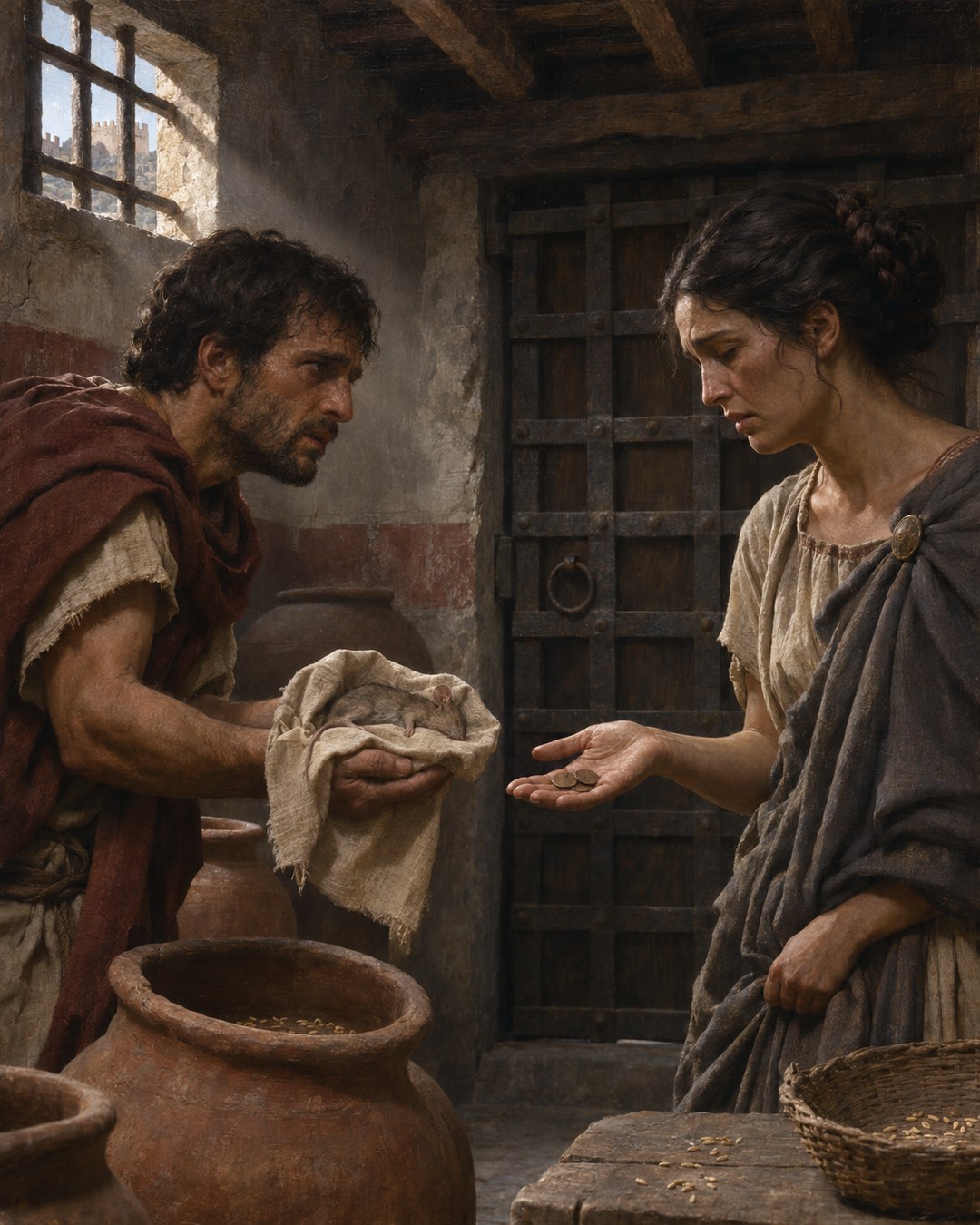
A siege can make the smallest animal carry the weight of an army. During Hannibal’s blockade of Casilinum, according to an anecdote Pliny the Elder says came from the Public Records, a mouse was sold for a remarkable price. The buyer survived. The seller died of hunger.
Pliny tells the story in one compressed sentence. He gives neither man a name. He does not describe bargaining, cooking or the use of the payment. That restraint is precisely why the exchange remains so sharp. One person converted food into money; the other converted money into the chance to eat. Under siege conditions, only one side of that trade preserved life.
The mouse is not important because it fed a feast. It is important because Casilinum had reached a point at which almost any edible body could become a strategic resource. Hunger had redrawn the boundary between vermin and provisions.
Pliny Found a Siege Story inside a Book about Animals
The anecdote does not arrive as part of a continuous campaign history. It appears in Book 8 of the Natural History, among observations about mice and shrews. Pliny has just discussed mice gnawing iron and the way their appetite supposedly exposed stolen gold in mines. After Casilinum he turns to white mice as favourable omens and to shrews interrupting auspices with their squeaking.
That setting matters because Pliny’s method joins natural behaviour, public memory and marvel. A mouse can be a thief in one sentence, food in the next, and an omen immediately afterward. Casilinum is the point where the animal’s ordinary smallness collides with extraordinary human scarcity.
Pliny strengthens the anecdote by attributing it to Public Records. That does not answer every historical question, and it does not turn his sentence into a modern archive extract. It does tell us how he wanted readers to receive the episode: not as a joke invented for the animal book, but as an event preserved in Roman civic memory.
The source’s brevity should govern our confidence. We can say that a mouse was sold, the buyer lived and the seller died of hunger. We cannot supply dialogue, motives or a detailed marketplace. The power of the record lies in the hard sequence it does preserve.
The Sale Made Hunger Visible
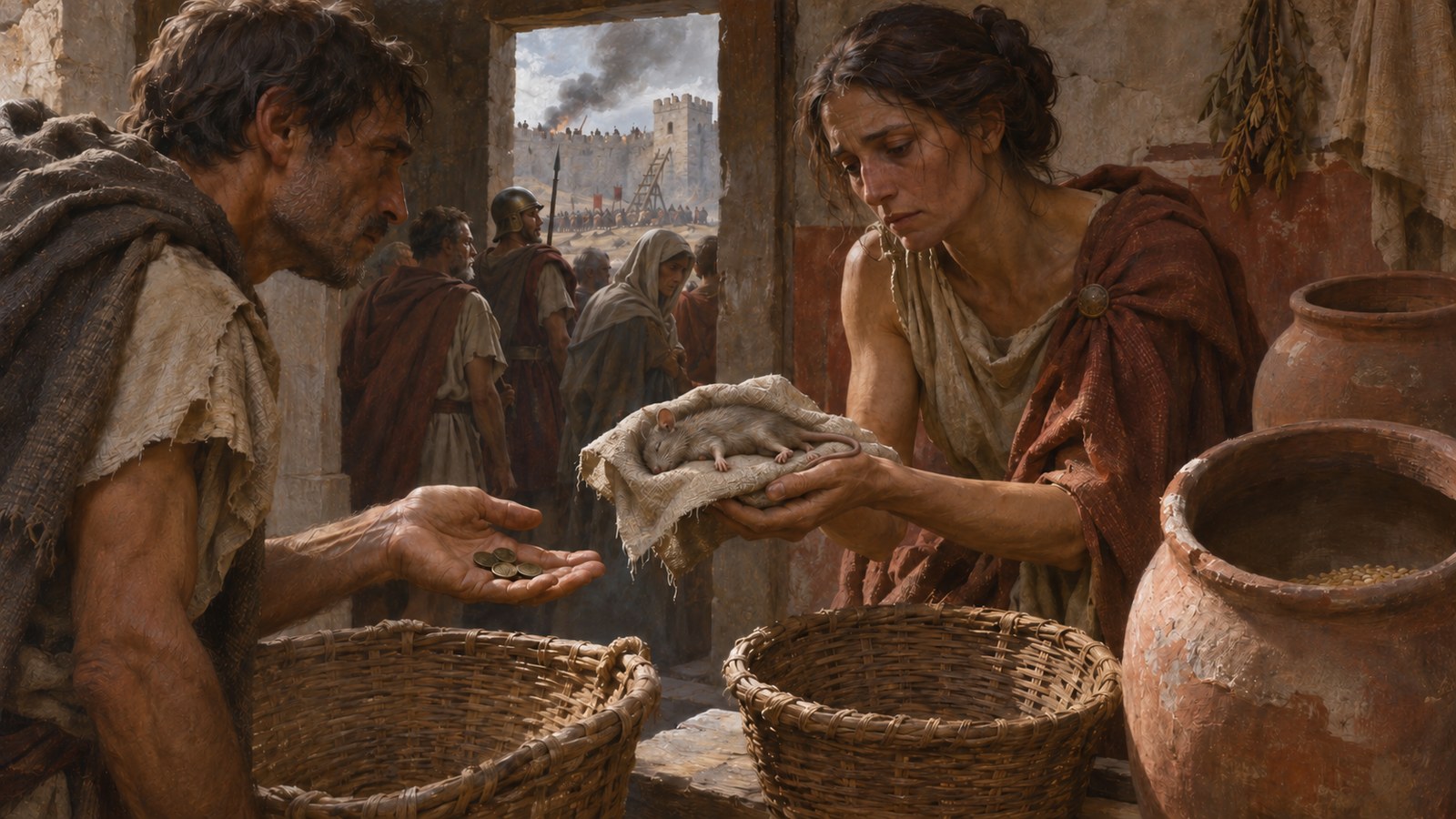
Scarcity is often described through totals: days without grain, shrinking rations, dead animals or surrendered towns. Pliny instead gives a transaction. The mouse had an owner, acquired a buyer and commanded a price. The siege had not erased exchange; it had transformed what people were willing to exchange.
The edition’s translation renders the ancient sum as 200 francs, a reminder that old translations sometimes convert money into terms once familiar to their readers. The exact modern purchasing equivalent is not recoverable from that label alone, and there is no need to force one. Pliny’s point is that the price was memorable enough to enter the anecdote.
What can be read securely is the new hierarchy of value. Coin retained enough meaning for a sale to happen, yet edible matter held the final advantage. The seller acquired payment and lost the mouse. The buyer lost payment and acquired the thing that mattered while the siege continued.
Another Roman story makes hunger visible through military defiance: hungry legionaries threw bread made from roots at Pompey’s lines to prove they would endure. Casilinum offers no such boast. Its mouse is private, pitiful and stripped of spectacle.
Buyer and Seller Reversed the Expected Advantage
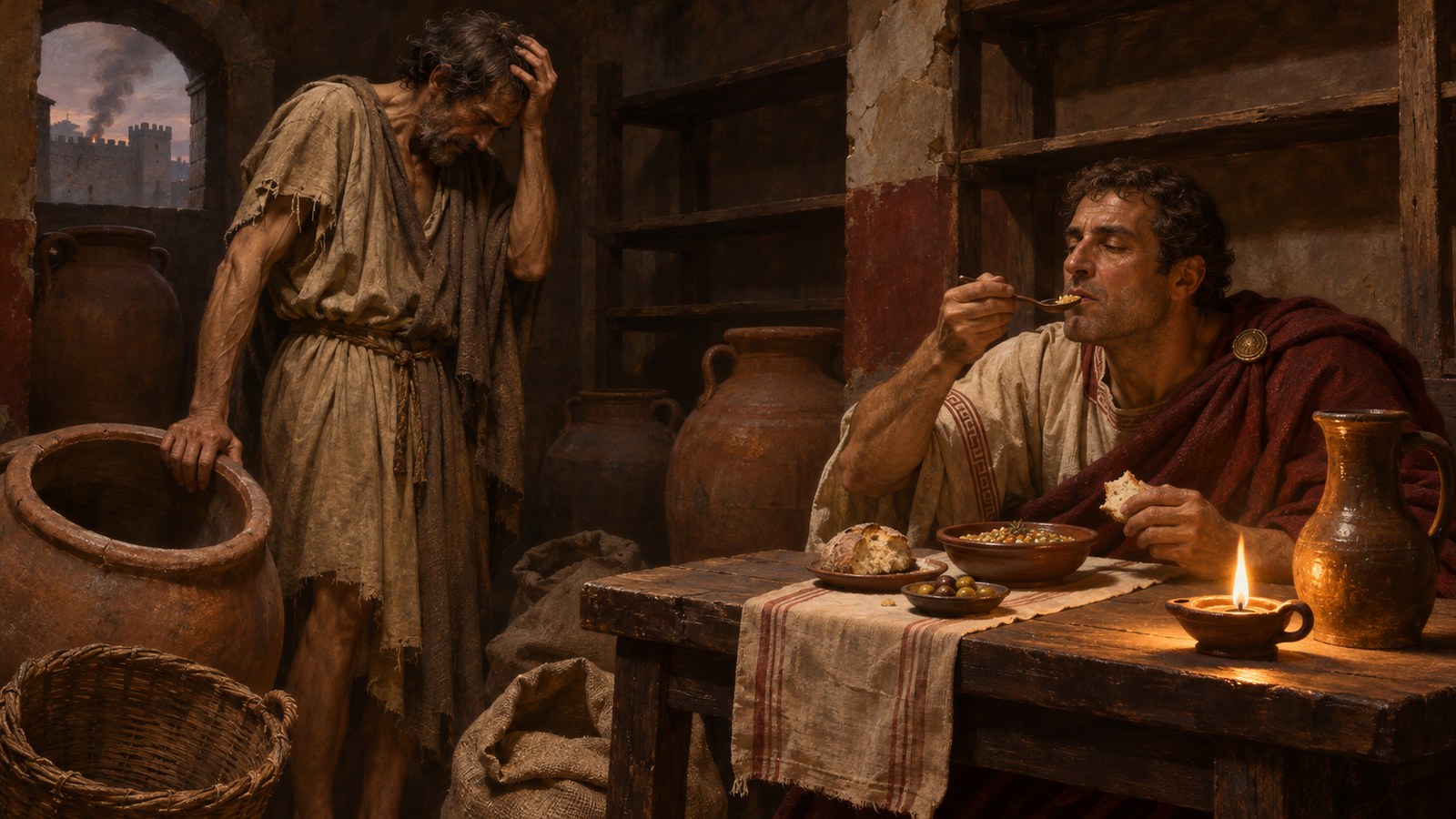
In an ordinary sale, the seller may appear to have won the more flexible asset. Money can be saved or exchanged again; a mouse is only a mouse. Pliny’s ending overturns that expectation. The buyer lived, while the seller’s payment could not prevent starvation.
We should resist turning this into a universal lesson that money becomes meaningless in every crisis. The very existence of a price shows that money still organized the encounter. The sharper conclusion is narrower: in this siege, at this moment, payment was less immediately useful than food.
Nor does Pliny say the single mouse alone sustained the buyer for the whole blockade. “The buyer lived” records the outcome, not a complete diet. Perhaps the purchase formed one part of a longer struggle. The source does not say. It binds survival to the buyer and starvation to the seller without filling the space between.
That narrative compression produces a brutal symmetry. Two men exchange one object. Their paths diverge. The person who held the money died for lack of food; the person who held the food survived. Pliny needed no battlefield casualty list to show what Hannibal’s pressure had done inside the town.
The Mouse Was Also Part of the Battlefield
A blockade weaponizes time. Walls may remain standing while stores diminish behind them. Casilinum’s defenders were not defeated in Pliny’s sentence by a charge or a broken gate. Hunger reached into the town’s smallest private decisions and made survival depend on possession of a creature usually chased away.
This is why the anecdote belongs to military history even though no soldier appears in it. Armies create siege conditions, but civilians and garrisons experience those conditions through containers, portions and choices. A mouse entering the food supply is evidence of the pressure exerted by the army outside.
Hannibal’s Italian war repeatedly generated stories in which value behaved strangely under threat. Rome could even stage confidence by treating the ground occupied by an enemy as saleable property, as in the tradition that Hannibal’s campsite sold at full price. Casilinum is the inverse image. Instead of public confidence stabilizing land value, private desperation inflated a mouthful of food.
Both stories use a sale to measure morale, but they move in opposite directions. One insists that enemy occupation cannot cheapen Roman property. The other admits that a siege can make a mouse precious. Roman memory had room for confidence and misery, sometimes within the same long war.
A Tiny Record Preserved the Shape of Scarcity
Pliny’s animal chapter surrounds Casilinum with claims that modern readers may find curious: mice gnawing iron, white mice as happy signs, shrews disturbing auspices. The siege anecdote should not be isolated from that literary environment, but neither should it be dismissed because of it. Pliny explicitly marks the Public Records as his authority for the sale and its outcome.
The responsible reading is therefore both attentive and limited. The episode tells us how Romans remembered scarcity at Casilinum. It does not provide names, a date within the siege, an inventory of provisions or the buyer’s later biography. The gaps are real.
What survives is enough to expose the logic of blockade. The mouse crossed from nuisance to commodity and from commodity to sustenance. Its price recorded desperation; the opposed fates of buyer and seller recorded the consequence.
The sequence also explains why the anecdote endured despite its missing names. It offers a complete reversal in very little space. At the opening, the seller owns the useful thing and the buyer owns the negotiable wealth. At the close, ownership has changed, and the outcomes expose which asset answered the siege’s immediate demand. Roman memory did not need biographies for the two men because their positions in the exchange did the narrative work.
There is a physical detail hidden inside the economic one. A mouse is small enough to disappear in a storeroom, slip through a wall or be ignored when grain is abundant. Under blockade, that same small body becomes visible, countable and saleable. Scarcity did not enlarge the animal; it enlarged the human attention fixed upon it.
Pliny’s placement after stories of mice in mines adds another reversal. There, mice betray people who try to conceal stolen gold. At Casilinum, a mouse itself acquires a price, yet gold or coin cannot guarantee that its new holder will eat. The animal chapter repeatedly tests human value against appetite.
Large wars are usually remembered through generals, routes and battles. Pliny left a smaller scale beside them: two hungry people, one sale, and an animal barely large enough to feed either. At Casilinum, that was enough to divide life from death.
Sources
Pliny the Elder, Natural History, Book 8.