
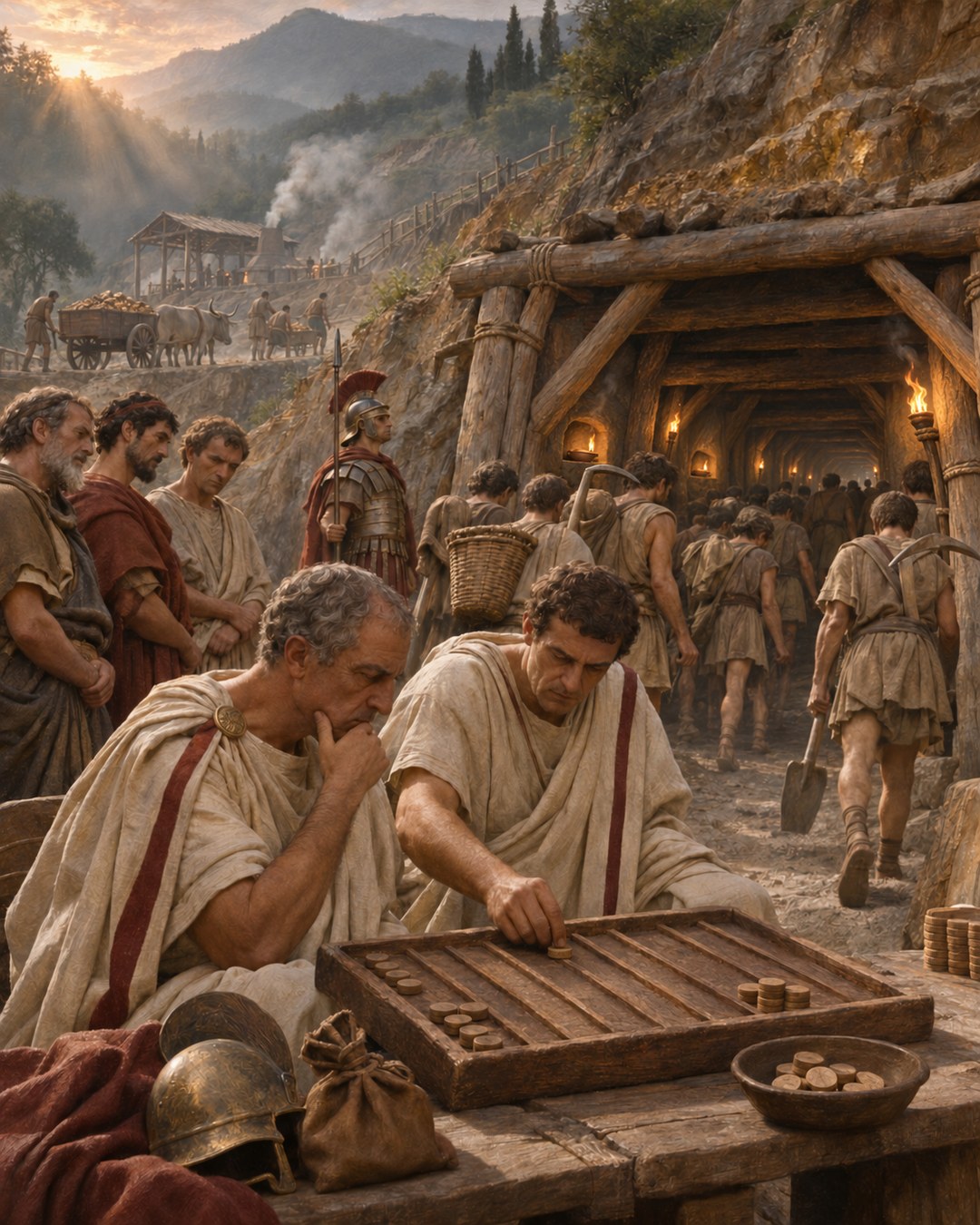
Five thousand is an awkward number to meet in a Roman mine. It is too large to feel like a household tally and too exact to be a casual way of saying “many.” Pliny the Elder preserves it at the end of his account of gold extraction: at Victumulae, in the territory of Vercellae, the censors prohibited the farmers of public revenues from keeping more than 5,000 men at work.
The line is brief, but its angle is unusual. Pliny does not introduce a celebrated owner, a miraculous nugget or an emperor displaying treasure. He gives us a limit. The mine enters history at the point where Roman administration tried to define how large an extractive operation could become.
That makes the notice more than an isolated mining curiosity. It shows a state looking at labour, contractors and territory together. Rome did not need to describe every tunnel to recognize that scale itself could become a public question.
Pliny Set the Rule against a Wider Landscape
Pliny’s Book 33 moves through the appetite for precious metal and the physical methods used to satisfy it. His description of mining elsewhere is deliberately oppressive. Galleries run under mountains. Lamps measure spells of work. Timber and arches hold up ground that can collapse. Broken material passes from worker to worker through darkness before it reaches daylight.
Victumulae appears after that larger account. Pliny first says that an old prohibiting decree of the senate protected Italy from exploitation. He then makes a striking counterfactual claim: without that protection, Italy would have been highly productive in metals as well as crops. The sentence asks readers to imagine wealth left in the ground because extraction had been restrained.
That claim should be kept in its proper form. Pliny is presenting Italy as protected; he is not supplying a complete statute book for all Italian mining. His surviving words do not tell us when every restriction began or how consistently it operated. What he does provide is one concrete administrative trace: the censorial ruling for the gold mines at Victumulae.
The contrast gives the number its force. The Spanish landscapes in the preceding account are measured by water, crushed rock and mountains moved. The Italian example is measured by people. Five thousand men became the boundary through which the state expressed restraint.
The Number Belonged to Administration
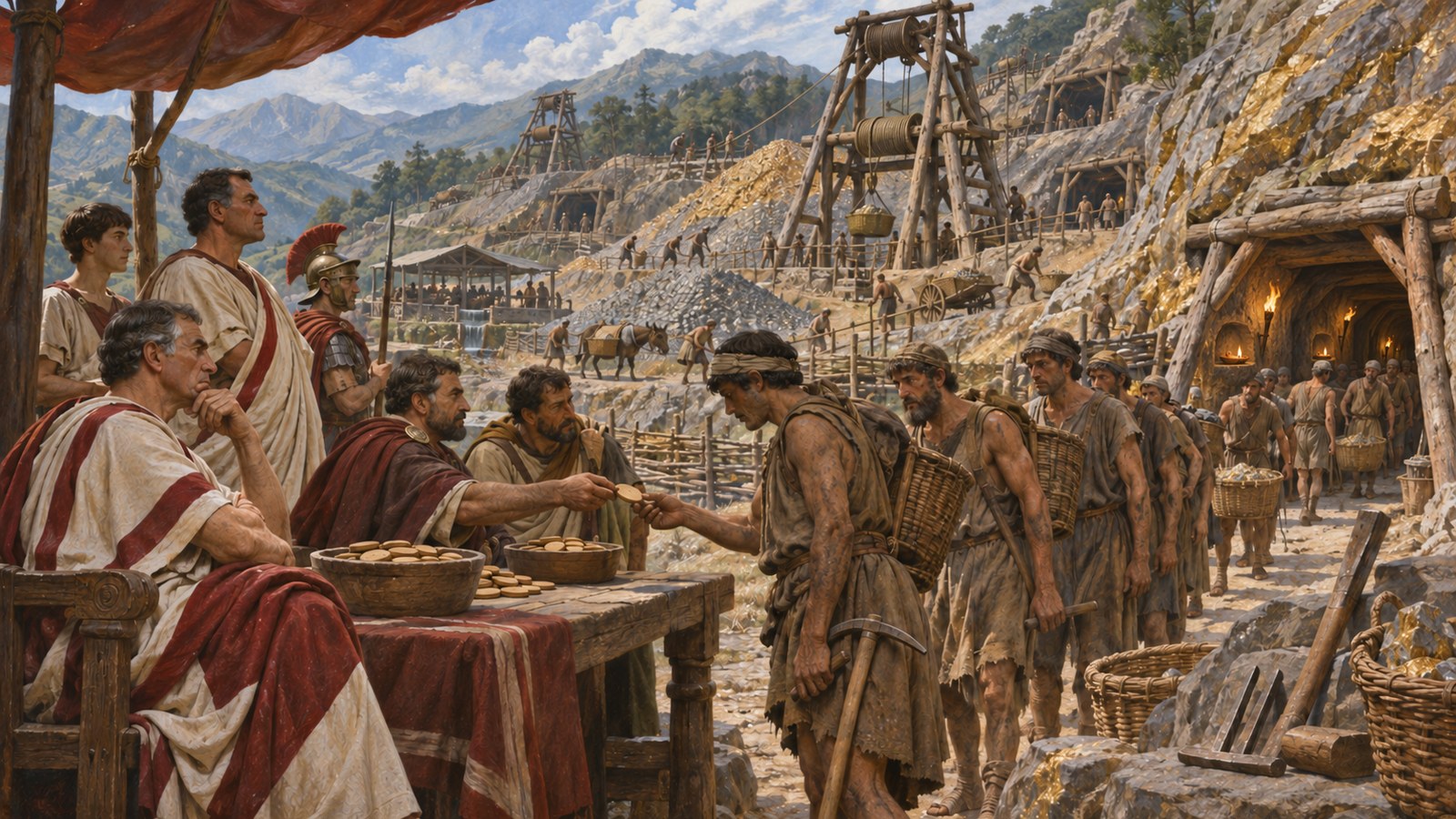
The ruling did not simply declare that “the mine” must stay small. Pliny directs it at the farmers of public revenues. These were the people responsible for exploiting a public income stream under arrangements with the state. The sentence therefore identifies who could be held to the ceiling.
That wording matters. A headcount without an accountable operator would be only an observation. A headcount attached to revenue contractors is a rule. The censors were not estimating how many miners happened to live near Vercellae; they were limiting how many men the contractors could have engaged in the work.
Roman administration often becomes visible through objects and procedures rather than broad constitutional language. A scale and witnesses could make a transfer public, as in the ceremony that moved Roman property. At Victumulae the instrument was different, but the habit is recognizable: define the responsible parties, define a measurable boundary, and make the transaction or enterprise legible to authority.
Pliny does not preserve the forms, inspections or penalties behind the ceiling. We should not invent them. Yet the reported rule assumes that a contractor’s workforce was something the censors believed could be counted and constrained. Even if enforcement was imperfect, the number translated political concern into an administrable test.
A Cap Is Different from a Closed Mine
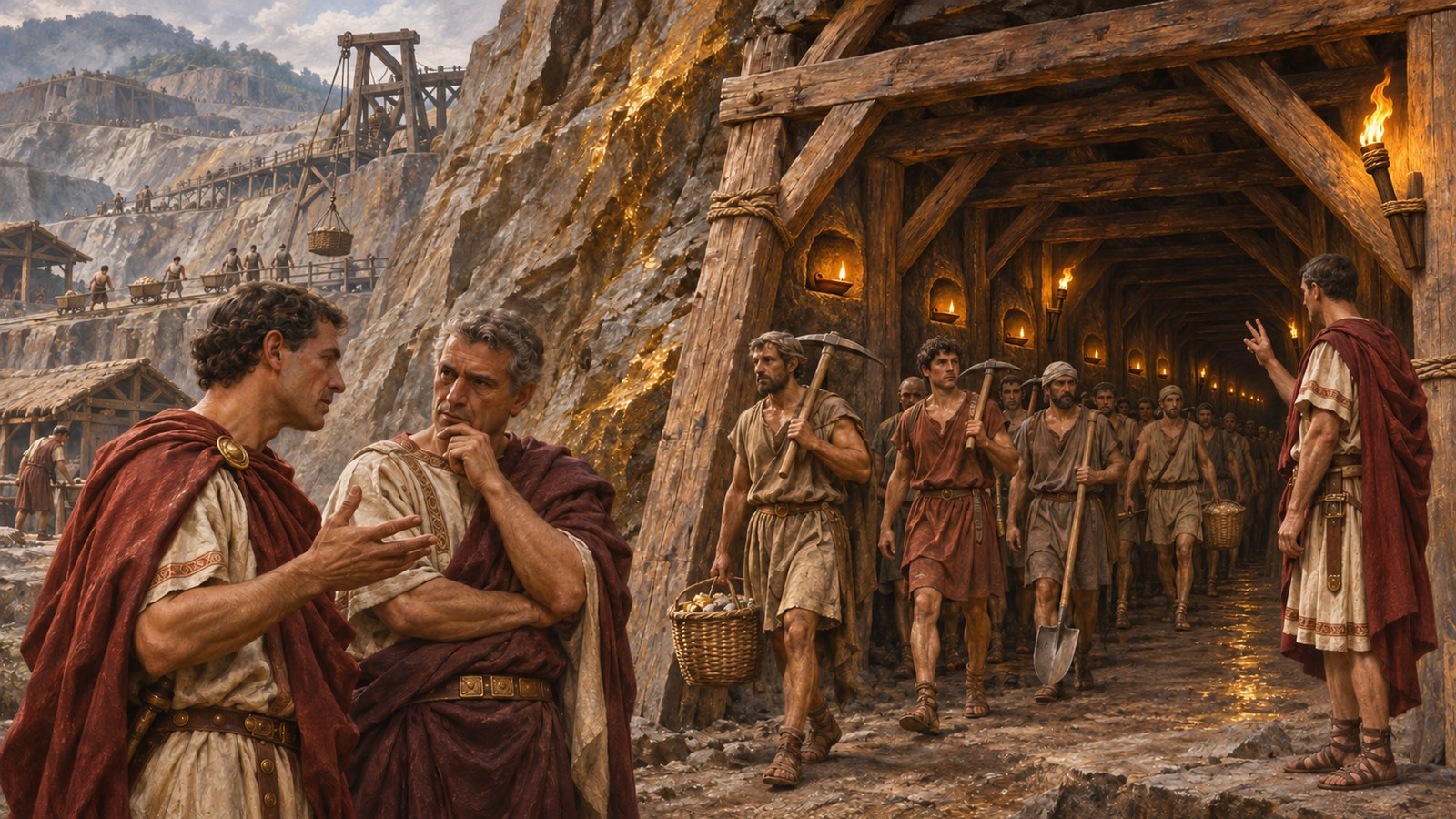
The most careful reading begins with what the rule does not say. “No more than 5,000” is not the same as “exactly 5,000.” It does not prove that the mine employed that many men on an ordinary day. It does not show that all 5,000 worked below ground at once. It is a ceiling, and ceilings are designed for the largest permitted case.
Nor is the ceiling a total prohibition. Pliny’s sentence presumes continued work under a limit. That distinction keeps the notice from becoming a simple morality tale in which Rome nobly rejected gold. The state still recognized the mine as a source of revenue. It tried to prevent that source from expanding without bound.
This is where Victumulae complicates Pliny’s opening anger about mining. He condemns the search for wealth inside the earth, but the censorial notice is practical rather than philosophical. It does not ask contractors to become indifferent to gold. It tells them where lawful scale ended.
The same administrative culture could attach rank to property and behaviour. One Roman knight kept his social standing while losing the public horse, a reminder that censors could separate one privilege from another instead of treating status as a single switch. Victumulae shows a similar preference for a calibrated limit over an all-or-nothing response.
Five Thousand Made Industrial Scale Visible
Even as a maximum, 5,000 men is a startling administrative unit. It implies recruitment, movement, food, supervision and a chain of responsibility around the extraction itself. Pliny does not enumerate those supporting systems, so they should remain implications rather than invented details. The rule nevertheless reveals that Roman officials could imagine mining at a scale requiring a civic answer.
The location sharpens that point. Victumulae was not presented as a remote marvel beyond Rome’s world. Pliny placed it in the territory of Vercellae, inside the Italian landscape he had just described as protected. The mine sat where the argument about Italy’s crops, metals and restraint could become concrete.
The ceiling also changes how we picture Roman economic power. Monumental extraction did not depend only on spectacular machinery. It depended on the capacity to assemble people in very large numbers under contractors who expected profit from public revenue. The censors’ limit acknowledges that organizational power while trying to contain it.
It would be easy to turn the figure into a modern workforce statistic. The source cannot support that. We have no attendance roll, wage table or shift schedule in Pliny’s sentence. What survives is more narrowly valuable: proof that one Roman rule made the size of a mining labour force a matter of public regulation.
Victumulae Survives as a Boundary, Not a Production Total
The best way to remember the passage is not to picture 5,000 anonymous men frozen at a mine entrance. Picture instead a line drawn before the workforce reached 5,001. That line joined the censors in Rome, the revenue contractors and a gold-bearing landscape near Vercellae.
Pliny’s account leaves major questions open. He gives no date for the extant ruling, no story of a prosecution, and no measured output from the mine. Those absences are part of honest reading. They prevent a legal limit from masquerading as a complete industrial census.
Yet the surviving details are unusually firm: gold mines, a named territory, public-revenue farmers, censors, and a maximum of 5,000 workers. Together they show Roman government treating extraction not merely as wealth won from nature but as an enterprise whose human scale could be regulated.
The actors named in the rule also keep its chain of authority clear. The senate supplied the wider protective setting as Pliny understood it. The censors supplied the particular ruling he could cite. The public-revenue farmers were the operators whose conduct was bounded. The workers were the counted human scale of the enterprise. No single part of that chain should be substituted for another.
This precision prevents two tempting exaggerations. Victumulae does not prove that all Roman mines were state-run in one uniform fashion, and it does not prove that humanitarian concern alone created the ceiling. Pliny gives a regulatory fact, not the debate that produced it. The limit may reveal restraint without revealing every motive behind restraint.
In a book filled with gold’s power to distort desire, Victumulae offers a different image of power. The decisive object is not a coin or a nugget. It is a number placed between contractors and the ground they wanted to open.
Sources
Pliny the Elder, Natural History, Book 33.