
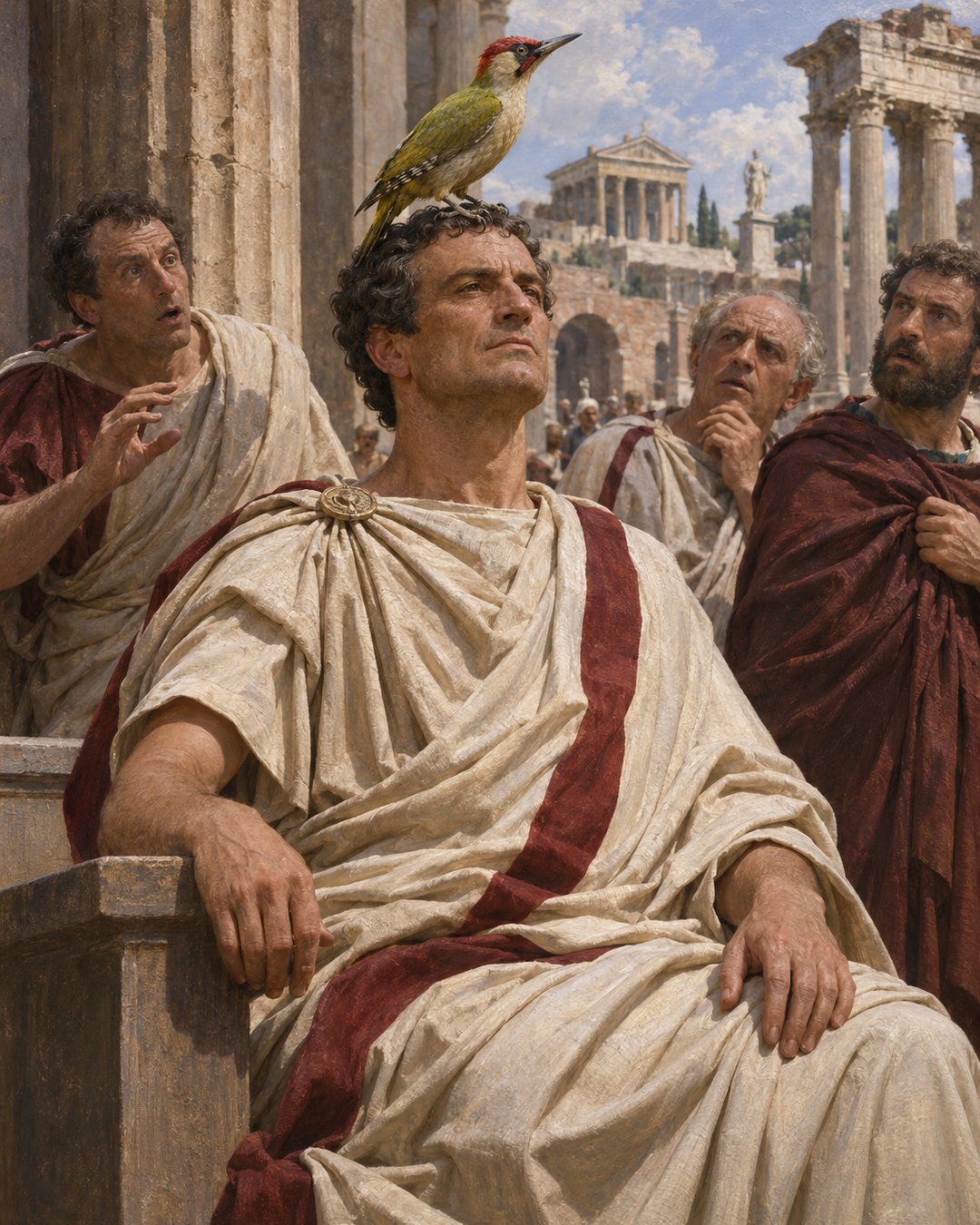
A woodpecker landed on the head of Aelius Tubero while he was giving judgments in Rome’s forum. The bird did not merely brush past him. Pliny the Elder says it perched so fearlessly that the city praetor caught it in his hand. What followed turned a small interruption into a political trap. The seers offered two readings, and neither allowed Tubero to leave the scene unharmed.
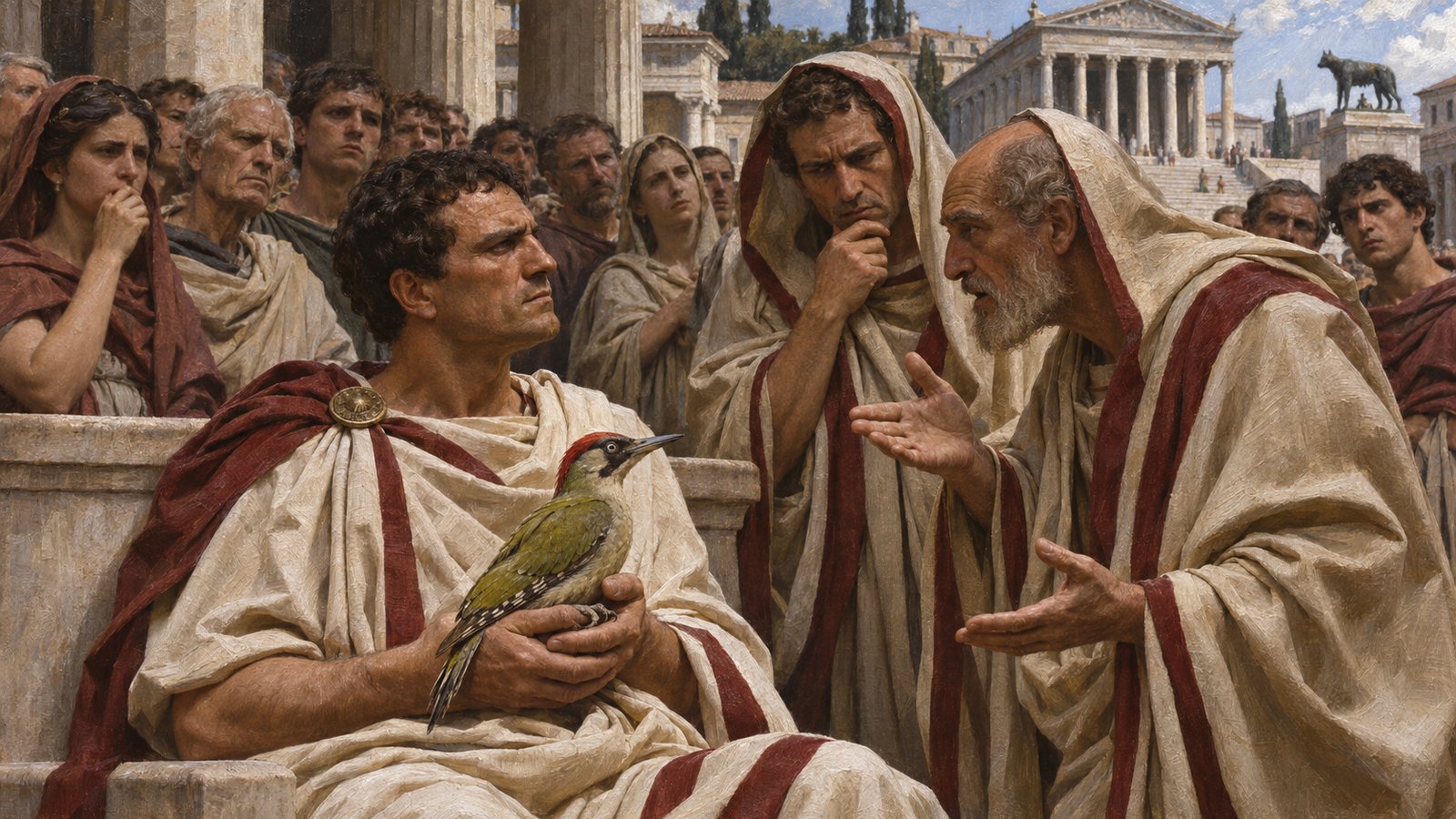
If he released the bird, they said, disaster threatened the Roman state. If he killed it, disaster threatened Tubero himself. Pliny reports that the magistrate chose the second danger. He tore the woodpecker apart, and not long afterward, according to the author, the personal omen was fulfilled. The point is not that a bird could forecast a death. It is that Roman public life could force a magistrate to answer an ambiguous natural sign as though the safety of the state had entered his hand.
A Court Session Became an Augural Scene
Tubero was no private wanderer surprised in a field. Pliny identifies him as City Praetor and places him on the judgment bench in the forum. His work therefore already carried public authority. Litigants, attendants and bystanders would have understood the seat as a place where a Roman magistrate interpreted rules and issued decisions. The woodpecker invaded that controlled setting with a different kind of question.
The bird’s position made the moment harder to dismiss. It perched on Tubero’s head, the most conspicuous possible contact between animal and official. Pliny adds that it remained calm enough to be taken by hand. A fleeting shadow might have passed without consultation. A captured bird turned the incident into an object that demanded action. Tubero could not pretend it had vanished.
Roman readers were accustomed to the idea that public business could be interrupted by signs. The mechanics were not identical in every period or office, and Pliny does not provide a procedural transcript. His anecdote instead preserves the social pressure of interpretation. An unusual encounter involving a magistrate in the forum could become a question about Rome itself.
The Bird Already Belonged to Mars
Before telling Tubero’s story, Pliny identifies a class of woodpeckers as Birds of Mars and says they mattered greatly in augury. That association gave the animal a political vocabulary before it touched the praetor. This was not simply an unidentified creature whose behaviour seemed odd. Its species carried inherited religious meaning linked to a Roman god of war and civic protection.
Pliny reaches even deeper into Latian memory. He says woodpeckers had held first importance among local auguries from the time of the king who gave his name to the bird. The statement joins natural history to legendary kingship. A reader encountered the woodpecker as a living animal, a sacred sign and a fragment of the region’s oldest political past.
That layered identity helps explain why specialists were consulted. The bird on Tubero’s head did not need to speak. Its recognised place in augural tradition made posture, location and contact meaningful. Roman religion often worked by classifying the circumstances of an event rather than waiting for a miraculous message in words.
Release and Death Divided the Risk
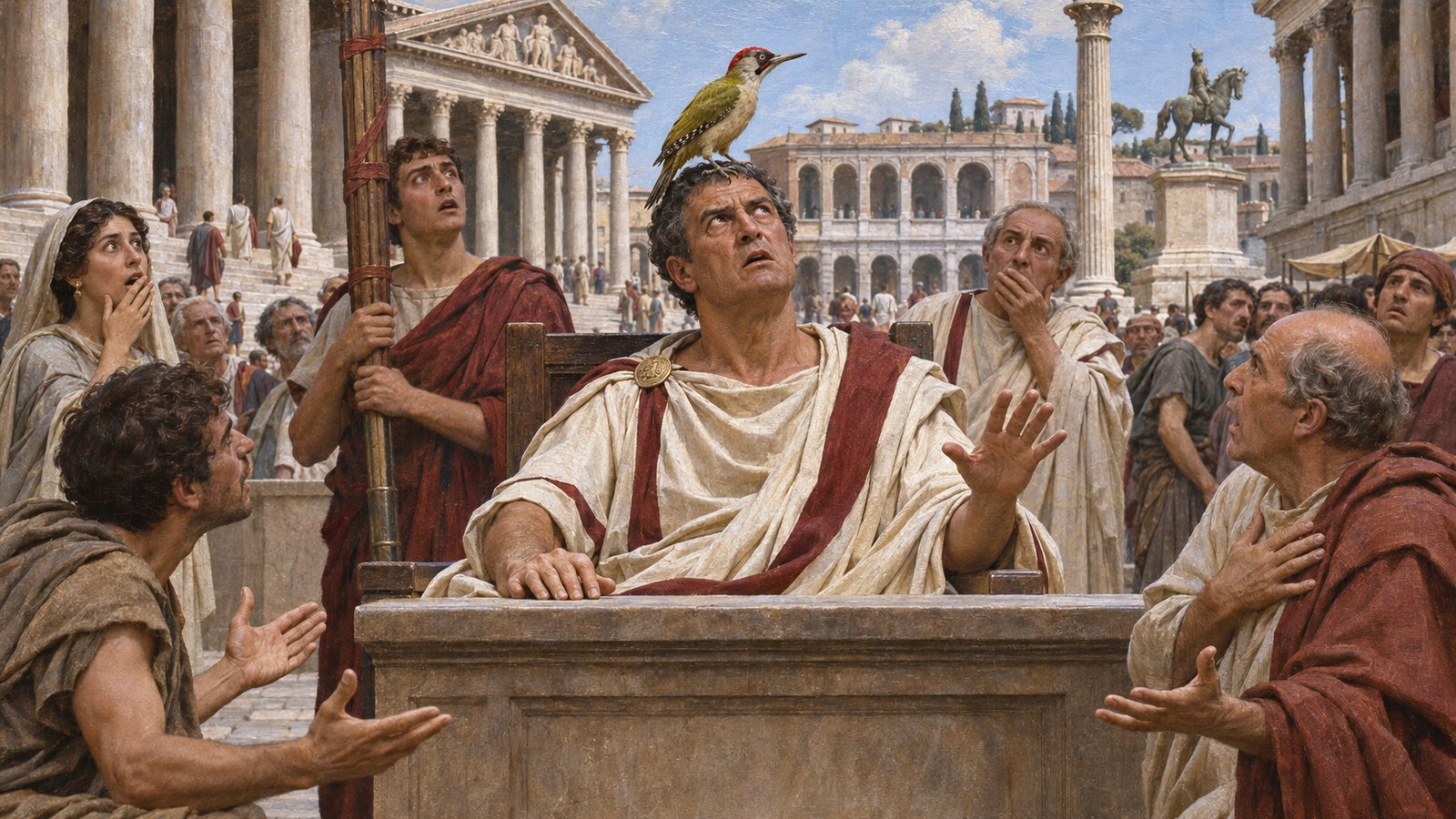
The seers’ response created a cruel balance. Release transferred the threatened disaster outward to the empire. Killing transferred it inward to Tubero. The alternatives made the magistrate’s private safety compete with the community he served. Once framed that way, an apparently merciful release could be represented as neglect of Rome.
Pliny does not record Tubero challenging the interpretation, asking for another consultation or delaying until the bird escaped. His compressed narrative moves directly from the two alternatives to the choice. Tubero destroyed the bird. The brutality matters because it shows how an omen could demand a physical answer. Interpretation was not only discussion; it changed what happened to the living creature held in the magistrate’s hand.
The anecdote also flatters a familiar Roman virtue. Tubero accepts the danger aimed at himself rather than the danger aimed at the state. Pliny can therefore present a grim act as public self-sacrifice. Whether the event occurred exactly as told is less important for cultural history than the shape of the approved choice: the officeholder must prefer Rome even when the gods appear to price that preference with his life.
Pliny Joined Observation to Marvel
The surrounding chapter makes the story more revealing. Pliny describes woodpeckers climbing nearly upright like cats, clinging upside down and striking bark to detect food beneath it by sound. These are close observations of movement and feeding. He also says the birds rear their chicks in holes. The naturalistic details establish an animal recognisable in trees and woodland.
Then the text shifts into claims modern readers should not accept as zoological fact. A common belief said that woodpeckers applied a special plant to wedges driven into their nest holes and made them slip out. Pliny attributes to Trebius an even stronger version: however forcefully a nail or wedge was driven into the nesting tree, the bird’s arrival made it spring out with a creak.
The practical and marvellous sit together without the clean border a modern field guide would draw. That mixture matters for Tubero’s omen. Pliny has already made the woodpecker a creature whose ordinary skills seem to cross into hidden power. A bird that finds food through bark and supposedly defeats iron wedges can plausibly, within the chapter’s logic, carry a dangerous message into the forum.
The Portent Was Completed by Retelling
Pliny closes by saying that Tubero fulfilled the portent not long afterward. He gives no medical account, date or independent chain of evidence in this passage. The phrase supplies narrative closure rather than proof. First the seers define the danger; then the magistrate chooses; then later misfortune is made to fit the chosen branch.
This is how portents survive. Countless birds landed, flew away or died without entering literature. Tubero’s woodpecker remained memorable because the event could be told as a completed sequence. The office, the fearless perch, the capture, the double prophecy, the sacrifice and the later death all pointed backward and forward at once.
The story therefore reveals less about a woodpecker’s ability to know the future than about Roman habits of assigning responsibility. Once the bird was caught, doing nothing was no longer presented as neutral. Tubero had to choose which risk he would own. Pliny’s short anecdote turns augury into a test of office: a magistrate’s body could be treated as expendable when interpreters set it against the imagined safety of Rome.
That public framing distinguishes this incident from a private superstition. The forum made witnesses possible, the praetorship made the man representative, and the bird’s link to Mars made the encounter legible. The omen acquired force from institutions as much as from religion. Rome’s civic stage transformed an animal’s accidental landing into a decision about the empire.
Other Roman stories made birds carry martial meaning through a similarly public chain of observation and memory. The battlefield tradition behind the raven that won Valerius a name before two armies joined an animal’s arrival to courage, spectators and a lasting surname. Sacrificial interpretation could be just as dependent on sequence: the account of the twenty-first ox at Pydna turned repetition and timing into a verdict about who would win. Tubero’s woodpecker belongs to this wider habit of making an unusual creature or ritual event meaningful through place, office, expert reading and a later outcome. The omen did not stand alone; Roman institutions supplied the frame that made it memorable.
Sources
Pliny the Elder, Natural History, Book 10, section 20.