
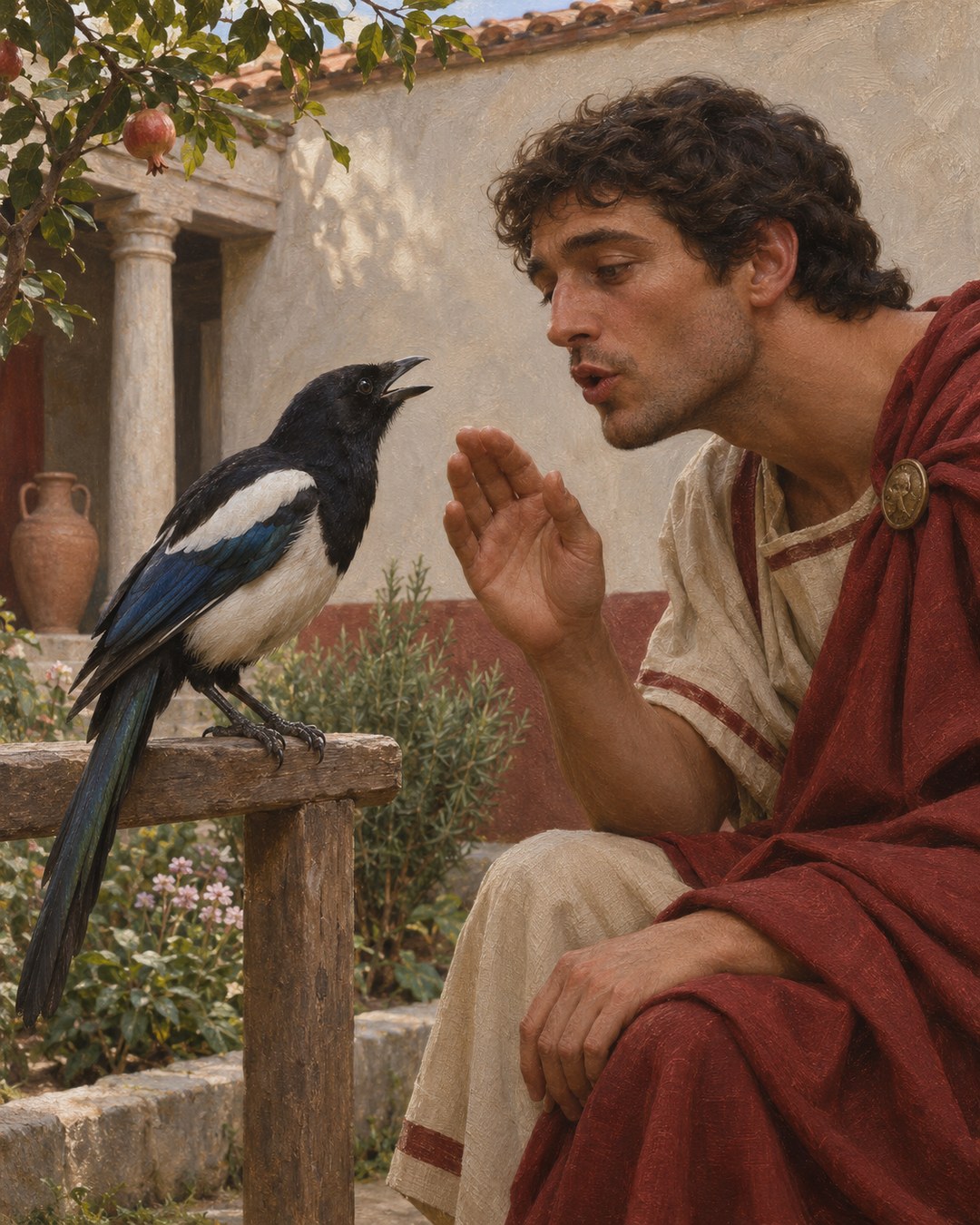
Pliny the Elder did not describe a talking magpie as a feathered echo that copied noise without attention. He gave the bird an interior drama. Certain magpies, he wrote, became fond of particular words, practised them in secret and were distressed when a difficult word defeated them. Repetition restored memory; hearing the missing word could visibly revive the frustrated bird.
No modern reader should turn that passage into a controlled experiment. Pliny’s claims about death from a difficult word are literary testimony, not measured animal cognition. Yet the account is valuable because it shows how Roman observers interpreted imitation. They heard a bird’s voice, watched pauses and recoveries, and supplied concepts such as affection, memory, reflection and failure. The animal became a mirror for human learning.
Articulation Made the Local Bird Remarkable
Pliny introduces this magpie after discussing parrots imported from India. The parrot was exotic, green and marked with red at the neck. The magpie, by contrast, was less celebrated because it did not come from far away. Distance raised prestige, but familiarity did not prevent surprise. Pliny says the local bird spoke more articulately.
That comparison is about Roman taste as much as birds. An imported animal arrived with the glamour of geography and trade. A familiar species had to compete through performance. The magpie’s claimed advantage was clarity: its imitation sounded sufficiently shaped for listeners to hear words rather than general noise.
Roman writing culture already treated the spoken word as disciplined work. Pens, dictation and trained memory all converted language into repeatable form, as the material history of Roman reed pens and written voices makes clear. Pliny’s magpie crossed that boundary from the other side. It had no pen, but listeners believed its beak could hold and reproduce a verbal pattern.
Affection Turned Repetition into Practice
Pliny says the birds did not merely learn particular words; they loved them. That emotional verb changes the mechanism. Repetition was not described as a response forced from an indifferent creature. The magpie returned to sounds because it had formed an attachment to them.
He then imagines the bird pondering words secretly and with careful reflection. The privacy is crucial to the story. A public performance could be explained as reaction to a trainer or reward. Secret rehearsal suggested that the lesson continued when no audience prompted it. To Pliny, this made imitation look like intention.
We cannot recover the exact observations behind those sentences. A bird muttering fragments alone might have inspired the account; repeated anecdotes may also have sharpened it into a more human narrative. The responsible conclusion is not that Roman magpies studied vocabulary exactly as pupils did. It is that Roman listeners interpreted solitary repetition as practice and gave it a moral language of effort.
A Difficult Word Became a Crisis
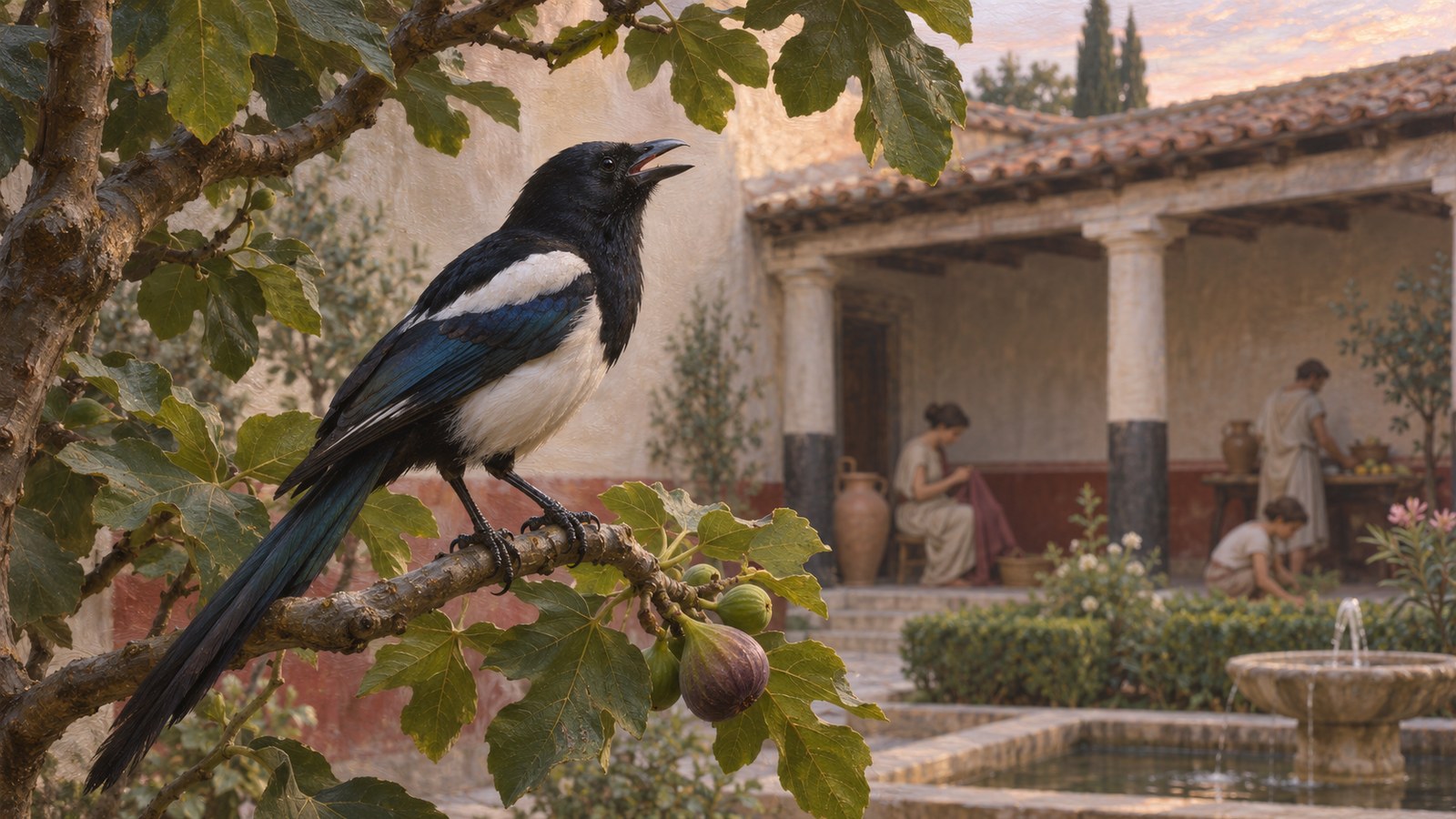
The most dramatic claim is that a word’s difficulty could defeat the bird so completely that it died. Pliny calls this an established fact. Modern standards require more than his confidence, and the claim should remain Pliny’s, not ours. Its historical importance lies in the structure of the anecdote: learning had a cost, failure produced distress, and language could overwhelm the learner.
The story makes the word an obstacle with almost physical force. The magpie tries, cannot secure the sequence and suffers. Romans reading this could recognise a familiar human scene in miniature. Their own education demanded exact sounds, memorised passages and correction. A bird defeated by pronunciation made disciplined speech look both natural and dangerous.
Pliny’s phrasing also rewards perseverance. The bird cares enough to be harmed by failure. This is not a neutral portrait of intelligence; it is an ethical one. Effort, affection and pain authenticate the performance. The clearer the bird’s frustration, the easier it became for an observer to believe that the bird understood the importance of the task.
Hearing the Word Restored What Memory Lost
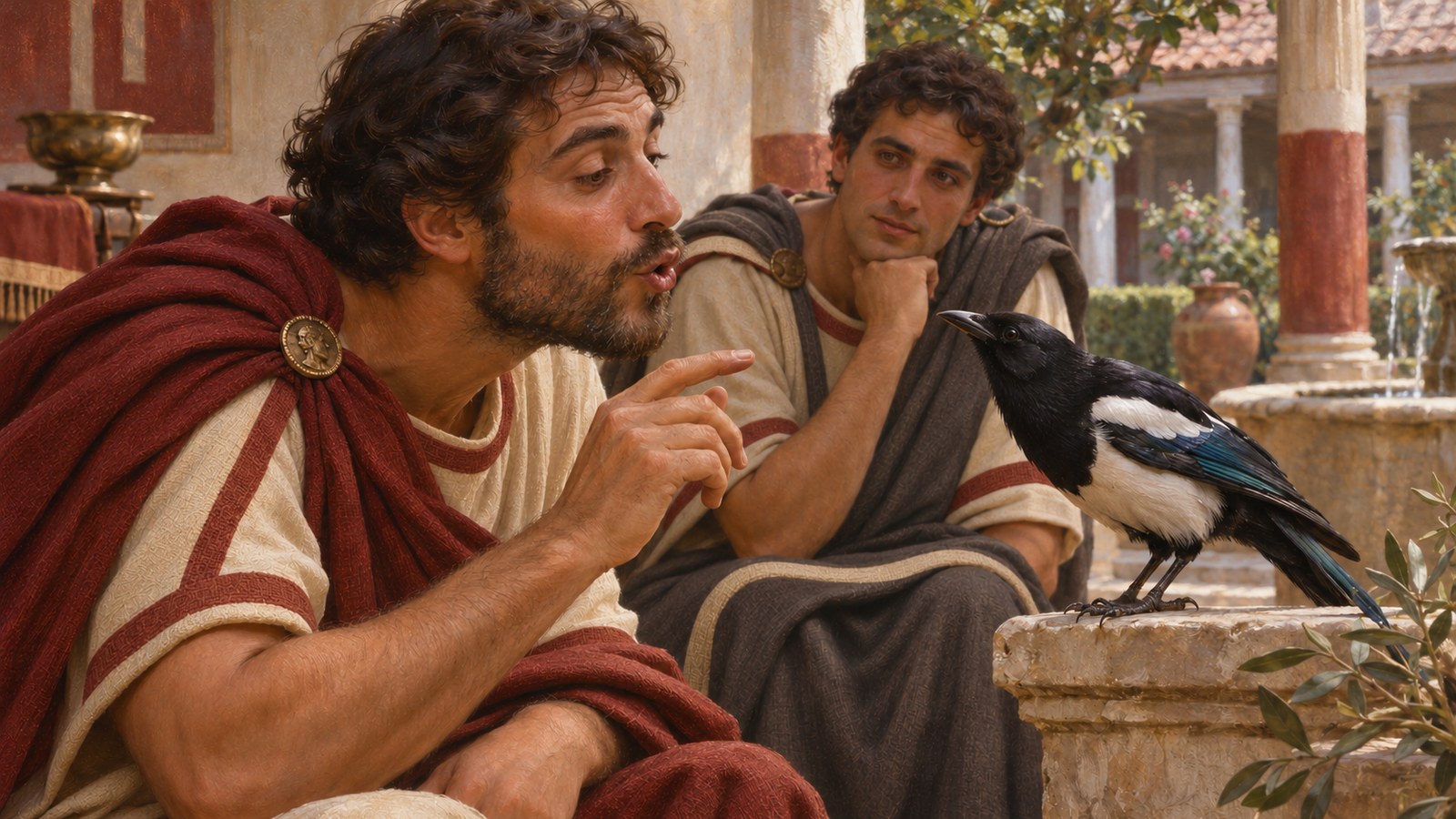
Pliny says memory failed unless the magpie heard the same word repeatedly. The remedy was therefore renewed sound. When the bird was at a loss, hearing the word spoken made it cheer up wonderfully. The account describes a loop: model, imitation, lapse, fresh model, recovery.
That loop resembles oral teaching more than silent reading. The learner depends on a voice outside itself. Accuracy is maintained through recurring exposure, not secured once and forever. In a society where texts were often read aloud, that dependence would have seemed familiar. A Roman grammarian could also build extraordinary attention around a single expression, as the story of one Latin word that sent a scholar searching demonstrates.
The magpie’s recovery gave observers visible confirmation. A change in posture, movement or vocal activity could be read as relief. Pliny compresses that observation into “cheering up,” an interpretation that turns behaviour into emotion. The bird’s body completed the story the human listener wanted to tell about memory returning.
The Anecdote Reveals Roman Listeners
Pliny ends by noting that the magpie’s shape was unusual but not beautiful. Its distinction lay in its power to imitate the human voice. Appearance could not explain its value; performance did. This is why the passage belongs not only to natural history but also to Roman cultural history.
The account shows people listening for articulation, ranking species by verbal clarity and explaining repetition through affection. It also shows the limits of ancient evidence. Pliny could label an extraordinary claim established without giving the observations, number of birds or alternative explanations a modern reader would ask for.
Those limits do not make the passage useless. They tell us what kind of proof persuaded its author. A familiar bird spoke clearly, repeated a cherished sound, struggled, heard the model again and appeared restored. From that sequence Pliny built a mind. The story is less a window into exactly what a magpie understood than into how Romans recognised intelligence: through disciplined imitation of the thing they valued most, a human word successfully returned.
The contrast with the parrot sharpens that recognition. Pliny’s parrot came from India, carried striking green and red colouring, greeted its masters and became playful with wine. Its foreign origin made it celebrated before it spoke. The magpie lacked that imported glamour. Pliny therefore made its claim through finer articulation and through the elaborate emotional life he assigned to rehearsal. One bird was remarkable because Roman trade brought it from far away; the other became remarkable because attentive listening supposedly disclosed more than its ordinary appearance promised.
The passage also warns us about words such as “secretly.” If no person witnessed an act, how could an author know exactly what occurred? The likely answer is that the bird was heard without an obvious trainer nearby, and the observer interpreted that distance as privacy. Pliny then strengthened a behavioural scene into a claim about reflection. Historical reading must reverse that movement carefully: begin with what he says people perceived, separate observation from explanation, and refuse to convert his confidence into modern proof.
Even after that caution, the anecdote preserves a distinctive Roman encounter. A person paused long enough beside a common bird to detect recurring sounds. Someone remembered a failed sequence and the response when it was spoken again. The report moved through conversation or writing until Pliny placed it beside parrots in a vast natural history. The magpie’s supposed lesson was therefore produced by many acts of human attention: training, listening, retelling, comparison and finally literary arrangement. The bird may be the subject, but Roman habits of hearing made the story possible.
Sources
Pliny the Elder, Natural History, Book 10, section 59.