
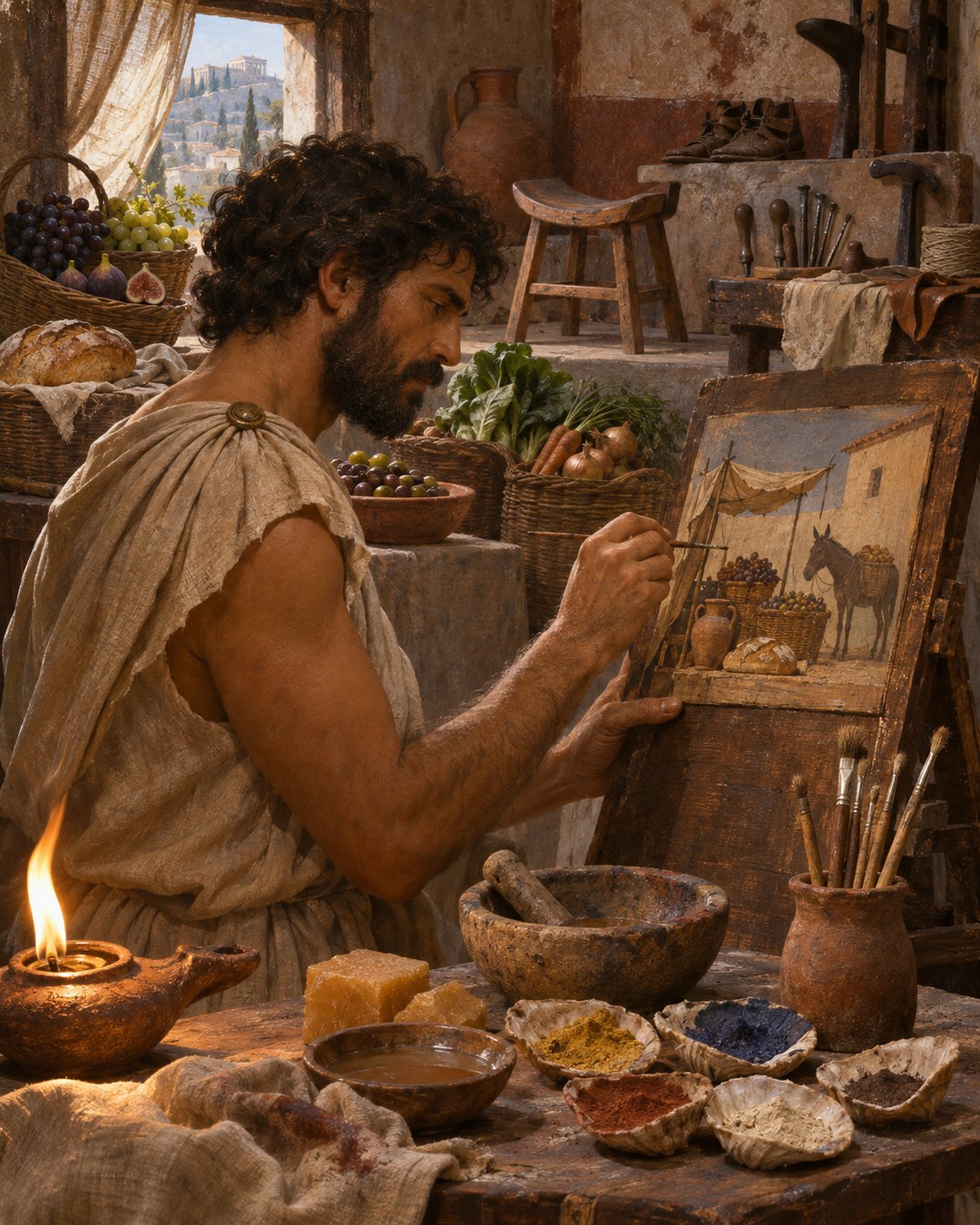
Piræicus painted barbers’ shops, cobblers’ stalls, donkeys, and food. In Pliny the Elder’s history of painting, those subjects belonged to a “humble walk.” The judgment sounds like a dismissal until Pliny reveals the market result: Piræicus’s small, pleasing scenes sold for more than the largest works of many other masters.
The contradiction is the point. Ancient art did not divide neatly into celebrated gods and forgotten everyday scenes. A painter could choose low-status subjects, earn an unflattering nickname from the genre, and still acquire the highest reputation within it. Size and subject announced hierarchy, but skill and demand could overturn the expected price.
Roman daily life survives most vividly when ordinary labour slips into an elite text. The Lost Eagles has followed the social theatre of Roman barber shops and the hidden work of Roman wheelwrights. Piræicus matters because he made such scenes worthy of the painter’s close attention, even while Pliny repeated the prejudice that called them humble.
Pliny Praised the Skill Before Questioning the Subject
Pliny introduced Piræicus among artists who became famous through what his translation calls an “inferior style” of painting. He immediately complicated that label. Piræicus was inferior to few painters in skill. The problem, if there was one, lay not in execution but in the choice of what to paint.
Pliny even wondered whether the artist had done himself an injustice through that choice. This is not a neutral description of genre. It is the voice of a critic measuring artistic ability against a hierarchy of suitable subjects. A painter capable of competing with the best was expected to choose themes that looked equally elevated.
Piræicus did not follow that expectation. He adopted the humble field and reached its highest reputation. Pliny’s sentence preserves both condescension and admiration. The artist’s route is judged too small for his talent, yet his mastery within that route cannot be denied.
That tension helps us avoid treating “Roman art” as a single taste. Pliny had preferences, collectors had prices, painters had specialties, and audiences could value what critics ranked low. The same work might be humble by subject, exquisite by execution, and expensive in the market.
No painting securely identified as Piræicus’s survives for us to inspect. His reputation comes through a literary report written long after the scenes were made. We therefore cannot reconstruct his brushwork or composition. What we can recover is the argument around his art: extraordinary skill applied to ordinary things.
Barbers, Cobblers, Donkeys and Food Filled the Frame
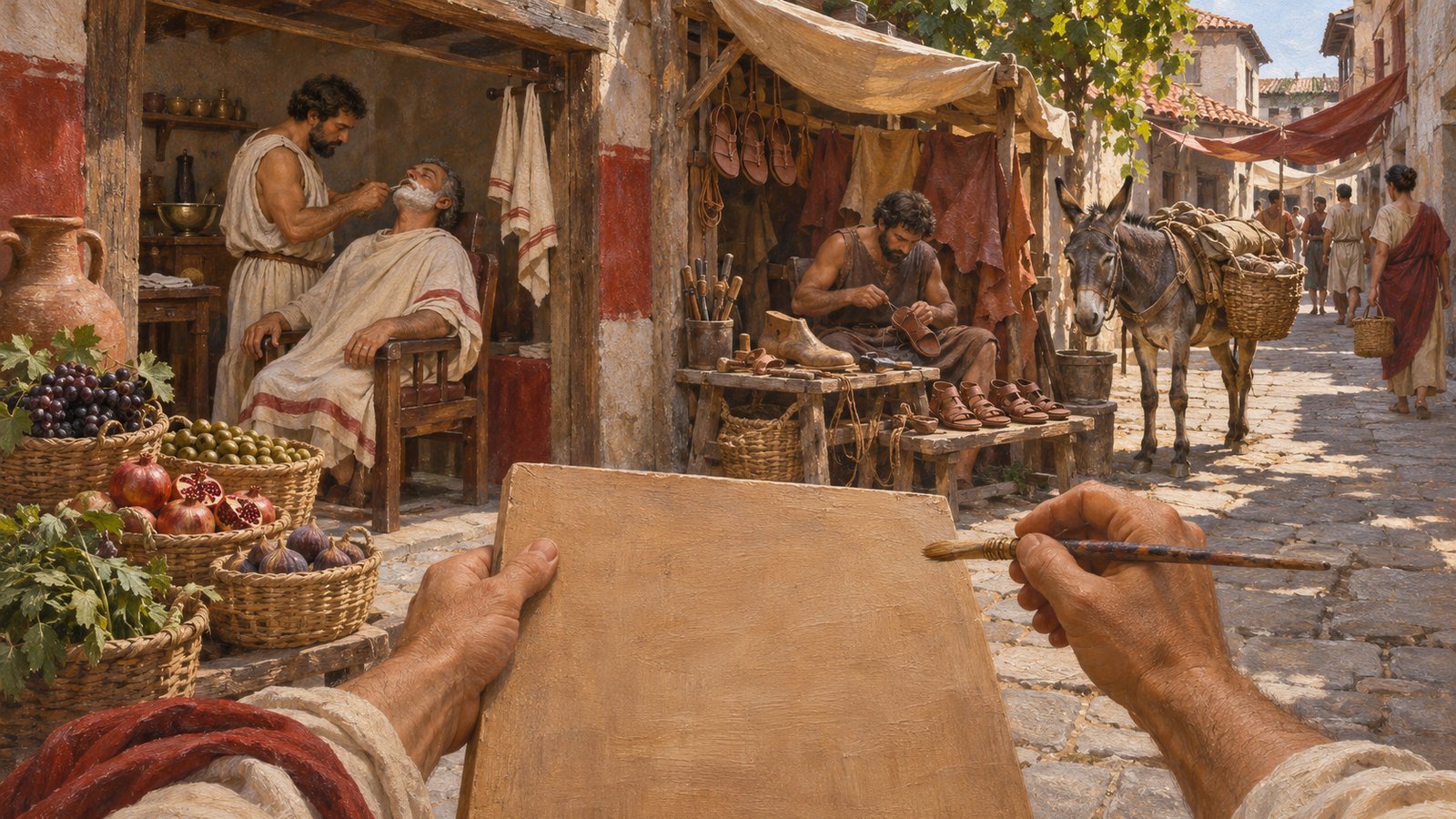
Pliny’s subject list is short and concrete. Barbers’ shops came first, then cobblers’ stalls, jackasses, eatables, and similar things. These were places, animals, and goods encountered in working streets rather than mythic battlefields or royal courts.
A barber’s shop offered more than a seated customer. It contained tools, mirrors, cloth, gestures, waiting people, and conversation. A cobbler’s stall gathered leather, lasts, straps, repairs, and the posture of labour. Donkeys brought harness, burden, stubborn movement, and the traffic of transport. Food allowed colour, texture, abundance, and decay to become subjects in themselves.
Pliny does not tell us whether Piræicus combined these elements in one image or painted them separately. He does not describe named works, dimensions, owners, or display settings. Any detailed visual reconstruction would be invention. His list establishes the range but not the composition.
Even so, the range is revealing. Piræicus selected subjects that elite literary history often treats as background. Shops support the city, animals move its burdens, and prepared food reaches its tables, yet grand narratives rarely make them central. The painter’s speciality reversed that focus.
The choice also required close observation. A generic symbol of a barber would not necessarily produce an exquisitely pleasing scene. Reputation depended on particulars that viewers recognised: the way a tool was held, the arrangement of a stall, the weight of a donkey, or the surface of food. Ordinary subjects punish vagueness because audiences know how they look.
“Rhyparographos” Turned a Hierarchy into a Nickname
Piræicus’s subjects earned him the epithet Rhyparographos. The name is usually connected with painting low, sordid, or humble things. Pliny presented it as a direct consequence of the barbers, cobblers, donkeys, and food.
A nickname can preserve fame and prejudice at once. It made the painter memorable by reducing his work to its social rank. Instead of naming a signature colour or technique, the epithet pointed to the supposed baseness of the objects represented.
Yet the label did not keep Piræicus outside the canon. Pliny included him precisely because the painter’s success was too striking to omit. The nickname became the hook by which later readers remembered a specialist who challenged the usual scale of importance.
Genre names often look descriptive after they become familiar. In this case the name carried judgment. A painting of food was not merely a food painting; it occupied a lower place than histories, gods, heroes, and monumental themes. Piræicus’s career shows that classification did not dictate commercial failure.
The source leaves a productive uncertainty. We do not know whether Piræicus embraced the epithet, whether admirers used it affectionately, or whether opponents coined it. Pliny only reports the connection. It would be unsafe to turn the label into the artist’s own manifesto.
Small Pleasures Beat Monumental Scale at the Sale
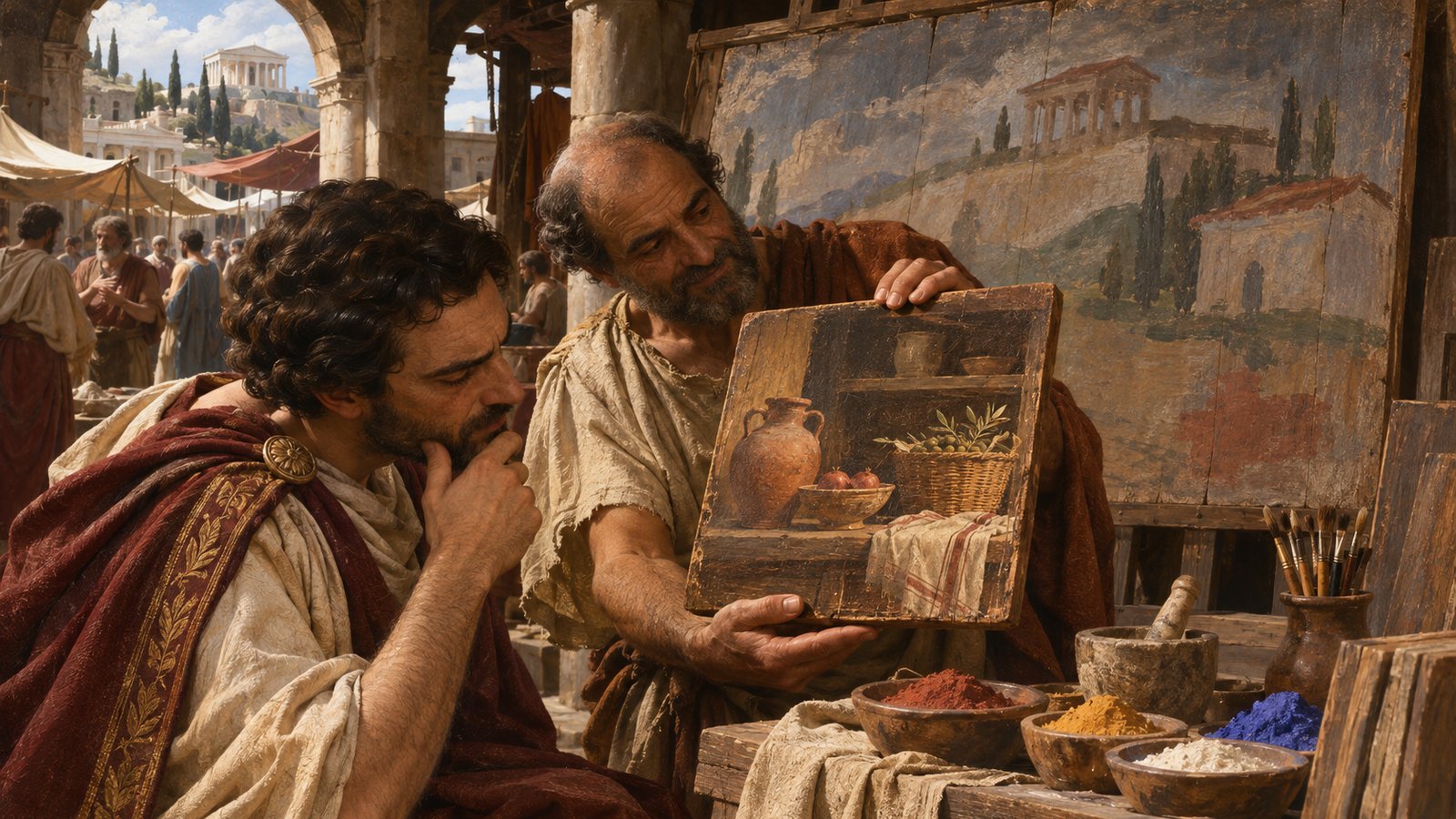
Pliny called Piræicus’s pictures exquisitely pleasing. He then supplied the most startling comparison: they sold at higher prices than the very largest works of many masters. The phrasing pits concentrated appeal against physical size.
Price does not automatically measure artistic quality, and Pliny did not provide figures, dates, or sale records. His statement is comparative rhetoric rather than an auction ledger. Still, it tells us what made the reputation surprising. Large works normally carried an expectation of labour, spectacle, and prestige. Piræicus’s scenes exceeded that expectation in the market.
Small scale may have offered practical advantages. A compact panel could be displayed in a domestic setting and moved more easily than monumental decoration. But Pliny does not give those reasons, so they remain possibilities rather than facts about particular buyers.
The safest conclusion stays close to his words. Collectors were willing to pay unusually high prices for Piræicus’s pleasing treatment of humble subjects. The artist did not escape the hierarchy by painting bigger. He made the hierarchy fail to predict value.
This distinction matters because Roman taste is often reconstructed from surviving monuments. Buildings, public sculpture, and wall painting endure because they were fixed, durable, or buried. Portable paintings on perishable supports disappeared far more easily. Pliny’s price comparison preserves a market that archaeology cannot simply display.
Specialisation Defined the Painters Around Him
Pliny strengthened Piræicus’s portrait by placing other specialists nearby. Serapio painted a picture so large that it covered the balustrades beneath the Old Shops. He was successful at stage scenery but unable to depict the human form. Scale did not grant universal skill.
Dionysius moved in the opposite direction and painted nothing but men, earning the surname Anthropographos. Callicles painted small pictures, while Calates made small works in a comic style. Antiphilus crossed between elevated subjects and a ridiculous figure whose name became attached to a class of comic images.
The sequence reads like a set of crossed axes: large and small, human and nonhuman, serious and comic, elevated and humble. Painters could excel in one region of that field and fail in another. Ancient criticism recognised specialisation even while it ranked the specialties.
Piræicus stands out because all three judgments collide around him. His subject rank was low. His skill rank was high. His market rank was higher than the size of his works seemed to promise. Pliny could not resolve those facts into a single verdict, so he preserved the contradiction.
That contradiction is more valuable than a tidy story in which an overlooked artist simply defeated snobbery. The hierarchy remained visible in the word “humble” and in the nickname. The success remained visible in reputation and price. Both conditions could be true at the same time.
A barber’s shop on a small painted panel was still a barber’s shop. Piræicus did not need to disguise it as myth. By making the familiar exquisitely pleasing, he persuaded buyers to value the street more highly than critics thought its subject deserved.
Sources
Pliny the Elder, Natural History, Book 35, chapter 37.