
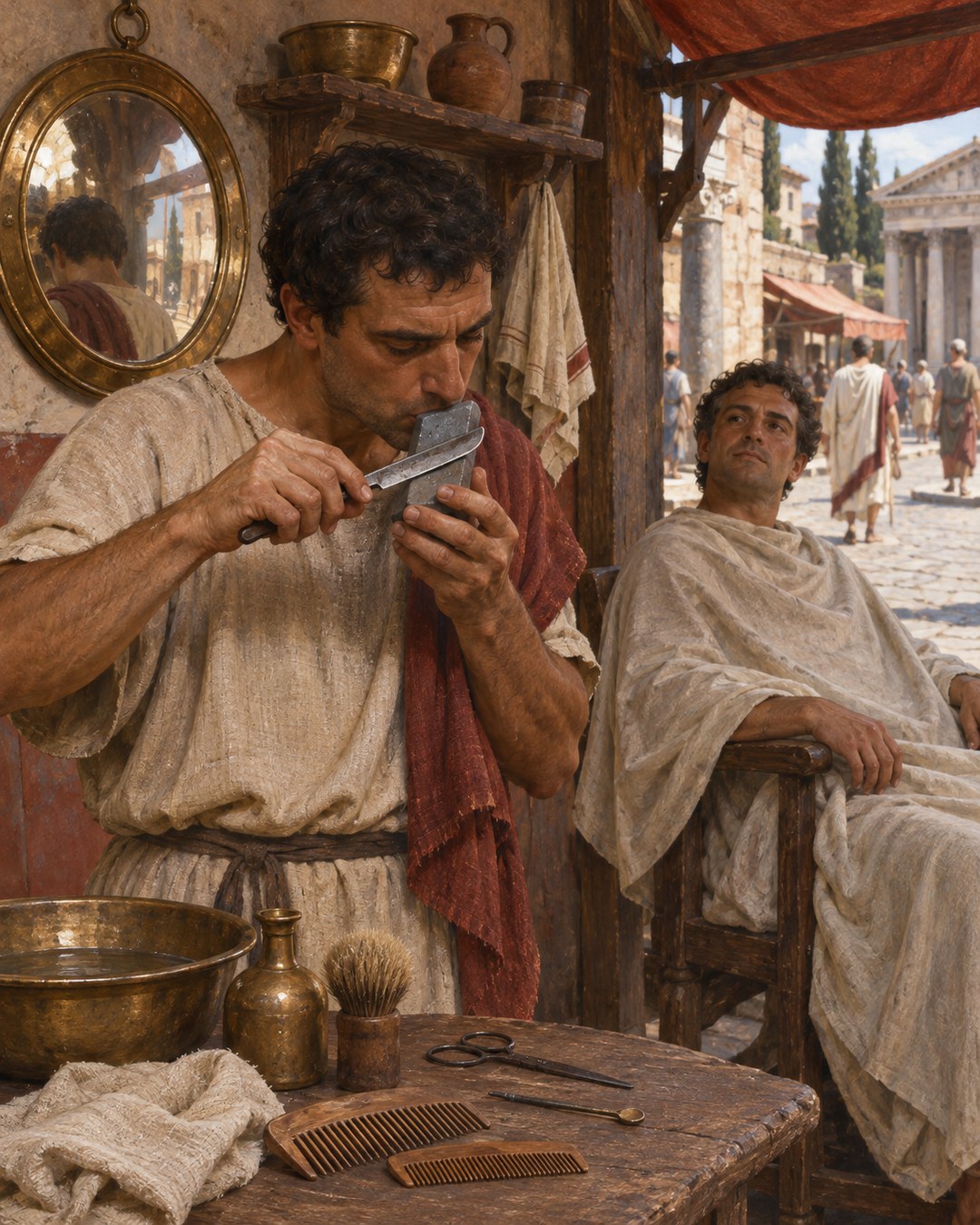
The sharpest object in a Roman barber’s shop depended on something softer than the blade. Pliny the Elder described a class of whetstone that gave iron an edge through human saliva. These stones were common in barbers’ shops, and the best came from the district of Laminium in Nearer Spain.
It is an intimate detail, but not a trivial one. A razor’s edge was produced by relationships: iron against stone, imported material against a practiced hand, and a particular liquid against a particular abrasive. Water and oil served other hones. Saliva belonged to this one.
The Lost Eagles has already followed Roman barbers as grooming became public theatre and the startling legal anecdote in which a stray ball sent a barber’s razor into a client’s throat. Pliny’s whetstones reveal the preparation behind those scenes. Before conversation, shave, and risk, someone had to make iron keen enough to work.
The Razor Edge Began Far from the Chair
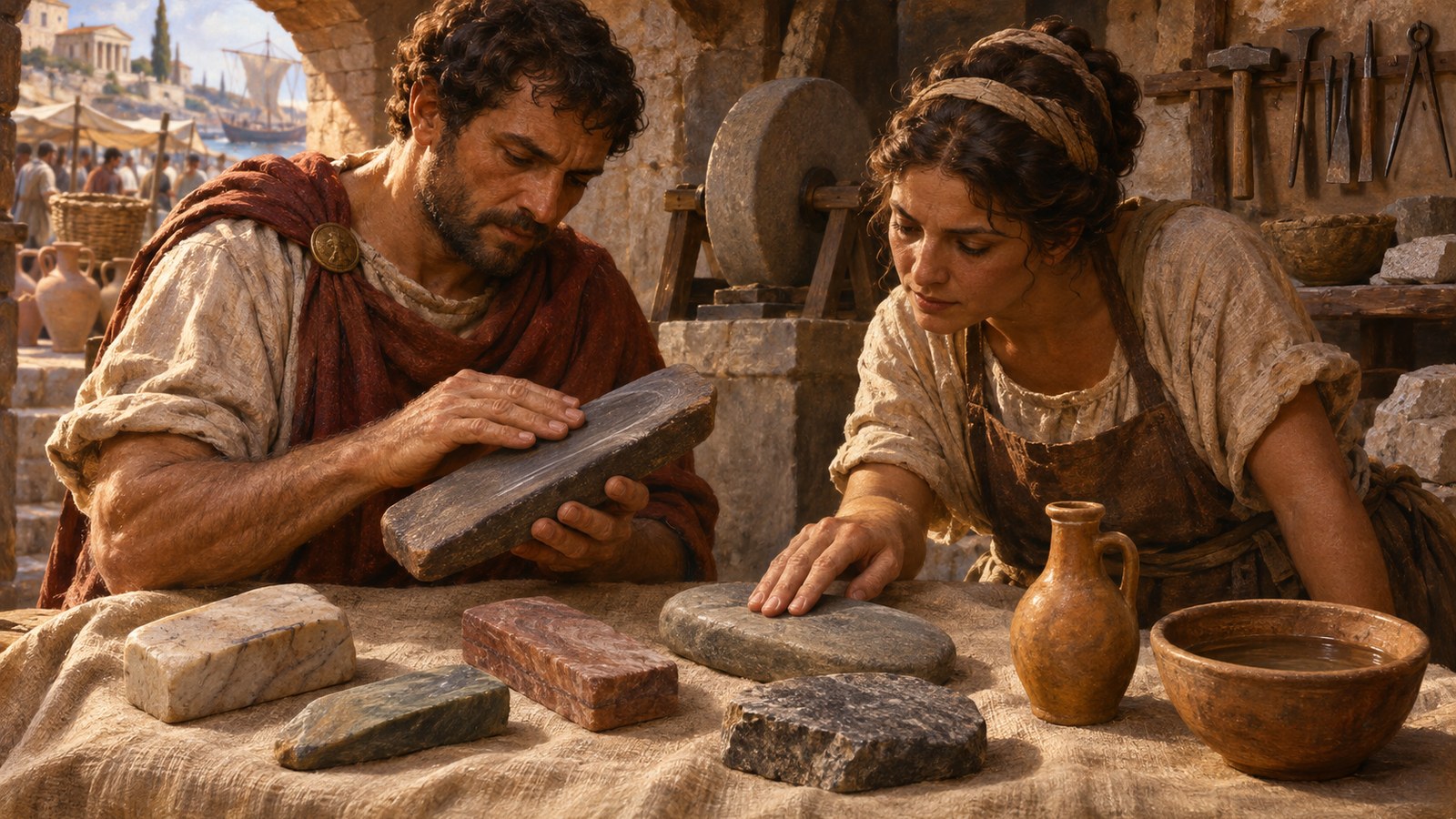
Pliny did not describe whetstones as anonymous pieces of rough rock. He gave them places. Cretan stones had long held the highest reputation. Those from Mount Taygetus in Laconia ranked next. Naxos, Armenia, Cilicia, Arsinoë, Italy, lands beyond the Alps, and Laminium followed in a catalogue that crossed much of the Roman world.
That geography mattered because stone was not interchangeable. A quarry region stood for a particular behaviour at the edge of a tool. A buyer looking at a hone was buying the reputation of a landscape as much as a block of mineral. Crete implied the leading oil hone. Naxos led the water-whetstones. Laminium represented a softer, more specialised class.
The barber’s small abrasive therefore belonged to a network running from stone deposit to merchant stall to workshop. Its size concealed the distance it had travelled. The razor might be maintained each day in a neighbourhood shop, but the surface that renewed it could carry an identity from Spain, the Aegean, Anatolia, Egypt, Italy, or the transalpine world.
Pliny’s list does not prove that every Roman shop stocked an international selection. It does show that specialist stone circulated with regional reputations attached. Natural history became, for a few lines, a buyer’s map of sharpening materials.
The map also gives us a practical way to read ancient trade. Whetstones were not glamorous cargoes like pepper or silk, yet they travelled because daily labour consumed edges. Every razor, knife, and iron tool eventually required renewed contact with stone. Abrasion created repeat demand.
Some Hones Asked for Oil and Others for Water
Pliny organised the first part of his catalogue by liquid. Cretan and Taygetan stones were used as hones and required oil. Naxian and Armenian stones belonged among the water-whetstones. Cilician stones were excellent with either oil or water. Stones from Arsinoë worked well with water only.
Those differences turn sharpening into a choice rather than a single repeated motion. The worker did not merely pick up any stone and wet it with whatever was close. The stone’s identity indicated the liquid with which it was expected to perform.
Pliny did not give a mineral analysis or explain why one surface suited oil while another suited water. His account is procedural. It preserves combinations that users considered effective: Crete with oil, Naxos with water, Cilicia with either. The classification came from handling and result.
The liquid would have affected the contact between iron and abrasive, carried away loosened material, and changed the feel of the stroke. Those general effects help modern readers picture the work, but the source does not describe them in technical terms. Pliny’s reliable boundary is narrower: certain named stones were paired with certain liquids.
Italian whetstones supplied another water-based option. Pliny said they gave a remarkably keen edge. He also named “passernices” from countries beyond the Alps, though he did not add an equal set of instructions for their use. The uneven detail is typical of a catalogue assembled from many observations. Some entries preserve ranking, some preserve liquid, and some preserve little more than a traded name and origin.
Saliva Marked a Separate Fourth Class
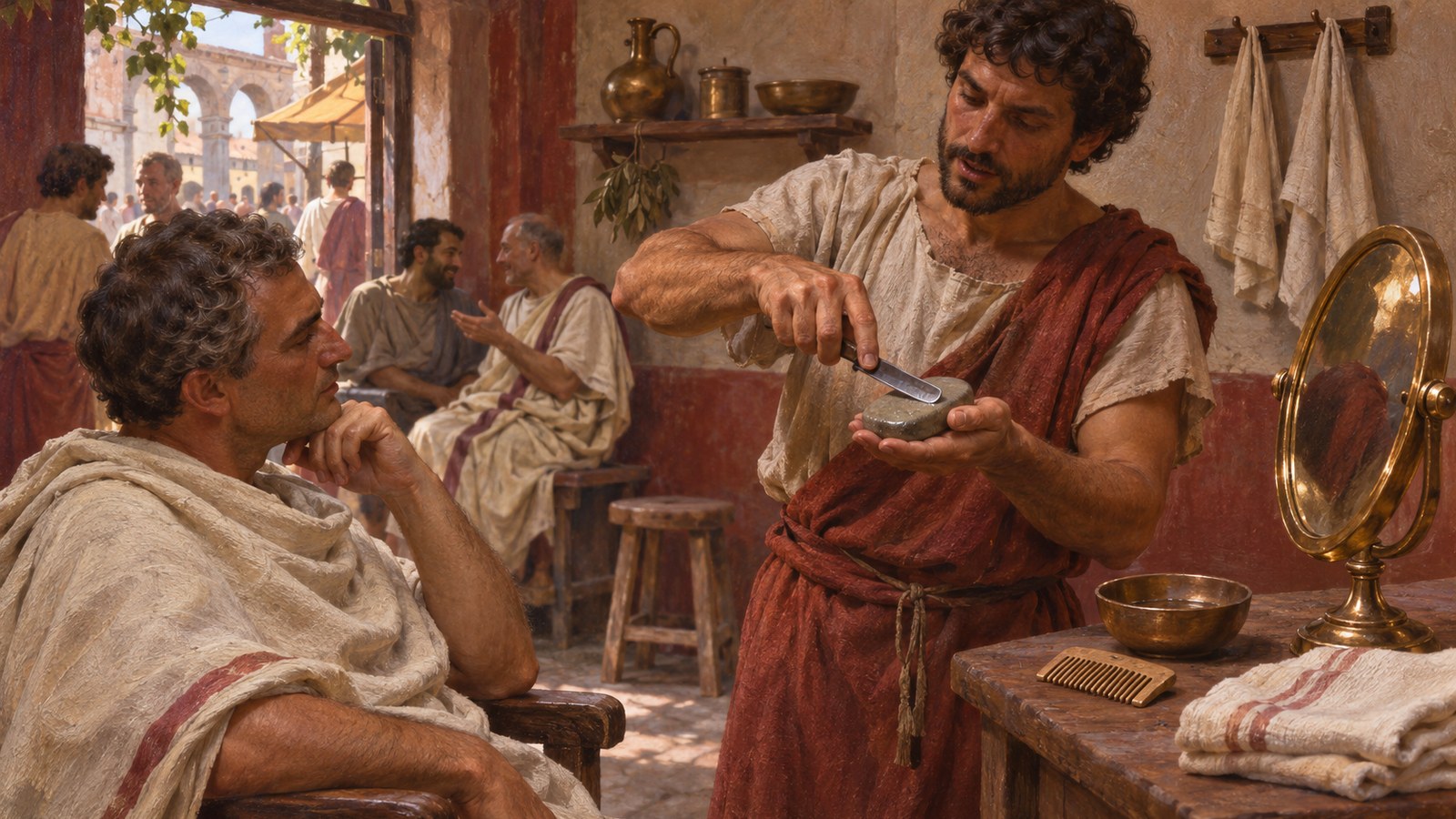
After oil and water came the unusual category. Pliny called the saliva hones a fourth class. They gave an edge “by the agency of human saliva” and were much used in barbers’ shops. The phrasing separates them deliberately from the better-known oil and water stones.
Saliva was practical for a compact tool. It required no bottle or bowl and could be applied in a tiny amount at the moment the razor needed attention. That convenience helps explain why the practice suited a barber’s station, but it remains an inference. Pliny named the liquid and profession; he did not explain the barber’s reasons.
The detail nevertheless places maintenance in front of the customer. A barber could pause, moisten the hone, and draw the razor across it before returning to the face. The motion would be visible and the sound audible: light stone against iron in a shop already filled with talk.
Saliva also makes the tool personal. Oil and water could be supplied as workshop materials. Saliva came from the worker’s own body. The edge was prepared through direct contact between barber, stone, and blade, not by an abstract technology hidden elsewhere.
Nothing in the passage says that saliva sharpened every Roman razor or that all barbers used Laminium stone. The category was “much in use,” not universal. That restraint matters. Pliny gives evidence of a recognisable practice, not a rule for every shop across centuries and provinces.
Soft and Brittle Made the Stone Useful in One Place
Pliny attached an apparent defect to the saliva hones. They were soft and brittle. Because of those qualities, he said, they were worthless for every purpose other than the barber’s work.
The judgment reveals how material value depends on task. Softness and brittleness made these stones poor general-purpose tools. They could not simply replace the respected oil hones from Crete or the water stones from Naxos. Yet in the narrow setting of a barber’s shop, the same class remained common enough to merit its own place in the catalogue.
A razor demanded a fine working edge on a relatively small blade. The stone did not need to survive every workshop operation. It had to perform one controlled job often enough to justify its purchase. Specialisation converted a weak all-purpose material into useful equipment.
This is a valuable correction to the idea that ancient craftspeople always sought the hardest or most durable material available. The “best” stone was conditional. Cretan stone held the highest general reputation in Pliny’s sequence. Laminium stone was the best of the saliva-hone class. Different rankings answered different questions.
The barber’s choice therefore involved limits. Using a soft, brittle hone outside its niche would waste it or produce a poor result. Keeping it near the razor respected the property that defined it. Knowledge meant knowing not only what a material could do, but where it stopped being useful.
Laminium Won by Being Best at a Narrow Task
Within the saliva-hone class, Pliny gave first place to stones from the district of Laminium in Nearer Spain. He did not name a single quarry, price, or merchant. The district itself carried the claim: its stones were the best of this specialised kind.
Laminium’s position shows how a provincial material could become part of routine urban grooming. Nearer Spain was not just a source of metals, wine, or oil in Roman accounts. A soft stone from its territory could reach a barber and influence the quality of an edge placed against a cheek.
The chain joined very different kinds of expertise. Someone recognised the stone in the ground. Someone cut and traded it. A merchant preserved its name. A barber learned that saliva, rather than the oil or water used with other stones, belonged on its surface. The customer experienced only the final edge.
Pliny compressed that chain into five sentences. His catalogue moves quickly, but its classifications are precise enough to reconstruct a working principle: origin, liquid, and task had to match. A famous stone paired with the wrong practice was not the same tool.
The passage also reminds us that maintenance sits behind every dramatic object. Roman razors appear in law, satire, and social history because they could cut. Their sharpness was not permanent. Each use wore the edge, and each return to the hone removed a little more iron to restore it.
The public barber’s shop may have been noisy with news and argument. Its most consequential sound was quieter: a razor passing over a soft Laminium stone, prepared not with a bowl of water or a drop of oil, but with the barber’s own saliva.
Sources
Pliny the Elder, Natural History, Book 36, chapter 47.