
A Roman drinking glass could imitate crystal, replace silver at the table, fail under heat, concentrate sunlight, and return to the furnace only after being broken small. Pliny the Elder placed all of those claims within a few lines. Read together, they are not a smooth account of “Roman glass technology.” They are a set of workshop observations about what glass would and would not tolerate.
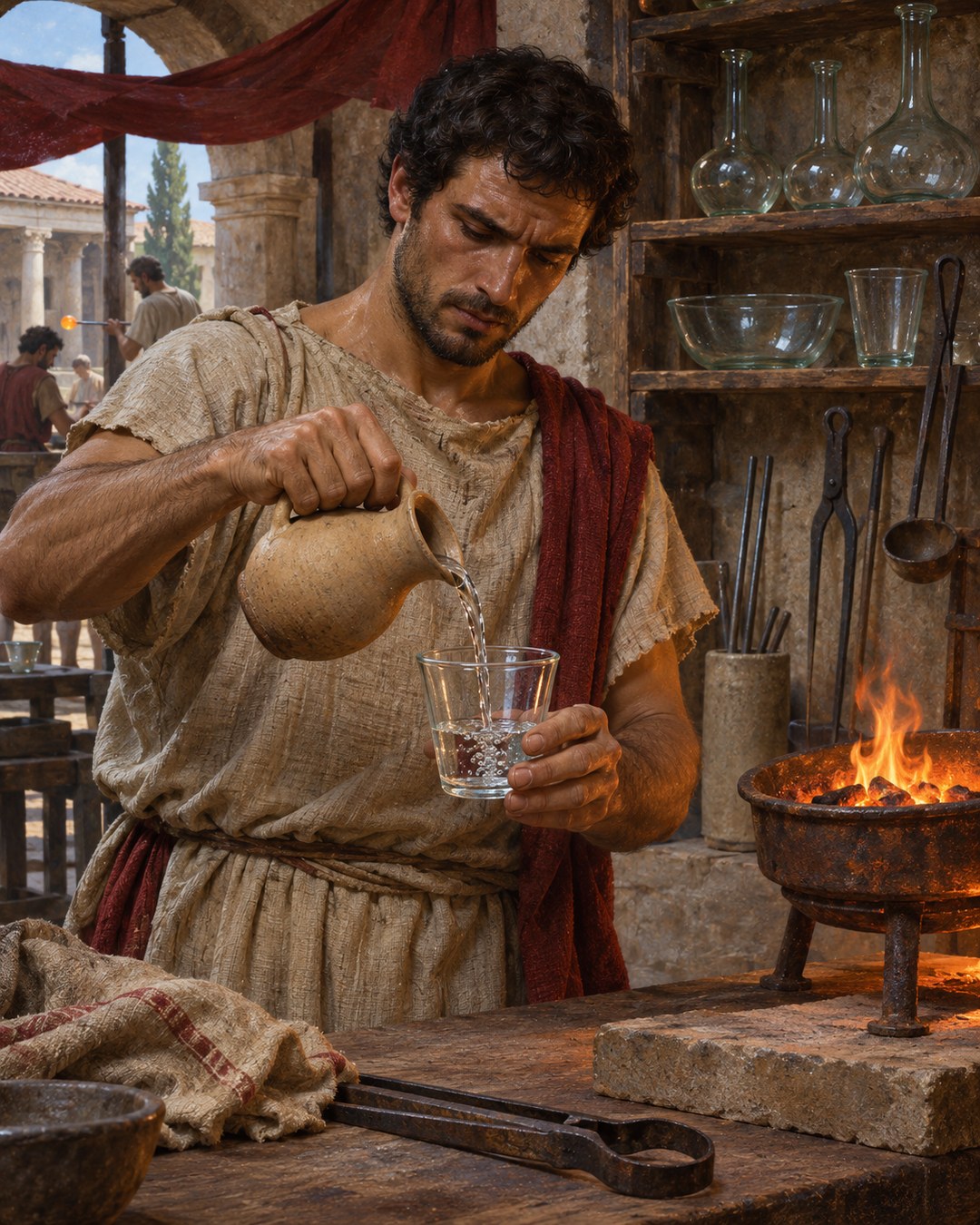
The most revealing detail is also the easiest to overlook. Pliny wrote that glass used for drinking vessels could not stand heat unless a cold liquid went in first. He did not give a temperature, a recipe, or an explanation. He gave an order of operations. That small instruction turns an elegant cup into a material with a memory of how it was handled.
Elsewhere on The Lost Eagles, Roman glassblowing shows how breath made a hollow vessel, while the Lycurgus Cup shows what light can reveal inside glass. Pliny’s passage asks a different question: what did users learn from the moment a finished vessel met heat, sunlight, fracture, and repair?
Colourless Glass Won the Highest Praise
Pliny began with appearance. Glass could be made in opaque red, dead white, and colours that imitated expensive stones or luxury materials. That range mattered, but he said the greatest value belonged to glass that was entirely colourless and transparent, as close to rock crystal as makers could achieve. The prized result was therefore not the most visibly decorated one. It was the one that seemed to make its own substance disappear.
This preference helps explain why glass could compete with precious metal at the table. Pliny claimed that drinking vessels of glass had “quite superseded” silver and gold. The sentence is too broad to serve as a census of Roman households, and it should not be read that way. It is still valuable evidence for a change in prestige. A material made from furnace work could be praised precisely because it did not look heavy, metallic, or opaque.
The visual triumph did not remove physical limits. A clear cup might resemble crystal, but resemblance was not identity. Pliny immediately followed his claim about glass replacing silver and gold with a warning about heat. The transition is sharp: first the consumer sees purity; then the user discovers fragility through handling.
That contrast gives the passage its structure. Roman glass is not presented as a single invention that became steadily better. It is a material whose virtues and failures appeared under different conditions. Colour and transparency belonged to the eye. Heat exposed another set of properties.
Cold Liquid Came Before the Hot Test
Pliny’s practical rule was brief: a glass vessel could not stand heat unless cold liquid was poured in first. The wording preserves a sequence rather than a theory. Vessel, cold liquid, then heat. Whatever exact practice stood behind the sentence, the user was not meant to expose an empty glass abruptly and hope that beauty guaranteed strength.
Modern readers may be tempted to translate the line immediately into thermal stress. That idea can help us understand why uneven heating threatens glass, but it is not Pliny’s own vocabulary. His evidence is procedural. Someone had learned that the order mattered, repeated the warning, and made it worth recording. The instruction belongs beside workshop habits that survive because a failed object makes the lesson memorable.
The cold liquid also complicates a simple picture of Roman tableware. A glass cup was not merely chosen and filled. Its use could require preparation. The person handling it needed to know whether heat was coming next and to treat the vessel accordingly. Material knowledge therefore extended beyond the glasshouse to kitchens, dining rooms, bath spaces, or any other setting in which a vessel might encounter changing temperatures.
Pliny did not say that every glass object failed in exactly the same way. He did not identify wall thickness, glass composition, or the size of the vessel. His sentence is broad because ancient natural history often compressed varied experience into memorable rules. The responsible reading keeps both parts: the rule is real evidence for observed behaviour, but it is not a laboratory specification.
A Water-Filled Globe Turned Sunlight into Danger
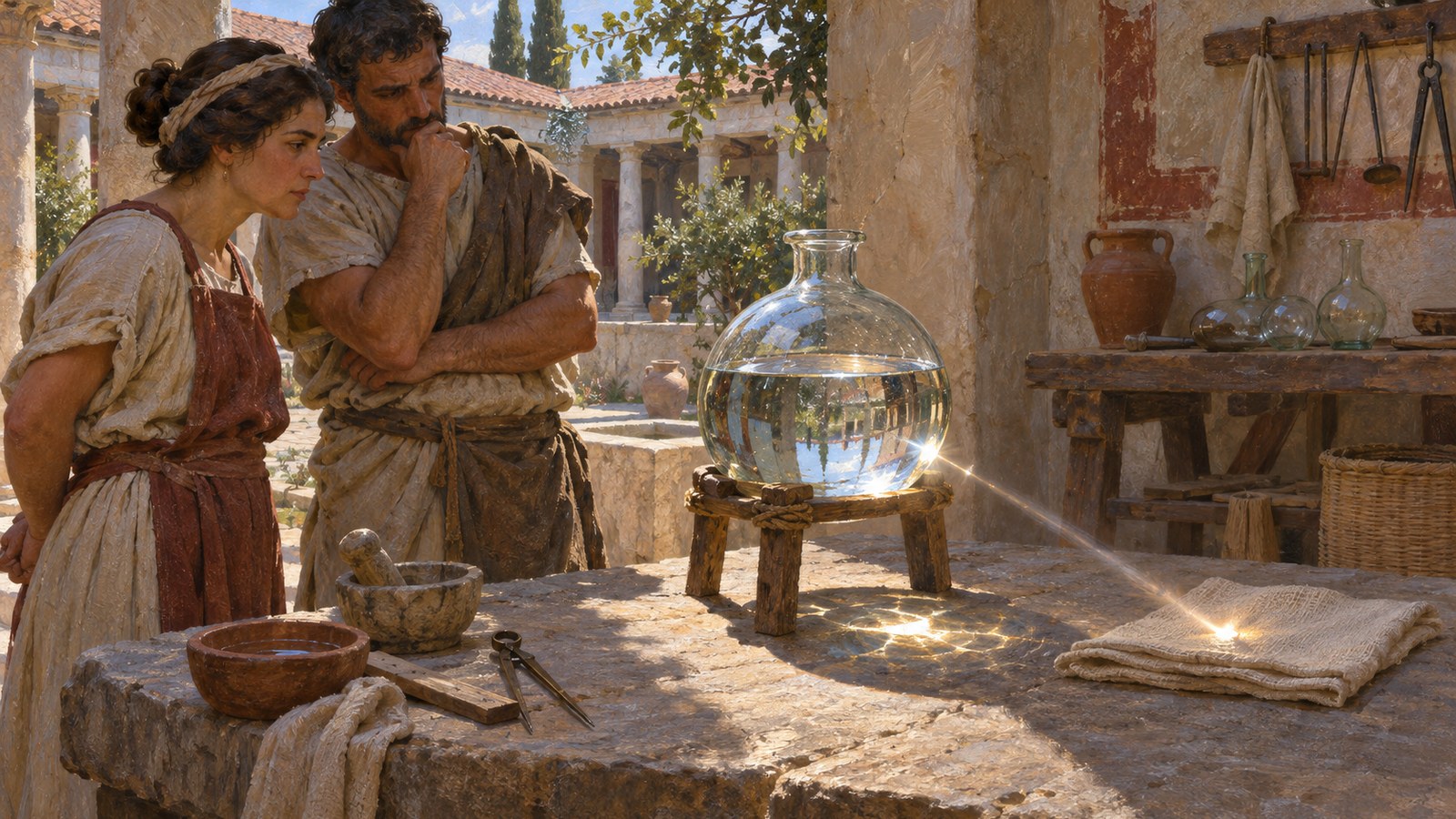
The next observation reverses the relationship between glass and heat. Pliny wrote that globular glass vessels filled with water could become so hot in the sun’s rays that they ignited clothing. The water that appeared as protection in one sentence became part of a heating device in the next. Shape, contents, and light changed what the same general material could do.
The scene is unusually concrete. Imagine a rounded transparent vessel, water inside it, sunlight crossing the curved surfaces, and cloth placed where the concentrated light fell. Pliny did not offer a diagram, but he supplied the necessary objects and outcome. The claim belongs to a long ancient fascination with burning effects produced by transparent or reflective materials. Here the instrument was not a polished metal mirror. It was a water-filled glass globe.
Again, precision matters. The text says clothing could ignite; it does not tell us the vessel’s diameter, the clarity of the glass, the distance to the cloth, or how the globe was held. Those missing measurements prevent a modern reconstruction from being smuggled into the ancient report. They do not erase the central observation that curved, water-filled glass could concentrate solar heat strongly enough to be treated as a fire risk.
For a Roman reader, the sequence may have made glass seem almost contradictory. Direct heat threatened a drinking vessel unless it was prepared in the right order. Sunlight passing through another vessel created heat. Glass did not simply resist or transmit fire. Its behaviour depended on form and circumstance.
Broken Glass Could Be Joined but Not Simply Reset
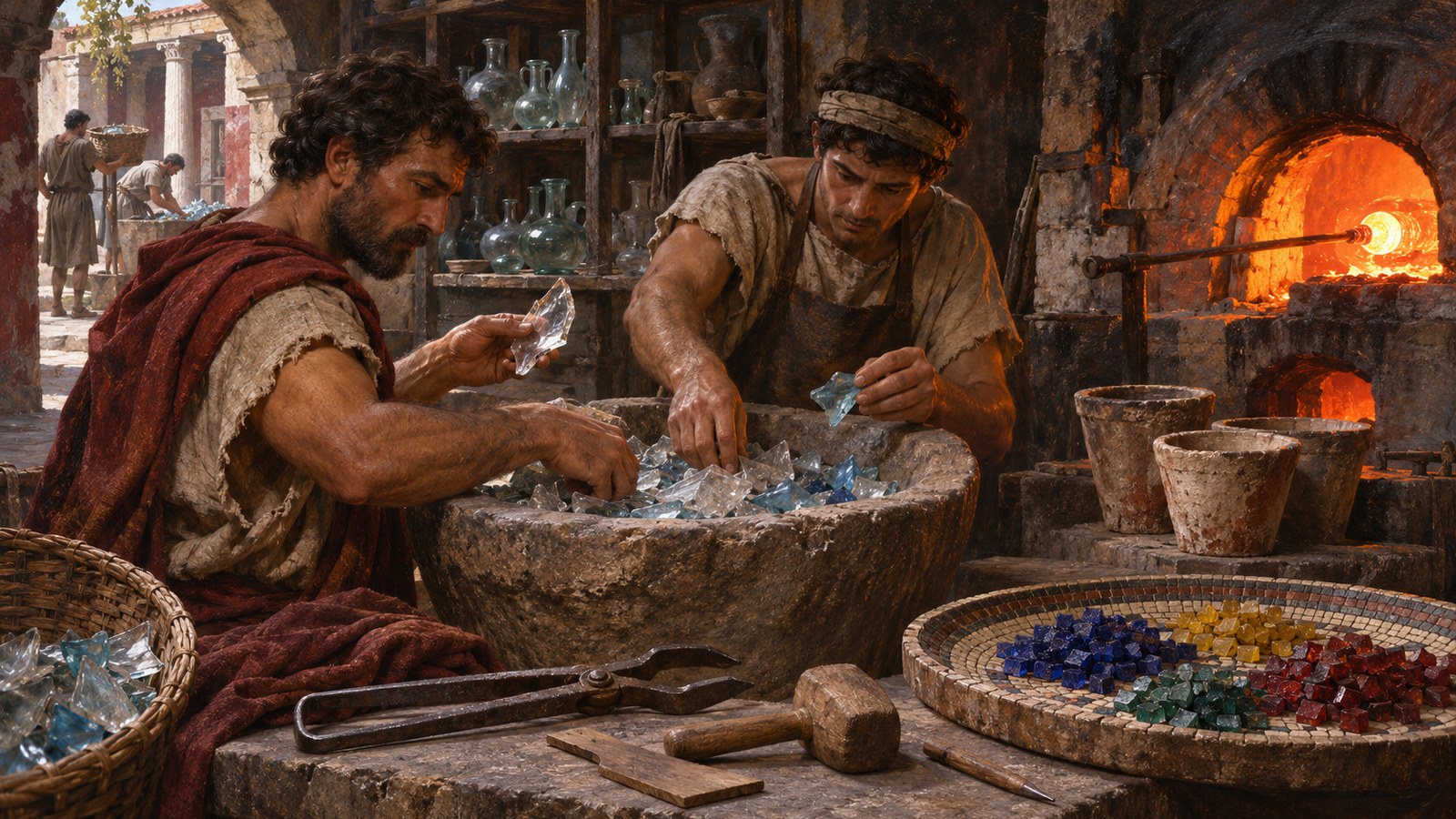
Pliny then moved from use to repair. Broken glass, he wrote, could be joined by heat. Yet the material could not be completely fused again unless it had first been pulverised into small fragments. This is a different kind of limit from a cup cracking at the table. It concerns what the furnace worker could recover after failure.
The distinction between joining and full fusion is important. Heat might connect broken edges without returning the whole object to an undifferentiated molten mass. To go further, the pieces had to become small. Pliny linked that reduction to the making of abaculi, the little coloured or shaped pieces used in mosaic work. Breakage therefore did not always end the material’s usefulness. It could redirect glass into another production chain.
That chain began with sorting and crushing, not with pretending the vessel was still intact. A cracked cup and a heap of prepared fragments were different workshop inputs. The passage makes recycling visible as labour: pieces had to be reduced before the furnace could act on them as a whole.
The observation also fits Pliny’s larger habit of following matter through transformations. He was interested not only in finished luxury objects but in the intermediate states that made them possible: sand, additives, dark molten masses, blown vessels, fragments, and mosaic pieces. A consumer might see a transparent cup. The natural historian tried to keep the furnace and the debris in view.
Sulphur Ended the Sequence by Making Glass Stone-Like
The final sentence adds one more transformation. Glass fused with sulphur, Pliny said, became as hard as stone. He did not explain the reaction, identify proportions, or describe the resulting object. The claim stands as an endpoint in a compact catalogue of material surprises.
That catalogue is more useful than a modern-sounding verdict about whether “the Romans understood glass.” Understanding was distributed. A colour maker knew how to imitate stone. A glassworker knew how to shape a vessel. A household user remembered the order of liquids and heat. Someone handling a water-filled globe had seen sunlight turn dangerous. A recycler knew that fragments had to be made small. Pliny gathered those separate practices into prose.
His method had limits. He placed reported marvels beside repeatable procedures and did not always tell the reader how firmly each claim had been tested. The water-globe fire and the sulphur-hardened glass therefore deserve cautious language. They are claims in an ancient technical-natural history, not measurements from a controlled experiment.
Even with that caution, the passage changes the way a Roman glass vessel looks. Transparency was only its public face. Behind it stood handling rules, curved optics, fracture, crushing, reheating, and altered hardness. The cold liquid mattered because it was one point in a much larger lesson: glass revealed a different character whenever its conditions changed.
Sources
Pliny the Elder, Natural History, Book 36, chapter 67. The Lost Eagles articles on Roman glassblowing and the Lycurgus Cup.