
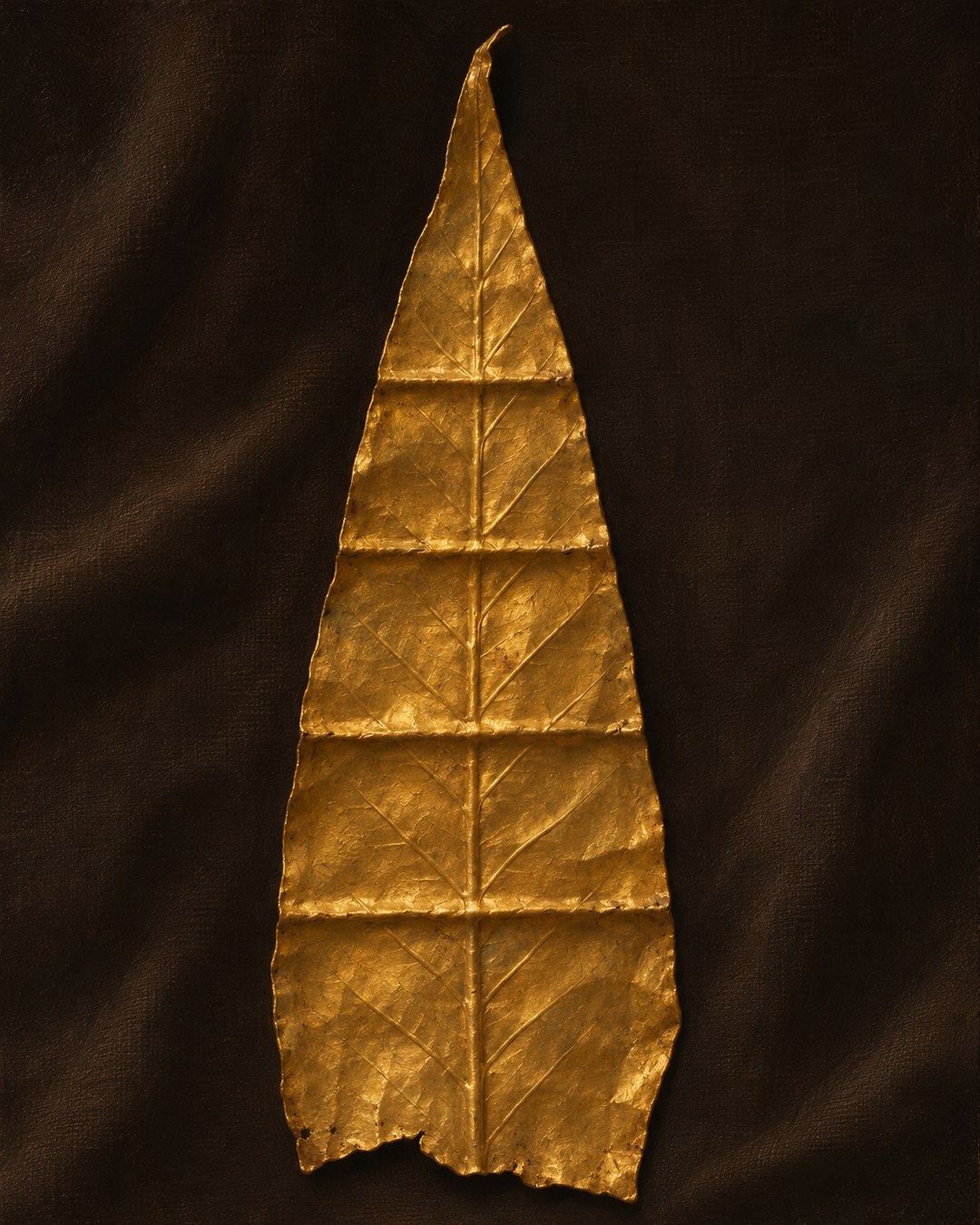
A thin scrap of gold can look almost weightless beside a temple wall, a statue, or an altar. Yet one Romano-British find preserves a surprisingly dense sequence of actions. A goldsmith made a leaf-like design. Someone offered the plaque in a sacred setting. Later hands folded it across four parallel lines, compressed it, and at some point opened it again. The object is small and incomplete, but its damaged surface still separates devotion from the later history of precious metal.
The Portable Antiquities Scheme records the piece as a probable Roman votive plaque. Its importance does not depend on a named god or a reconstructed prayer. The surviving facts are physical: converging edges, a bent point, a broken base, four creases, and a central rib flanked by angled veins. Together they show how a dedicatory object could imitate a leaf while remaining thin enough to fold.
The Gold Sheet Was Shaped as a Leaf
The surviving piece is slender and sub-triangular. Its two long sides converge toward a pointed tip, while the base appears broken. This geometry matters because it keeps the interpretation anchored in the object rather than in a generic idea of temple treasure. The long edges appear complete. The tip is bent. The base, by contrast, interrupts the form and suggests that some material is missing.
Across the face runs a central rib. Angled veins branch on both sides. The decoration was incised or raised by repoussé, although the record cannot make every manufacturing decision certain after the sheet was folded and unfolded. The result evokes a leaf without needing a naturalistic outline. A viewer could recognize the basic pattern from line, symmetry, and sheen.
Roman metalworkers used gold, silver, and bronze for plaques of this broad class. The choice of gold made this particular offering materially conspicuous even if its scale was modest. Gold also let a very thin sheet catch light. Unlike a cast figurine, the plaque could communicate value through surface rather than mass.
Four Creases Recorded a Second History
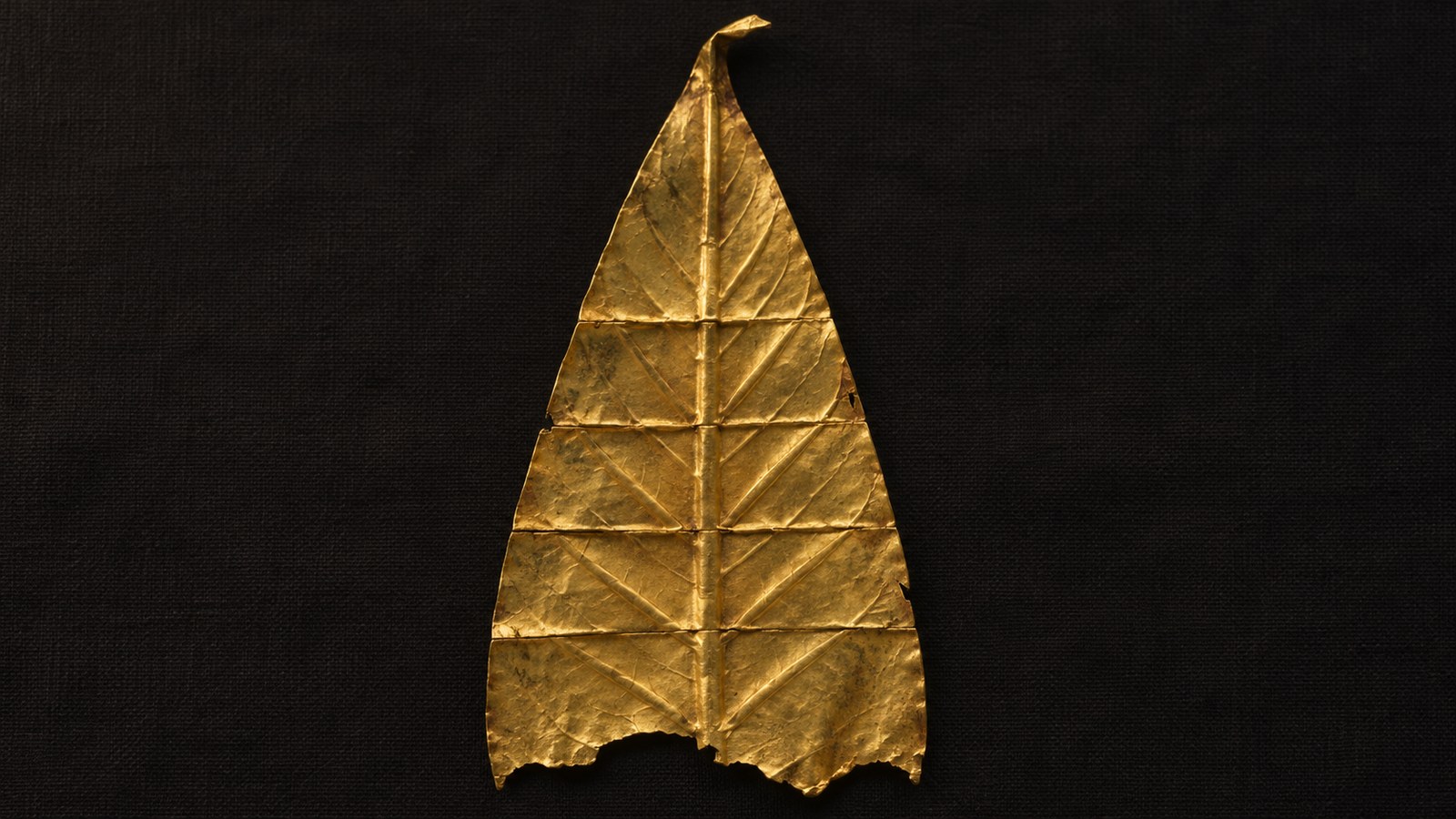
Four parallel crease lines cross the long axis at right angles. They are equally spaced. The record interprets them as evidence that the sheet was folded and compressed, then perhaps unfolded relatively recently. The folds are not decorative borders: they cut across the leaf design and disturb its surface.
That distinction gives the object two readable phases. The rib and veins belong to its deliberate presentation as a votive form. The creases belong to a later treatment that reduced its size. Folding gold sheet into a compact packet could make it easier to carry, conceal, store, or recycle, but the find alone cannot choose among those motives. What it can show is that the offering did not remain forever in its original displayed condition.
The bent tip and irregular surface reinforce that later history. They are not reasons to dismiss the plaque as an unintelligible fragment. They are evidence that precious sacred material could pass through rough handling after dedication. The object’s afterlife is written over, but does not entirely erase, its first design.
The regular spacing of the creases is particularly revealing. An accidental bend might mark one weak point, but four parallel folds imply a repeated, controlled reduction. The sheet was made shorter in stages. Even without knowing who folded it, the surviving geometry distinguishes deliberate compression from random burial damage and keeps the sequence tied to visible evidence.
A Tiny Offering Could Still Carry a Temple Language
Leaf-marked decoration is characteristic of Roman votive plaques dedicated at temples and shrines in Britain and elsewhere in the empire. A find need not preserve an inscription to belong to that language. Repeated forms, materials, and display practices could make the object intelligible to worshippers who encountered similar offerings.
The plaque might be nearly complete, the tip of a longer simple leaf-marked strip, or one component from a more elaborate object. Those alternatives should remain open. The broken base prevents a confident reconstruction. Editorially, the uncertainty is useful: it shows where archaeological description ends and a modern illustration would otherwise begin inventing.
Each reconstruction would imply a different original silhouette. A nearly complete plaque would have been a very small, self-contained leaf. A surviving tip would belong to a longer strip whose missing base carried more of the pattern. A component could have sat within a larger arrangement. The record does not use the intact long edges to pretend that the broken base is irrelevant. Instead, it preserves all three possibilities while identifying the feature they share: the visible rib and angled veining belong to a recognized votive vocabulary.
Surface damage complicates the reading without destroying it. Folding pushed one part of the design against another, and unfolding introduced further irregularities. Even under those conditions, the central rib remains detectable. This survival explains why specialists can compare the piece with leaf-marked plaques while refusing to supply a god, inscription, or complete outline. Recognition here comes from patterned workmanship, not from a spectacular scene.
The Lost Eagles has previously examined how a civic authority could struggle over moving a shrine that Rome could not consecrate. This gold sheet approaches sacred space from the other direction. Instead of law governing a building, it preserves one portable act of dedication. The two scales—architecture and a hand-sized offering—belonged to the same wider world of Roman religious practice.
Removal Changed the Meaning of the Metal
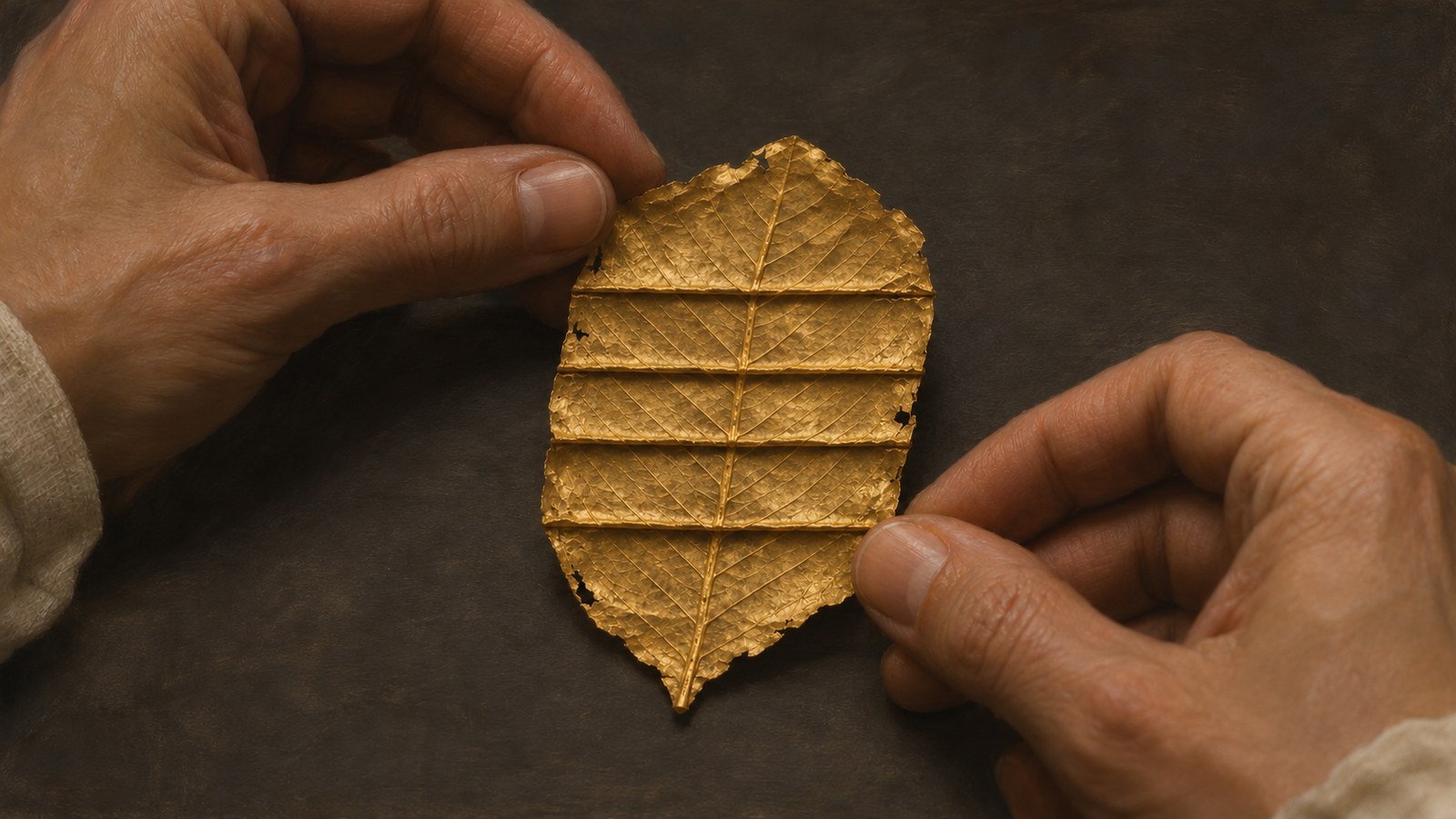
The record notes that incompleteness combined with folding suggests removal from the plaque’s presumed temple context. “Suggests” is essential. No surviving label identifies the person who moved it or the moment when the sacred object became recoverable gold. Even so, the compact folds make more sense as treatment after display than as the intended final appearance of a leaf-marked dedication.
Once removed, gold invited a different calculation. Its sacred role had depended on placement, form, and social recognition. Outside the shrine, the same sheet could be valued for portability and metal content. Folding did not chemically change it, but it changed the relationship between image and material: the veins disappeared into a packet, while the gold remained gold.
This tension also appears in Roman stories about sacred fire and ritual continuity. In Plutarch’s account, mirrors could concentrate sunlight to renew the Vestal flame. The votive sheet offers no comparable literary scene, yet both cases show that Roman sacred meaning depended on controlled material actions. Light, metal, placement, and handling were not decorative extras. They helped make ritual legible.
The Find Survived as Treasure and Evidence
Because of its age and precious-metal content, the plaque qualified as Treasure under the 1996 Treasure Act. That modern classification is separate from its Roman purpose, but it shaped the object’s documented afterlife. The record could preserve dimensions of form and damage, compare the leaf-marked pattern with other plaques, and prevent the gold from becoming anonymous scrap.
The comparison cited in the record is the “Near Baldock” hoard discussed in the Treasure Annual Report 2002. That group included gold and silver votive plaques. The parallel does not prove that this fragment came from the same workshop or served the same deity. It supports a narrower point: leaf-marked precious-metal plaques are an attested Roman dedicatory form, not a category invented to rescue an otherwise puzzling scrap.
What survives, then, is not a complete prayer. It is a chain of physical predicates. The sheet was made from gold. Its sides converged. A rib and veins formed a leaf. Four crosswise folds compressed that design. The base broke, and the object left its presumed sacred setting. Each statement is modest. Together they reveal how an offering could be made visible, reduced to a packet, and recovered as evidence centuries later.
Sources
Portable Antiquities Scheme record for DENO-49C065; Treasure Annual Report 2002, “Near Baldock” hoard discussion.