
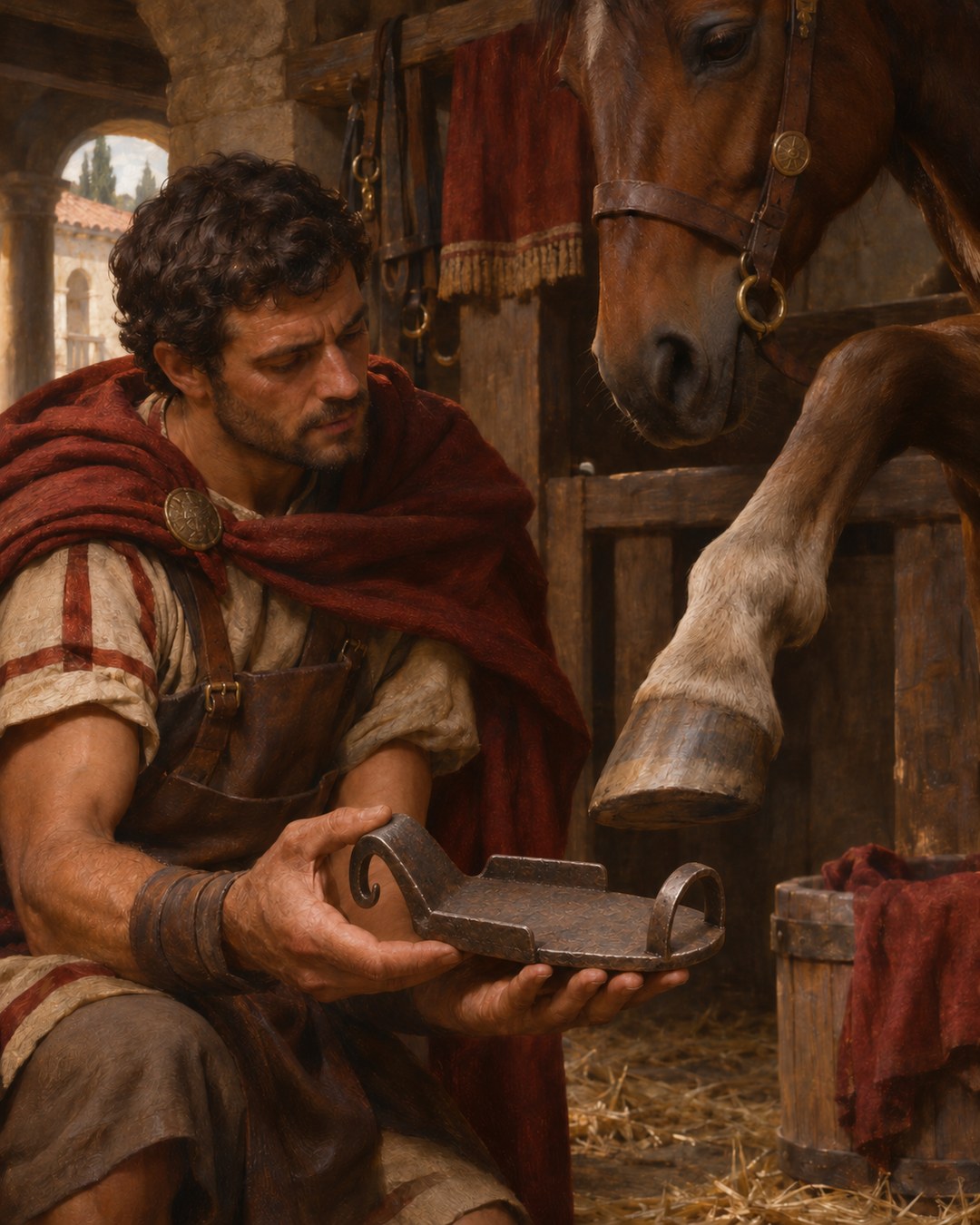
A Roman horse did not need to leave a complete skeleton, a stable block or a cavalry diploma to place one practical problem in our hands. Sometimes the evidence is a piece of iron weighing 245.29 grams. The object is a hipposandal: a removable fitting built around a flat sole plate, side wings, loops and a hooked heel. Its surviving geometry is more informative than the modern nickname “Roman horseshoe” suggests.
The best-preserved example considered here is 167.45 millimetres long and 114.85 millimetres wide. Those measurements describe something compact enough to sit beneath a hoof, yet complicated enough to demand several bends and projections. It was not simply a sheet of iron. Every change of direction helped turn a plate into a fastening system.
That distinction matters. A familiar nailed shoe is fixed by driving nails through its rim into the insensitive outer wall of a hoof. A comparative archaeological record describes the hipposandal differently: the hoof stood on the plate, and ties attached the fitting. The iron therefore had to provide places for those ties to pull against while resisting movement in more than one direction.
A Flat Plate Had to Control a Moving Hoof
The primary record begins with a broadly rectangular plate. It tapered toward both front and rear, while its base remained flat. That simple floor carried the animal’s hoof, but a floor alone could slide away. The other surviving parts show how Roman ironworkers made the plate behave as more than a loose pad.
Two projections stood at right angles to the sole. The record calls them side wings, although both are incomplete. Their position is the important detail. A vertical or near-vertical wing could meet the side of the hoof and resist sideways displacement. This is bounded mechanical interpretation rather than a claim about the object’s exact use on a particular journey. The iron itself preserves the direction in which support was intended to act.
The plate also had a front attachment. One loop near the toe is complete but bent downward. Another loop above the toe is broken, though the surviving pieces fit together. Damage complicates the outline, yet it also reminds us that the original fitting depended on connections beyond the sole. The plate, wings and loops formed one object because each addressed a different route by which the hoof might move.
Roman handlers already understood equipment that had to be fitted to a living animal rather than merely placed beside it. The site’s account of wooden horses used to train recruits shows the same practical interest in repeated movement and controlled positioning, although the training device and this iron fitting solved entirely different problems.
The Heel Hook Turned a Plate into a Fastening System
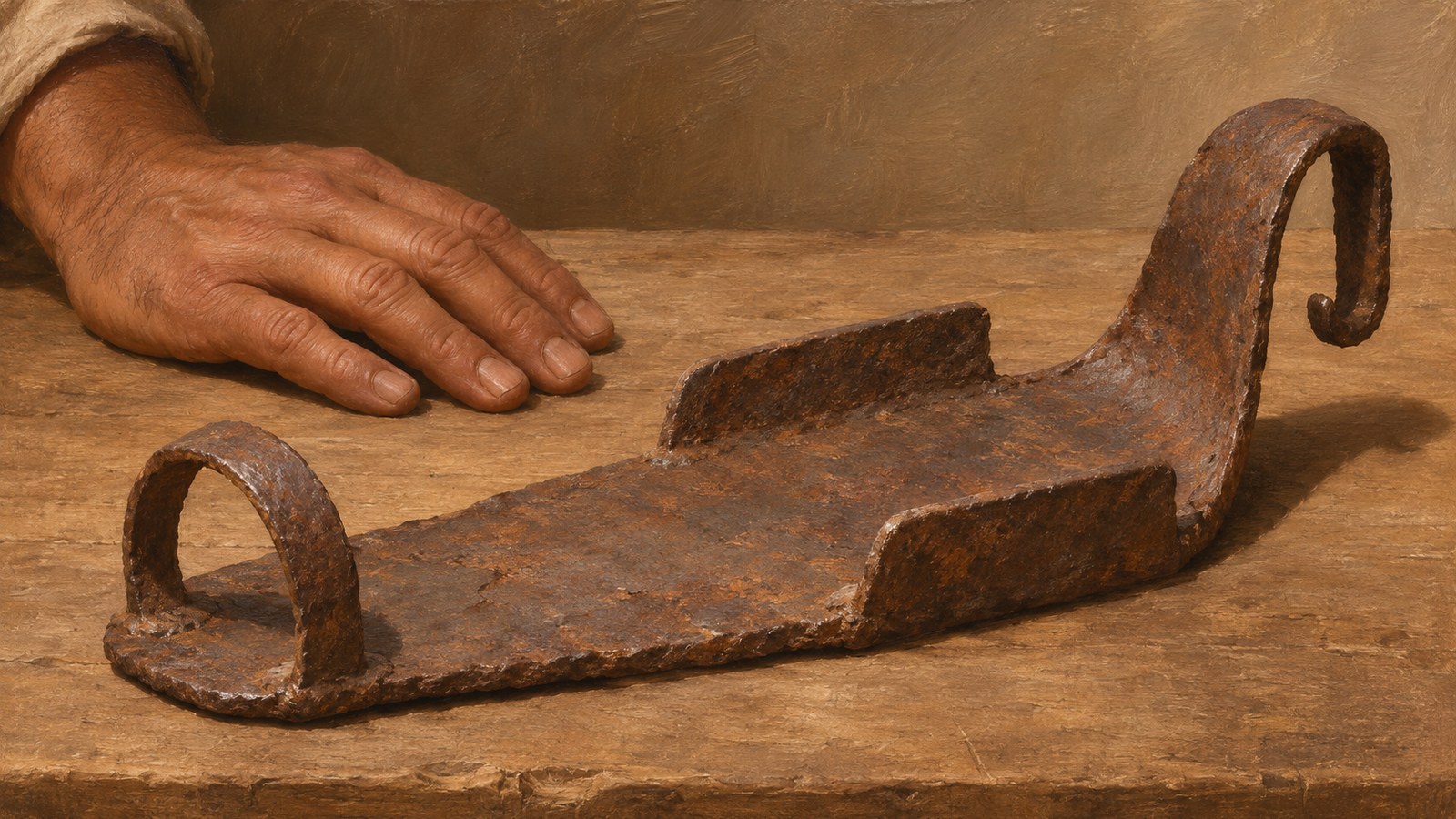
The most striking change occurs at the rear. The heel rises at about 45 degrees, flares outward and ends in a downward-facing hook. This is not decorative ironwork. The sequence of bends changes the direction of force: up from the sole, outward at the heel, then down at the terminal hook.
A hook gives a tie somewhere to catch. Its downward orientation could help prevent a fastening from simply riding upward and slipping free. The outward flare gave the rear structure breadth before it narrowed into that terminal feature. We should not pretend to reconstruct the exact knot, strap material or tying sequence, because the source record does not preserve them. What survives is the anchor geometry that made some form of binding possible.
The object’s condition sharpens the picture. The toe loop was bent, the upper loop was broken, and the rear corner of one side wing was missing. Even so, the record describes the hipposandal as largely complete and in very good overall condition. Enough of the structure remains to follow a circuit around the hoof: support below, restraint at the sides, attachment toward the toe and a hooked return behind the heel.
That circuit explains why reducing the object to “a Roman horseshoe” hides its most interesting evidence. The maker was not copying the outline of a nailed crescent. The maker was building a small iron frame whose projections allowed an external binding to hold a hoof on a plate.
Ties, Not Nails, Completed the Object
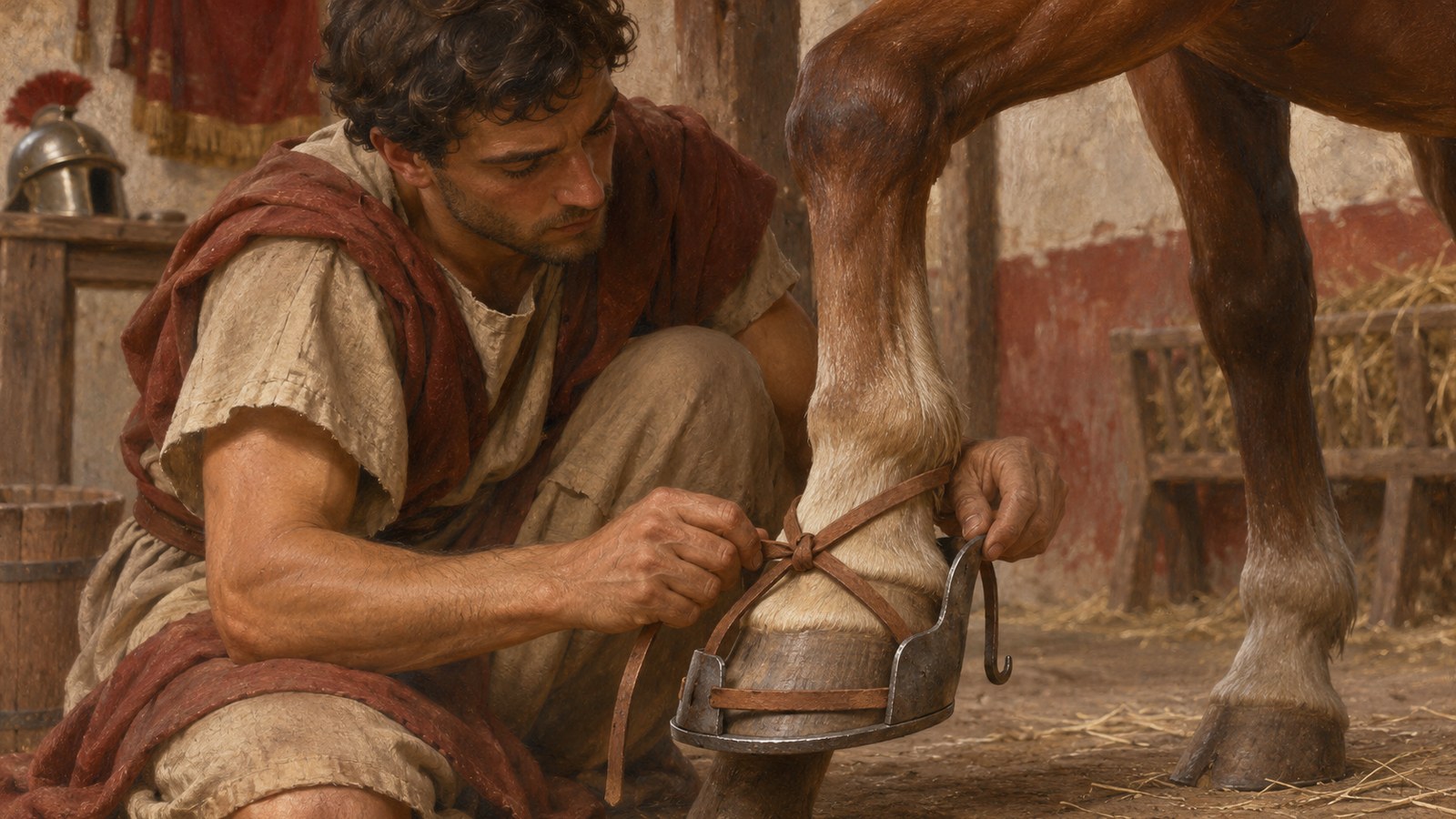
A related, more fragmentary hipposandal makes the fastening principle explicit. Its archaeological record says that fittings of this type acted as a form of horseshoe but were not nailed to the hoof. Instead, the hoof was placed on the plate and the shoe attached with ties. That sentence supplies the missing soft component around the surviving hard component.
The contrast is useful because iron survives differently from leather or fibre. A recovered plate can look self-sufficient when displayed alone, but it was only the rigid half of the device. The ties converted its loops, wings and hook into a working system. Without them, the plate would have had nothing to keep it aligned beneath a lifting, turning hoof.
Removability also changes how we imagine the human action. Someone could position the hoof, bring the plate beneath it, and secure the fitting from outside. The evidence does not tell us who did this, how quickly, or for how long the fitting stayed in place. It does show a technology based on fitting and binding rather than permanent attachment.
The comparative fragment is much smaller because only part survives: 67.3 millimetres long, 67.1 millimetres wide and 7.7 millimetres thick, with a weight of 53.14 grams. Its broken state prevents a direct size comparison with the 245.29-gram example as though both were complete. Instead, it demonstrates why several records matter. One preserves the architecture; another states the attachment principle.
Classification Connects One Find to a Wider Technology
The larger object is classified as a Type 1 hipposandal. Its record traces that label to Aubert’s 1929 scheme and to Manning’s 1985 catalogue of Romano-British iron tools, fittings and weapons in the British Museum. Classification does not erase the individuality of the find. It allows archaeologists to compare a specific arrangement of plate, wings, heel and hook with other surviving fittings.
The related record dates its fragment to approximately AD 43–200. It also mentions finds from Colchester and Bishopsgate in London, along with more complete examples recorded by the Portable Antiquities Scheme. Those comparisons place the technology in a Romano-British archaeological landscape without assigning the primary object a journey or owner that its record cannot support.
The distribution point is modest but important. A fitting found in isolation can seem eccentric. Multiple examples from excavated contexts and recorded finds show that the idea was repeatable enough to recognize. Like the measured mechanism inside Vitruvius’s road cart, the hipposandal turns movement into a problem of components, contact and controlled displacement. The machines are unrelated in purpose, but both become legible when each piece is asked what motion it constrained.
Type labels should therefore be treated as tools, not conclusions. “Type 1” does not tell us whether this particular fitting crossed a muddy street, protected an injured hoof, served briefly on difficult ground or was discarded before use. None of those stories appears in the record. The label says that its construction belongs within a recognized family.
Two Hundred Forty-Five Grams Preserve the Design Logic
The surviving mass gives the object a physical presence that photographs can flatten. At 245.29 grams, the hipposandal was not an enormous iron boot. Nor was it a weightless accessory. Its 167.45-by-114.85-millimetre footprint concentrated a quarter-kilogram of corroded iron into a plate and a set of carefully directed restraints.
The surface is now uneven, dull brown and corroded. That texture belongs to the object’s long archaeological afterlife, not necessarily to its working appearance. Beneath the corrosion, however, the construction remains readable. The sole lies flat. The wings rise. The heel turns upward at roughly 45 degrees, flares and hooks down. The toe attachments complete the logic at the opposite end.
That sequence is the article’s real subject. Roman craft knowledge did not reside only in monuments or spectacular weapons. It also appeared in the angle of a heel piece and the decision to make a loop catch a tie. The fitting had to cooperate with a hoof that lifted from the ground, shifted sideways and pressed down again. Its design answers those movements with different pieces of the same iron body.
The object cannot tell us the name of its maker or the animal that may have worn it. It can tell us what the maker considered necessary: a stable platform, lateral restraint, front attachment and a hooked rear anchor. Those are not literary claims imposed on mute metal. They are observations bounded by the measured form and by a comparative record that explains the ties.
A hipposandal is easy to mistake for an awkward ancestor of something more familiar. Seen closely, it is better understood on its own terms. It was a removable, composite technology in which iron supplied the geometry and perishable bindings supplied the grip. The 245.29-gram survivor matters because its hook, wings and loops still let us reconstruct that division of labour without inventing the journey beneath them.
Sources
Europeana record supplied by the Portable Antiquities Scheme, “Roman Hipposandal” (WILT-A3591B); Europeana record supplied by the Portable Antiquities Scheme, “Roman Hipposandal” (WILT-DECF07).