
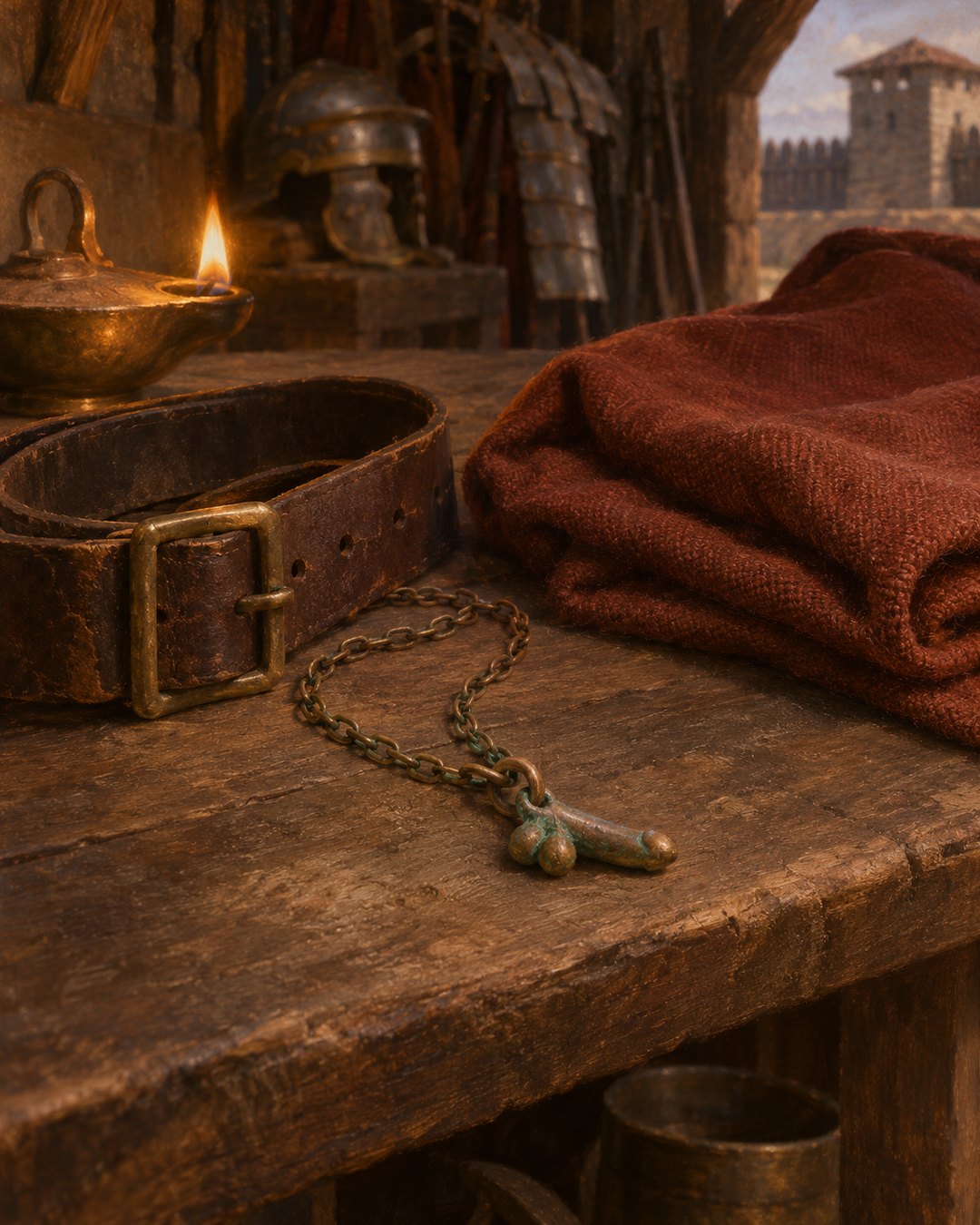
The Roman copper-alloy amulet in London Museum has not survived alone. Part of its chain remains in place. That small fact changes how the object must be read. The amulet was not merely a shaped piece of metal made to be looked at. It belonged to a portable assembly intended to hang, move, and remain close to a wearer or equipment.
Its phallic form was explicit rather than hidden. The museum explains that representations of male genitals served as charms against the evil eye and signs of good luck. It also notes that pendants of this type occur commonly in first-century military contexts, citing examples from Colchester. Protection, display, and attachment met in one object whose surviving chain still records mobility.
The Chain Turns a Symbol into Worn Equipment
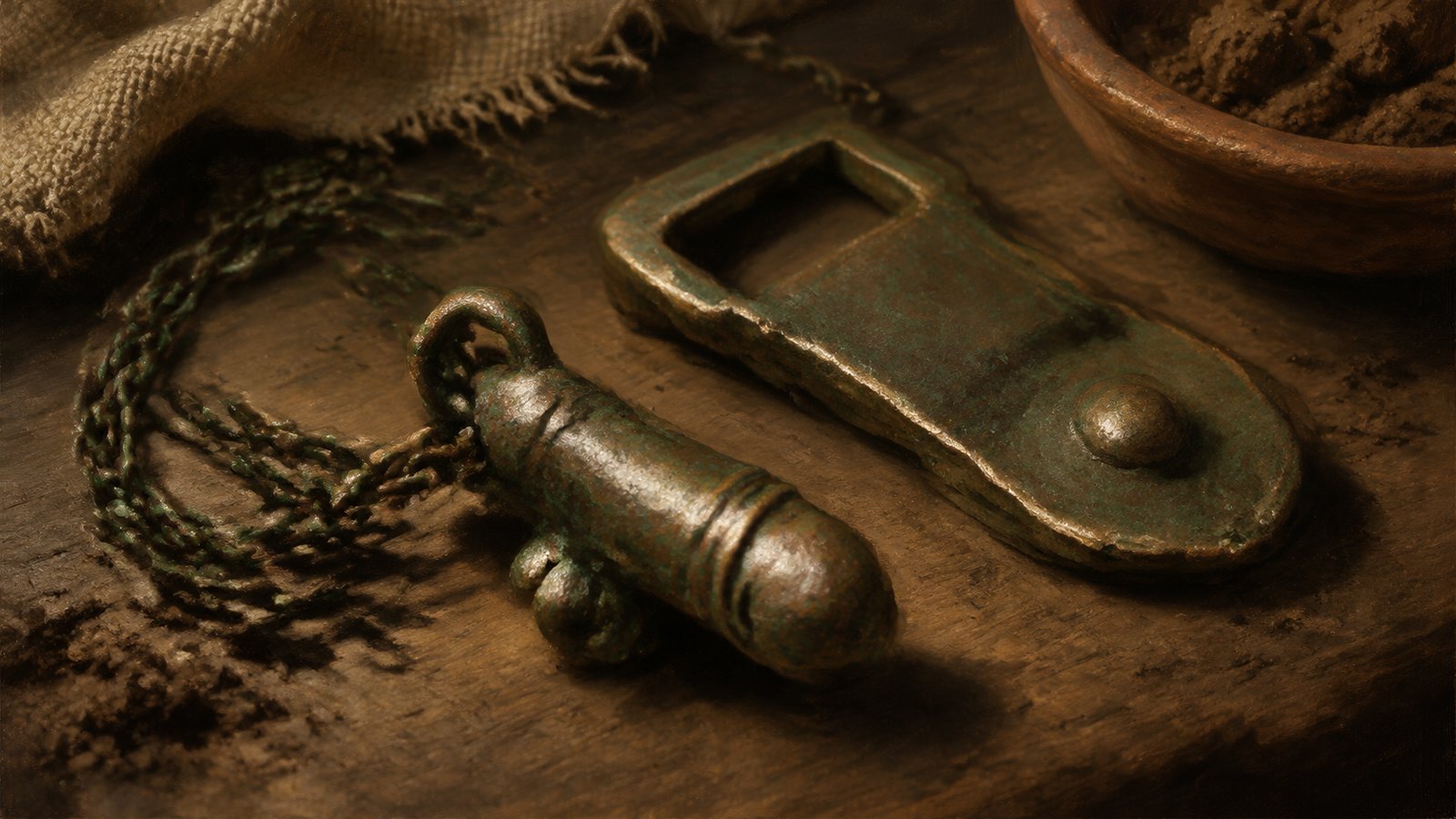
A chain in situ is more than an incidental fragment. It preserves the relationship between amulet and suspension. Without it, a perforation or loop might show that the object could hang. With it, part of the hanging system remains physically joined to the pendant.
The record does not give the chain’s full original length or say where it was fastened. It cannot establish whether the amulet hung from a neck, belt, harness, box, or another fitting. Those are different placements with different social meanings. The surviving evidence supports portability and attachment, not a specific position on the body.
Movement would have made the amulet visible from changing angles. Copper alloy catches light differently as it turns, while a chain lets a pendant swing instead of remaining fixed flat against a surface. The exact finish and original colour are not described, so the object should not be imagined as permanently bright. Its construction nevertheless placed the image in motion.
That mechanical relationship matters because protection was carried rather than installed in a building. A doorway charm could guard a threshold. A chained pendant could travel with whatever held it. The archive’s discussion of bells and protective imagery at Roman doorways shows one fixed setting for apotropaic objects. This amulet’s chain points toward a different scale: small, mobile, and personally or materially attached.
The chain also complicates the museum’s measurements. The record presents two overall length values, 190 and 173 millimetres, with a width of 15 millimetres, but the page does not explain the two lengths. One may relate to the chained assembly and another to a component, but the article cannot assign them confidently. Preserving the ambiguity is better than silently choosing the more convenient number.
An Explicit Image Confronted the Evil Eye
The museum describes the amulet as phallic and connects that form with protection against the evil eye. In Roman visual culture, the image did not operate by polite concealment. Its force came partly from being unmistakable, confrontational, and difficult to overlook.
The “evil eye” named a threat imagined through hostile or envious looking. A counter-image could answer sight with sight, shock, humour, fertility, vitality, or aggressive display. The museum’s wording secures the broad protective interpretation. It does not preserve the private thoughts of this object’s owner, so the article should not reduce every use to one emotion.
Calling the pendant a sign of good luck adds a positive side to the same object. Protection is not only the removal of danger. It can be the attempt to attract favourable outcomes or carry reassurance into uncertain situations. The copper-alloy form could therefore communicate both resistance and hope without requiring a written prayer.
The symbol was also efficient. A narrow pendant only 15 millimetres wide could remain recognizable while using little material compared with a figurine or plaque. The museum’s two length fields make the complete scale difficult to parse, but the width confirms a slender assembly. The form did not need a large surface for an inscription. Recognition came through outline.
No text survives on the object in the collection description. That absence matters. The amulet’s message depended on a visual convention familiar enough to work without labels. A viewer who understood the form did not need the object to explain its desired effect.
This differs from a legal or military document, where words can define obligations precisely. The amulet worked through condensed imagery. Its power, whether believed, joked about, displayed, or simply inherited as custom, lay in carrying a recognizable protective sign into daily movement.
Military Context Does Not Name a Soldier
The collection record says pendants of this type occur commonly in first-century military contexts and points to Colchester examples published by Nina Crummy. That comparison situates the type without proving the biography of this individual object.
“Military context” can describe a find environment associated with forts, soldiers, or military communities. It does not automatically identify the original owner as a serving legionary, assign a rank, or name a unit. Camps and garrison towns contained families, traders, craftspeople, dependants, animals, and visitors as well as troops. A type’s frequency establishes a pattern, not a personnel file.
The date range for this object is AD 43–200, broader than the first-century comparison emphasized for the pendant type. Those two chronological statements should remain separate. The museum places this amulet across roughly the first two centuries of Roman rule in Britain, while noting that comparable pendants are common in first-century military settings.
The Colchester citation is valuable because it shows that the military association is not invented from the object’s appearance. The museum anchors it to published comparative material. At the same time, the online record does not reproduce the entire typology or explain whether every cited example had a chain, identical dimensions, or the same alloy.
The military setting makes the desire for protection easy to romanticize. Soldiers faced danger, but an article should not invent a battle, march, or frightened recruit around an unproven owner. The stronger point is structural. Roman military communities contained many objects designed to be worn and secured. Military belts turned equipment into a carried system; this amulet’s surviving chain shows a protective image entering that broader world of attachment.
Portability was particularly useful in environments where people and gear moved. A building shrine remained in place. A chained charm could accompany a person, garment, animal, or kit, though this record does not choose among them. Its value was not tied to a single wall.
Two Lengths Warn Against False Precision
Museum measurements often look more certain than narrative interpretation, but this record teaches caution even there. It lists length values of 190 and 173 millimetres alongside a width of 15 millimetres. The page labels them overall without explaining why length appears twice.
It would be easy to treat one number as the pendant and the other as the chain, or one as surviving length and the other as reconstructed length. Neither assignment is stated. The correct article response is not to erase one figure. It is to report the ambiguity and avoid building a visual reconstruction that depends on an unsupported division.
The record’s 80-percent quality figure is also administrative metadata, not a probability that the amulet is genuine or that the protective interpretation is 80 percent true. Record quality, measurement clarity, object condition, and cultural interpretation are different layers. Keeping them separate prevents database fields from becoming invented history.
Several facts remain firm despite those limits. The material is copper alloy. The form is phallic. Part of the chain remains attached. The museum links such imagery to protection from the evil eye and good luck. Comparable pendants appear commonly in first-century military contexts, including Colchester. This object is dated AD 43–200 and belongs to the permanent collection under identifier A5899.
Together those claims support a precise conclusion. Roman protective imagery could be made portable through metalwork. The pendant did not merely represent a charm; its chain turned the representation into something capable of travelling. The attachment was part of the meaning because protection had to remain close to what mattered.
The missing biography should stay missing. We do not know the wearer, unit, journey, or moment of loss. The surviving object offers a different intimacy: a chain link still joined to a symbol meant to resist harmful looking and invite good fortune. Its owner has disappeared, but the decision to carry protection has not.
Sources
London Museum, “Amulet” collection record; Nina Crummy’s 1983 Colchester catalogue, as cited by the museum.