
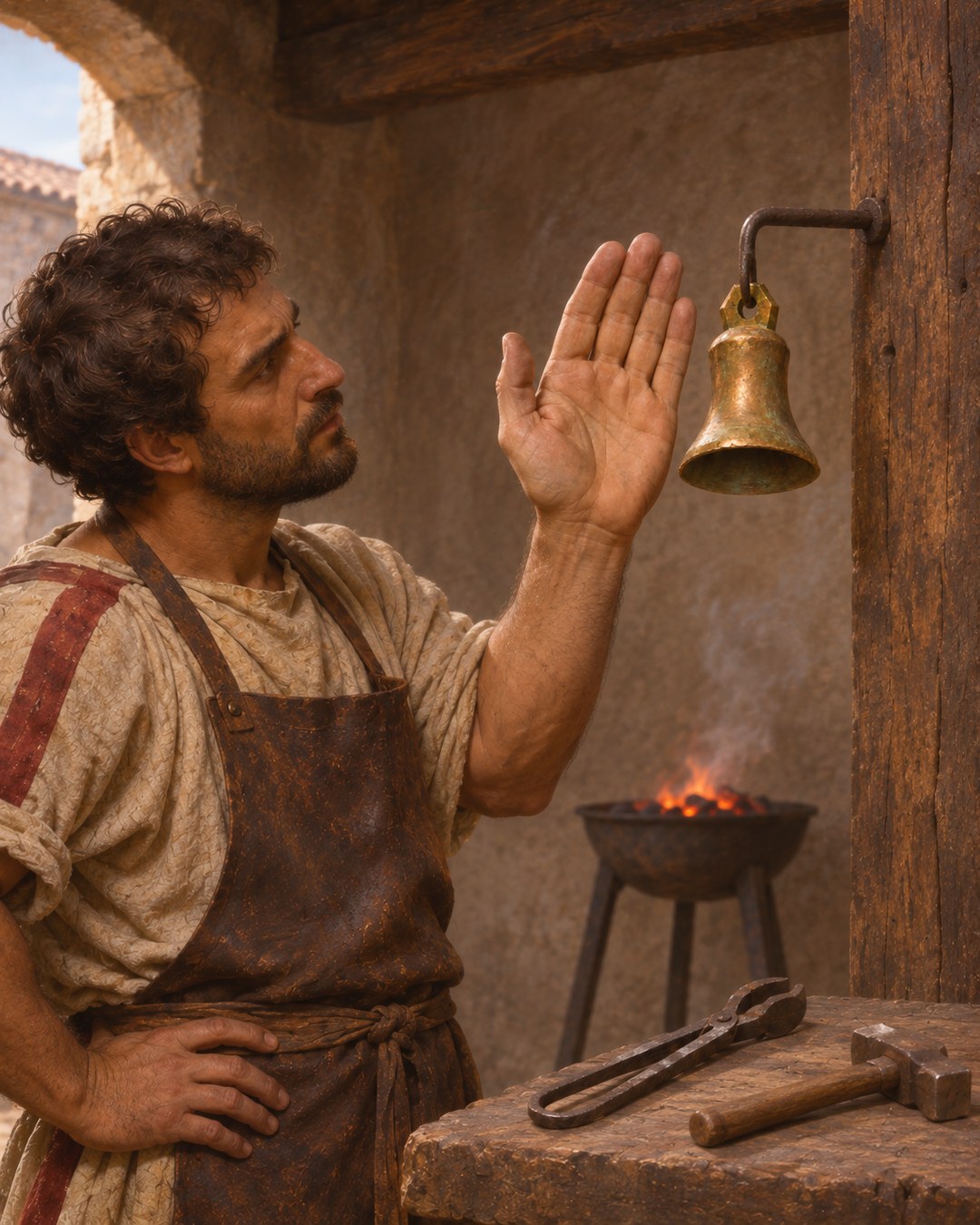
The bell recovered from the Thames does not begin with a sound. Its iron clapper is gone. What remains is a complete copper-alloy body, 122 millimetres high, narrowing through the middle before opening into a mouth 70 by 56 millimetres. London Museum calls the profile tulip-shaped. That description turns a familiar object into a problem of geometry: the bell had to hang, receive a moving clapper, and turn each impact into vibration.
Its maker solved those demands in one casting. The body and polygonal handle were formed together, with a circular hole through the handle for suspension. Nothing in the record identifies the original place where it rang or the people who heard it. The surviving construction tells a more disciplined story. Before a Roman bell could announce anything, metal had to be shaped so that it could hang freely and answer a blow.

The Body Narrowed Before the Mouth Opened
The museum’s “tulip-shaped” label is exact rather than decorative. The body contracts at its middle, then flares toward an elliptical mouth. A circle would have one diameter. This opening has two: 70 millimetres across the wider axis and 56 across the narrower. The bell therefore changed section as it descended, moving from a tighter waist to an oval edge.
Those proportions made the surviving object readable even without the missing clapper. At 122 millimetres high, the bell is not a miniature bead and not a monumental fixture. Its mouth is wide enough to create a distinct open edge, while its height leaves room for a suspended striker to travel inside. That statement describes the mechanical space, not a reconstructed clapper length. The record preserves the cavity but not the moving iron that once occupied it.
The flare mattered because the rim was where the body reached its broadest opening. A clapper moving through the hollow did not need to strike every surface equally. Its path brought it toward the lower wall, where impact could set the cast shell vibrating. The exact tone cannot be recovered from catalogue dimensions alone. Alloy composition, wall thickness, casting variation, damage, and the absent clapper would all affect it. The outline nevertheless shows that sound depended on controlled empty space.
The elliptical mouth also cautions against treating ancient manufacture as crude approximation. The museum does not say whether the oval was intended from the first mould or resulted from later deformation. It records the present geometry. Responsible reading keeps both facts in view: the mouth is measurably unequal, and its original acoustic intention is not stated.
That distinction resembles the care needed when reading the three bells attached to a Roman dice tower. In that mechanism, bells had a documented relationship to a game. Here, the bell’s setting is absent. Its construction can be described without assigning it to a doorway, animal, shrine, workshop, or vessel.
One Casting Joined the Handle to the Shell
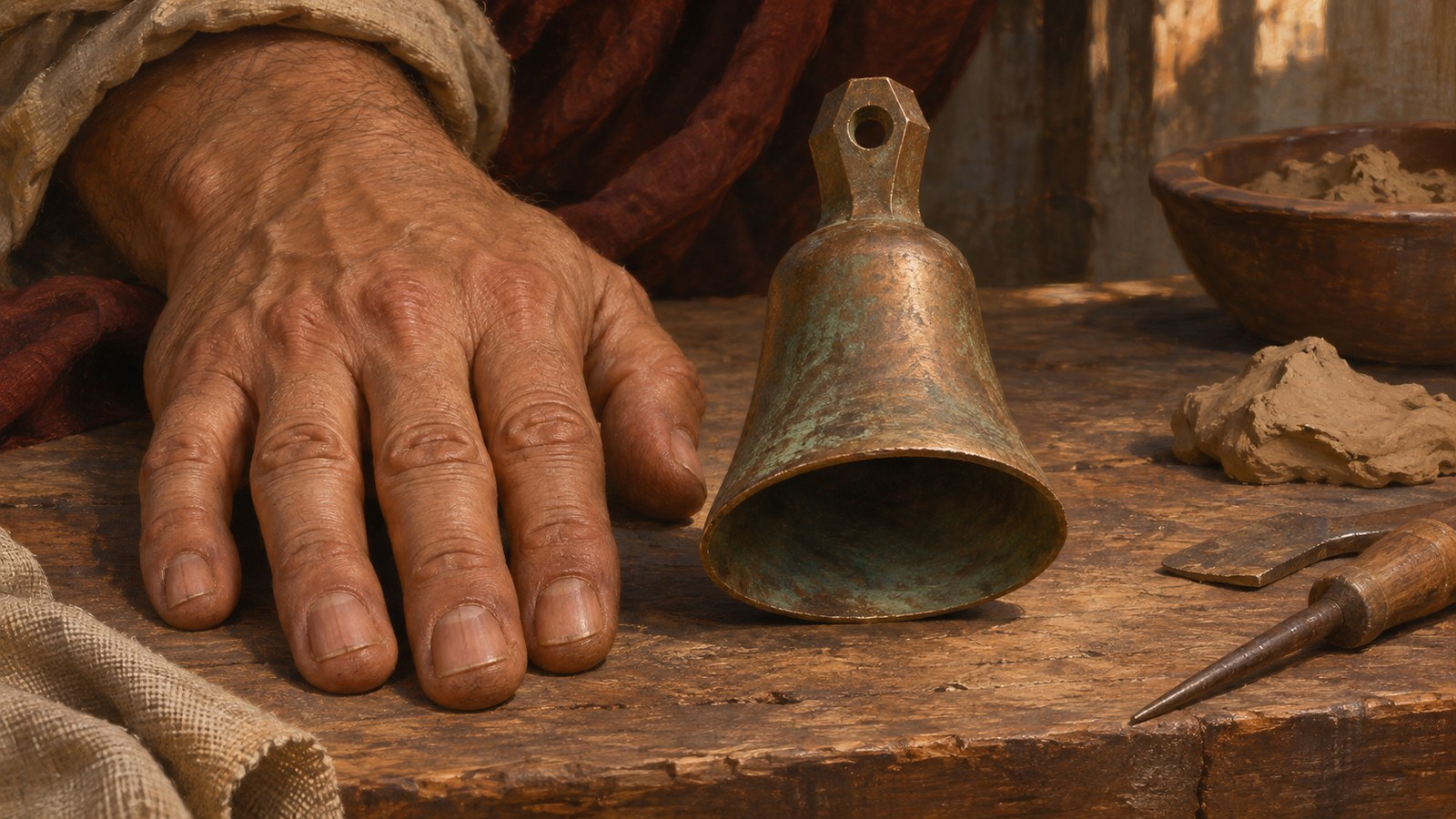
The most consequential phrase in the record may be “cast in one piece.” The polygonal handle was not a loose loop later tied to a finished shell. Its form belonged to the same copper-alloy casting as the body. The maker had to create a mould that accounted for both the hollow bell and the solid structure above it.
That decision concentrated stress at a critical point. A bell hangs from its handle, so the connection between handle and body must carry the object’s weight while allowing the shell below to remain free. A separate handle would introduce a joint. Casting them together removed that particular junction, though the finished object still depended on sound metal around the handle’s base.
The handle was polygonal rather than described as round. Its central hole, however, was circular. The contrast shows two kinds of shaping in one small component: faceted outer faces for the handle and a smooth opening through which a cord, ring, or other suspension element could pass. The museum does not identify what occupied the hole, so the article cannot choose among those possibilities. The hole proves suspension; it does not preserve the suspending material.
A one-piece casting also meant that an error near the top could compromise the whole bell. A poorly formed hole, weak handle, or flawed junction was not easily replaced as a separate fitting. Finishing work could clean surfaces and openings, but the basic relationship between shell and handle had already been fixed when the alloy took the mould’s shape.
The method places the bell beside other Roman objects in which an unassuming connector explains the larger performance. A forge bellows made heat depend on controlled air; this bell made sound depend on controlled suspension. In both cases, the visible result—hotter coals or a ringing shell—rested on a less dramatic piece of construction.
The Missing Iron Clapper Leaves a Material Pair
The bell body is copper alloy, while the lost clapper was iron. A trace no longer occupies the centre as a complete object, but the catalogue identifies what is missing. The original assembly therefore joined two metals with different roles. Copper alloy formed the resonant shell and integrated handle. Iron supplied the moving striker.
The clapper had to be suspended inside the body, yet the record does not describe the internal attachment. It would be tempting to draw a complete chain, pin, or eye from better-preserved bells. That would turn comparison into evidence for this object. The secure statement is narrower: an iron clapper existed, and it is now missing.
Its absence changes the object from instrument to shell. The bell can be measured and its profile studied, but the documented assembly cannot perform as it once did. A modern replacement might make it ring, though that experiment would introduce a new striker with a new mass and contact surface. The resulting sound would belong partly to the reconstruction.
The material pair also explains why different parts could survive differently. Iron and copper alloy corrode in distinct ways, especially after burial or immersion. The publication cited by the museum calls this “A Roman bell from the Thames,” preserving the river in the object’s scholarly identity. The catalogue does not provide a full deposition history, so the Thames should not be turned into a dramatic loss scene. It establishes provenance in the publication title, not the moment or reason the bell entered the water.
What the river left is enough to separate body from voice. The complete shell preserves the architecture of ringing, while the missing clapper marks the part that repeatedly moved. Wear, corrosion, and recovery have divided a once-active pair.
A Published River Find Still Keeps Its Use Open
Angela Wardle published the object in 1980, and the museum’s bibliography identifies the short study and its Thames provenance. Publication made the bell available as more than an isolated catalogue entry. Even so, the online record does not assign a specific original function. “Bell” is secure; the event that required ringing is not.
Roman bells could exist in several settings, but listing possibilities is not the same as identifying this one. The archive already preserves a different pattern in small bells hung at Roman doorways. Shared object type does not prove shared placement. This Thames bell’s 122-millimetre body, polygonal handle, oval mouth, and absent iron clapper must carry the interpretation on their own.
The record’s 80-percent quality figure is catalogue metadata, not a probability that the identification is correct. It should not be read as “80 percent of a bell” or “80 percent certain.” The body is described as complete even while one functional component is missing. Catalogue completeness, object condition, and interpretive certainty are separate questions.
Those separate questions produce a useful final picture. The object was recognizably a bell. Its shell survived complete. It was cast with its handle in one piece. It hung through a circular hole. An iron clapper once moved inside. The mouth flared into a measured ellipse. Each statement is concrete, but none names the listener.
That restraint does not empty the bell of meaning. It restores the sequence by which sound became possible. First came a mould capable of forming shell and handle together. Then came a circular suspension point and an internal iron striker. Hanging freed the body. Movement brought iron against copper alloy. Only after those physical conditions were met could the bell become a signal, warning, ornament, accompaniment, or noise in somebody’s day.
The Thames object therefore survives at the border between mechanism and event. Its geometry still explains how it could ring. Its missing clapper and lost setting prevent us from saying exactly why it did.
Sources
London Museum, “Bell” collection record; Angela Wardle, “A Roman Bell from the Thames” (1980), as cited by the museum.