
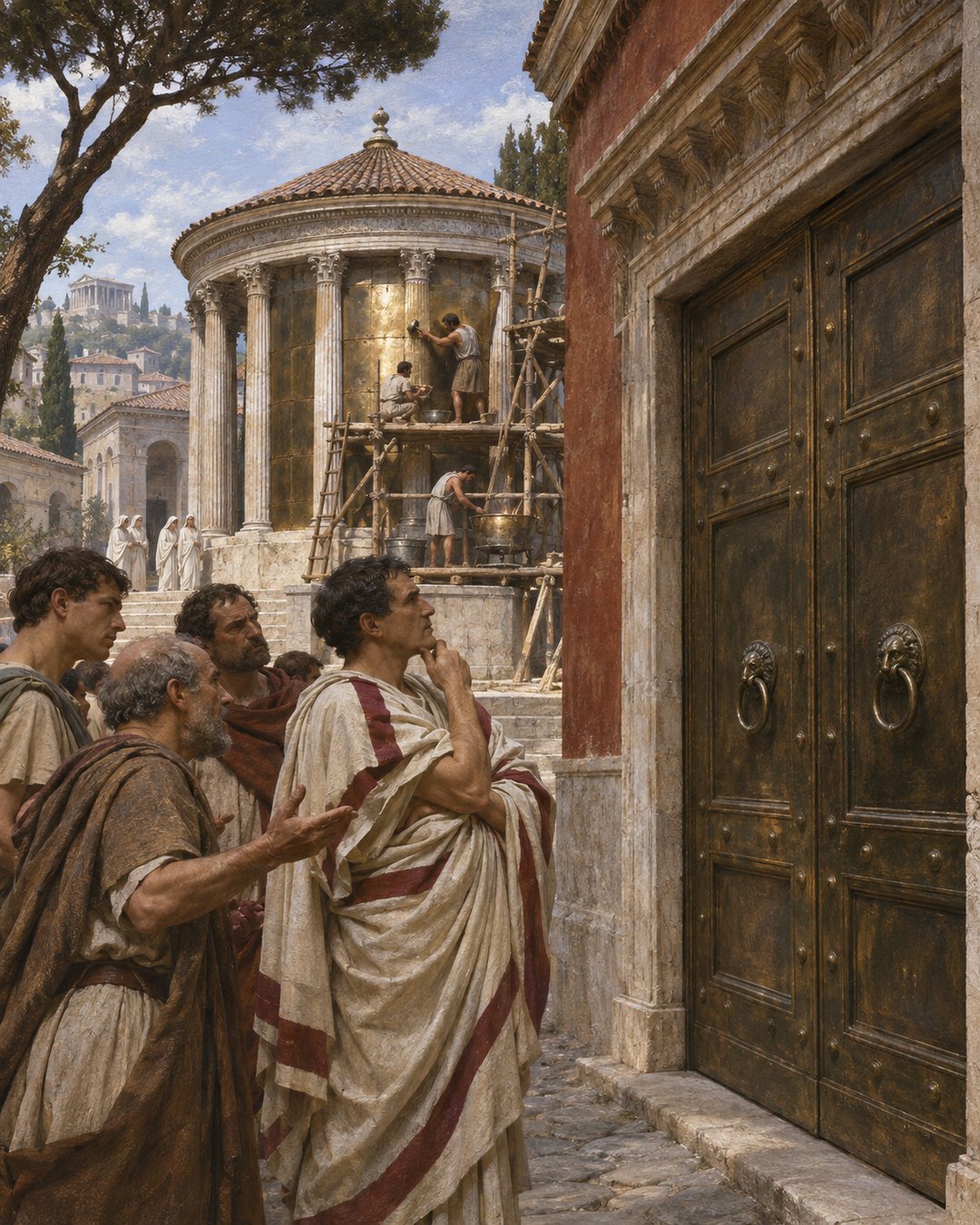
Bronze could make a Roman doorway sacred, monumental or suspicious. Pliny places all three possibilities in one short chapter. Ancient temples used brass for door-sills and even doors. An ordinance ordered a coating of Syracusan metal for the Temple of Vesta. Yet a quaestor also accused Camillus of having brazen doors in his private house.
The contradiction is only apparent. Pliny’s examples do not treat metal as guilty by itself. They ask who displayed it, where it stood and what authority made the display legitimate. The threshold between public honor and private opulence could be made from the same bronze.
Temples Made Bronze Part of the Threshold
Pliny begins with a broad architectural memory: the ancients made temple door-sills and even temple doors of brass. The material occupied the point of passage. A worshipper approaching a sanctuary met metal before entering the sacred interior.
His wording does not identify every temple or establish one standard design. It tells us that the practice was familiar enough to introduce a list of notable uses. Door-sills could take wear underfoot; doors could close, open and reflect light. Both turned a functional boundary into visible expenditure.
The choice also joined durability with ceremony. That is an interpretation of the setting, not a claim that Pliny states a formal theology of bronze. What his text securely establishes is placement. Metal belonged at sacred thresholds and could define them.
Vesta’s cult generated other material disciplines in Roman memory. A pointed container, for example, was said to keep the Vestals’ sacred water from standing still. The bronze chapter offers a larger architectural version of the same historical lesson: objects and materials shaped how sacred practice was encountered.
Vesta’s Coating Required an Ordinance
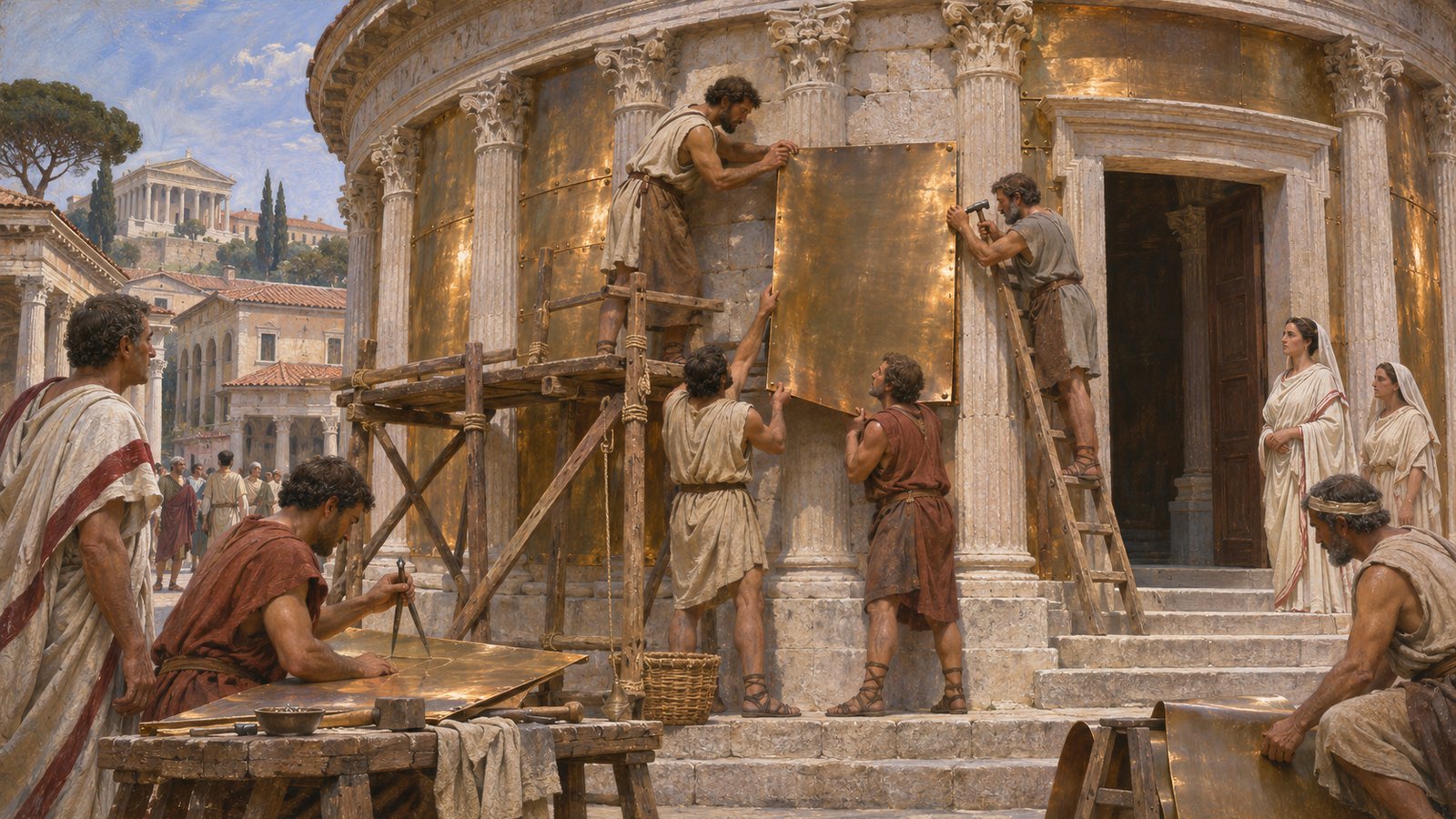
The Temple of Vesta receives the chapter’s clearest public authorization. Pliny says an ordinance was made that the building should be covered with a coating of Syracusan metal. He does not provide the ordinance’s date, sponsor or exact installation method. The supported facts are the command, the temple and the named metal.
“Coating” is crucial. Pliny is not describing a sanctuary cast as one solid object. The metal belongs to a surface applied to architecture. That distinction should guide both reconstruction and visual imagination: panels or sheathing over a built form are plausible; a fantasy building made entirely from molten bronze is not.
The ordinance also separates this display from private choice. Someone did not merely decide that reflective metal would look impressive. Civic authority attached the material to one of Rome’s central cult sites. Authorization made the opulence public and sacred.
Pliny gives no reaction from worshippers, no price and no maintenance schedule. Those absences prevent us from turning the coating into a complete building account. Still, the legal verb matters. The city’s relationship to bronze was mediated by decisions as well as taste.
Public Columns Carried Metal into Civic Memory
Two more examples broaden the map. Cneius Octavius, who had won a naval triumph over King Perseus, erected a double portico at the Flaminian Circus. Pliny says it was called “Corinthian” because of the bronze capitals on its pillars.
The name therefore arose from a visible architectural feature. The metal was not hidden reinforcement. It crowned supports and supplied the label by which the portico was remembered. Military success, public building and material prestige met in one structure.
Pliny then notes that pillar capitals placed by Marcus Agrippa in the Pantheon were made of similar metal. He does not say the two projects were identical, and “similar” should not be inflated into an exact alloy recipe. The comparison shows a recurring public vocabulary: bronze at the upper edge of columns signaled distinction.
Rome often made civic memory legible through physical arrangement. The city could also police that arrangement, as when censors removed unauthorized statues around the Forum. In both cases, public display depended on more than the value of an object. Place and sanction decided whether it belonged.
Camillus’s Doors Moved the Same Metal into a Charge
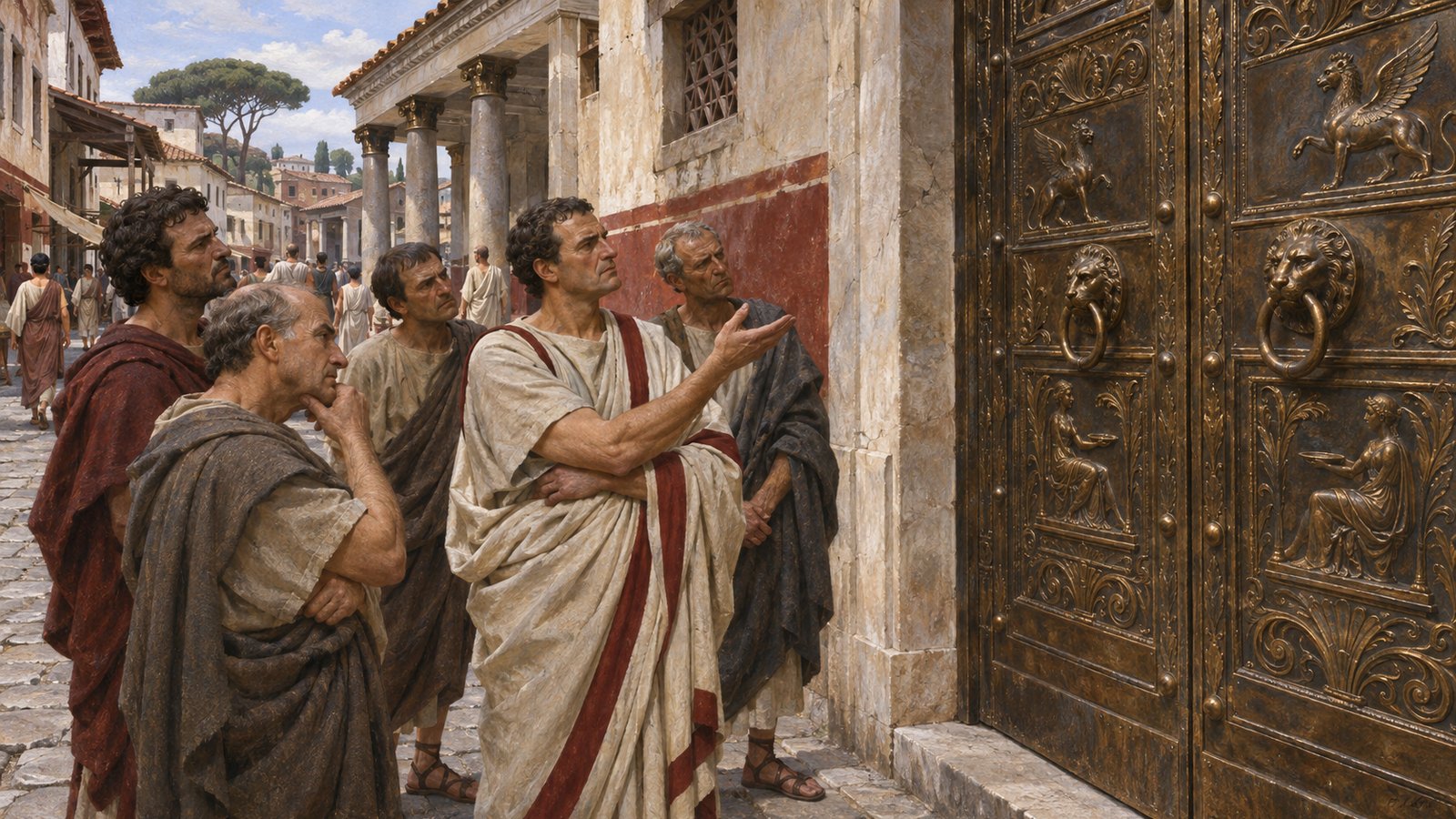
Pliny pivots sharply from public monuments to private wealth. He says the opulence of individuals was “wrested” to similar purposes, then names Spurius Carvilius, a quaestor, among charges brought against Camillus. One accusation was that Camillus had brazen doors in his house.
The source does not preserve the full indictment, explain the legal provision or tell us the outcome of this particular charge. It would be wrong to claim that all private bronze doors were illegal. Pliny gives one politically charged example, not a universal building regulation.
But his placement makes the contrast unmistakable. Temple doors introduced the chapter as accepted ancient practice. A private house with brazen doors closes it as an emblem of opulence. The object has barely changed. Its institutional setting has.
A sacred threshold could represent collective expenditure and authorized honor. A domestic threshold could turn the same gleam toward one owner. In Pliny’s narrative, that shift was enough for architecture to become evidence.
Bronze Needed a Public Claim
The chapter’s examples form a progression: temple thresholds, a triumphal portico, Vesta’s metal coating, Agrippa’s Pantheon capitals and Camillus’s house. The sequence moves from customary sacred use through named public commissions to contested private display.
No simple rule such as “public bronze good, private bronze bad” can capture every Roman case. Pliny does not provide one. His evidence supports a narrower conclusion: monumental metal acquired meaning from authorization, location and audience.
That conclusion also explains why the doors matter so much. A door is both structure and announcement. It tells a visitor where one domain ends and another begins. When temple doors shone, the threshold belonged to the gods and community. When Camillus’s doors shone, a quaestor could present the same material as personal excess.
The Temple of Vesta and the private house were not separated by metallurgy. They were separated by a political judgment about who could claim splendor. Pliny’s compact list lets us watch that judgment settle on the surface of the city.
The named varieties of metal reinforce that point without allowing false precision. Pliny calls Vesta’s coating Syracusan and connects Agrippa’s capitals with similar material; he calls Octavius’s capitals bronze and Camillus’s doors brazen. The passage does not give recipes that would let us reconstruct each alloy. What it gives is a Roman vocabulary of prestige, attached to surfaces that citizens could see.
Visibility unites every example. A sill marks entry underfoot. A door faces the street or sanctuary approach. A capital crowns a column. A coating changes the exterior presence of a temple. None of these uses hides valuable metal deep inside a wall. Pliny has selected architectural positions where material announced itself, which helps explain why a private door could attract political attention.
The offices and honors in the passage matter too. Octavius had a naval triumph; Agrippa placed capitals in the Pantheon; an ordinance authorized Vesta’s coating; Carvilius acted as quaestor when accusing Camillus. Public role surrounds the approved projects, while legal accusation surrounds the domestic one. Pliny does not state a single constitutional rule, but his arrangement makes authorization part of the visual story.
Camillus’s case must nevertheless remain bounded. The chapter says brazen doors appeared among other charges. It does not preserve a verdict, prove that the doors alone carried a penalty or show that every elite house faced the same objection. Their value as evidence lies in the fact that they could be mentioned at all. Domestic architecture had become legible as a claim about wealth and status.
Sources
Pliny the Elder, Natural History, Book 34, chapter 7.