
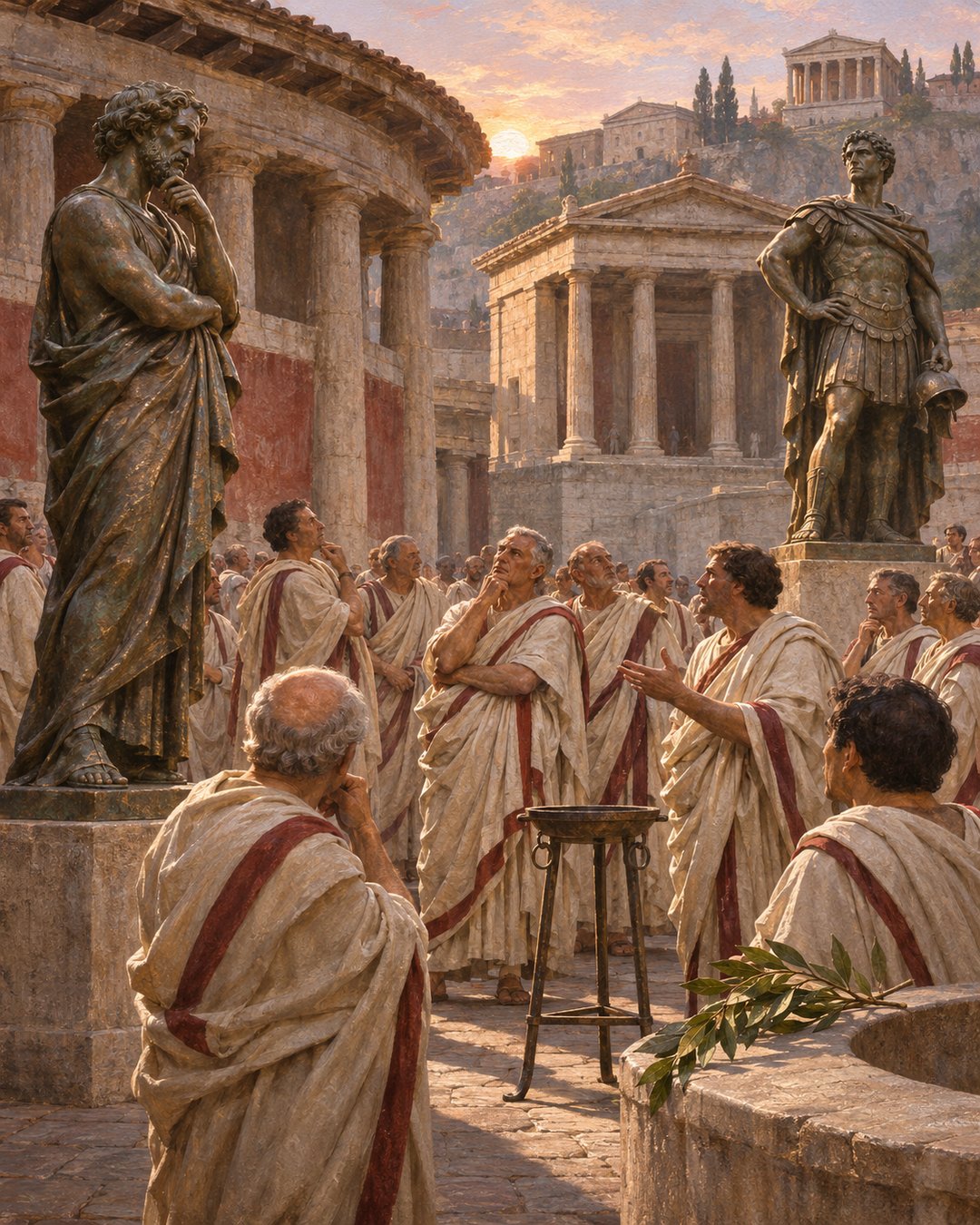
During the Samnite War, Rome received a strangely open instruction. According to Pliny, Pythian Apollo ordered the city to place the bravest and the wisest of the Greeks somewhere conspicuous. The oracle supplied two roles but no names. Rome had to turn divine categories into human choices.
The answer was Alcibiades and Pythagoras. Their statues stood at corners of the Comitium, the civic space beside Rome’s political institutions, until Sulla built a senate house on the site. Pliny preserves the installation, but he also preserves an argument. He thought both choices were debatable.
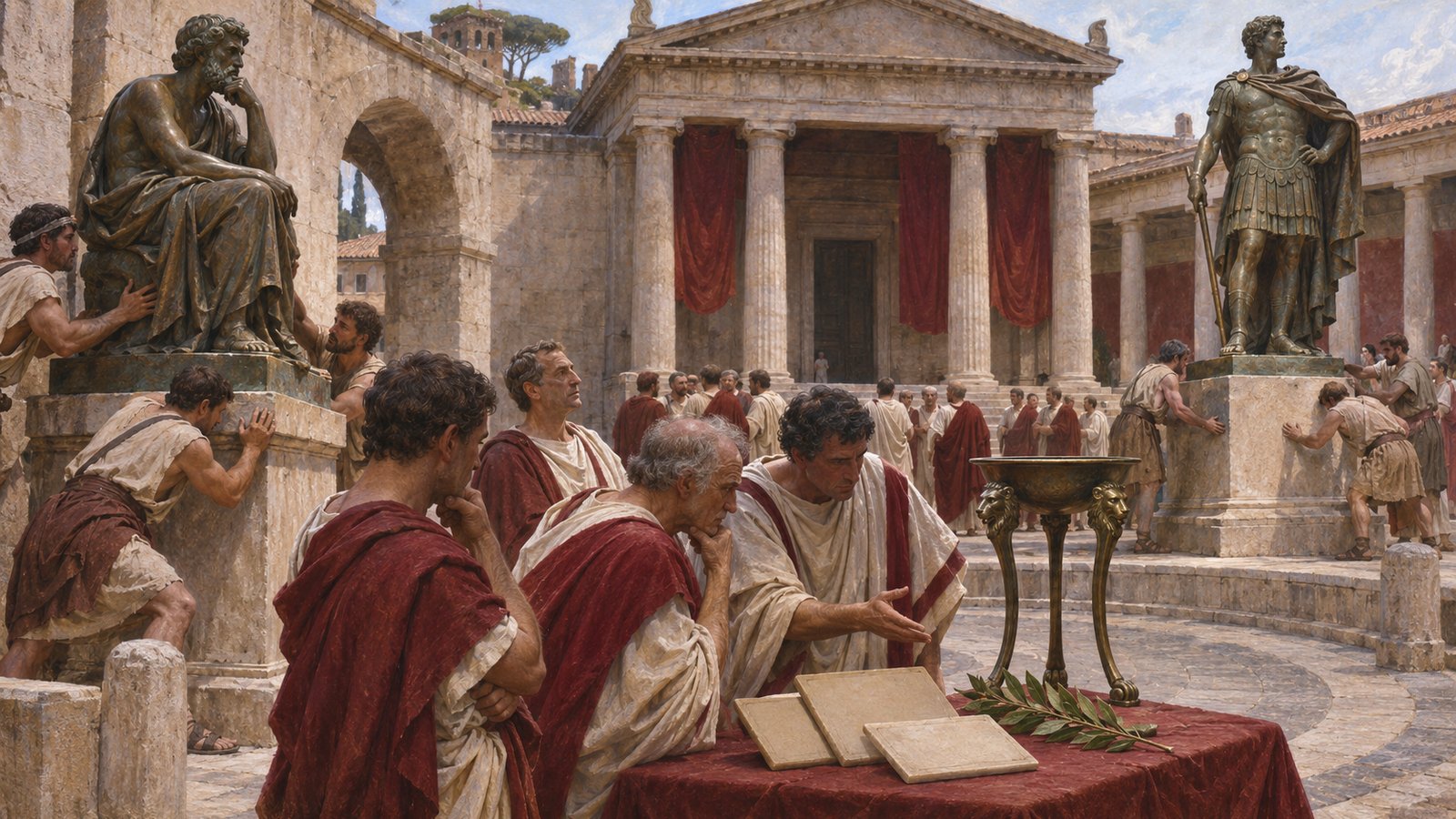
An Oracle Supplied Two Empty Roles
Pliny’s wording begins with command rather than admiration. The statues were erected “in obedience” to Pythian Apollo. That distinction matters. Rome was not simply collecting Greek celebrities or decorating an open square. In the story as Pliny gives it, a wartime instruction demanded visible embodiments of wisdom and bravery.
The command came during the Samnite War. Pliny does not identify the exact consultation, explain who carried the response or describe a dedication ceremony. Those gaps should remain gaps. The supported sequence is enough: war created the setting, Apollo defined the categories, and Romans selected the men.
A category can sound precise until it must be given a face. “Wisest” requires a judgment about what wisdom means. “Bravest” requires another about the kind of courage a city wishes to honor. The oracle moved responsibility back to Rome at the moment of selection.
Pythagoras already carried several traditions into Roman reading. Elsewhere, Aulus Gellius could still debate his discipline, as in the question of whether beans truly belonged outside Pythagoras’s diet. The Comitium statue did something different. It compressed a disputed intellectual legacy into one public answer: this is wisdom.
Pythagoras Beat Socrates in Rome’s Answer
Pliny openly wonders why the Senate preferred Pythagoras to Socrates. His surprise is part of the evidence, not a defect to smooth away. The ancient source gives us both the official selection and a later Roman author’s dissatisfaction with it.
His comparison invokes another divine judgment. Pliny says Socrates had been preferred to all other men for wisdom by the god himself. If that standard carried authority, Rome’s Pythagorean choice seemed inconsistent to him. Yet he does not supply the Senate’s reasoning, so no secure explanation can be recovered from this passage alone.
That absence prevents easy answers. Perhaps different traditions of wisdom competed; perhaps the selectors valued a type of teaching they associated with Italy; perhaps Pliny’s report telescopes a more complicated story. Those are possibilities, not facts in his text. The firmer point is that Roman public commemoration could remain contestable even when linked to an oracle.
The statue made a decision durable without making it unanimous. Bronze could settle the appearance of the square while leaving the argument alive.
Alcibiades Made Bravery Look Politically Difficult
Pliny is equally skeptical about Alcibiades. He asks how the Athenian could be preferred for valour to so many heroes. Then he names Themistocles, whom he believed excelled in both the qualities at issue.
Again, the passage does not explain the original Roman vote. Pliny’s comparison instead exposes how public virtue was edited. Alcibiades could embody audacity and martial distinction, but his career also made him a difficult figure to turn into a simple moral label. Pliny does not narrate that whole career here, so the article need not either. His question alone shows that “bravest” did not produce an uncontested answer.
The pairing creates a second tension. Apollo asked for two superlatives, and Rome responded with two individuals whose reputations could not be exhausted by a single word. The statues reduced them to roles; Pliny restored the friction.
Roman authorities repeatedly tried to control which honors occupied civic space. A later episode in the same broad history saw censors remove unauthorized statues around the Forum. The Pythagoras and Alcibiades pair reveals an earlier version of the same power: not only clearing memory, but choosing which memory could stand.
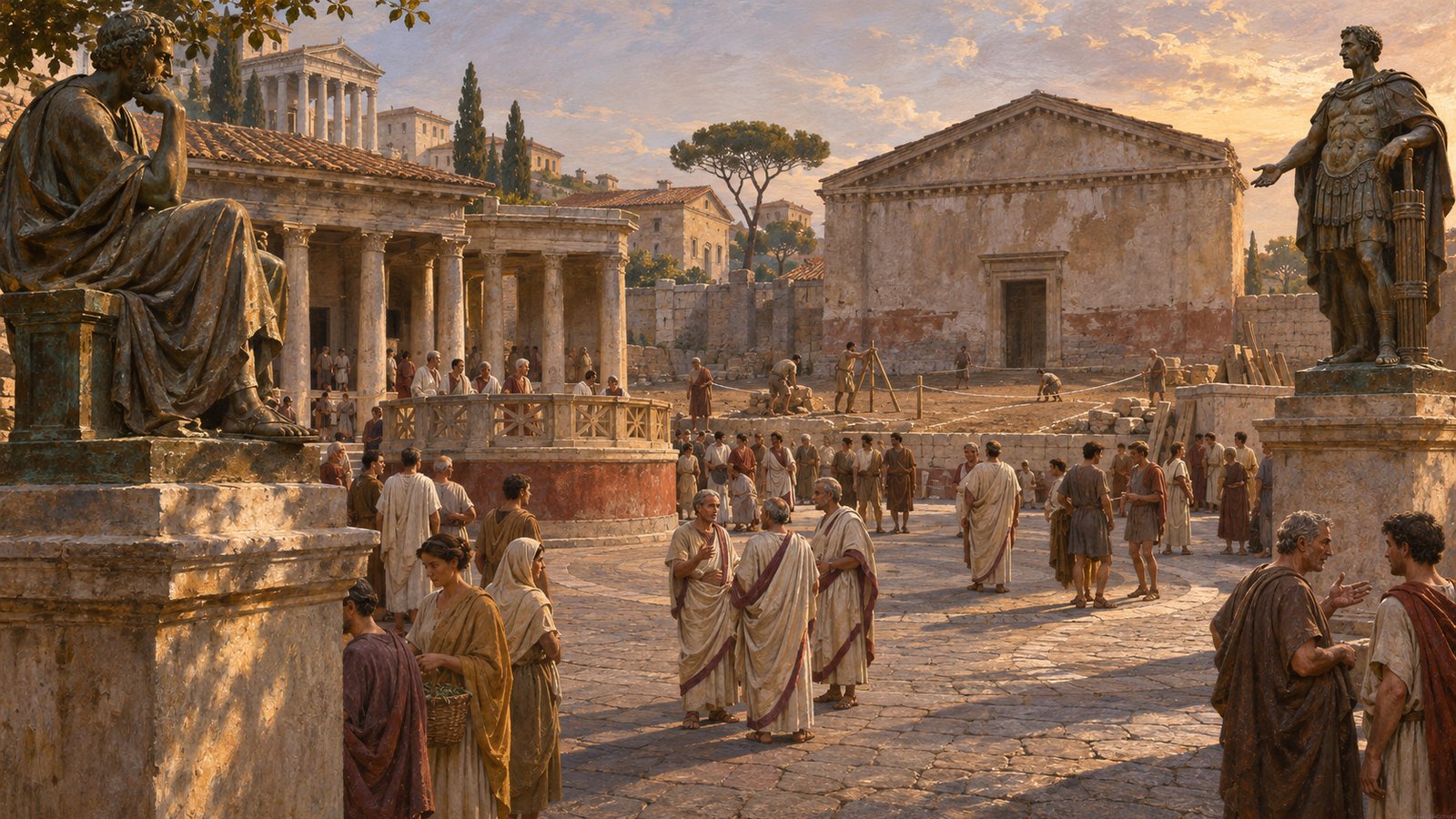
The Comitium Turned Selection into Public Memory
Location gave the answer force. Pliny places the statues in corners of the Comitium and says Apollo had requested a conspicuous spot. These were not private portraits kept in a collector’s room. Their categories faced citizens in a political landscape.
The two positions also let the pair operate together. Wisdom and bravery became separate figures within one civic field. A passer-by did not need to read an argument; the arrangement itself stated that Rome had answered both halves of the command.
Pliny adds a general observation about elevated statues. Figures raised on columns were lifted above other mortals. He connects arches with the same meaning and calls the device a Greek invention. The physical height of an honor therefore translated rank into space.
He does not explicitly say these two statues stood on columns, so the general remark should not be forced into their exact construction. But it clarifies his way of seeing monuments. Placement, height and visibility were not neutral supports. They manufactured distinction.
Sulla’s Senate House Ended the Arrangement
The statues remained until Sulla built the senate house on their site. Pliny’s endpoint is architectural. He does not say that a philosophical debate defeated Pythagoras or that a new verdict on courage displaced Alcibiades. A remade political landscape ended their occupation.
That detail turns the story into a miniature history of Roman memory. An oracle prompts a selection during war. The answer is fixed in a public place. Later readers dispute the names. Finally, new construction changes what can remain visible.
The selections were neither timeless nor meaningless. They lasted long enough for Pliny to explain why they mattered, yet not so permanently that Sulla’s project could not overtake them. Rome answered Apollo in bronze, but Rome’s political building program controlled how long the answer stayed in the square.
Pliny leaves us with no clean winner in his debate. Pythagoras and Alcibiades were the chosen men. Socrates and Themistocles were his counterclaims. The historical interest lies precisely in that split between public decision and surviving criticism.
The two categories also asked Rome to compare unlike lives. Wisdom was not an office with a list of holders, and bravery was not a single recorded act. Each label gathered stories, reputations and later judgments. By choosing one Greek for each, Roman decision-makers converted comparison into a monument. Pliny’s objections reverse that process: he opens the categories again and asks readers to compare.
The Comitium made that disagreement public even when no debate was taking place. A statue can keep asserting a selection after the selectors and their reasons are gone. Citizens encountered the chosen bodies, while alternative candidates such as Socrates and Themistocles remained absent from the arrangement. Pliny’s text restores those absences without pretending that his preferred names replaced the monuments.
The oracle’s role does not remove human responsibility. Apollo, in Pliny’s report, requested the bravest and wisest Greeks; he did not name Alcibiades and Pythagoras. The command gave the project religious authority, but the gap between category and individual remained a Roman problem. That is why Pliny can respect the story’s divine origin and still criticize the Senate’s answer.
Time added another layer. The statues survived long enough to become features of the political landscape, then disappeared from that location when Sulla’s senate house occupied the site. Their removal does not prove that Rome formally reversed the oracle’s answer. It shows that civic space could overwrite even a religiously prompted commemoration. Buildings reordered memory by deciding what could still be seen.
Sources
Pliny the Elder, Natural History, Book 34, chapter 12.