
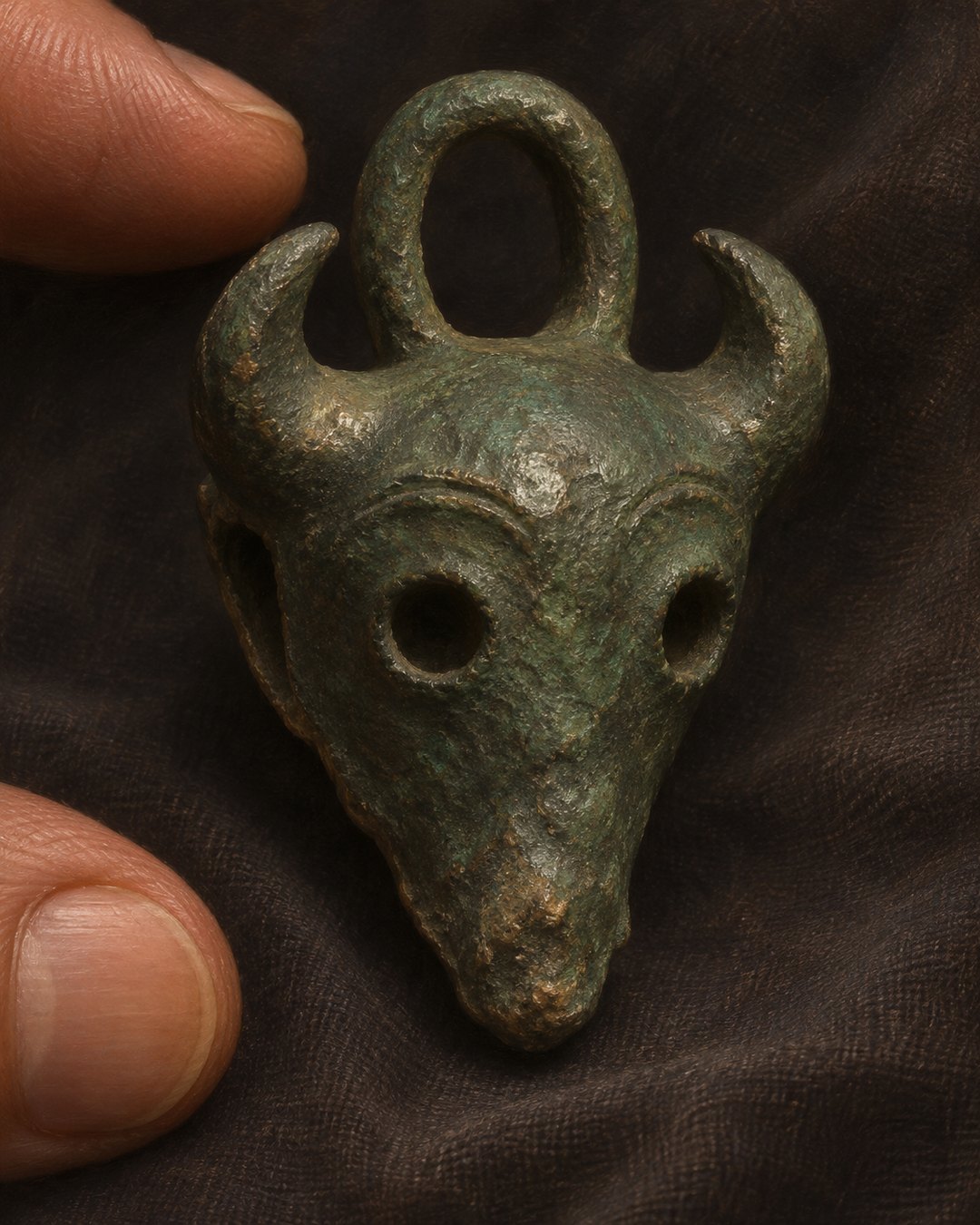
A bucket mount found in Staffordshire turns an ordinary vessel into a close study of Roman-British metalwork. The surviving copper-alloy fitting is only 48 millimetres long, yet it presents a bull’s head with curved horns, hollow eyes, arched brows, and a loop rising from the crown. Its back is hollow. The face ends in a damaged point. These features were not assembled merely to make a miniature animal: the loop and shell-like reverse helped the fitting do work on the side of a bucket.
The Portable Antiquities Scheme dates the object to AD 43–100 and records it as an incomplete cast bucket mount. The description is unusually useful because it binds image to mechanism. Horns and brows created a recognizable face; the upper loop gave the vessel a place for attachment or suspension; the hollow back kept the mount from becoming a solid block of bronze.
The Face Was Built around Two Curving Horns
In plan the mount is sub-triangular. In section it resembles a shallow bracket, open at the back. Two sub-triangular horns project from either side of the face. Each is about 10 millimetres long. They first extend outward and then curve inward toward the forehead, giving the small mount its clearest bovine feature.
Beneath the horns, two circular hollows mark the eyes. Both are incomplete and corroded, but their original diameter is estimated at about 5 millimetres. The eyes stare outward rather than being rendered as solid knobs. Above them, an incised eyebrow curves from the space between the eyes over each socket.
The composition therefore depends on a compact stack of features. Horns occupy the upper corners. Brows organize the centre. Empty eyes sit about 14 millimetres below the top. The lower face runs another 11.5 millimetres before ending in a worn and broken point. No nose or mouth now survives clearly enough to describe.
A Loop Turned the Animal into Hardware
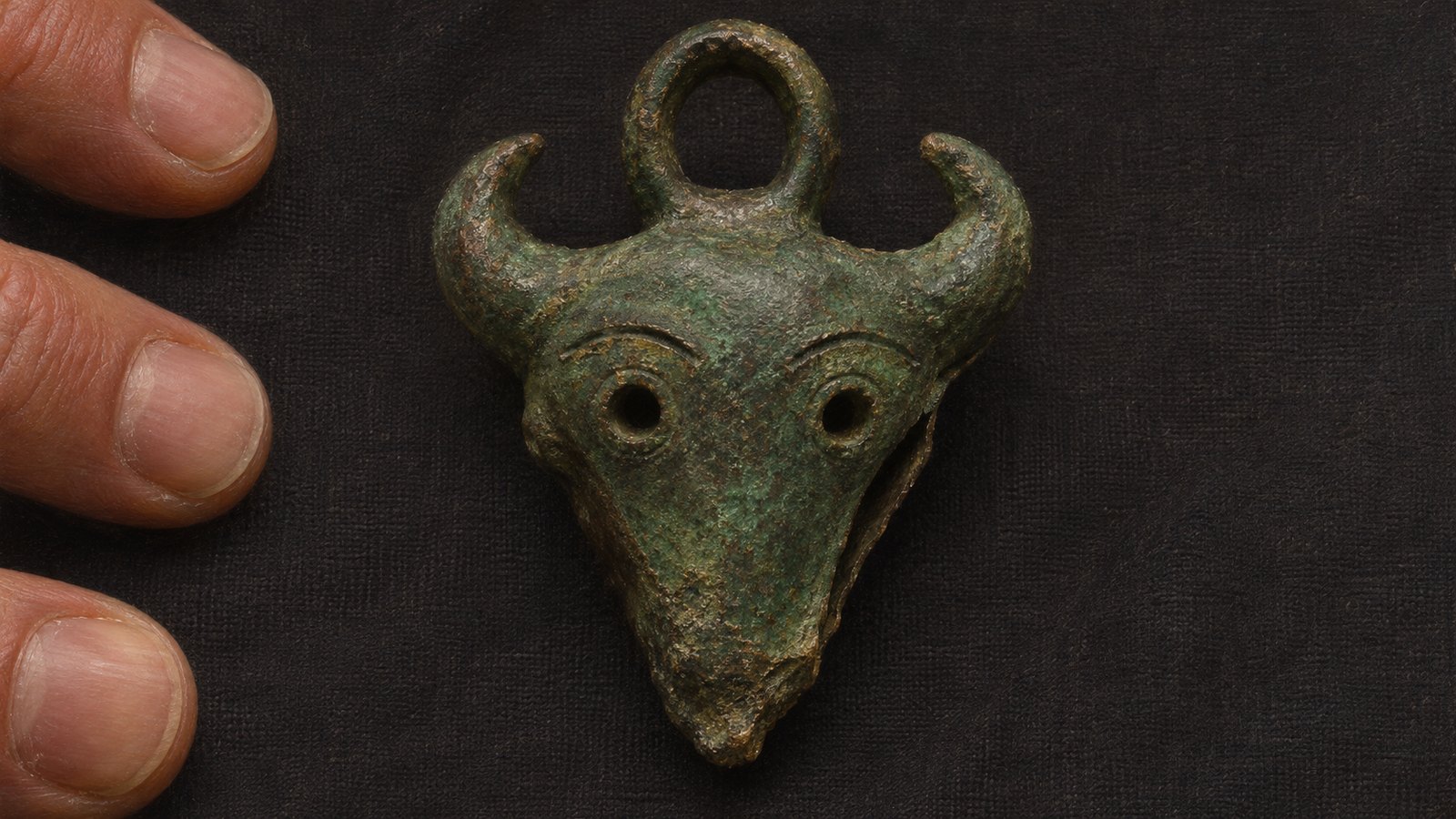
At the top of the head rises a circular loop with a D-shaped section. The loop is 14 millimetres long, 20 millimetres wide, and 5.5 millimetres thick. Its inner opening measures 10 millimetres across. This is the part that most directly explains why the face belongs to a vessel rather than standing alone as a figurine.
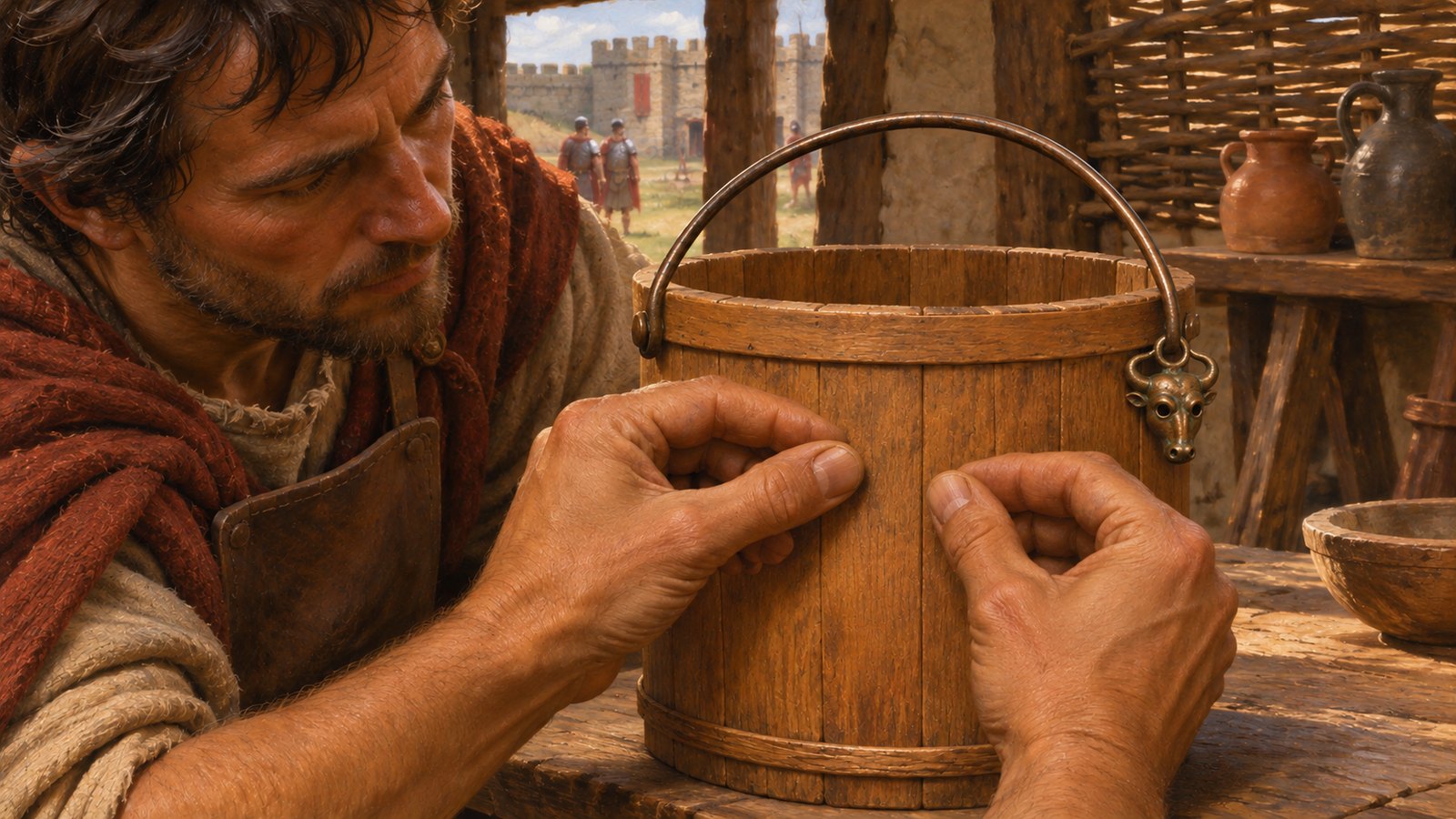
The record says the loop is where the mount would have been attached on the side of the bucket. A handle or related fitting could engage with that elevated opening while the decorated shell sat against the vessel wall. The design concentrated strain above the face, leaving the horns and brows visible below.
This arrangement differs from the lifting system examined in the bronze buckets raised by an iron chain. That mechanism moved water through repeated links and suspended vessels. The Staffordshire mount operates at the scale of one bucket: it joins the visual identity of the container to the point where carrying hardware met its side.
The Hollow Back Saved Metal and Fitted a Surface
The reverse is mostly hollow. That construction reduced the amount of copper alloy required and made the mount more compatible with the curved wall of a vessel. A fully solid bull’s head of the same external size would have added weight without improving the visible face. Casting a shell allowed relief on the front and space behind it.
The whole object weighs 29.6 grams. Its maximum dimensions are 48 by 44 by 19.5 millimetres. Those figures keep the animal imagery in scale. This was not a large sculptural head fixed to monumental furniture. It was a palm-sized fitting whose deepest projection remained under two centimetres.
The measurements also describe how tightly the sculptural and mechanical parts overlap. At 20 millimetres wide, the loop occupies almost half the mount’s total width of 44 millimetres. Its 10-millimetre inner opening is comparable to the length of either horn. The builder did not attach a tiny, inconspicuous eyelet behind a decorative mask. The suspension feature rises visibly from the same compact silhouette as the animal.
The incomplete lower face makes the upper half even more important. The horns, eye sockets, eyebrows, and loop all survive within a short vertical interval. They provide enough repeated symmetry to identify a face even though corrosion has opened the eyes and removed the lower details. This is a useful reminder that object recognition can depend on arrangement rather than on a complete portrait.
The dark green patina and worn, corroded condition belong to the mount’s archaeological history. They should not be projected backward as its original appearance. When newly made, the copper alloy surface would have read differently, and the contrast between recessed eyes, incised brows, and projecting horns would have been sharper.
A Caerleon Parallel Preserves More of the Face
The database record compares the mount with a similar example from Caerleon in south Wales. The Caerleon piece is more elaborate, preserving additional ears and nasal features. Even so, its hollow back and facial structure resemble the Staffordshire find. The comparison supports identification without pretending the two pieces are identical.
Geography adds another bounded detail. The surviving mount was recorded in the Lichfield area of Staffordshire, while the cited parallel came from Caerleon in Newport. The separation does not prove a shared workshop or distribution route. It does show why a type cannot be defined from one county alone: related construction and facial choices can be compared across different Roman-British findspots without collapsing them into one provenance.
This is where damage becomes informative. The Staffordshire mount’s pointed lower end is worn, broken, and corroded, so the missing nose cannot simply be painted back in. The Caerleon parallel demonstrates that related bull-head mounts could carry more anatomy, but it does not authorize copying every feature onto this object.
Comparison works best as a boundary. It strengthens the interpretation of the hollow shell, loop, horns, and eyes as a coherent mount type. It also highlights what has been lost. The result is more precise than either extreme: calling the fragment meaningless, or reconstructing a complete bull solely from a better-preserved neighbour.
The Bucket Carried an Image at Its Point of Strain
Roman metalwork often placed decoration where an object had to bend, pivot, grip, or carry weight. The bull’s head mount follows that logic. Its loop is functional hardware, but its position above the forehead makes it look as if the animal itself supports the handle. Engineering and image occupy the same few centimetres.
The choice of a bull gave the fitting immediate visual force, although the record does not name a god, owner, workshop, or ritual use. A bull image on a bucket should not automatically become a cult object. The secure claims are narrower: the face has horns, hollow eyes, incised brows, a suspension loop, and a hollow reverse; it belongs to the early Roman-British period proposed by the record.
The casting also belongs beside other Roman techniques that made small fittings visually emphatic. In lost-wax bronze casting, a model could preserve relief and fine transitions before the original wax vanished. The bucket mount’s exact production sequence is not specified, but its undercut horns, hollow form, and facial grooves show why casting served hardware that also had to be seen.
What survives is a compact argument in copper alloy. A 10-millimetre opening accepted the carrying system. A hollow back met the vessel. Two 10-millimetre horns bent inward. Five-millimetre eyes and arched brows made the fitting look back at the person lifting it. The bucket’s point of strain became its most memorable face.
Sources
Portable Antiquities Scheme record for WMID-C96A57.