
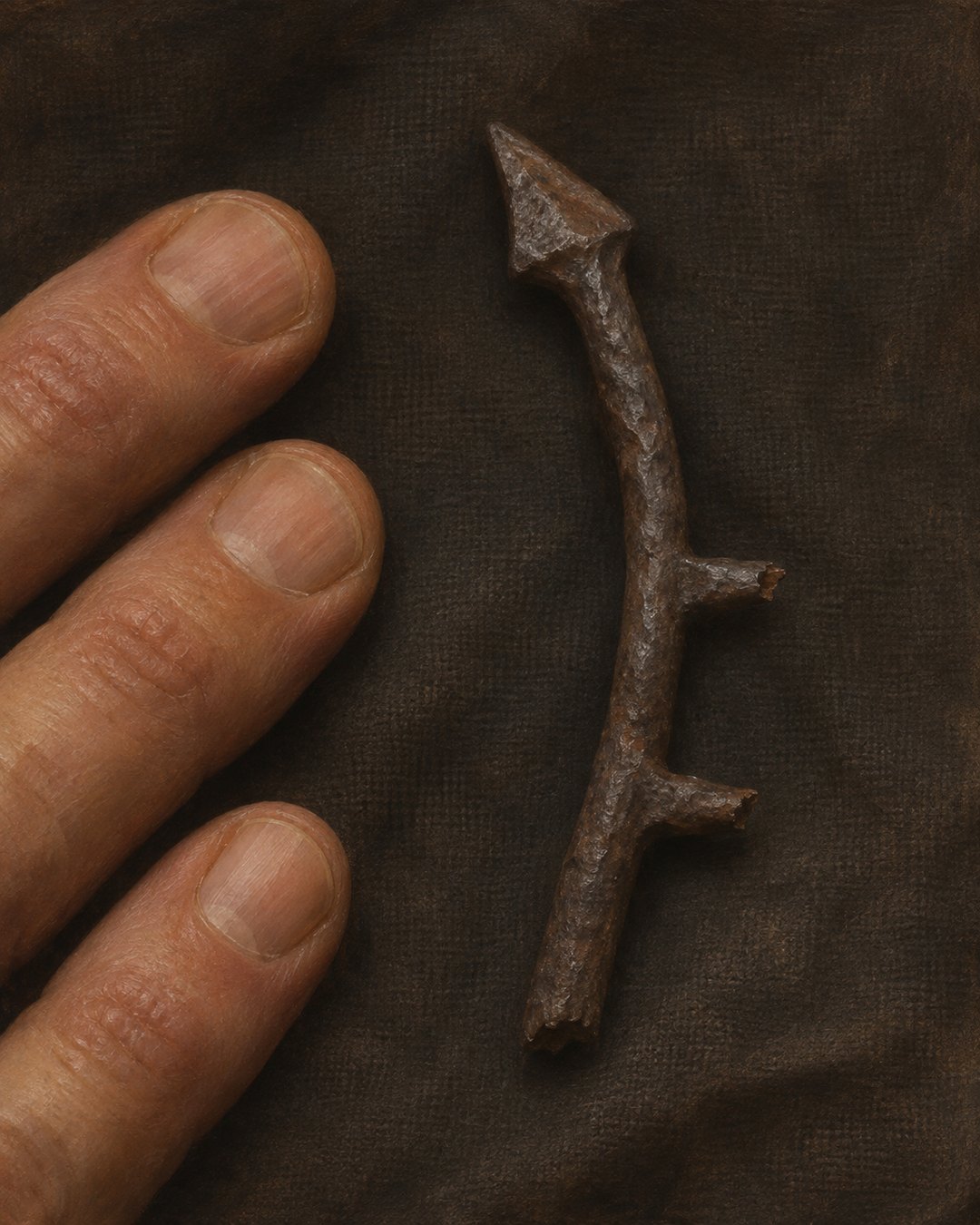
An iron fragment from Worcestershire preserves only the business end of a tool: a slender stem expanding into two damaged points. The Portable Antiquities Scheme identifies it as the tip of a probable flesh hook, perhaps Roman, while also recording the reasons for caution. Its form fits a tool used to lift pieces of meat from a cauldron, but the stem is unusually slight and long-lived functional shapes do not always belong neatly to one period.
This makes the fragment valuable for more than a reconstruction of dinner. It shows how archaeologists reason from incomplete working edges. Measurements, tooth arrangement, corrosion, and published typology support an identification. Missing metal and chronological overlap prevent certainty. The object is most informative when both halves of that judgment remain visible.
Two Points Survived at Right Angles to the Stem
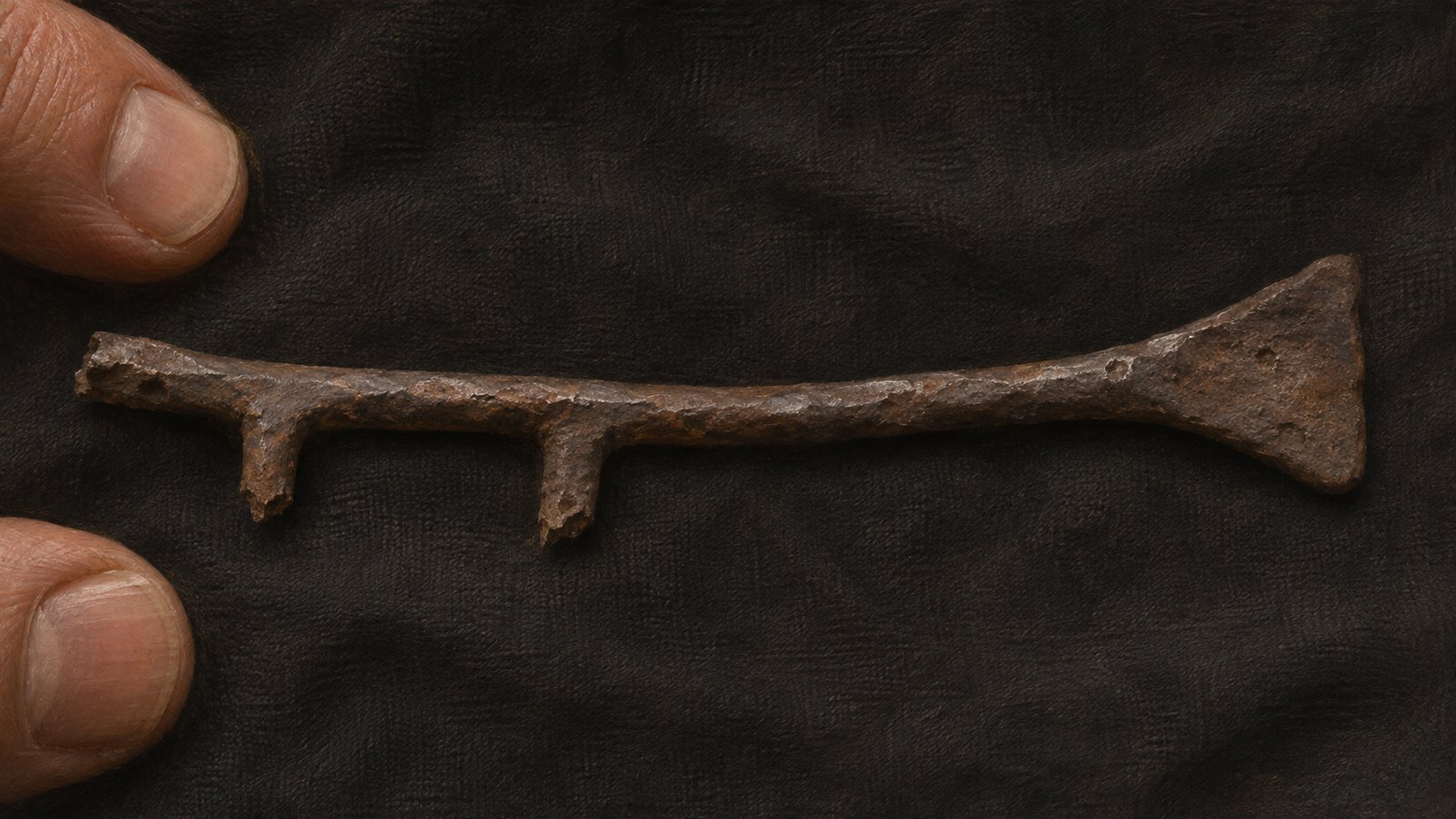
The wrought-iron fragment is irregular in plan and cross-section. A slender rod expands at its lower end into a triangular junction. From that expansion, two points extend at right angles to the stem. Both are damaged and incomplete.
The surviving piece measures 51.84 millimetres long, 15.51 millimetres wide, and 14.90 millimetres thick. The metal itself is 5.47 millimetres thick, and the fragment weighs 5.9 grams. Those numbers describe a small broken tip, not the complete length of a utensil.
The measurements also prevent the reconstruction from drifting into a heavy carving fork. A working fragment barely over five centimetres long and under six grams belonged to a slender implement. The 15.51-millimetre width is concentrated where the teeth spread apart; it does not describe a broad blade running the length of the stem.
At the upper end, the rod curves slightly in the same direction as the lower points. Because the break interrupts the stem, the original handle and full reach are unknown. The lower points might once have continued as straight teeth, curved as hooks, or joined into a ring; the record leaves that detail unresolved.
A Flesh Hook Reached into a Cauldron
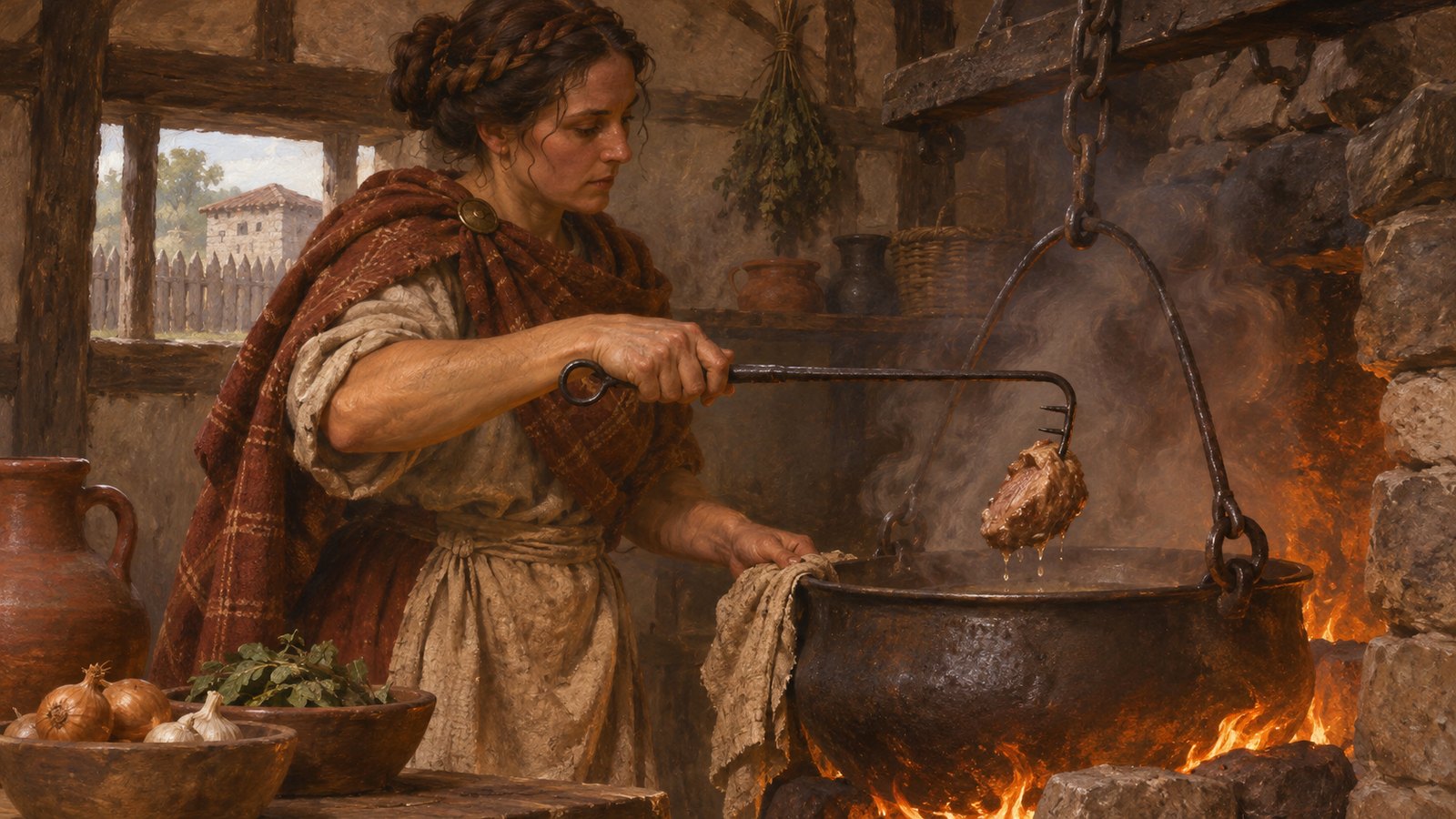
The functional interpretation is direct. A flesh hook was a straight rod furnished with teeth, usually hooked at the far end. It let a cook retrieve pieces of meat from stew in a cauldron without pouring away the liquid or putting a hand near the hot vessel.
The tool converted reach into selection. A ladle lifts broth with whatever it contains. A toothed hook can catch one solid piece and draw it upward. The surviving pair of points would have given more purchase than a single smooth rod, especially when meat moved in hot liquid.
The damaged geometry also explains why the record cannot settle whether the lateral points were straight, hooked, or connected. All three possibilities begin from the same surviving expansion. An illustration that chooses one would go beyond the fragment. A responsible reconstruction can show the two existing teeth and let the missing continuation remain outside the frame.
This mechanism belongs beside other Roman kitchen practices in which a small tool controlled texture and presentation. The Lost Eagles has examined how eggs and steam transformed anchovies at dinner. The flesh hook concerns an earlier and less theatrical moment: separating a chosen piece from a communal cooking vessel.
The Tooth Pattern Fits Manning Type 2
The record compares the fragment with W. H. Manning’s Type 2 flesh hook. In that form, a pair of teeth sits on either side of the stem tip, and the stem itself often continues as a third tooth. The Worcestershire fragment preserves the two lower teeth but not enough metal to show a complete central point.
The published Type 2 example, numbered P38, came from Tokenhouse Yard in London. That site produced a large quantity of Roman material along with some later material. The context supports a Roman date for the comparison, but it does not turn every similar fragment into a securely dated Roman utensil.
Typology is strongest when it names shared construction. Here the relevant predicates are a straight stem, paired lateral teeth, and the possibility of a central tooth. It is weaker if treated as a stamp that overrides every difference. The slightness of the Worcestershire stem is precisely the feature that keeps the identification provisional.
Bare Metal Shows a Modern Intervention
The fragment is dark brown and has been heavily cleaned. No iron-oxide corrosion layer remains; bare metal has been exposed. The record describes the object as stable and notes no sign of active corrosion.
That surface condition must be separated from Roman workmanship. Heavy cleaning can reveal the surviving outline, but it also removes corrosion products that formed during burial. The current dark metal is therefore not a simple picture of how the utensil looked in a kitchen or how it first emerged from the ground.
The absence of active corrosion is a conservation observation, not a dating argument. Likewise, the two points are not sharper because the tool was necessarily well maintained in antiquity. Their present edges belong to a history of breakage, burial, recovery, and cleaning.
The Date Remains Probable, Not Certain
The record proposes a Roman date of AD 43–410 but also allows that the object could be medieval, between about 1100 and 1500. Medieval flesh hooks tend to have short, angled stems. This fragment’s form is closer to the Roman comparison, yet its unusually slight stem raises concern.
The two proposed ranges are separated by centuries, so “probably Roman” should not be softened into a precise imperial date. The classification weighs the Tokenhouse Yard parallel and the general stem form against the possibility that a practical utensil survived or reappeared later. The article keeps that balance rather than using Roman imagery to settle the question visually.
Functional tools can preserve useful shapes for long periods. A tooth that catches meat in a cauldron does not need to change merely because political authority, pottery fashion, or language changes. That persistence makes tools excellent evidence for mechanisms and sometimes difficult evidence for narrow chronology.
The cautious date does not make the object useless. It tells readers exactly what the fragment can carry. The two teeth, expanding junction, curved rod, measurements, and proposed cauldron function are observed or closely reasoned from form. A precise owner, meal, settlement, and century are not recoverable.
A Broken Tip Can Preserve a Whole Operation
The flesh hook fragment is less spectacular than a complete cauldron, but it isolates the point where a cook’s movement met food. A long stem kept the hand away from heat. Lateral teeth caught a piece. The tool lifted it clear while liquid drained back into the vessel.
That operation helps explain why only the damaged end can still be recognizable. The toothed tip carried the identifying geometry. A plain handle fragment might have looked like an anonymous rod. The working edge preserves the difference between stirring, piercing, and retrieving.
Roman dining articles often focus on what reached the table, from elaborate dishes to the social arrangement of couches. A tool like this redirects attention toward the hot cauldron and the person managing it. It also complements the account of wild boar presented behind Roman walls: before spectacle came handling, heat, and the practical problem of moving meat.
The best conclusion remains conditional. This is an incomplete two-toothed flesh-hook tip, consistent with Manning Type 2 and probably Roman, but not beyond challenge. Its 5.9 grams of iron preserve a mechanism more securely than a date. That imbalance is not a failure. It is the honest shape of the evidence.
Sources
Portable Antiquities Scheme record for WAW-673403; W. H. Manning, Catalogue of the Romano-British Iron Tools, Fittings and Weapons in the British Museum.