
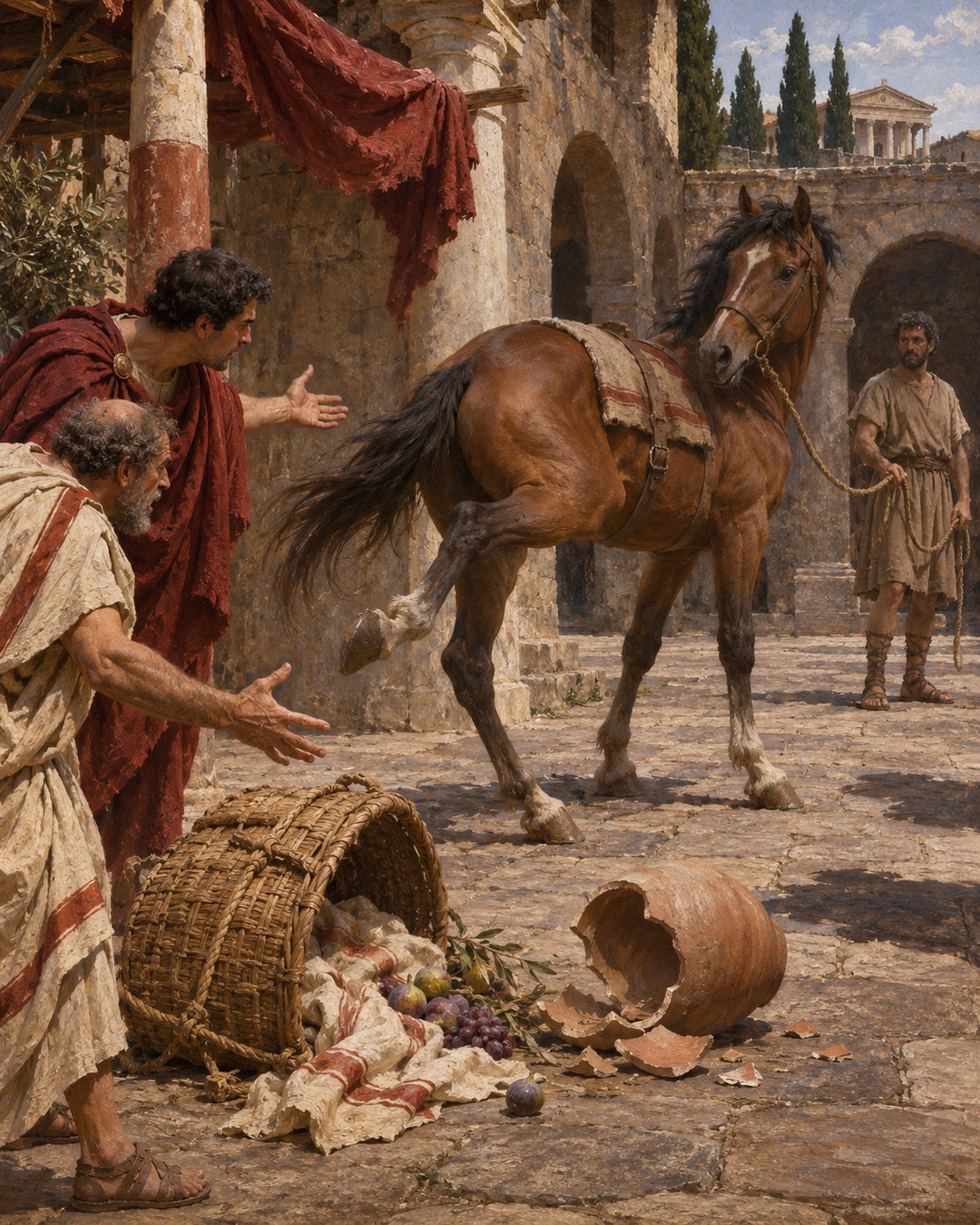
A Roman horse with a habit of kicking could create a legal problem that outlasted the person who owned it on the day of the damage. Digest 9.1 says the offence followed the animal. The action could therefore be brought against the person to whom the horse belonged when the claim was pursued, not necessarily the person who owned it when the kick landed.
That rule sounds strange if the case is treated as a search for personal guilt. The jurists framed it differently. An animal lacked the reason required for legal wrongdoing, yet its body, behaviour and ownership still created a loss that needed an answer.
The remedy carried that structure into court. The owner could pay an amount equal to the damage or surrender the living animal. Liability was attached to control of a tangible creature, while the jurists carefully separated an animal’s own dangerous action from bad handling, provocation, overloading and rough ground.
The Twelve Tables Left the Owner Two Forms of Reparation
Ulpian says the action came down from a Law of the Twelve Tables. In the form preserved by the Digest, the rule offered a choice: whatever caused the damage could be given up, meaning the animal itself, or money equivalent to the damage could be paid.
This was not a declaration that the animal was morally guilty. The praetorian phrase pauperiem fecisse described damage caused without legal wrong by the creature. Ulpian’s explanation is blunt: an animal could not be guilty of wrong in law because it lacked reason.
The distinction preserved the reality of the injury without pretending that a horse or ox could form a human intention. Something had happened; property or a body had suffered; but the legal route did not depend on placing a rational mind inside the animal.
Surrender supplied a concrete answer. The source later specifies that reparation meant giving up the animal alive. A carcass was not an equivalent performance. The owner transferred the very creature around which the claim was organised.
Payment supplied the alternative. Digest 9.1 does not assign a fixed tariff in this passage. It speaks of money equivalent to the damage, keeping the financial response tied to the loss rather than to an invented price for animal misconduct.
The pairing resembles another Roman noxal choice in the case where a slave’s theft could leave an owner two options. The legal persons and doctrines were not identical, but both arrangements made surrender an alternative to bearing the full monetary consequence.
A Habitual Kick Was Different from a Provoked Kick
The jurists did not stop at the fact that an animal had moved and damage followed. They asked what made it act. Servius’s examples include a horse with a habit of kicking, an ox accustomed to butting and a mule acting from extreme savageness.
Those examples place dangerous behaviour inside the animal’s known pattern. A habitual kicker is not the same problem as a calm animal driven into a sudden reaction by someone else. The difference changed the route of the claim.
Ulpian says the animal action did not apply when a horse kicked because pain had irritated it. Attention shifted to the person who struck or wounded the horse. The animal remained the immediate physical source of the kick, but the jurist traced legal responsibility through the human act that provoked it.
The contrast becomes sharper in the next example. If a person merely caressed or patted a horse and was kicked, the animal action could apply. A touch that caused pain and a touch that did not were not treated as interchangeable explanations.
This is mechanism rather than moral theatre. The court needed to know whether the dangerous movement expressed an animal’s own disposition, followed human provocation or emerged from some other failure. Each account pointed toward a different defendant or action.
The source gives no named horse, victim or verdict. These are juristic examples used to mark boundaries. Their concreteness—kick, pain, pat—made abstract causation testable through small differences in a scene.
Bad Ground and a Bad Driver Redirected the Claim
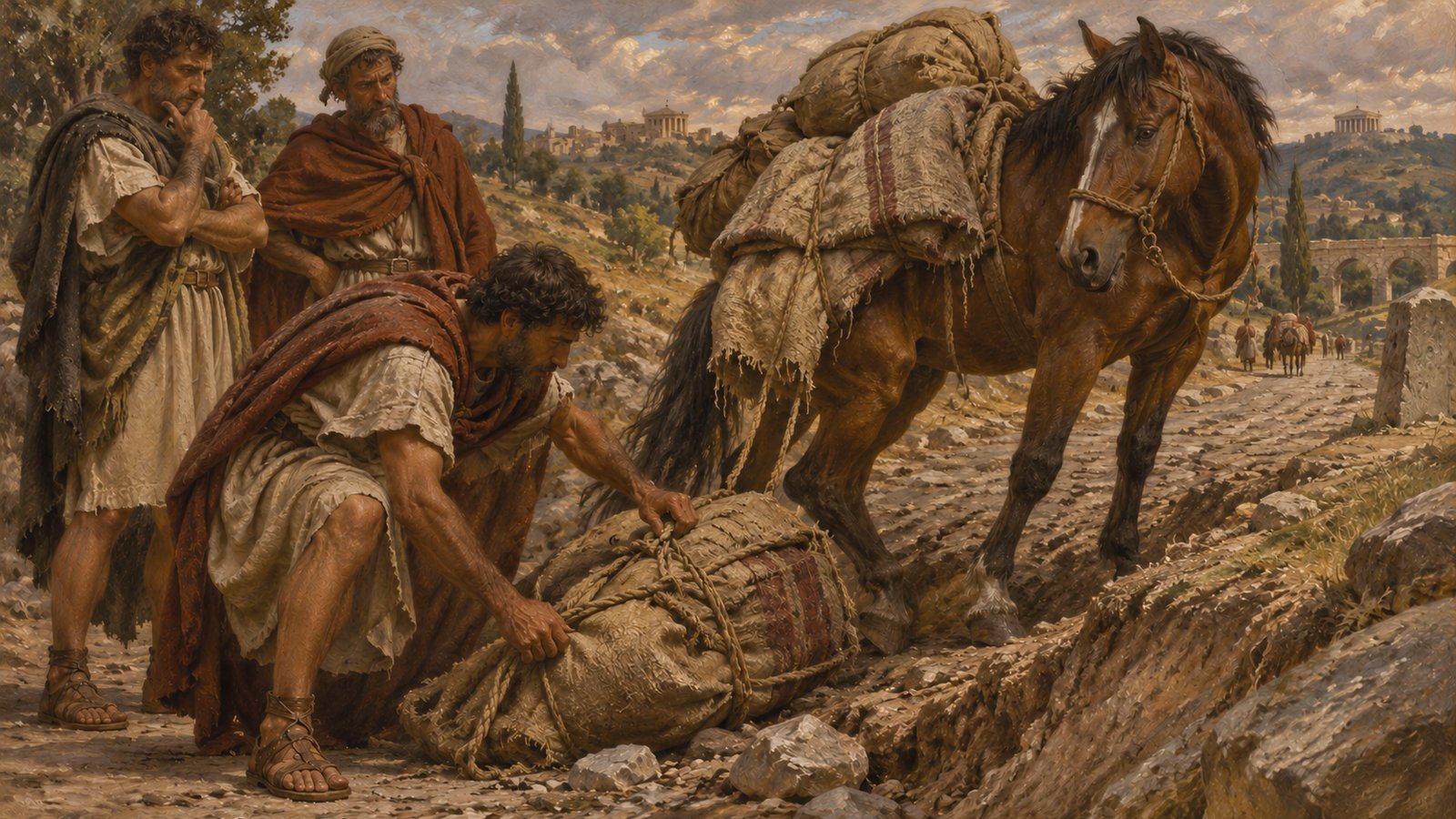
A fallen load produced another set of distinctions. If an animal upset a load because the ground was uneven, the driver was negligent or the animal had been overloaded, Ulpian says this animal action would not lie. Proceedings should instead be brought for wrongful injury.
The damaged person did not lose all legal language simply because the quadruped action failed. The route changed. The jurist looked past the animal’s movement to the condition of the road, the conduct of the driver and the amount placed on the animal.
A dog on a lead made the point still more personal. If the dog broke away through viciousness and injured someone, but a stronger handler could have held it or the person should not have led it through that place, the handler could be liable. Control was evaluated as a human task.
Damage could also be done indirectly through an object touching the animal. Ulpian gives the example of an ox bruising someone by means of a wagon or another overturned thing. The animal did not need to strike flesh with horn or hoof for the action to be considered.
These variations prevent a simple rule such as “the owner always pays when an animal is involved.” Roman jurists separated disposition, handling, load, terrain, provocation and physical connection. The proper action depended on how the harm was produced.
That concern with a falling object has a distant parallel in the Roman rule that priced a death below a window. In each setting, lawyers examined the chain between movement, control and injury rather than stopping at the final impact.
The Claim Followed the Animal to Its Current Owner
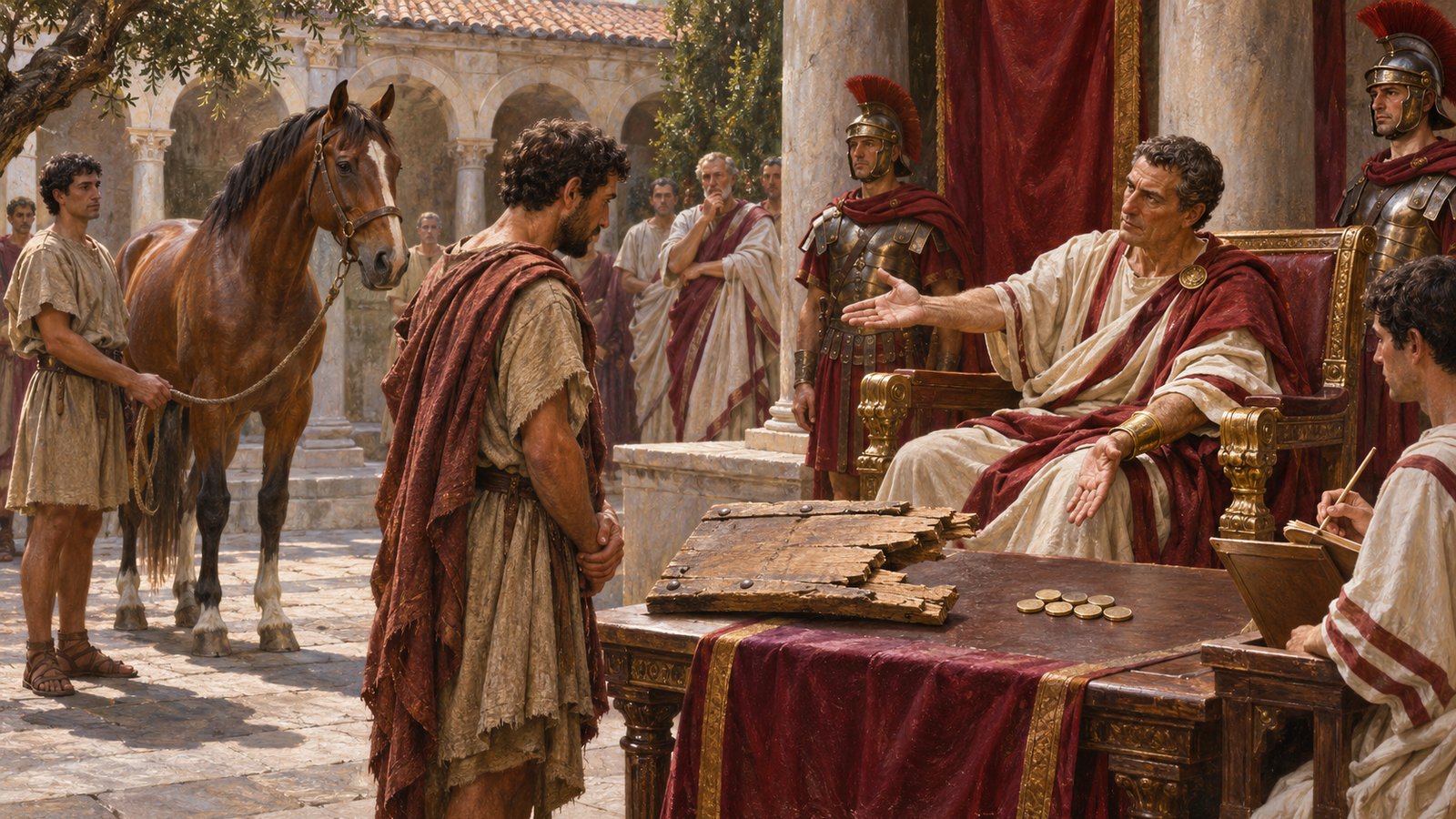
The most unusual rule appears after the examples of kicks, dogs, wagons and fighting animals. In the case of quadrupeds, Ulpian says, the offence followed the animal. The action was brought against the party to whom the animal belonged, not the person to whom it had belonged when the damage occurred.
A sale or other transfer could therefore separate the damaging event from the person who later faced the noxal choice. This did not make the new owner the historical cause of the kick. It made present ownership the legal point through which surrender or payment could be demanded.
The logic becomes visible in the remedy. Only someone who presently controlled the animal could normally surrender that animal alive. If the claim remained fixed forever on a former owner, the option of handing over the creature might become impossible after transfer.
The Digest does not describe a seller hiding a dangerous horse or a buyer discovering an old lawsuit. Those would be invented stories. The secure rule is narrower and more striking: the action attached to the party who owned the quadruped when the claim was brought.
The animal’s death could end the action if it happened before issue was joined. Again, the rule shows how closely the claim was attached to the living creature. Once the subject that could be surrendered no longer existed, this route expired.
Timing therefore mattered in at least two ways. Ownership could change the person answerable, and death before the procedural threshold could extinguish the action. A victim’s legal position was shaped not only by the original damage but by what happened to the animal afterward.
Bulls and Bears Marked the Edge of the Rule
Quintus Mucius supplied a dispute between two rams or two bulls. If the aggressor was killed, the animal action did not lie. If the animal that had not provoked the fight was killed, the action could be brought, and the other owner had to pay the damage or surrender the surviving animal.
The example asks which animal initiated the chain. It does not treat both owners as automatically equivalent merely because both beasts entered the fight. Provocation again organised the legal result.
Wild beasts stood outside this action because ferocity was natural to them. Ulpian imagines a bear escaping and causing damage. Its former owner could not be sued under this rule because ownership ended when the beast escaped; if someone killed it, the carcass belonged to the killer.
That bear is not proof that every Roman encounter with a wild animal worked identically. It is a boundary example. The tame quadruped action depended on ownership and behaviour that could be judged against the creature’s ordinary nature. Natural wildness broke that framework.
Across the section, Roman law repeatedly refuses to flatten unlike scenes. A habitual kick differs from a pain-provoked kick. An animal’s ferocity differs from a negligent driver’s load. A bull that starts a fight differs from the bull that answers it. A privately controlled quadruped differs from an escaped bear.
The rule that followed the animal makes sense only inside that careful sorting. It was not a superstition that guilt lived in a horse. It was a practical legal design linking a living source of damage, its present owner and two possible forms of reparation.
A Roman buyer could thus acquire more than muscle, transport or breeding value. If the animal already carried a valid noxal claim, its new ownership could place the buyer before a choice created by an earlier event: pay for the damage or give up the horse alive.
Sources
Digest 9.1, especially Ulpian, On the Edict, book 18, translated by S. P. Scott.