
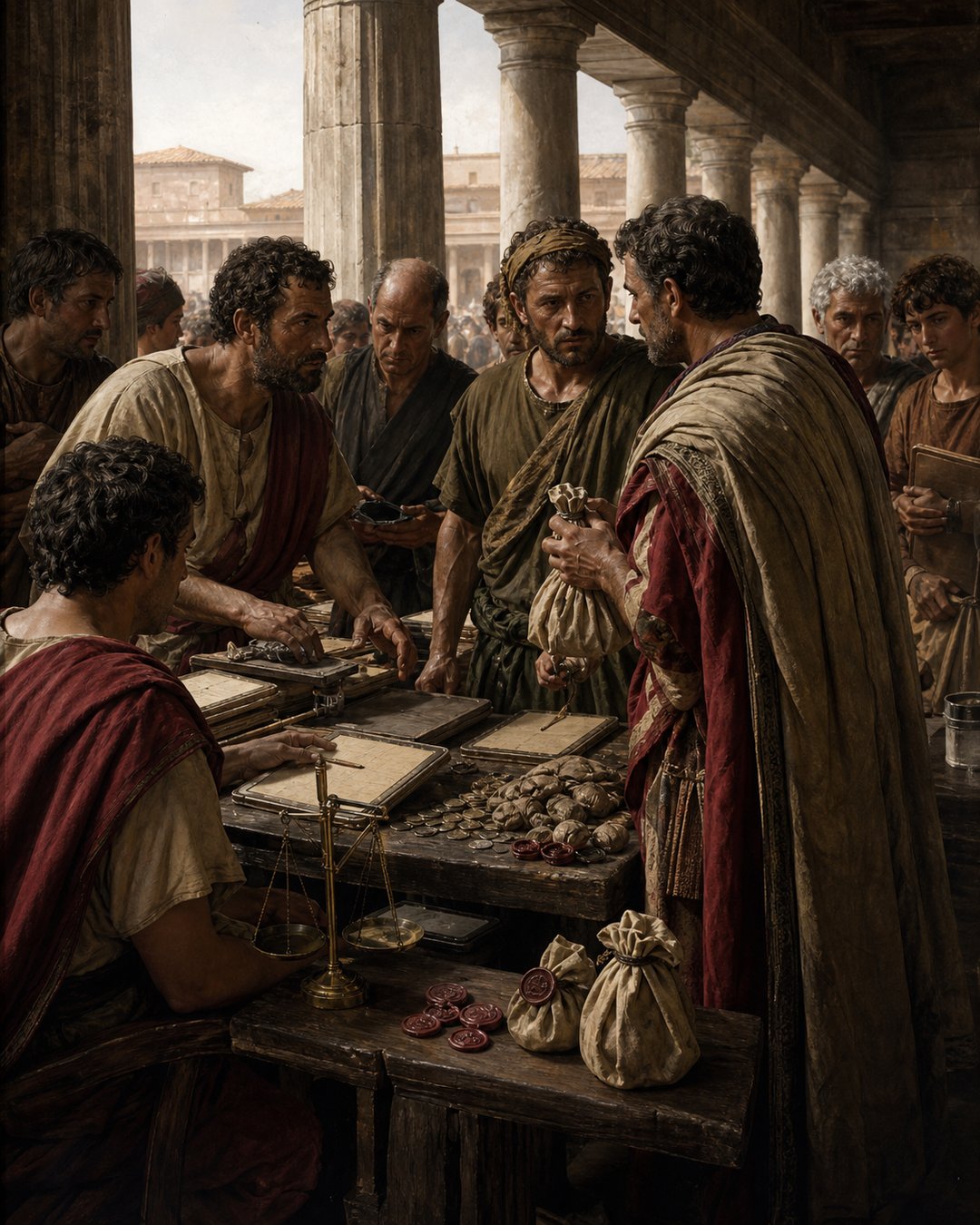
Revenue sounds abstract until someone places a scale on the table. In the Roman world, taxes, rents, tolls, and customs could appear as coins counted under a portico, seals pressed into wax, goods weighed at a station, or a contractor insisting that the state’s claim had become his business.
Roman tax farmers made revenue public because they gave public income a human and material face. The state’s need for money met private capital, written contracts, partnerships, and ordinary people who encountered empire at the point of payment.
The contractor stood where the state could not always stand
Publicani were not simply greedy figures in a moral story. They were contractors who undertook public revenues, works, or services. Their importance begins with that uncomfortable mixture: public authority, private risk, and private profit.
Imagine a trader at a road station, amphorae stacked nearby, a clerk bending over tablets, and a scale swinging while coins are counted. The emperor is absent, but the obligation is present. Rome has arrived as a demand that can be measured.
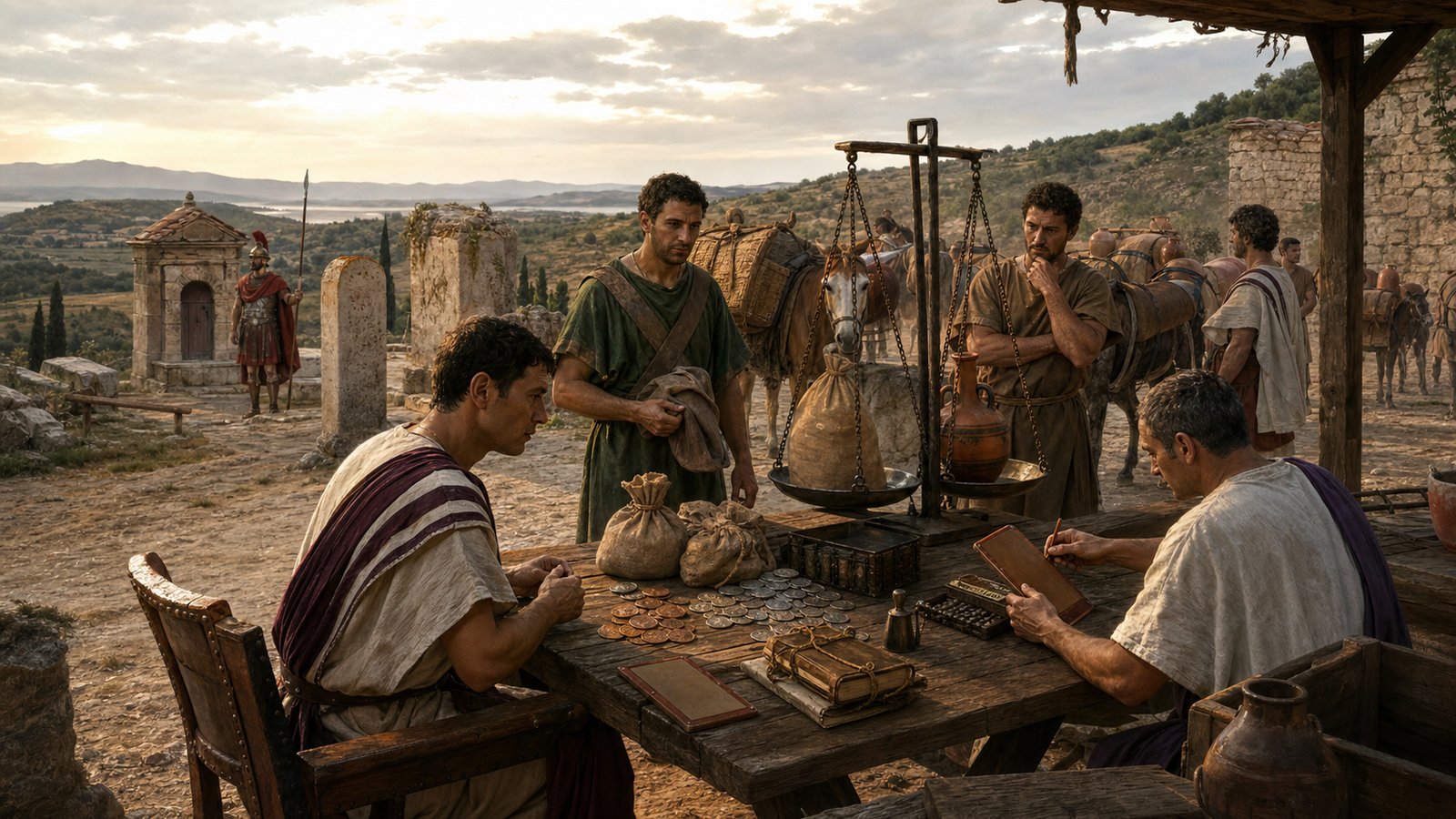
Revenue became visible through objects
Vectigalia could include rents, tolls, customs, and other public revenues. Those categories became real at thresholds: gates, harbors, markets, estates, and offices. Each payment turned policy into an encounter.
This connects with Roman market weights. Measurement was not neutral decoration. Weights, scales, tablets, and witnesses helped turn trust and obligation into public facts.
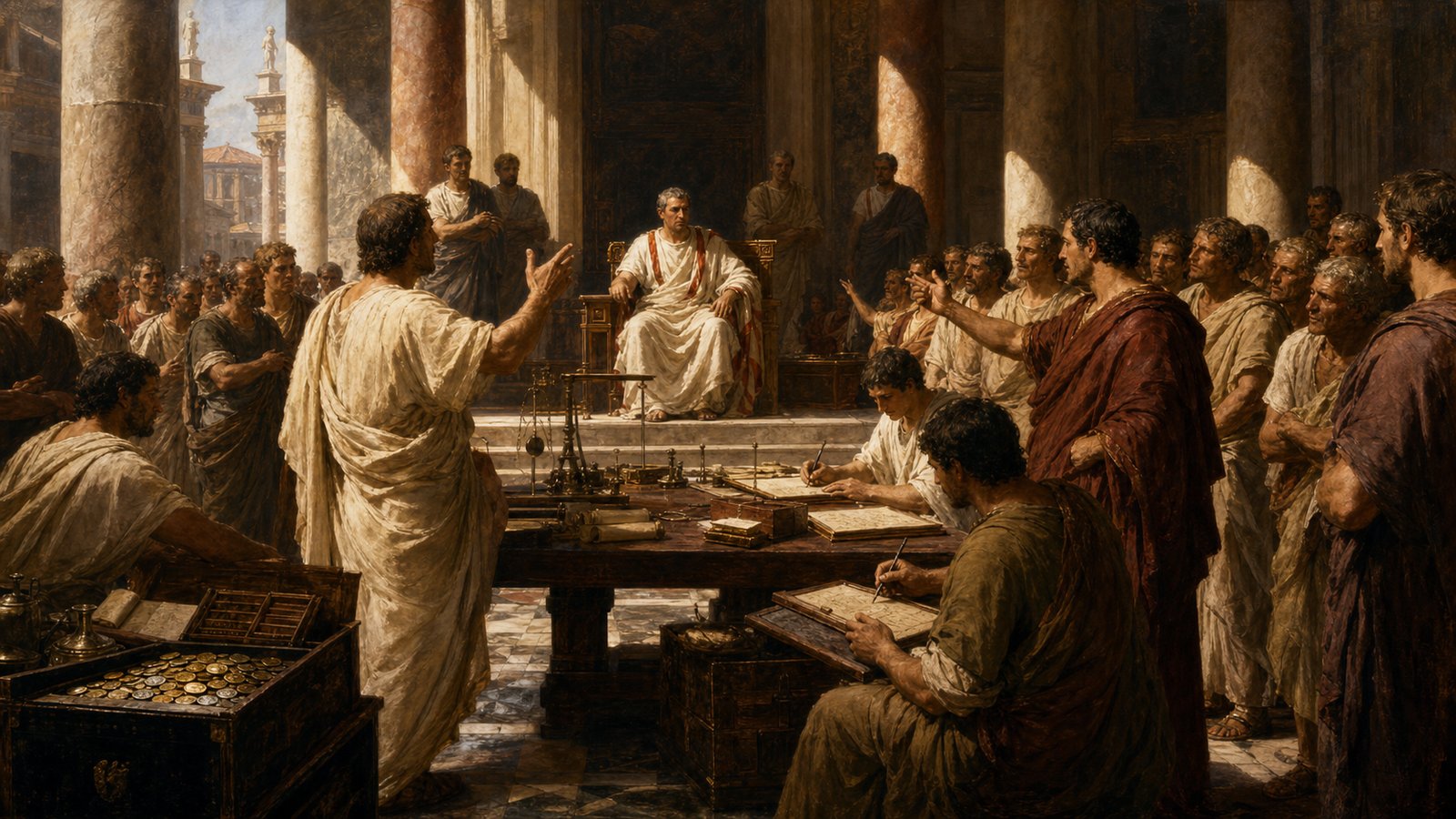
Partnership spread risk and sharpened incentive
Societas, partnership, explains why tax farming could be larger than one man with a purse. Investors could pool resources, share risk, and pursue profit through a contract with the state. That made revenue collection more organized and more dangerous.
The danger was built into the incentive. A contractor who paid or promised the state needed to recover money from the people and places assigned to him. Public income could therefore be felt as private pressure.
Written accounts made disputes durable
Tabulae remind us that accounts mattered. A demand without record is one kind of power; a demand written, copied, sealed, and remembered is another. Documents made revenue harder to dismiss and easier to fight over.
For a provincial merchant, the most important Roman object in the scene might not be a sword. It might be the tablet on which a payment was entered, the seal that fixed a transaction, or the scale that made a claim appear exact.
The public and private were deliberately tangled
Tax farmers made revenue public by standing in a border zone. They were private actors, but their contracts drew strength from Rome. They were not the state, yet they could make the state painfully tangible.
This is why their role belongs in the history of Roman power. Empire was not only roads, legions, and governors. It was also the moment when a person with goods met a contractor with a tablet and discovered that distant authority had a price.
The arrangement could be efficient, resented, profitable, abusive, or all of these at once. The point is not to flatten every publicanus into a villain. The point is to see how Rome converted the problem of revenue into institutions that ordinary people could meet face to face.
Coins gave the meeting sound. Tablets gave it memory. Scales gave it an image of fairness, whether or not the outcome felt fair. Seals and witnesses gave it durability. These details made revenue into an experience rather than a line in a treasury.
The same Roman habit appears in treasury ledgers. Counting does not only record power after the fact. Counting helps power act by making claims portable, comparable, and recoverable.
A tax farmer also changed the emotional shape of government. If a magistrate demanded payment, anger might attach to office. If a contractor demanded it, anger could attach to profit. The state gained reach but also acquired a buffer that could absorb blame.
That buffer was unstable. People rarely separate public authority neatly from the private person enforcing it. A contractor’s table could become, in local memory, the face of Rome itself.
The system shows how empire could operate through delegated friction. Rome did not need to station a grand official beside every road, harbor, or storehouse if a contract could place interested men there instead.
This made revenue surprisingly visible. The tax obligation was not hidden in a palace. It appeared where goods moved, where merchants waited, where accounts were entered, and where arguments over rates and exemptions could flare.
The visibility was double-edged. Public revenue gained presence, but resentment gained a target. Every coin counted under pressure could teach people that Roman order had a cost.
The partnership behind the collector mattered because it connected local encounters to wider pools of wealth. A man at the table might represent investors elsewhere, contracts negotiated elsewhere, and expectations of profit that the payer would never see.
That distance is what made the scene politically charged. The person paying did not only meet one collector. He met an arrangement in which the state’s fiscal hunger and private calculation had learned to work together.
Roman tax farming therefore helps explain why empire could feel both organized and personal. The system was built from categories, contracts, and revenues, but it reached people as voices, hands, documents, and measured goods.
The revenue was public because the claim belonged to Rome. It was also public because the payment happened in spaces where others could see, wait, complain, learn, and carry the story onward.
A contractor at a table is less monumental than an aqueduct or arch. Yet he may reveal more about how empire touched daily life. Grand structures announced what Rome could build. Revenue tables announced what Rome could demand.
This is the strange power of the publicanus. He made the state visible not by wearing a crown or commanding a legion, but by turning public income into a transaction that ordinary people had to complete.
The materials of the scene reveal the politics. A wooden table created a boundary; a scale claimed precision; a tablet preserved obligation; a seal suggested that the matter would outlive the argument. These were small tools, but together they let revenue behave like public fact.
The contractor also made Roman power negotiable in the uncomfortable sense of the word. People could plead, bargain, delay, protest, or accuse, but the discussion began from a claim that had already been authorized somewhere else. The local argument carried the weight of a distant contract.
That distance was part of the system’s strength. Rome could turn an imperial need into many local encounters without making each encounter look like a meeting with the central treasury. The publicanus converted fiscal policy into thousands of practical scenes.
For the payer, however, those scenes were not minor. A toll at a gate could change profit. A customs charge at a harbor could shape a journey. A disputed entry on a tablet could become a memory of unfairness that outlasted the day’s transaction.
Public revenue therefore became visible not only when money reached Rome, but when people learned where and how Rome asked for it. The publicanus stood at that point of learning, making empire countable in coin and memorable in irritation.
Sources & Further Reading
- Smith Dictionary, Publicani
- Smith Dictionary, Vectigalia
- Smith Dictionary, Societas
- Smith Dictionary, Tabulae