
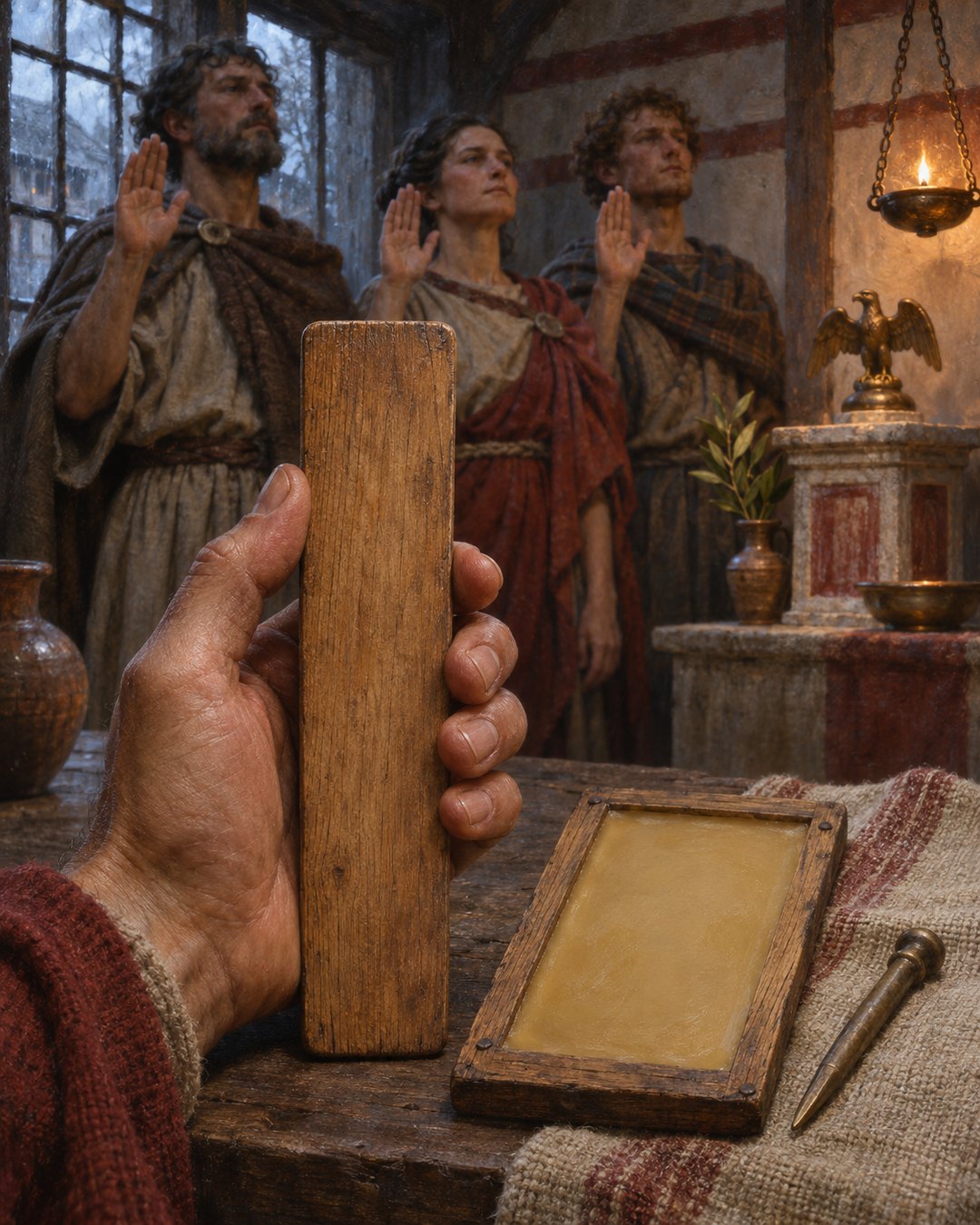
A strip of wood from Roman London preserves an unusually crowded promise. The London Museum describes its text as an oath sworn to Jupiter, to the genius of the emperor Domitian, and to the native gods, named in Latin as deos patrios. Three forms of sacred authority met in one formula.
The object is physically narrow: 141 millimetres high, only 34 millimetres wide, and 3 millimetres deep. Those measurements make the tablet feel less like a monument than a portable record. Yet its words reached from a local act in London to Rome’s chief god and the emperor’s sacred presence.
The oath does not survive in the museum record as a complete social drama. It does not identify every speaker, witness, dispute, or promised action. Its importance lies in the combination that remains. A person who used this formula did not have to choose between Roman and local divine language. The promise summoned both.
Three Divine Audiences Shared One Formula
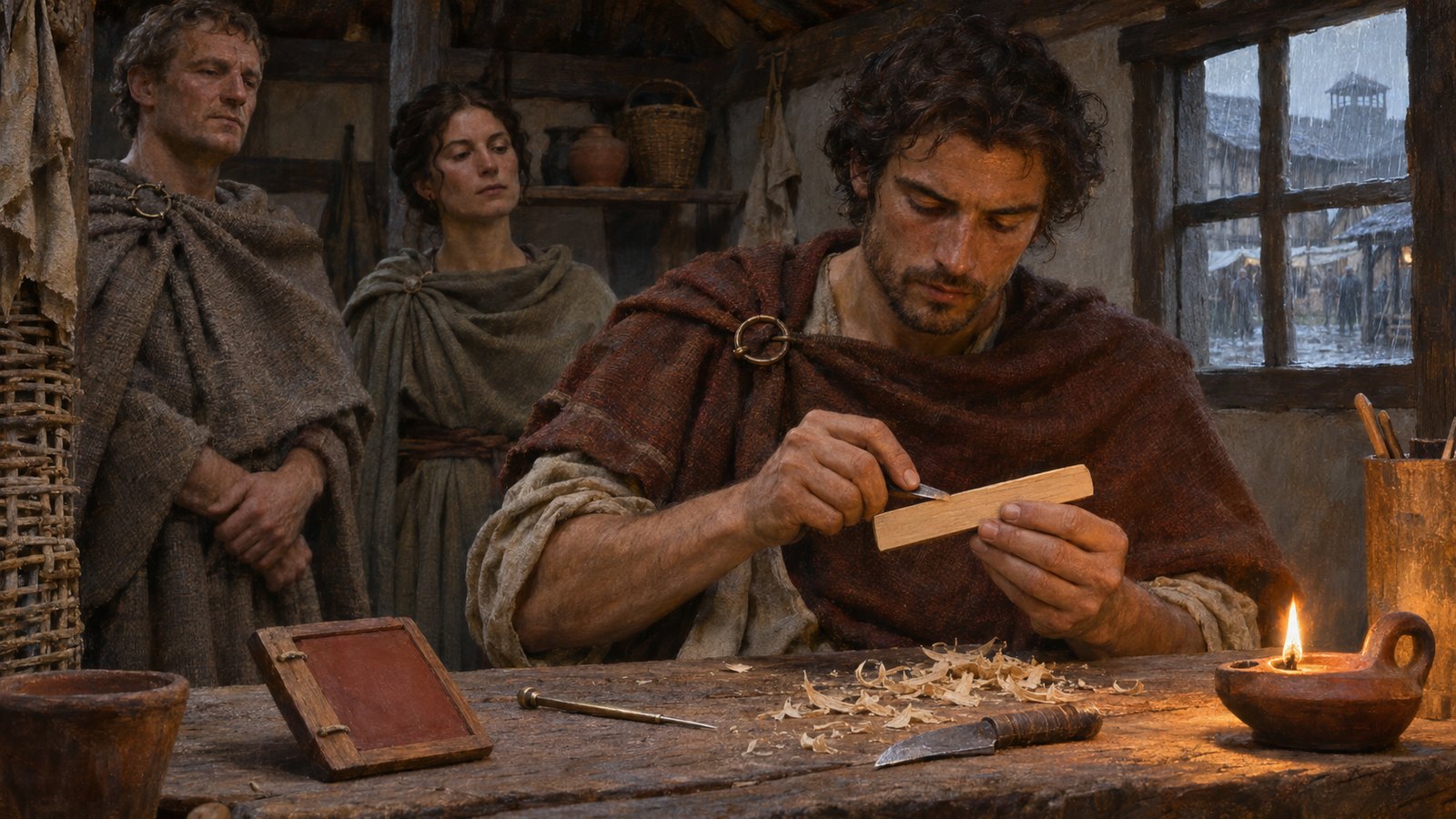
Jupiter came first in the museum’s summary. As Rome’s chief god, he supplied an immediately recognizable divine audience for a binding statement. Naming him located the oath inside a public religious vocabulary that travelled with Roman institutions, soldiers, officials, merchants and settlers.
The second audience was not simply Domitian as a distant man. The formula named the emperor’s genius, the sacred power associated with his person. That wording allowed imperial authority to enter the oath as a religious presence rather than as an administrative signature.
Then came the native gods, deos patrios. The phrase did not erase them beneath Jupiter or the emperor. It named them as another audience whose attention mattered. The formula therefore accumulated authority instead of replacing one divine world with another.
That accumulation is the tablet’s sharpest lesson. Roman rule often worked by adding imperial and civic forms to existing loyalties. In this oath, the local gods remained available precisely while Jupiter and Domitian’s genius were invoked. The speaker could present the promise as answerable across several religious frames at once.
The surviving sequence does not tell us whether all three invocations carried equal emotional weight. One participant may have cared most about Jupiter, another about the emperor, and another about ancestral gods. The formula did not need to settle that private hierarchy. It needed to make the promise difficult to dismiss.
An oath makes a statement heavier by placing it before powers that can punish falsehood or witness loyalty. Here the list widened the circle of accountability. Breaking the promise could be imagined as an offence against Roman religion, imperial order and inherited local divinity together.
That is different from a simple declaration of fact. A declaration asks listeners to believe the speaker. An oath gives the listeners named powers against which to measure the speaker’s sincerity. The wood preserved the shape of that appeal even after the original voices disappeared.
The Emperor Entered the Oath Through His Genius
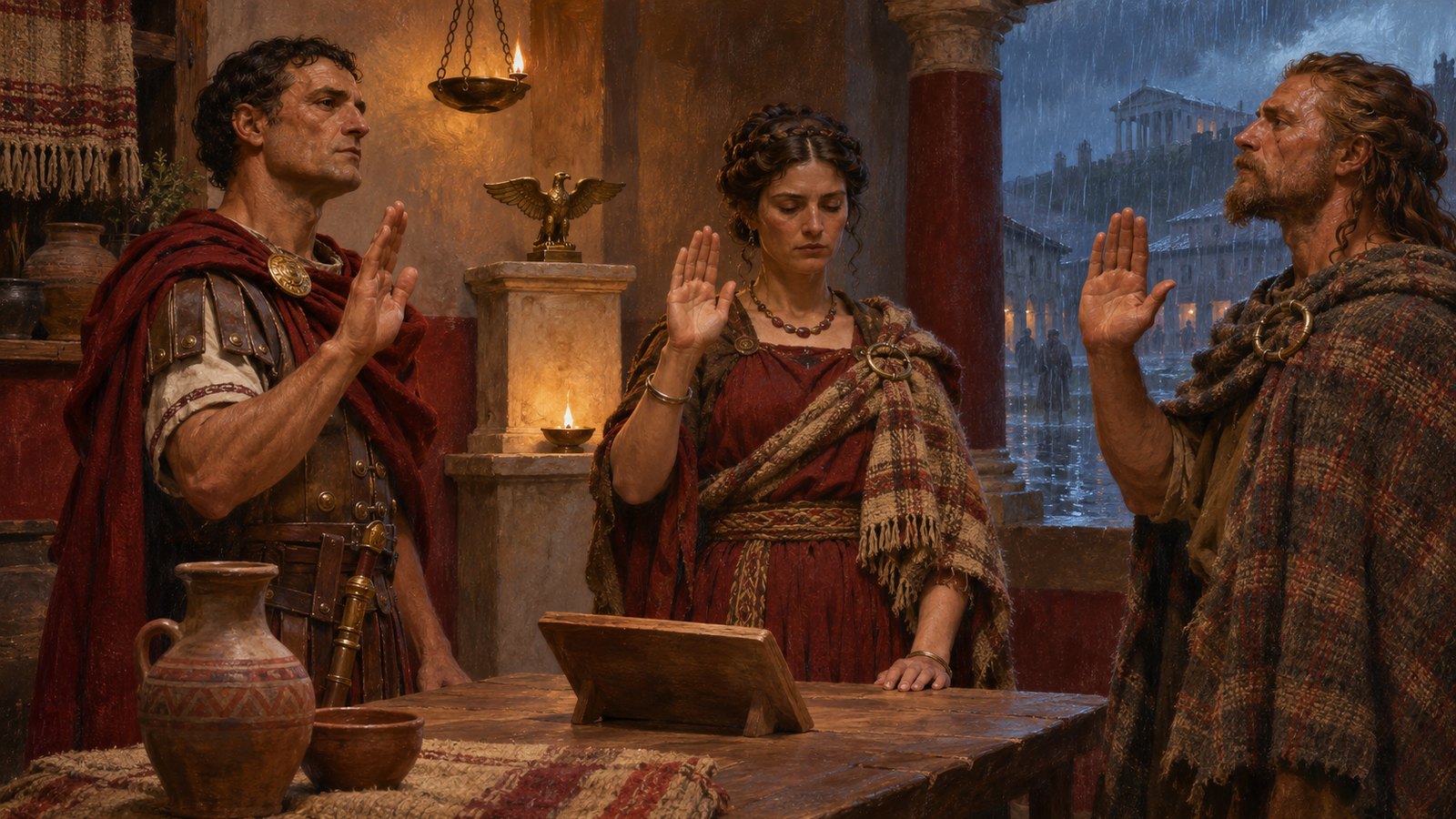
Domitian’s name gives the object political precision. The emperor ruled at the end of the first century, but the tablet does not need an imperial portrait or a bronze dedication to make him present. His genius could be invoked in a compact verbal formula far from Rome.
This was a subtle form of reach. The emperor did not have to hear the oath. A local gathering could make loyalty to his sacred standing part of its own act. Imperial power moved through repeated practices as well as commands, taxes and buildings.
The formula also shows why “politics” and “religion” are poor separate boxes for this object. Swearing by the emperor’s genius was religious language with political consequences. It treated the ruler’s position as something before which truth and loyalty could be tested.
Domitian’s genius stood between Jupiter and the native gods in the museum’s summary. That placement should not be turned into a precise ritual script without the full text, but the combination itself is secure. The ruler’s sacred presence belonged in a list that joined the highest Roman god with local divine powers.
London already held people with different origins, occupations and obligations. A shared oath formula could cross some of those differences without making everyone identical. Jupiter supplied a Roman point of reference; the emperor supplied the current regime; the native gods allowed inherited loyalties to remain named.
The effect resembles the careful verbal control described in the Roman prayer watched by four specialists. In both cases, wording mattered because the words established who was addressed and what kind of obligation was being created.
A 34-Millimetre Width Made Authority Portable
The tablet’s proportions deserve attention. At 141 millimetres high and 34 millimetres wide, it was more than four times as tall as it was broad. Its depth was only 3 millimetres. The result was a slim piece of wood, not a broad display panel.
That narrowness changed how the oath existed. A monumental inscription fixes words to a public place. A small wooden tablet could be handled, carried, stored and consulted. Authority did not always need stone, bronze or a crowd. It could fit into an object narrower than an adult palm.
Wood was also vulnerable. It could warp, split, burn or decay. The survival of any wooden text from ancient London is therefore materially different from the survival of a stone inscription. The object brings us close to the routine paperwork and writing that normally vanished.
The museum record does not specify the tablet’s complete writing technique, so the physical interpretation must remain cautious. Other Roman writing tablets could use wax, ink, bindings or paired leaves, but this object should not be forced into a construction detail the record does not give.
Its dimensions still support one conclusion: the record was made for use at human scale. Someone held it. Someone wrote or read its oath. Someone considered the wording worth keeping on wood.
That human scale also distinguishes this object from an imperial decree. The emperor entered not through a palace document but through the genius named in a local oath. A small London object could carry an enormous political geography.
Another surviving tablet shows how writing captured the rhythms of labour: one brickmaker counted a worker’s thirteen days away. The oath tablet used the same broad world of portable writing for a different purpose. Instead of tracking attendance, it gave a promise divine witnesses.
The Native Gods Were Included, Not Translated Away
The phrase deos patrios is easy to pass over after the famous names of Jupiter and Domitian. It may be the most revealing part of the formula. The native gods were not individually identified in the museum’s short description, yet the category itself was preserved.
That collective naming allowed local sacred loyalties to enter a Latin oath without requiring every deity to be made Roman. The gods could remain “native” or ancestral while still standing beside Jupiter and the imperial genius as guarantors.
The formula should not be romanticized as proof of perfect harmony. Roman conquest framed the setting, and imperial authority was explicit. Inclusion in an oath did not mean equal power in politics, law or society. It does show that effective ritual language could recognize more than one sacred community.
Nor should the native gods be guessed from later discoveries or regional cults. The tablet’s record does not name them. Their anonymity is evidence in its own right: the oath could rely on a shared understanding among participants that the surviving catalogue cannot reconstruct.
For the original speakers, “native gods” may have been specific enough. Everyone present could know which divine powers belonged to the place, family or community. A modern reader sees an open category because the local knowledge surrounding the words has disappeared.
The wood therefore preserves both information and absence. It tells us that Jupiter, Domitian’s genius and native gods were joined. It withholds the event, the promise, the participants and the local divine names. Responsible reading keeps those limits visible.
Within those limits, the object still overturns a simple picture of Romanization. The oath was neither purely imported nor purely local. It was assembled from layers: Roman supremacy, current imperial rule and ancestral sacred belonging.
A promise made under all three was designed to travel across divided loyalties. The 34-millimetre strip did not flatten those loyalties into one. It made them stand together as witnesses.
Sources
London Museum, “Writing tablet”; Dominic Perring, London in the Roman World, cited in the museum record.