
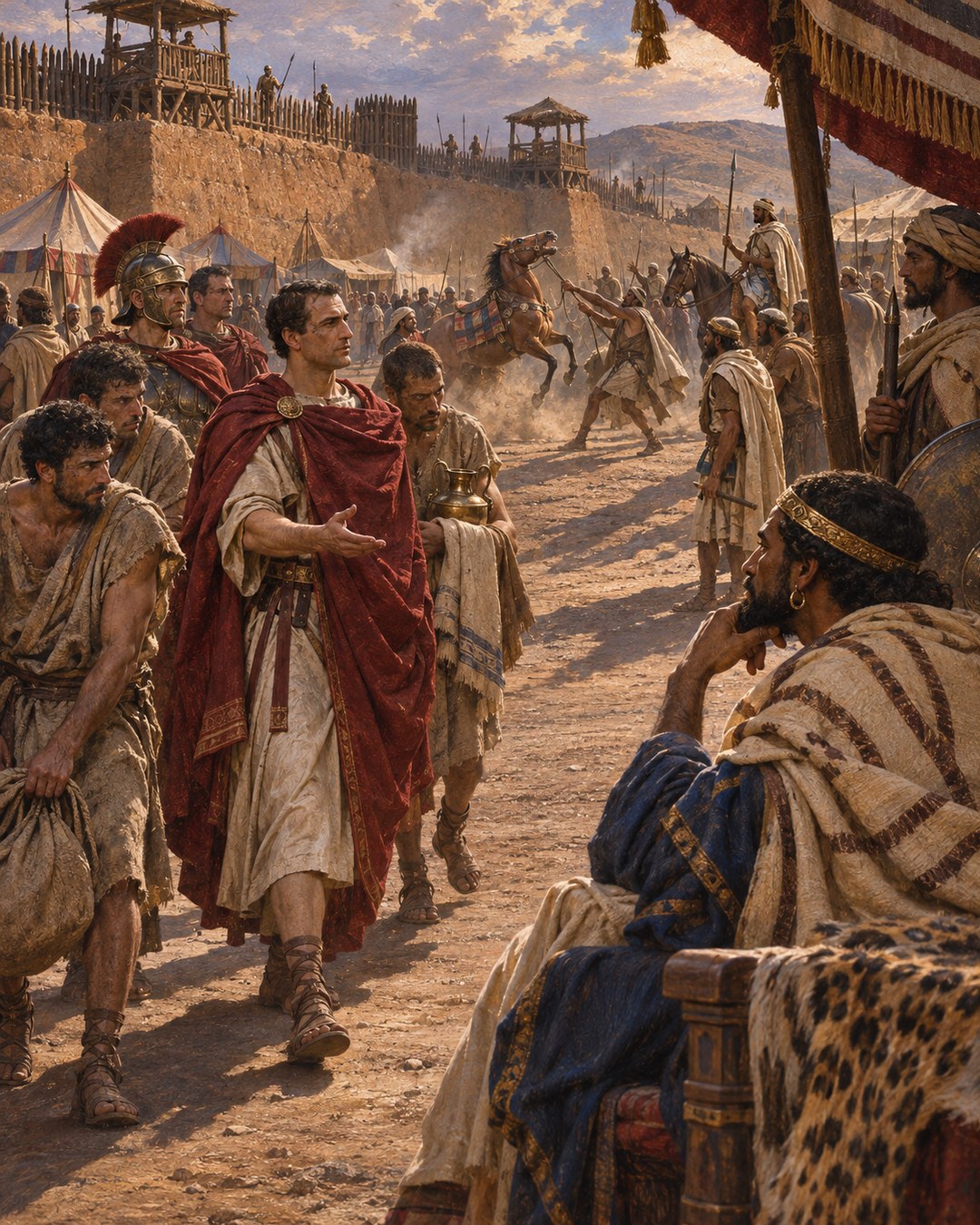
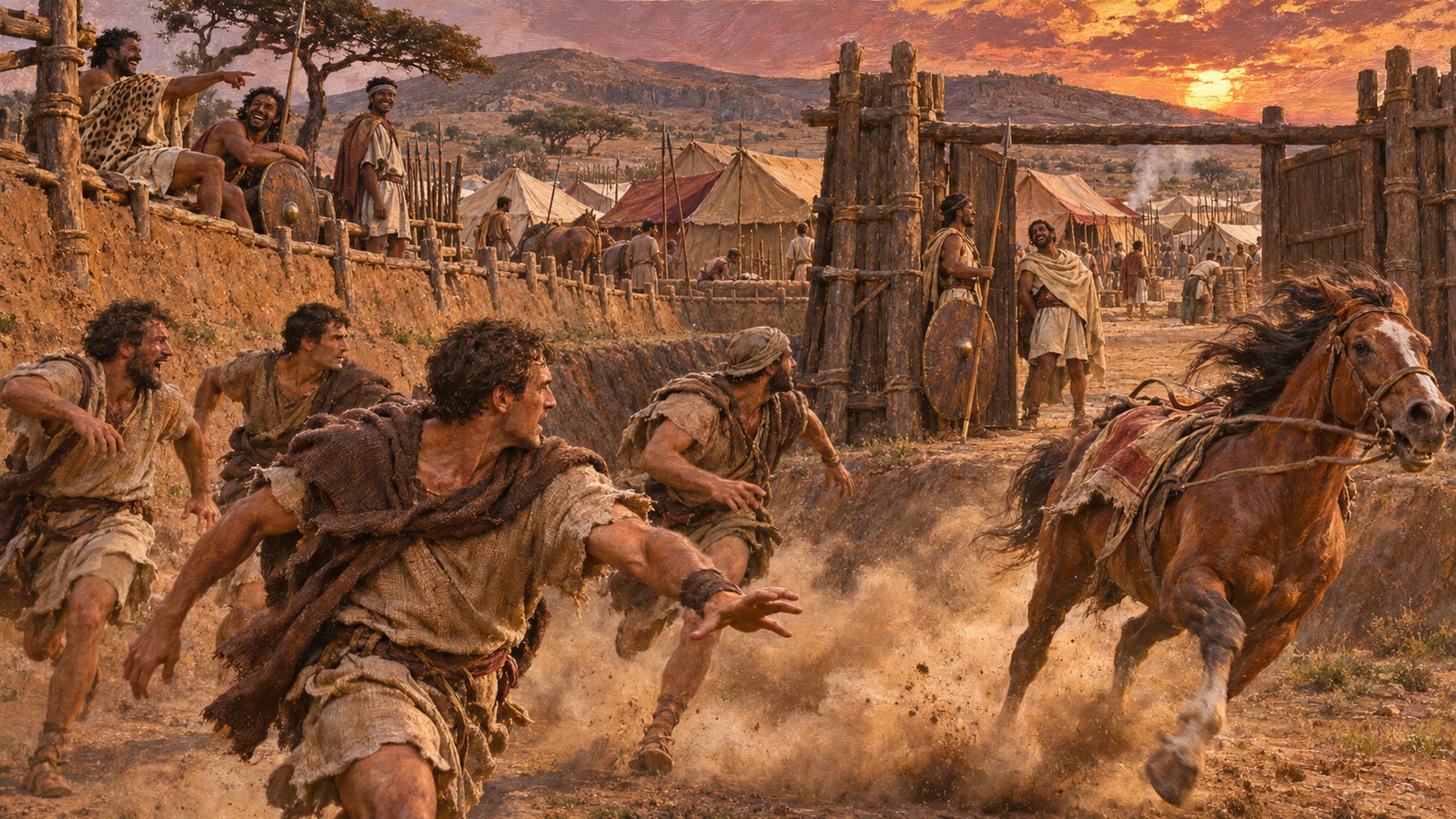
The most useful horse in Scipio Africanus’s reconnaissance did not carry a cavalryman or charge a line. It appeared to escape. While Gaius Laelius visited King Syphax as an ambassador, Roman officers disguised as enslaved attendants deliberately let the animal loose. They ran after it around much of the camp’s fortifications. To anyone watching, the servants were correcting an embarrassing accident. In Frontinus’s account, they were measuring an enemy position with their eyes.
The trick joined several kinds of concealment. Diplomacy provided lawful entry. Clothing and conduct hid the officers’ ranks. The horse created movement that did not look military. A chase gave the supposed attendants a reason to approach gates, earthworks, paths, and tent lines that formal visitors could not openly inspect. The report they carried back turned an ordinary-looking commotion into preparation for an attack by fire.
The Embassy Carried More Than Diplomats
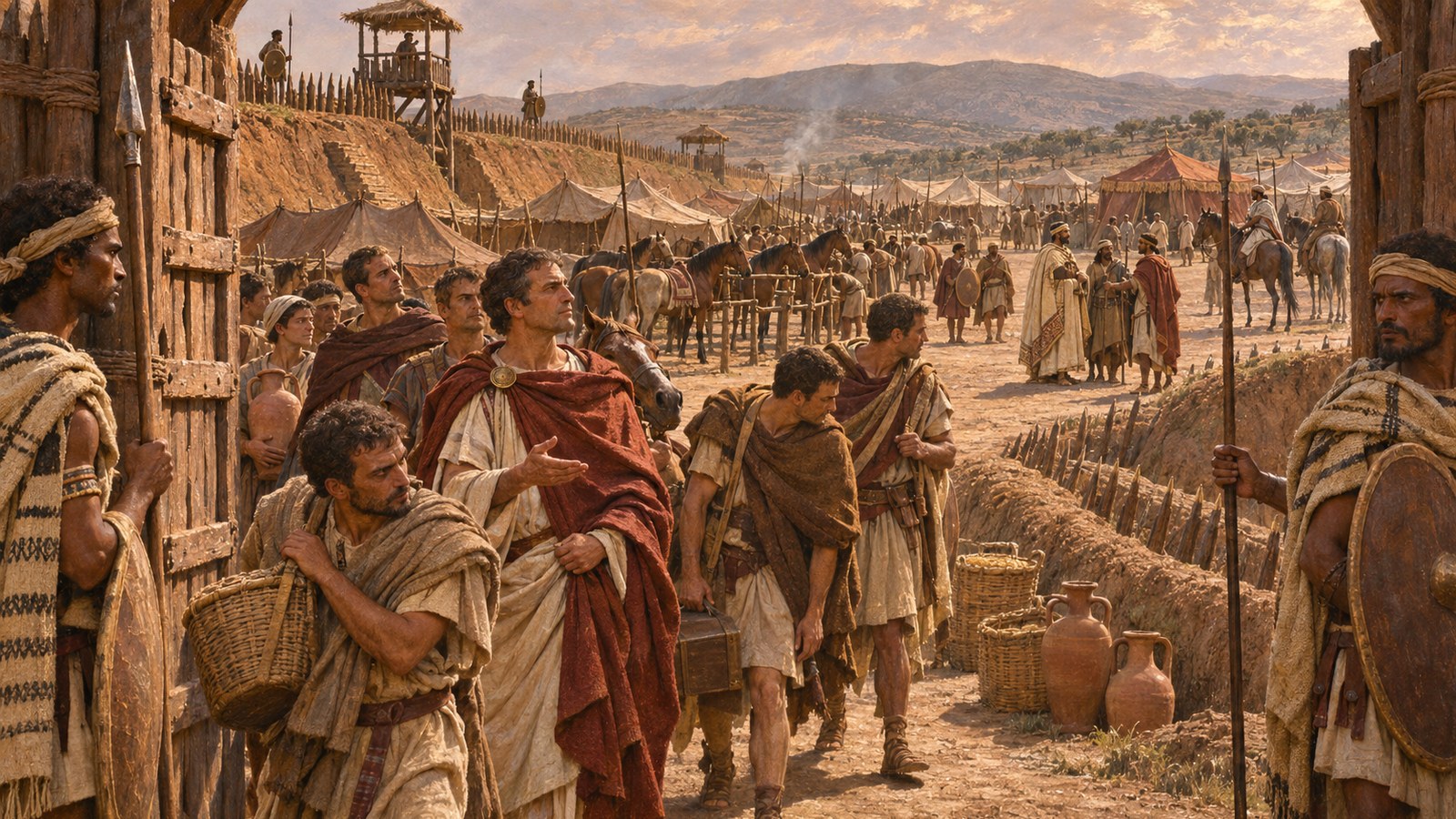
Frontinus says Scipio seized the opportunity created by an embassy to Syphax. Laelius was the visible representative. With him went selected tribunes and centurions, but not in the dress or posture expected of Roman officers. They were presented as enslaved attendants. The disguise mattered because their true ranks explained their real value: these were men trained to notice the practical shape of a camp and the strength behind it.
An embassy normally moved under rules different from those of an army. Its members could cross ground that armed scouts might never approach. They could enter a ruler’s camp without announcing a raid. That did not make them invisible. On the contrary, visitors would be observed, guided, and restricted. Scipio’s solution was not merely to put officers in plain clothes. It was to place them inside a social role whose presence around a senior envoy appeared ordinary.
Frontinus’s parallel telling makes the danger physical. Lucius Statorius had been in the camp often enough that some men seemed to recognize him. Laelius caned him as though he were enslaved. The act protected the disguise by humiliating the man it concealed. It also shows how much the operation depended on performance. A Roman centurion could not simply look downward and hope not to be noticed; Laelius had to make observers interpret familiarity as a mistake.
The episode belongs beside Scipio’s later night attack on the enemy camps, but reconnaissance deserves its own place in the story. Fire did not begin with a torch. It began with access, observation, and a credible report about what the enemy had built.
A Loose Horse Created Permission to Wander
The released horse solved the embassy’s hardest spatial problem. Visitors might be shown a command tent, a reception area, and an approved route. That route would reveal only what Syphax’s people wanted them to see. A runaway animal ignored the itinerary. The disguised officers could pursue it quickly, separate from the formal group, and cover the greatest part of the fortifications without stopping to ask why a gate stood where it did.
The story works because horses bring disorder with them. Tack can slip. A handler can lose a grip. An excited animal can pull away from noise, smell, or movement. No extraordinary device had to be smuggled into camp. The Romans used an event that was plausible in a place filled with cavalry, baggage animals, guards, and strangers.
As they ran, the officers could note relationships rather than take written measurements. How far did a ditch extend? Where did traffic pass through the perimeter? Which approaches were crowded, narrow, guarded, or open? How close did tents and temporary structures stand to one another? Frontinus does not give their checklist, so a modern retelling should not invent one. His essential point is precise enough: chasing the horse allowed them to examine the situation of the camp more freely.
The chase also made looking seem secondary. A spy who pauses before a rampart invites suspicion. A servant trying to recover an animal must look ahead, behind, and to either side. He can call, run, circle, and approach a barrier. Every motion that would betray deliberate reconnaissance in another setting becomes part of the apparent emergency.
Rank Disappeared into a Servant’s Role
Scipio selected tribunes and centurions because military knowledge could not be separated from the men doing the observing. A casual visitor might remember a wall. An experienced officer understood that a wall existed within a system of entrances, guard routines, camp streets, command points, and concentrations of men. The disguise hid exactly the expertise that made the visit dangerous.
It did so through Rome’s own hierarchy. Enslaved attendants were expected to accompany important men, handle animals, absorb orders, and remain socially beneath notice. Frontinus treats that expectation as an operational resource. The officers borrowed not just clothing but the assumption that people marked as servants did not possess independent authority or strategic purpose.
The caning of Statorius exposes the cost of the fiction. Frontinus presents it as a clever safeguard, yet the gesture drew its credibility from routine domination. An observer who doubted the disguise could be persuaded by seeing Laelius strike the supposed slave. The performance depended on a world in which violence from a master toward an enslaved attendant looked more believable than an officer hiding in plain sight.
That detail prevents the stratagem from becoming a frictionless puzzle. The Romans did not merely outthink the camp guards. They manipulated rank, expectation, and bodily vulnerability. Statorius’s real status protected him outside the role, but inside the camp the operation required him to endure treatment that confirmed the lie.
The Report Made Observation Useful
Frontinus states that the men reported the results of their observations. That final step is easy to overlook because the loose horse dominates the anecdote. Yet information seen inside an enemy camp had to survive the return journey and become intelligible to a commander. The officers needed to remember a complex position, compare impressions, and distinguish useful facts from the noise of the chase.
Scipio’s broader discipline made such a report valuable. An army that could not translate reconnaissance into movement, timing, and assigned tasks gained little from clever access. The article on how Scipio made troops build and demolish a camp every day shows the other side of that command culture. Repetition trained soldiers to understand how camps worked. Here, officers applied that understanding in reverse to an enemy position.
Frontinus links the observations to the destruction of the camp by fire and says that this brought the war to a close. His compact wording compresses planning, coordination, and combat into a clean sequence. It should not be expanded into details he did not provide. We do not know from this passage how long the visitors remained, exactly what each officer saw, or how the report was divided among them.
What survives is a chain of functions. The embassy crossed the boundary. The disguise protected military specialists. The horse widened their path. The pursuit concealed their attention. Their memories returned to Scipio. The later attack exploited knowledge gathered under diplomatic cover.
Frontinus Turned Confusion into a Method
Frontinus wrote for readers interested in reusable examples of command, not for readers seeking a continuous narrative of the campaign. He placed the episode under the problem of finding out an enemy’s plans. That framing explains why the anecdote is so concentrated. Names, ranks, disguise, horse, fortifications, report, and fire are the parts needed to demonstrate the mechanism.
The method did not depend on a magical invisibility. It depended on giving observers a better explanation for suspicious movement. Syphax’s guards could see the men running. What they were meant to misunderstand was the purpose. The apparent cause—the escape of a horse—was immediate, concrete, and urgent enough to crowd out the strategic explanation.
This is what makes the loose horse more than a colorful detail. It transformed reconnaissance from a forbidden act into a familiar duty. Instead of trying to hide every motion, the Romans made their motion conspicuous for the wrong reason. The strongest cover was not stillness but a story that made running around the camp look necessary.
Frontinus preserved no map from the embassy and no transcript of Laelius’s reception. He preserved something smaller and more revealing: an enemy camp briefly opened by its willingness to believe an accident. Scipio’s officers did not need to conquer the perimeter during the visit. They only needed to see enough of it while everyone else watched a horse.
Sources
Frontinus, Strategemata I.1.3 and I.2.1; Loeb Classical Library translation.