
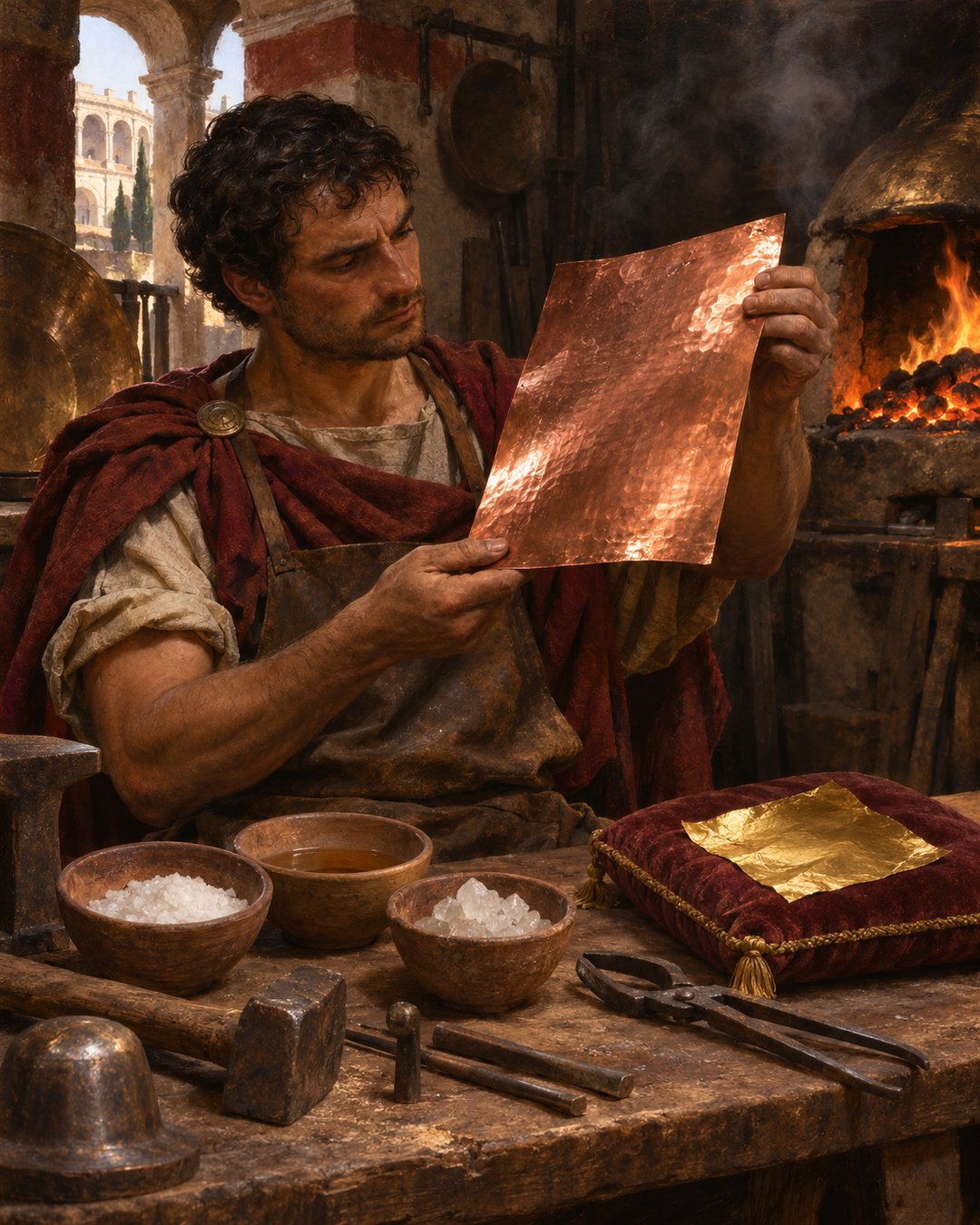
Gold leaf is almost weightless, but the surface beneath it had to survive a demanding sequence. In one compact chapter, Pliny the Elder describes copper being hammered, heated, cooled in salt, vinegar, and alum, cleaned until it shone, heated again, and prepared to receive gold. The leaf was the final visible layer. Most of the work happened before it arrived.
That order changes how Roman gilding looks. A finished object may present a continuous golden face, yet Pliny’s account begins with impacts, fire, liquid, abrasion, and inspection. The decisive moment was not merely placing precious metal on cheaper metal. It was making the copper ready to hold what the eye would eventually see.
Pliny Chose the Support Before the Gold
Natural History 33.20 does not offer one universal instruction for every object. Pliny begins by sorting surfaces according to what they could tolerate. Marble and other substances that could not be brought to white heat received gilt with glair of egg. Wood required a glutinous preparation he calls leucophoron. Copper led to a different sequence.
This opening makes the support material the first decision. Gold leaf could be the common finish, but marble, wood, and copper did not accept it in the same way. Heat was possible for one and unsuitable for another. An adhesive named for one surface did not automatically serve the next. Pliny’s categories therefore preserve a practical rule: the visible coating depended on the hidden behavior of the thing beneath it.
The distinction also limits what the source can prove. Pliny does not provide dimensions for an object, name a particular workshop, or say that every craftsperson followed one fixed formula. He records different routes for different materials. The useful evidence lies in that separation and in the detailed sequence he gives for copper.
Hammer and Fire Opened the Copper Sequence
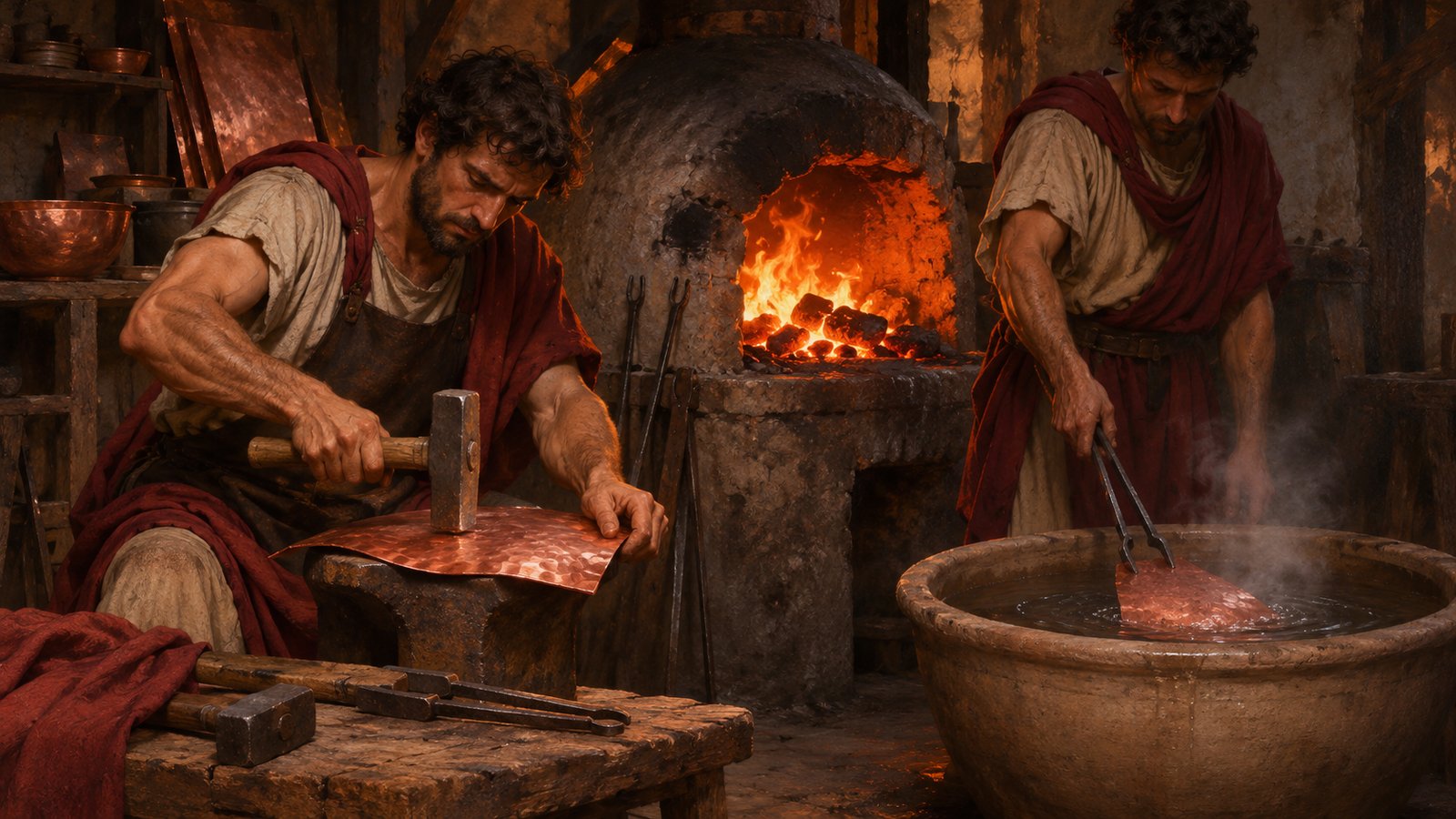
For copper, Pliny calls quicksilver—or hydrargyros—the most convenient aid. Before it entered the preparation, however, the copper had to be “well hammered.” Only then was it subjected to fire. The passage puts mechanical work before the first heating.
Those are not decorative preliminaries. Hammering changes the physical surface through repeated blows; heating changes the conditions under which later cleaning and preparation take place. Pliny gives no count of strokes, temperature, or duration, so none should be supplied from imagination. What he does preserve is an order that a workshop had to manage: impact first, fire second.
That sequence belongs to a broader Roman habit of treating surfaces as engineered layers. A separate account of how vinegar helped turn lead into white pigment likewise begins far from the finished appearance. The shining or colored surface was an outcome of preparation, not an untouched property waiting to be uncovered.
Salt, Vinegar, and Alum Marked the Cooling Stage
After the first firing, Pliny says the copper was cooled with a mixture of salt, vinegar, and alum. The three named materials form the most memorable part of the passage, but they should not be detached from the steps around them. The mixture followed hammering and heat; it did not begin the process.
The source gives no ratios. It does not say how much liquid was used, how long the metal remained in it, or what temperature the copper had reached. Turning the sentence into a modern recipe would therefore add claims Pliny never makes. It would also ignore the presence of mercury-bearing substances later in the process. This is historical evidence for a workflow, not an instruction for reenactment.
What can be said is concrete. A worker moved a heated copper surface into a cooling and cleaning stage built around substances that could be stored, poured, mixed, and recognized. Fire and liquid alternated. The metal did not travel directly from the hammer to gold leaf.
Brightness Was the Workshop’s Test
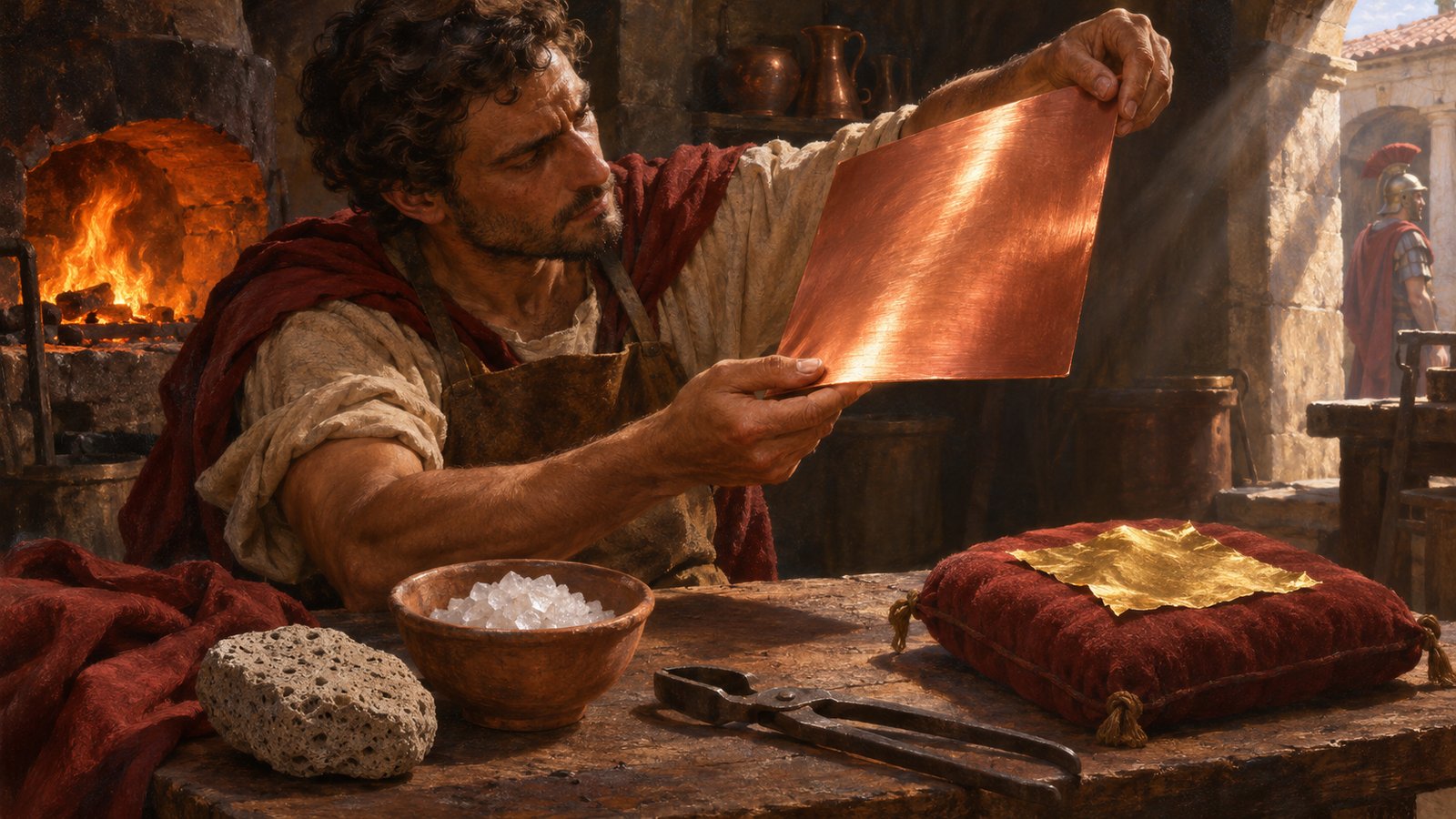
Pliny next says that extraneous material was cleaned away. He then gives an observable criterion: the copper’s brightness showed when it had been sufficiently purified. No clock appears in that test. The surface itself supplied the signal.
This detail is easy to pass over because brightness sounds like the desired finish. At this stage, however, it was evidence of readiness. The copper had not yet received the gold leaf. Its shine told the worker that the previous operations had done enough and that the next heating could begin.
That small checkpoint reveals judgment inside the sequence. The chapter does not describe an automatic chain in which materials guarantee success merely by being present. Someone had to inspect the metal and decide whether purification was sufficient. The eye became part of the tool kit.
Roman craft texts often preserve such practical signs more clearly than measurements. They name color, texture, sound, resistance, or shine because those were the conditions a worker could observe. The technique of using sand to cut marble slabs similarly makes the working medium, rather than the finished monument, the key to understanding the process.
A Second Heating Prepared the Surface for Leaf
Once the copper had been cleaned to brightness, Pliny sends it back to the fire. This second heating matters because it prevents the account from collapsing into a single wash-and-polish operation. The metal passed through heat twice, with the salt, vinegar, alum, and cleansing stage between.
Pliny then names an amalgam involving pumice, alum, and quicksilver as part of the preparation by which the copper could receive gold leaf. His wording places the amalgam at the threshold between the purified support and the precious finish. Gold came last.
The sequence can therefore be read as a series of controlled transitions. Hammering prepared the copper for the first firing. Cooling in the named mixture led to cleansing. Brightness marked sufficient purification. A second firing led into the amalgam preparation. Only then was the leaf applied. That is a more useful picture than imagining a craftsperson simply pressing gold onto an ordinary copper object.
Pliny closes by comparing alum’s purifying effect on copper with a property he had already assigned to lead in relation to gold. The comparison shows him organizing materials by what they did in contact with other substances. His chapter is not only a list of ingredients; it is an attempt to explain why one preparation belonged with one metal.
The Golden Surface Concealed a Chain of Decisions
The source’s omissions are as important as its details. We do not receive a named artisan, a workshop address, a batch size, or exact quantities. We cannot safely reconstruct temperatures or promise the result of a modern experiment. Mercury compounds are hazardous, and Pliny’s quicksilver process should not be treated as a practical guide.
Within those limits, the chapter is unusually vivid. It lets us follow a copper surface through blows, heat, a sharp mixture of salt and vinegar with alum, cleansing, inspection, more heat, and preparation for a leaf thin enough to hide the labor below. Each stage answered a different problem. The metal had to be shaped, treated, purified, recognized as ready, and made receptive.
The finished gold could advertise value, devotion, rank, or luxury depending on the object, but Pliny’s workshop sequence directs attention underneath. The illusion of a golden whole rested on an encounter between dissimilar materials. Copper supplied the body. A sequence of preparation made the bond possible. Gold supplied the final face.
Seen that way, gilding was not a shortcut that replaced solid gold with a cheap imitation. It was its own demanding craft. The precious surface succeeded only because the base metal had been worked carefully enough to disappear.
Sources
Pliny the Elder, Natural History, Book 33, chapter 20.