
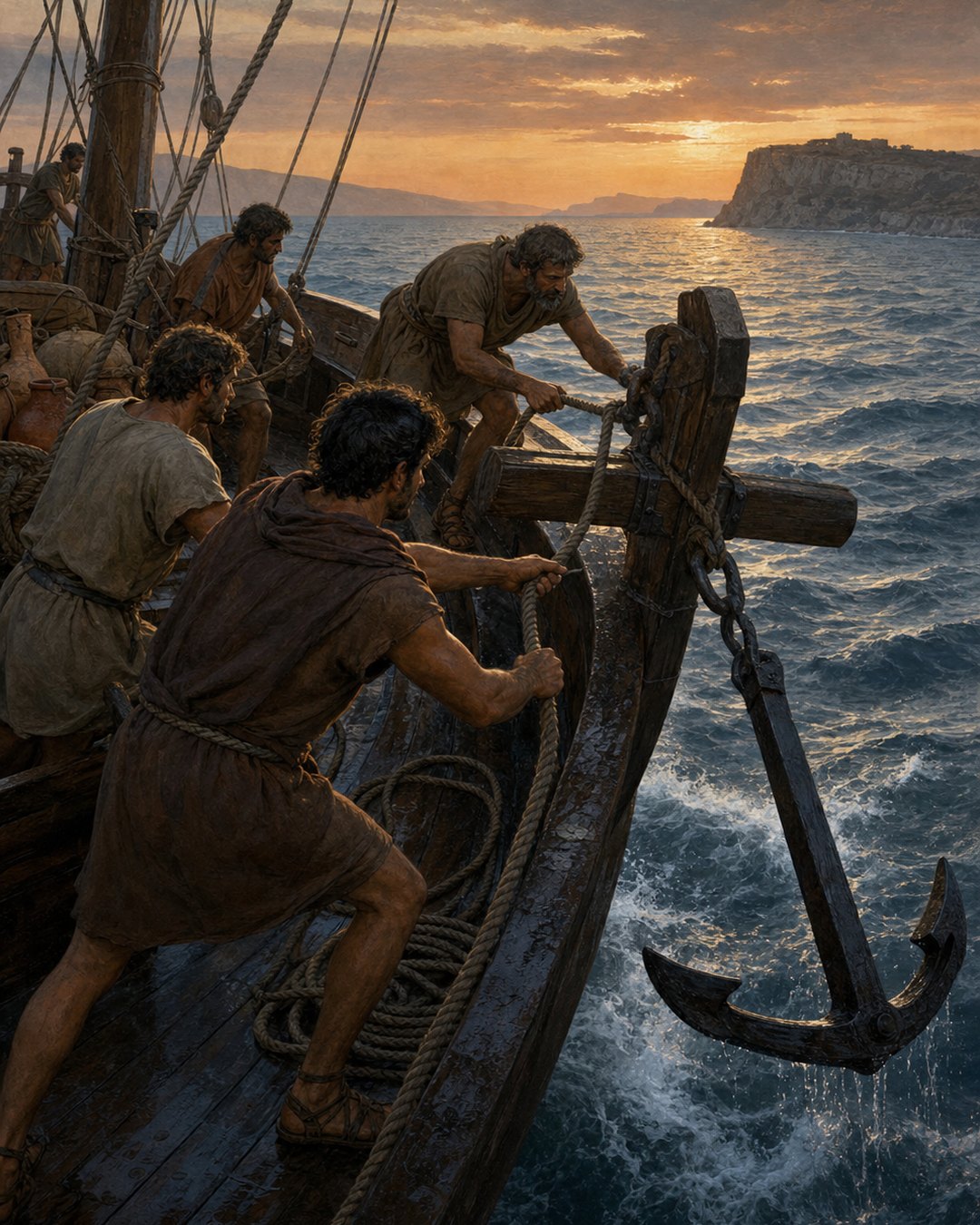
A ship could lower a heavy anchor and still keep moving. Weight carried the device through dark water, but stopping began only when a fluke met the seabed, the stock rolled it into position and the cable pulled at an angle low enough to make it bite. Wind continued pushing every plank above.
Roman sailors therefore treated anchoring as work, not as the moment work ended. Crew paid out line, felt for engagement, watched landmarks, managed strain and prepared to reset if the bottom failed. An anchor held a vessel through a changing triangle of ship, cable and seabed. The apparent stillness at the surface was continuously made below it.
Weight reached the bottom but did not guarantee a hold
The first task was descent. Stone, lead and iron gave ancient anchors enough mass to sink against buoyant wooden parts and the resistance of water. Yet a heavy object resting flat could slide. Effective anchoring required part of the device to enter or catch the bottom rather than merely press upon it.
Arms and flukes supplied that engagement. As the vessel moved away and cable tightened, a correctly oriented fluke could dig into sand, mud or another workable bed. The buried surface then had to displace seabed material before the anchor traveled. Holding power grew from resistance around the shape, not mass alone.
A stock crossing the upper anchor helped control orientation. When one side met the bottom, the stock encouraged the body to roll until an arm faced downward. This simple geometry turned an uncertain fall into a better chance of engagement. Wood, lead and iron cooperated before the crew felt any proof at deck level.
The distinction matters because ancient images can make anchors look like symbols of static heaviness. In practice, their useful action was dynamic: fall, roll, catch and dig while the ship continued to pull. Stopping was the successful end of a designed movement rather than the opposite of movement.
The seabed decided whether the design could work
An anchor had no universal surface. Soft mud might allow deep burial but offer weak material; sand could grip well under suitable load; rock might catch an arm securely or prevent it from setting at all. Weed, debris and uneven ground could keep a fluke from reaching the layer the crew expected.
Sailors needed local judgment. Color and depth of water, coastal form, prior experience and the behavior of the cable offered clues before anyone saw the bottom. Choosing an anchorage meant selecting not just shelter from wind but a hidden surface able to receive the gear carried aboard.
Failure appeared as drift. A landmark that slowly changed alignment with another point ashore showed the vessel was not holding. Crew could feel vibration or repeated snatching through the line. The anchor might be dragging without coming free, carving along the bottom while preserving the dangerous illusion of attachment.
This dependence distinguishes the anchor from the built confidence of a Roman harbor. Walls, quays and basins reshaped an approach at enormous cost. An anchor carried a smaller, mobile attempt at control, but it still had to negotiate local geology no empire could command.
Cable angle turned the ship’s pull sideways
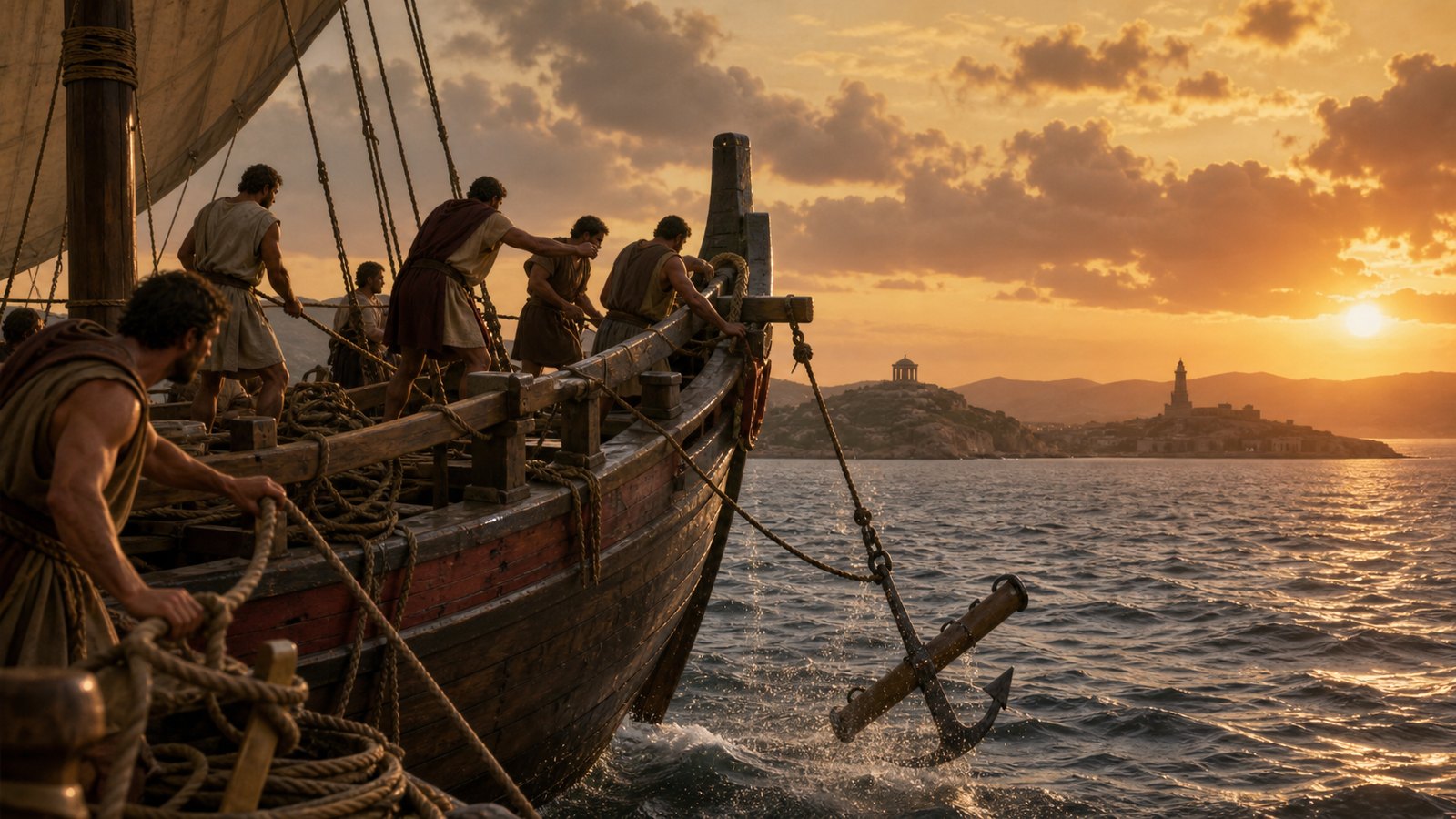
The cable connected movement above to resistance below. If it pulled nearly upward, it tended to lift the anchor and break the fluke out. More line allowed the force to approach the seabed at a lower angle, encouraging the anchor to remain buried while the vessel ranged around its attachment point.
Paying out line therefore created holding geometry. Too little left the anchor vulnerable to every rise of the bow; more scope absorbed motion and kept the pull flatter. Space limited the choice because a vessel on a long cable could swing through a wide circle as wind or current changed direction.
Rope itself added problems. Fibers swelled, stretched, chafed and weakened. A line strong in steady pull could fail after repeated shocks or abrasion at the hawse and seabed. Crew inspected worn areas, protected contact points and kept coils organized so a sudden release did not trap a foot or tangle the run.
The invisible angle made anchoring knowledge difficult to display. A visitor saw rope vanish over the side; sailors imagined the triangle beneath. Their decisions depended on forces and distances they could not inspect directly. Seamanship converted that hidden geometry into practical quantities of line, strain and room.
Setting the anchor required coordinated deck labor
Lowering uncontrolled heavy gear could damage the ship or crew. Sailors prepared cable, cleared the working area and controlled descent so coils ran without knots. At the chosen place, the vessel needed enough movement to stretch the line and encourage the anchor to set rather than dropping directly on top of it.
Hands then read the cable. A firm, steady load suggested engagement; jerks or continued movement raised doubt. Officers and experienced crew compared that feel with landmarks and depth. The decision to trust the hold came from several observations, because no single sensation proved what the fluke had done below.
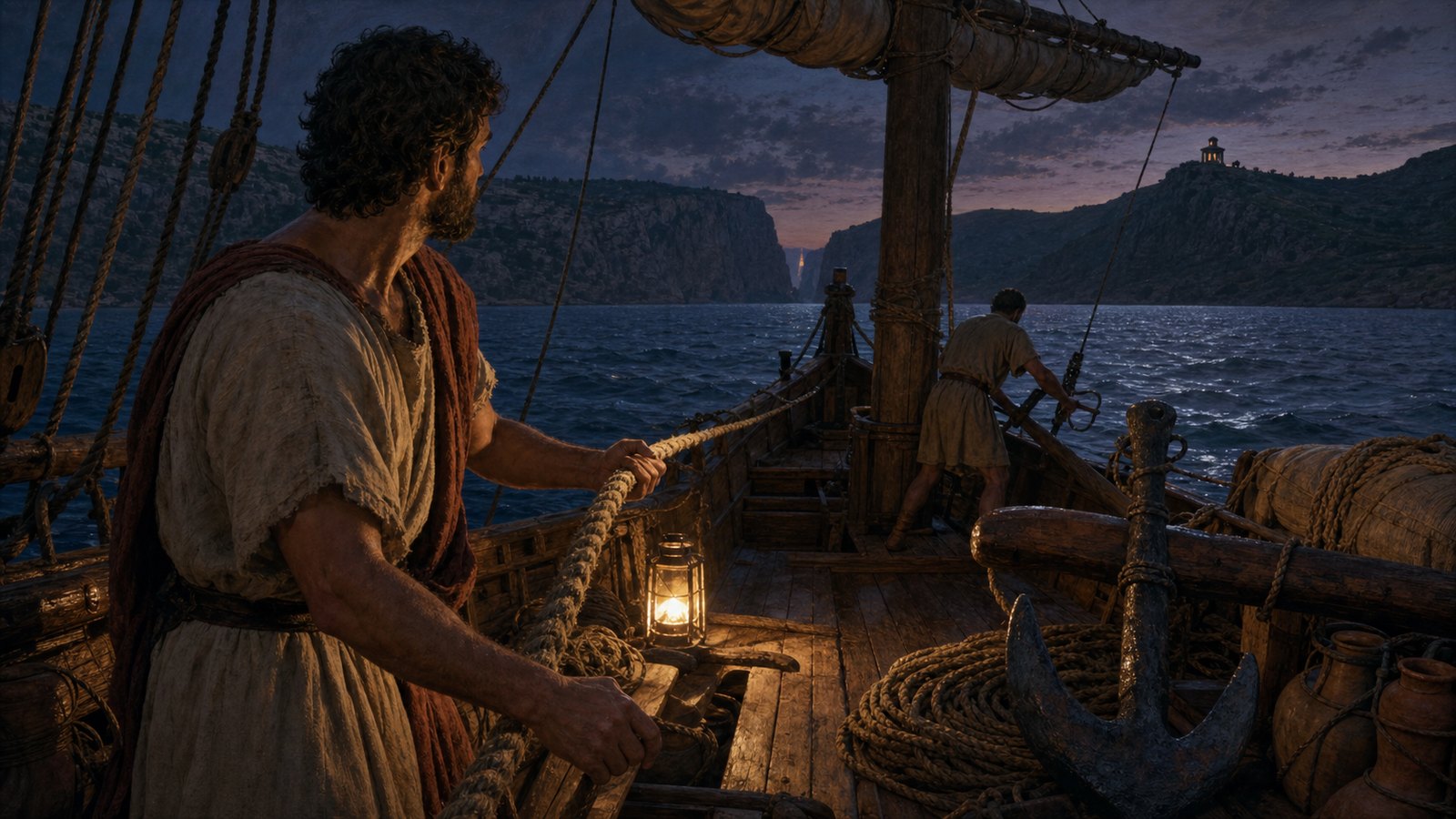
Imagine a dusk arrival: sail reduced, orders crossing the deck, wet rope moving through calloused hands while cliffs darken ashore. The anchor disappears with a splash. Moments later the cable straightens, the bow turns toward the wind and two lights on land stop sliding past each other. Only then does the noise ease.
The procedure belonged beside the infrastructure of Roman navalia. Sheds and basins sustained fleets ashore; anchoring routines sustained individual hulls where no quay received them. Both depended on practiced labor hidden behind the larger claim of Roman command at sea.
A holding ship was never completely still
Wind shifted, waves lifted the bow and current pressed the underwater hull. Each change traveled into the cable as a new load. The vessel swung around the anchor, describing an arc whose size depended on line and conditions. Nearby ships, rocks and shore had to remain outside that moving circle.
Gusts produced shock rather than simple steady force. The cable could slacken as the ship moved forward, then snap tight when it fell back. Repetition worked fastenings loose and punished rope fibers. Sailors adjusted line, altered exposure or prepared another anchor when weather exceeded the comfort of the first arrangement.
More than one anchor offered options. A second could provide redundancy, limit swing or help when the first failed to set, though deploying extra gear added cables that could foul. Carrying spare holding power consumed space and weight because the cost of losing a ship made redundancy worth the burden.
Anchoring was therefore a watch condition, not permission for everyone to sleep. Someone observed weather, shore and cable. If landmarks began to move or wind rose, the crew needed time to respond before drift turned into grounding. Stillness existed only while attention continued to renew it.
Raising the anchor reversed the hidden struggle
Departure began by hauling the ship toward the anchor. Human effort, capstan or other shipboard arrangements brought cable aboard while wet weight resisted. As the pull became more vertical, the geometry changed from holding to release. The same angle avoided during anchoring was deliberately created to break the fluke free.
A deeply buried or snagged anchor could refuse. Crew might work the vessel above it, change direction or wait for wave motion to help. In danger, saving the ship could require abandoning gear. A lost anchor represented expensive metal, wood and labor left as a permanent marker of one failed negotiation with the bottom.
Underwater finds preserve that cost. Lead stocks and iron elements survive where rope and wood disappear, revealing anchorages, wreck sites and routes of repeated use. Like amphora fragments from Roman trade, discarded ship equipment turns ordinary operations into an archaeological map after written schedules are gone.
Roman anchors made stopping a ship active work by joining mass to orientation, flukes to seabed and cable angle to crew judgment. The device did not cancel wind or current. It redirected their pull into the ground for as long as materials, bottom and attention held together. A quiet ship was a completed maneuver still under strain.
Sources & Further Reading
- Anchor
- World History Encyclopedia, Roman Navy
- Ancient maritime history