
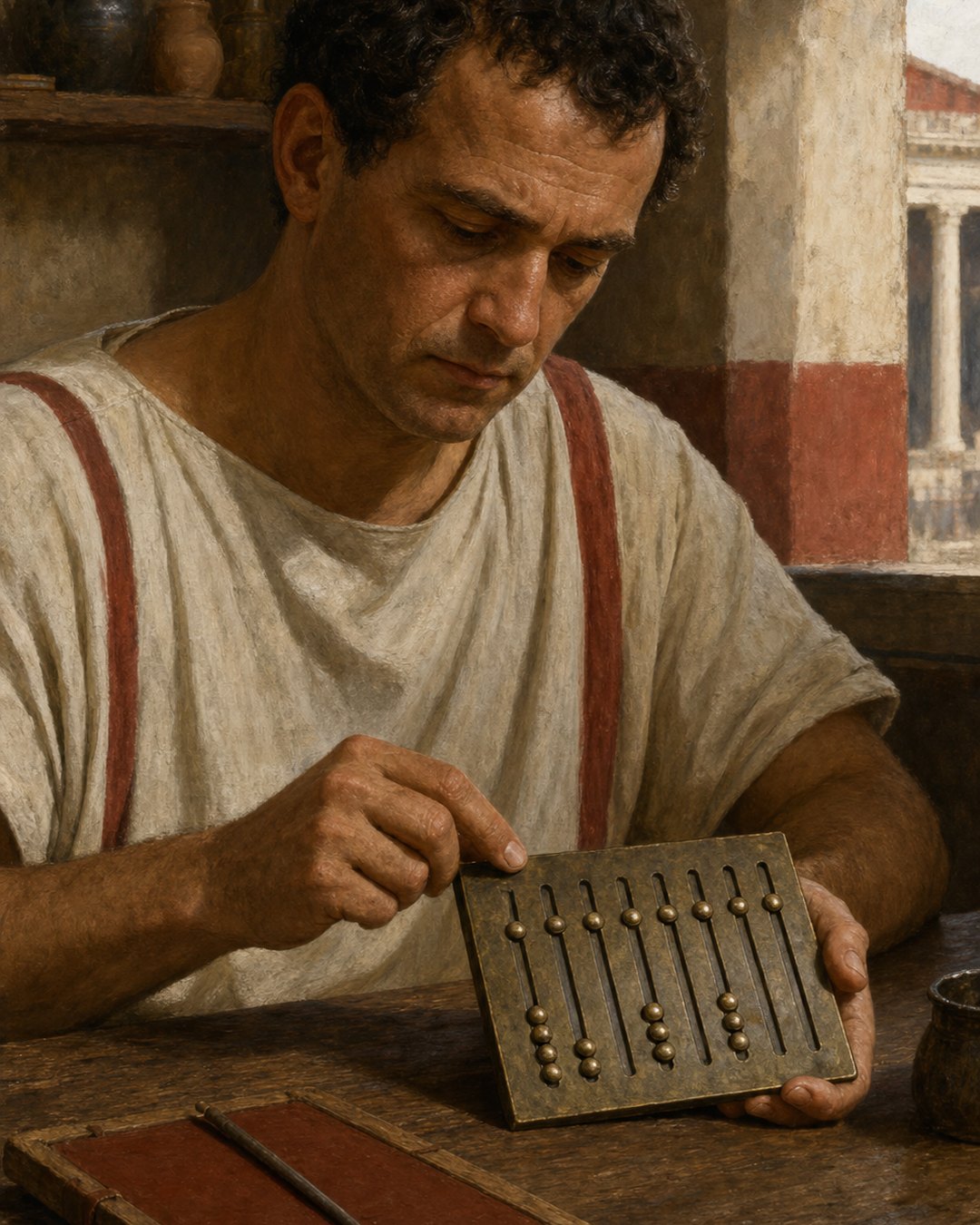
A Roman account could end as ink, but it did not have to begin there. Before a sum settled into a ledger, counters could slide through grooves beneath a clerk’s fingers. One groove represented units, another tens, then hundreds and thousands. A small piece of metal or stone had no permanent value by itself. Its position made it worth one, ten, a hundred, or more, and one short movement changed the quantity without crossing out a line.
That editability mattered wherever numbers arrived faster than clean copies could be made. Prices changed, payments were combined, loads were divided and an earlier entry proved wrong. Roman numerals were useful labels and records, but a working total needed room to move. The abacus supplied that room. It turned arithmetic into an arrangement that could be seen, touched, checked and cleared before the result passed into the more durable world of tablets and accounts.
A counter acquired value from its address
Place value is the abacus’s decisive economy. A counter in a units column stands for a different quantity from an identical counter in the tens column. The board therefore separates the material token from the number it expresses. Fingers do not need a unique object for every possible value; they need a stable map and the discipline to keep each token in the correct address.
Roman examples make this map compact. Surviving bronze hand abaci have narrow slots and moving buttons, while larger calculations could use loose counters on a ruled surface. The portable instrument held its pieces captive, an advantage in a crowded room or on a journey. A loose pebble could roll beneath furniture. A button trapped in a slot remained part of the calculation until the operator deliberately moved it.
The columns also made magnitude visible at a glance. A cluster toward the higher places announced a large total before every unit was read. Empty grooves mattered as much as occupied ones because they preserved the difference between, for example, a quantity in tens and the same number of counters in units. The board was not a bag of tokens. It was a spatial grammar for quantity.
Five-and-one groupings compressed a decimal total
A Roman hand abacus did not need nine identical counters crowding every decimal place. Its layout could represent a group of five separately from the single units below it. Combining one five-value counter with several one-value counters made values from zero through nine fit into a short groove. The next column then carried the same logic at ten times the scale.
This compact arrangement reduced motion while demanding fluency. The user had to recognize patterns rather than count every button from the beginning. One upper counter and three lower counters in the units place should be read as eight, not as four objects. The physical count and the represented count diverged, which is precisely why training made the device fast.
Exchange kept the board orderly. When units accumulated to ten, they did not remain as an unwieldy heap; they became one counter in the tens place. Subtraction reversed the process when necessary. Carrying was therefore a visible trade between neighboring columns. The hand performed a transformation that written arithmetic later compresses into a small carried mark above a line.
Fractions tied arithmetic to Roman measures
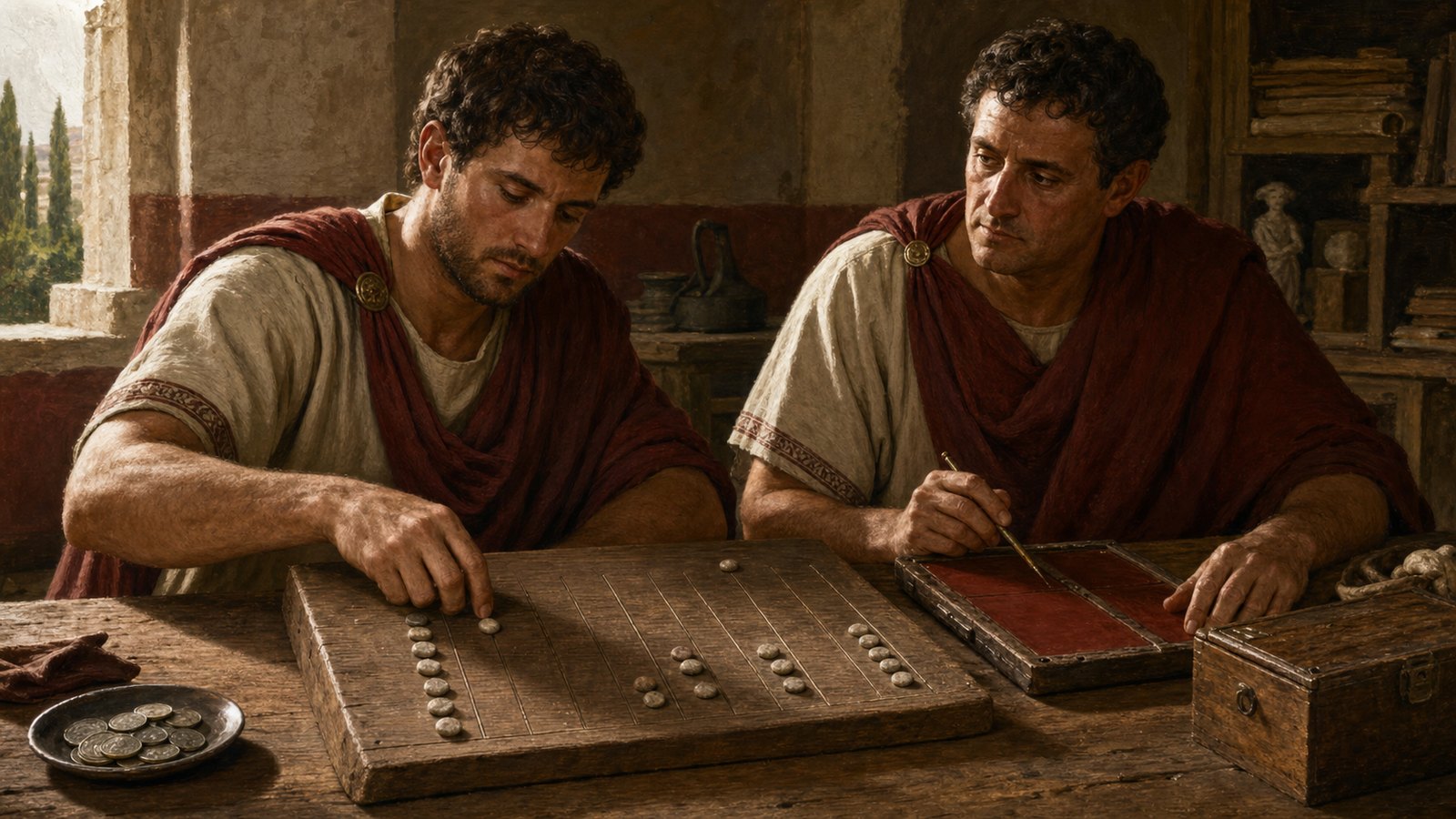
Whole numbers were only part of practical accounting. Coins, weights and measures could be divided, and surviving Roman abaci include places intended for fractional work. Their layouts reflect Roman systems rather than a modern classroom’s decimal point. A user needed to know not only how counters moved but what kind of quantity the fraction described.
This is where a generic idea of “the abacus” becomes too simple. The machine was not culturally neutral hardware waiting for any notation. Its labels, grooves and fractional positions belonged to habits of reckoning. A board useful for market payments had to meet the subdivisions its users actually named. Mechanical clarity depended on shared conventions about the unit being divided.
The link to Roman coinage was practical without making every calculation a money calculation. Coins brought denominations and quantities to the table, while weights, rations and goods created other fractions. The abacus did not certify that a coin was genuine or a measure honest. It helped the operator preserve the arithmetic after those judgments were made.
A working total could remain provisional
Writing gives a statement persistence, but persistence can become friction during calculation. Every revised written total leaves marks, erasures or another line. Counters make revision ordinary. The operator can add a payment, remove a charge, split a quantity, test a subtotal and return the board to an earlier arrangement without pretending that the first answer never existed.
This made the abacus an intermediate space between event and record. The treasury ledger preserved obligations and transactions, yet a ledger page was not necessarily the best surface for exploring every sum. Movable counters could handle the arithmetic; a clerk could then copy the accepted result into a durable account. Calculation and documentation supported one another without being the same act.
Provisional work still required trust. A careless sleeve, an interrupted clerk or an unobserved movement could alter the board. Users therefore needed routines: clear a column before beginning, name the unit, read back the arrangement and compare the final written figure. The device made errors correctable, not impossible. Its visibility invited checking only when another person understood the layout.
The hand learned patterns that the eye could audit
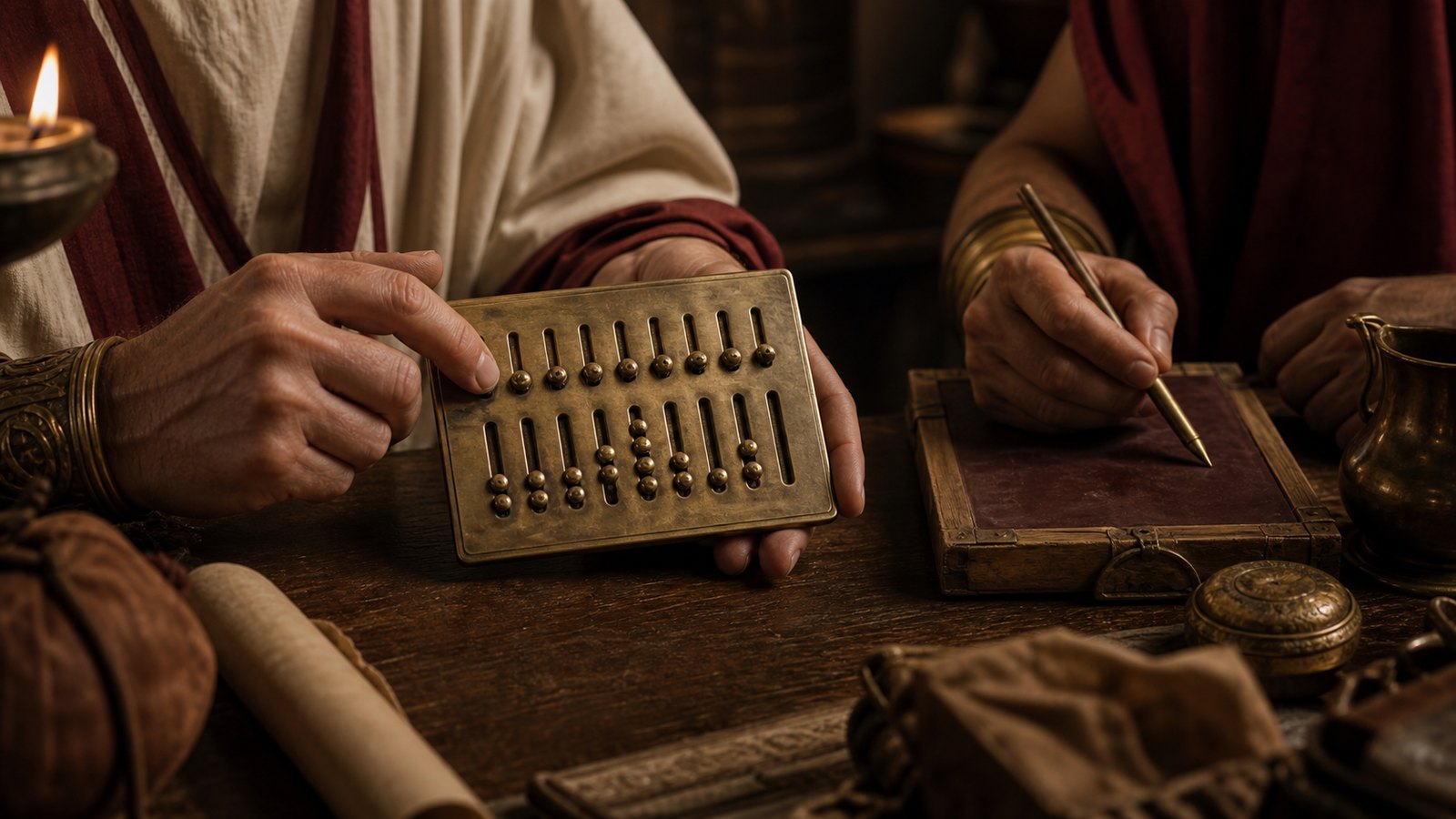
Fluency transformed the board from a slow counting aid into an instrument. Repeated arrangements became familiar shapes. Fingers learned the distance between grooves and the exchange needed when a place overflowed. This embodied knowledge reduced the need to narrate every step, much as a practiced reader stops naming each letter.
Yet the arrangement remained open to inspection. A colleague could look at the same counters and challenge the total. That differed from a calculation performed entirely in memory, where an error might survive without a physical trail. The abacus exposed the present state, though not necessarily every earlier move that produced it. Auditing began from the configuration in front of the witnesses.
The public logic resembles the Roman census at a much smaller scale. Both converted people or goods into organized quantities that institutions could act upon. The census carried legal and political consequences; the abacus merely manipulated values. Still, each depended on classification before arithmetic could appear authoritative.
Clearing the board separated calculation from memory
When the result had been checked and recorded, the counters could return to neutral positions. Clearing erased the working arrangement without destroying the written outcome. That small act explains both the strength and limit of the tool. The abacus excelled at live manipulation, but it did not preserve a chronological account once its pieces moved on.
The Roman art of keeping numbers visible therefore relied on a chain of media. Objects and obligations supplied quantities. The abacus made those quantities movable. A wax tablet or ledger preserved the accepted statement. Coins, seals or witnesses might support the transaction. No single object carried the entire burden of truth.
Grooves and counters mattered because they gave arithmetic a temporary body. Value could shift by place, groups could be exchanged, fractions could match Roman measures and mistakes could be corrected before ink hardened them into institutional memory. The instrument did not replace trained judgment or written records. It created the editable interval between them—the moment when number was still being made reliable by hands.
Sources & Further Reading
- Roman abacus
- Smith Dictionary, Abacus
- Abacus