
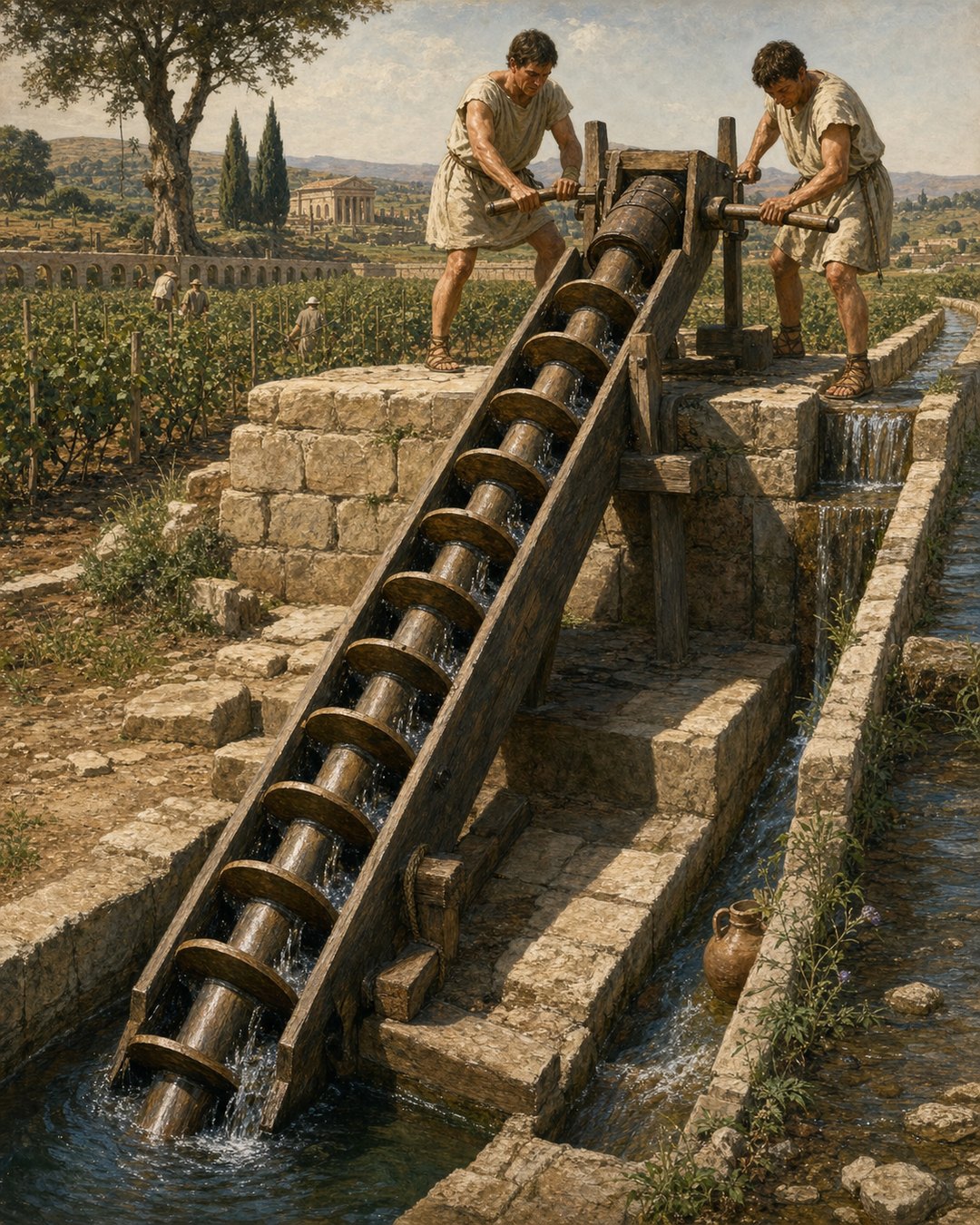
Water naturally finds the lowest available place. Roman builders and farmers often wanted it somewhere else: above a field channel, outside a wet excavation, or beyond a low basin that gravity alone could not empty. A bucket solves the problem one load at a time, but every lift begins again with an empty container and a worker changing direction. The water screw offered a different rhythm. Keep one inclined wooden mechanism turning and many small quantities climb in sequence.
The device associated with Archimedes and described by Vitruvius in Book X of On Architecture was built around a shaft, a helical path and a casing. Its lower end entered water. Rotation enclosed portions between successive turns and advanced them toward the raised outlet. Nothing inside pulled water straight upward. The screw repeatedly changed the boundaries around water while gravity kept each portion pooled in the lower side of its moving chamber.
The incline divided one difficult lift into many small advances
A vertical container must support the entire weight of its load through the full rise. The inclined screw spreads the journey along a longer path. Each water pocket advances only to the next position as the helix rotates, while the cylinder’s slope converts that travel into height. The device does not cancel the work required to raise water; it organizes that work into a repeatable motion around an axis.
Angle therefore belongs to the machine’s purpose. Lay the screw nearly flat and it gains little height over its length. Raise it steeply and each turn gains more elevation, but the shape and capacity of the trapped pockets change. The installer chose a compromise among available space, desired lift, manageable rotation and useful discharge. Geometry determined performance before the first worker took hold of the drive.
This makes the screw distinct from the aqueducts that carried water along a descending gradient. An aqueduct carefully spends height already possessed by its source. A screw adds height through labor. One protects gravity’s route across distance; the other uses rotation to push low water back into a position from which gravity can serve again.
The helix created chambers without separate buckets
Inside the casing, successive turns of the helical surface divide the wet interior into moving spaces. When the lower end rotates through water, one of those spaces admits a portion. Continued turning changes the orientation of the helix around the fixed incline, and the portion remains pooled against the lower surfaces while its boundaries progress upward. The chamber travels in effect even though no detachable bucket climbs a chain.
That continuity reduces the need to stop and reverse. A worker turning the shaft repeats one circular action. At the intake, new pockets form; farther along, earlier pockets advance; at the outlet, the highest release their water. Several stages happen during the same revolution. The screw turns intermittent human effort at one station into overlapping water movement throughout its length.
The volume is never a solid plug filling the entire pipe. Air shares the interior, and water settles according to gravity inside each helical compartment. This is why the device can leak backward yet still lift successfully. It needs enough separation and rotation to advance more water than slips past the working clearances, not a perfectly sealed pressure vessel.
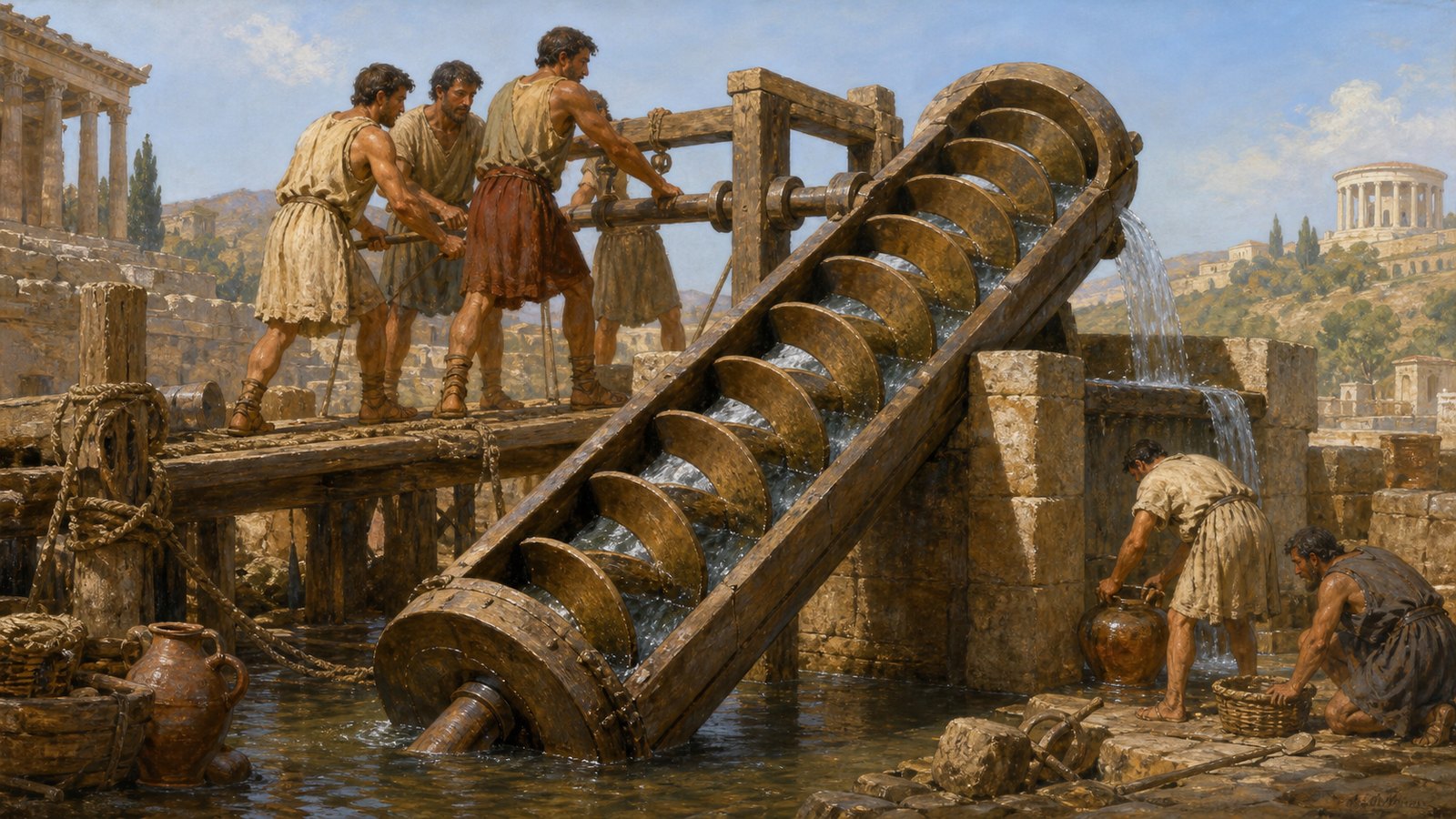
A wet intake was the beginning of every successful turn
The lower end has to meet the water at a depth and orientation that allow each chamber to fill. If the water level falls below the intake, the screw can continue turning while lifting mostly air. If debris blocks the opening, workers may feel the mechanism move without seeing the expected discharge. The machine’s output therefore begins with conditions at a point easily hidden by muddy or turbulent water.
Intake management connected operation to observation. Someone had to watch the source level, clear obstruction and recognize whether a weak outlet meant a dry intake or a fault elsewhere. In drainage, success could itself reduce submergence: as the low basin emptied, the screw that had worked well might need adjustment or the remaining water might have to be gathered toward its mouth.
The logic resembles the shipboard struggle to remove water from a bilge, but the screw uses a different moving geometry from a chain pump. Both concentrate attention on a low intake and a visible high outlet. Both also prove that a turning mechanism is useful only when water actually enters its lifting elements.
Fit controlled the argument between leakage and friction
A large gap between helix and casing allows water to escape backward around the edge of each pocket. Tighten the fit and leakage falls, but contact, swelling timber or grit can make the device harder to turn or cause it to bind. Builders needed a workable clearance rather than the abstract perfection of no gap at all. Real wood, water and wear set the terms.
Vitruvius describes timber construction arranged around a central shaft and helical course. Such a machine demanded repeated dimensions along its length. An error in one turn could narrow the path, open a leak or disturb balance. Carpentry shaped hydraulic performance: straightness of shaft, regularity of the helix and integrity of the outer casing all entered the same stream of water.
Use changed that fit. Wet wood could swell, surfaces could wear and abrasive sediment could score the path. Operators learned the ordinary resistance of the screw and the ordinary strength of its outlet. A sudden heavy turn might signal binding; easier rotation with weaker discharge might signal lost fit. Maintenance was interpretation of effort as much as inspection of parts.
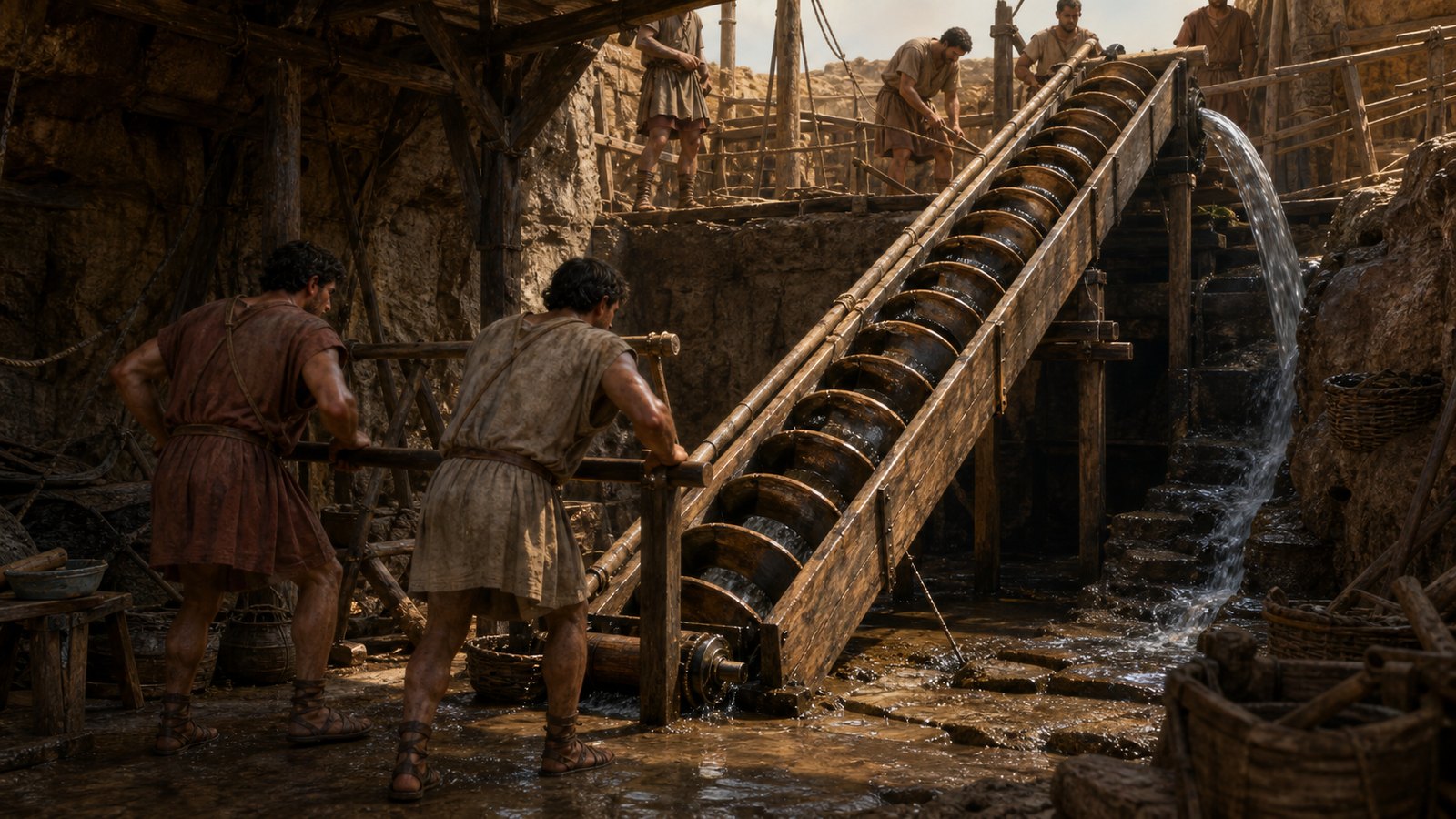
Human rotation became a continuous discharge
People could power the shaft, supplying torque through handles or by another practical turning arrangement. Their muscles did not lift visible buckets, yet every higher pocket represented work against gravity. A steady cadence mattered because slowing gave more time for leakage, while irregular force stressed construction and interrupted the outlet. The machine rewarded coordinated repetition rather than isolated heaves.
The high end made hidden movement legible. Water emerging there demonstrated that intake, helix, casing and drive were cooperating. A continuing stream could feed irrigation or carry drainage away, provided the receiving channel had somewhere lower to go. Like the outlet of a Roman street fountain, visible flow was the final expression of a much larger controlled path.
Output still had to be compared with need. A slowly refilling basin might be drained by periodic turning. A strong inflow could demand uninterrupted labor or more capacity. The screw did not decide when enough water had moved. Workers watched source and outlet, judged whether the level was falling, and supplied the rotation required to keep the balance moving in their favor.
The mechanism made water reusable after it reached height
Once released above, water regained the ability to move under gravity. It could enter an irrigation channel, run away from a drained space or feed another managed path. The screw’s work ended at the outlet, but the usefulness of the lift depended on what had been prepared beyond it. Raising water without a sound channel merely moved the problem to a new puddle.
This connection places the device within the broader Roman habit of joining mechanisms. The inspection of aqueducts protected long gravity-fed systems; the screw addressed a local break where source water began too low. Neither was a universal answer. Roman water management combined gradients, channels, pipes, reservoirs and lifting devices according to the obstacle in front of the builder.
The Roman water screw made uphill flow a matter of rotation because its helix repeatedly changed where a portion of water could settle. Incline converted travel into lift, close fit limited retreat, workers supplied torque and the outlet returned water to gravity. Its intelligence lay in refusing one impossible leap. The machine built height from a chain of small advances and kept building it for as long as the shaft turned.
Sources & Further Reading
- Archimedes’ screw
- Archimedes screw
- Vitruvius, On Architecture, Book X