
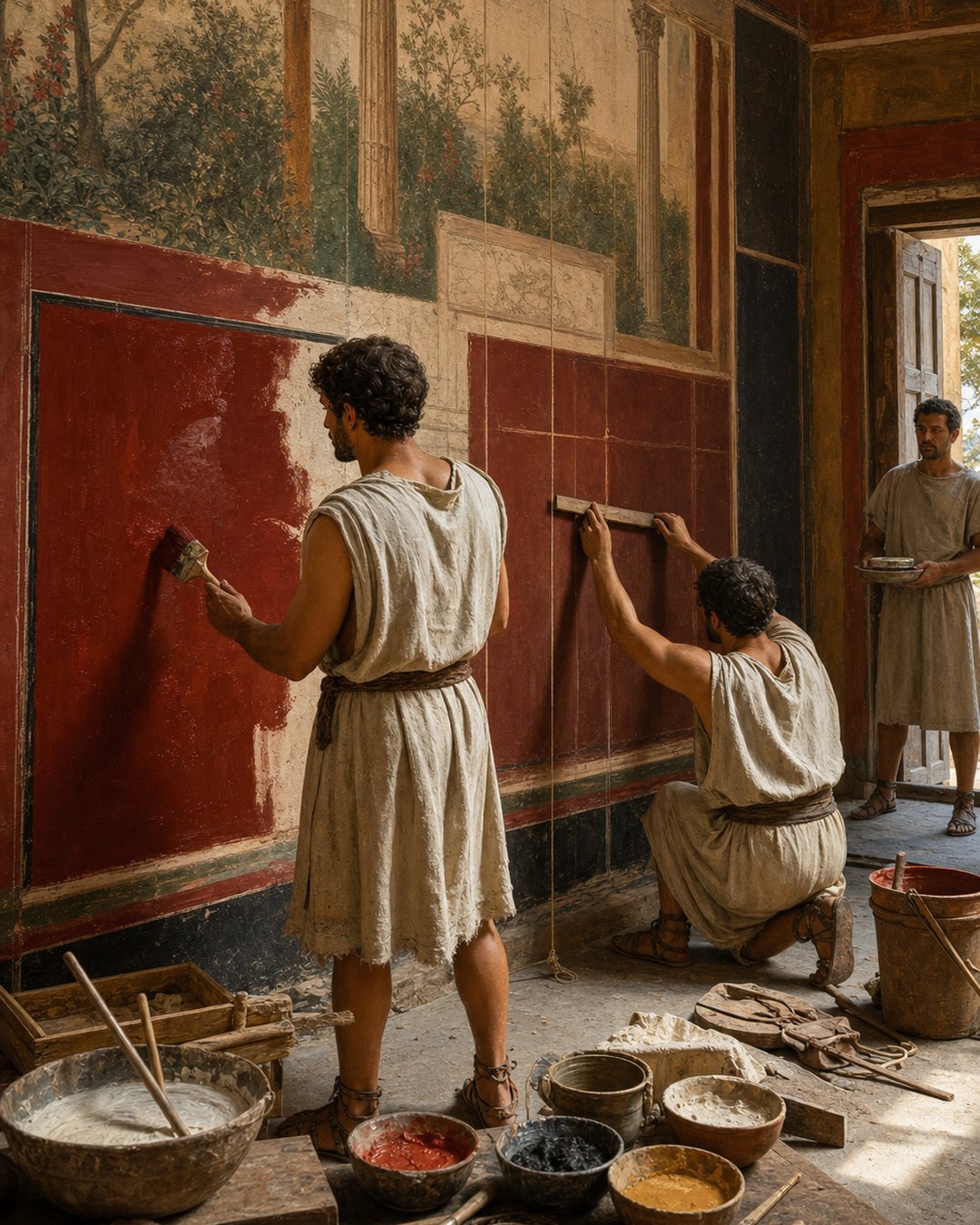
A Roman painter working on fresh plaster could not postpone the sky until tomorrow. The smooth surface was already changing beneath the brush. As lime-rich plaster set, pigment applied with water could bind into it; when the working area dried, the same opportunity closed. A wall-sized scene therefore began as a race managed through preparation.
The rooms preserved around Vesuvius make the finished result look effortless: red fields divided by fine lines, impossible columns, gardens that seem to open beyond masonry, tiny still lifes, gods, landscapes, and theatrical architecture. Behind that illusion stood layers of mortar and plaster, crews with different skills, straightedges, cords, palettes, and a planned sequence of daily work.
Vitruvius described elaborate preparation for polished wall surfaces, including repeated coarse and fine layers. Archaeology shows variation rather than one universal recipe, but his concern captures the mechanism. Roman painting did not merely cover a wall. It built a controlled skin whose chemistry, flatness, and timing determined what the room could become.
The Mason Made the Painter’s Surface
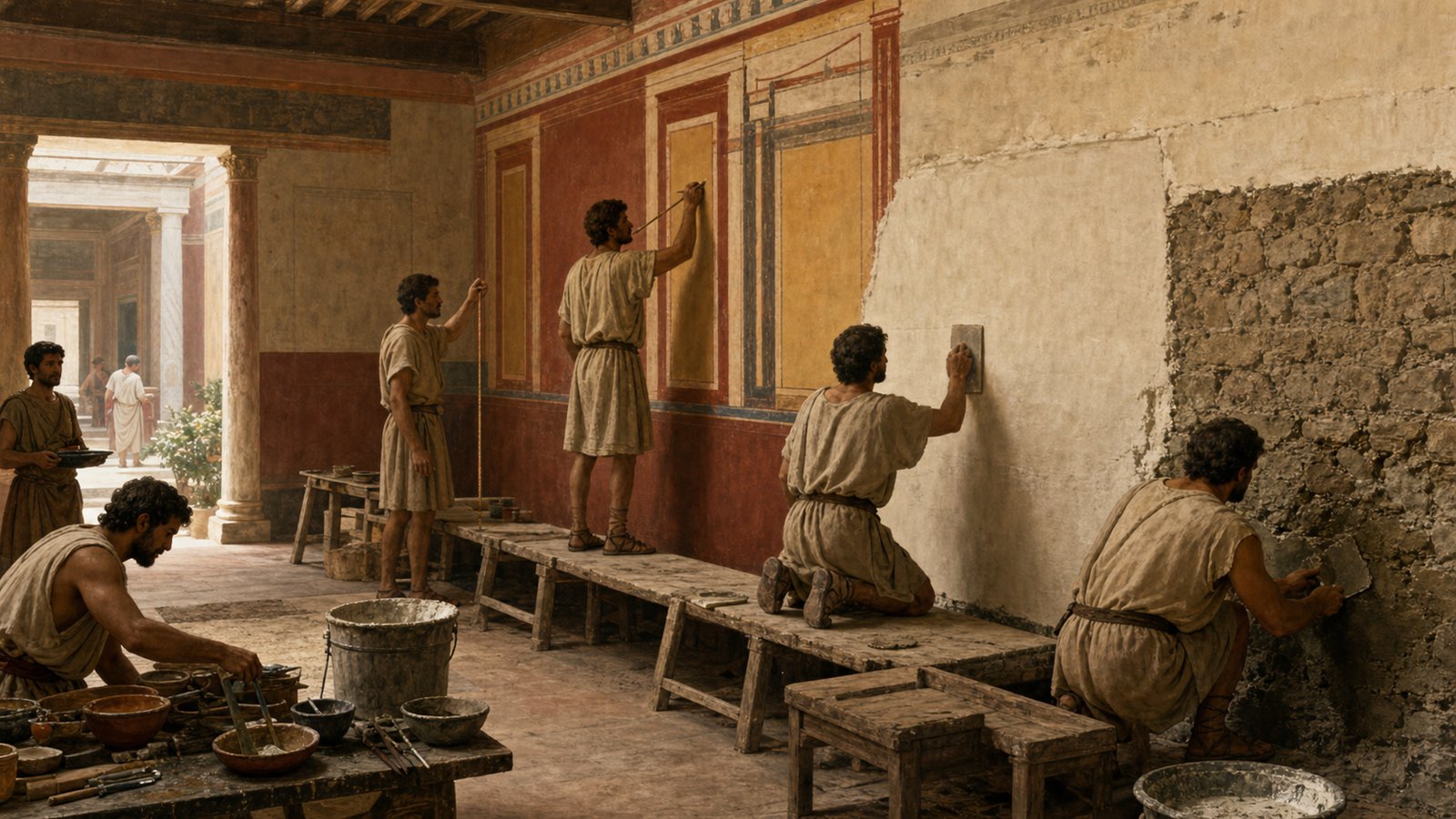
A bare masonry wall was too rough and absorbent for the refined interiors seen at Pompeii. Workers first corrected irregularities with mortar and successive plaster coats. Coarser layers provided body; finer lime-rich layers created a smoother face. Each stage managed cracks, moisture, and the geometry inherited from stone or brick beneath.
Vitruvius recommended multiple coats and careful polishing for high-quality work. His ideal may exceed common practice, especially in modest houses or hurried repairs, but it shows that elite finish depended on labor hidden from view. A mirror-like painted surface began with repeated spreading, leveling, and compression. Crews also had to respect the building itself. A settling wall could split an expensive scene, trapped moisture could stain it, and a coarse grain left beneath the finish could catch raking daylight after every color was applied.
The sequence required judgment about readiness. A lower coat needed enough firmness to support the next without remaining so wet that the layers slumped together. Corners, door frames, and junctions concentrated difficulty because planes had to meet cleanly while the plaster remained workable. What visitors later admired as polish was evidence of many earlier decisions that no painted god could conceal.
This invisible support resembles the roof system in our article on Roman roof tiles. The visible terracotta worked because layers overlapped according to a rule. A painted wall likewise succeeded because its layers controlled what water, weight, and time did next.
Wet Plaster Turned Time into a Material
In true fresco, pigments mixed with water are placed on damp lime plaster. As the surface carbonates, color becomes integrated with the setting skin rather than resting only in a separate glue. The painter receives durability in exchange for a deadline. Only the area that can be finished while workable should be prepared.
Roman walls could combine fresco with additions made after drying. Details, vulnerable colors, or corrections might be applied with binders in a secco technique. Modern analysis distinguishes materials that ancient viewers experienced as one image. The boundary reminds us not to force every surviving stroke into a single method.
Work divisions visible in plaster joins can reveal planned sections. A crew could complete a broad field, architectural framework, and central figure at different speeds. Timing became organization: plasterers stayed ahead without outrunning painters, while painters sequenced backgrounds before fine details blocked access.
Pigments Came with Different Behaviors and Prices
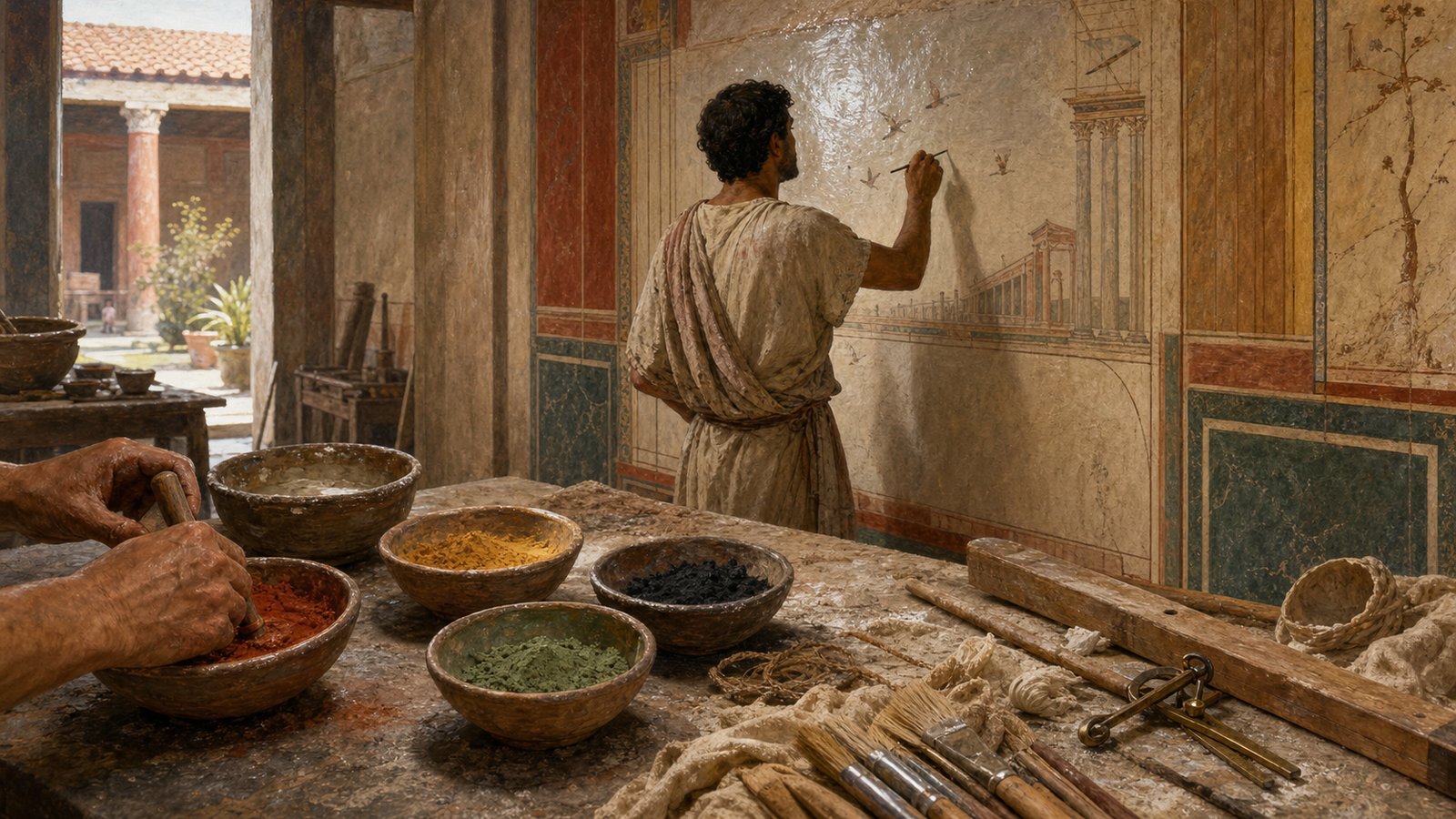
Mineral earths supplied durable reds, yellows, browns, greens, white, and black. Soot or char could produce black; iron-rich materials supplied ochres; copper compounds could produce greens and blues. Some colors were common, while others were costly, difficult, unstable, or reserved for emphasis.
Vitruvius discussed natural and manufactured pigments and warned about substances that reacted badly in particular conditions. Ancient recipes are not always easy to match with modern chemical names, but the concern is practical. A brilliant sample on a palette was useless if damp, lime, light, or incompatible materials destroyed it on the wall.
The costly dye process described in our article on murex purple belonged mainly to textiles, not a bucket of ordinary wall paint. Roman interiors could evoke luxury through color relationships without literally coating every red panel in the most famous purple dye.
Lines and Grids Built Impossible Architecture
Roman painters used cords, straightedges, compasses, and measured marks to divide large surfaces. Fine incisions or snapped guide lines survive beneath paint. These tools kept panels level across a room and allowed repeated borders to meet at corners where a freehand drift would become obvious.
Once the framework was secure, painters could make masonry seem to disappear. Columns projected where none existed; painted windows opened onto gardens; miniature buildings balanced on impossibly thin supports. Perspective was not governed by one modern vanishing-point system, but selected diagonals and shadows produced convincing zones of depth.
The wall therefore worked at two distances. From across the room, broad fields and architecture ordered the space. Up close, birds, fruit, masks, vessels, and figures rewarded inspection. The technical sequence had to protect both scales, leaving room for a specialist hand without losing the measured whole.
A Room Could Be Repainted When Ambition Changed
Wall painting was attached to architecture but not permanent in the way modern survival can imply. Owners remodeled, tastes changed, smoke accumulated, plaster cracked, and new occupants covered older schemes. Archaeologists sometimes find one decorative phase lying directly over another.
Redecoration could advertise money or cultural fluency. Mythological scenes suggested education; garden views manufactured calm; architectural fantasies enlarged confined rooms; small still lifes displayed abundance. Meaning came from placement as well as subject. An image beside a dining couch addressed different behavior from one in a corridor.
The social function parallels Roman floor mosaics, but the crafts controlled different surfaces. A mosaic endured feet through tesserae and mortar. Wall painting used light, vertical sightlines, and uninterrupted fields to make the enclosure itself perform.
The Buried Cities Preserved a Working System
Pompeii and Herculaneum dominate modern discussions because the eruption of AD 79 sealed extensive interiors. Their preservation is extraordinary but geographically and chronologically selective. Roman wall painting existed across the Mediterranean and provinces, in houses, tombs, villas, shops, baths, and public buildings.
Style classifications help scholars describe changes around the Bay of Naples, from simulated masonry to architectural vistas and increasingly intricate decorative fields. They are analytical tools, not rulebooks that every painter followed on the same date. Workshops borrowed, mixed, repaired, and adapted schemes to budgets and rooms. A patron might spend heavily on a reception room seen by guests while accepting faster work in a service corridor. Differences inside one building can therefore record social geography as well as changing fashion.
The preserved surfaces also keep traces of collaboration. A minor border, a repeated panel, and a delicate central scene need not come from one hand, even when they form one design. Workshop practice let experienced specialists concentrate on demanding figures while other painters established fields and ornaments. Attribution is difficult, but variation in touch is evidence that a room could be a collective product.
The durable lesson lies under the named styles. A Roman painted room was produced by coordinated construction, chemistry, measurement, and speed. The final illusion invited a viewer to forget the wall. Its makers succeeded only because they understood the wall more intimately than anyone else in the house.
Sources & Further Reading
- The Metropolitan Museum of Art, “Roman Wall Painting”
- World History Encyclopedia, “Roman Art”
- Vitruvius, On Architecture, Book 7
- Encyclopaedia Britannica, “Fresco Painting”