
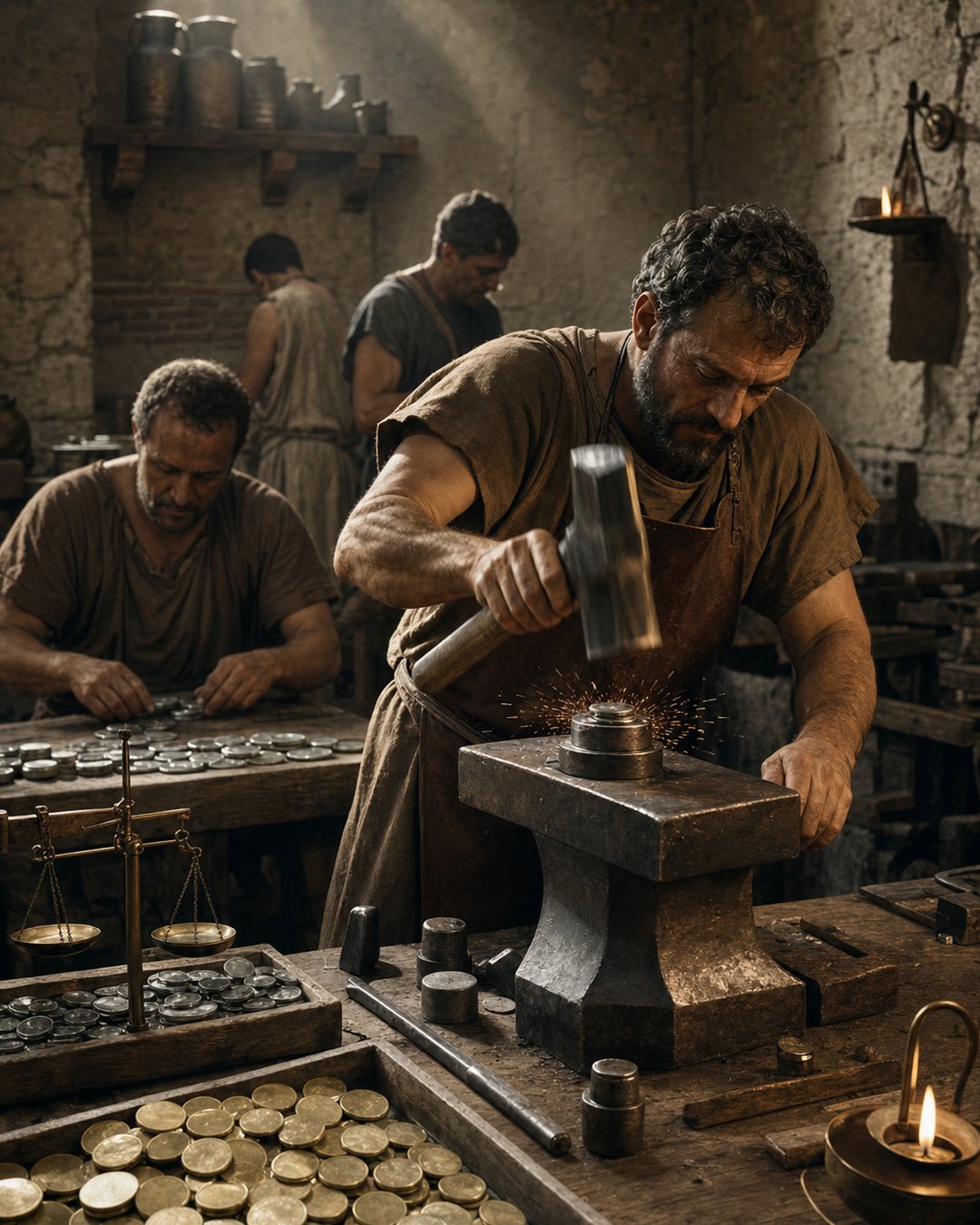
A Roman coin began as an awkward little piece of metal. It might have the right alloy and roughly the right weight, but it had no face, legend or claim to authority. In the mint, a worker placed that blank on an engraved die, positioned a second die above it and trusted a hammer blow to make both sides appear at once.
The operation was quick only at the final instant. Ore, bullion or recalled metal had been refined and alloyed. Blanks had been cast or cut, adjusted and sometimes heated. Engravers had cut designs in reverse into hard dies. Inspectors had to notice weak strikes, cracks, poor weight and dies worn past useful service.
Coins seem mechanically uniform when spread across a museum tray. Look closely and the workshop returns: off-center portraits, doubled lines, edge splits and changing die details. Roman money carried official images because thousands of individual hand operations made repetition reliable enough.
The Mint First Had to Control the Metal
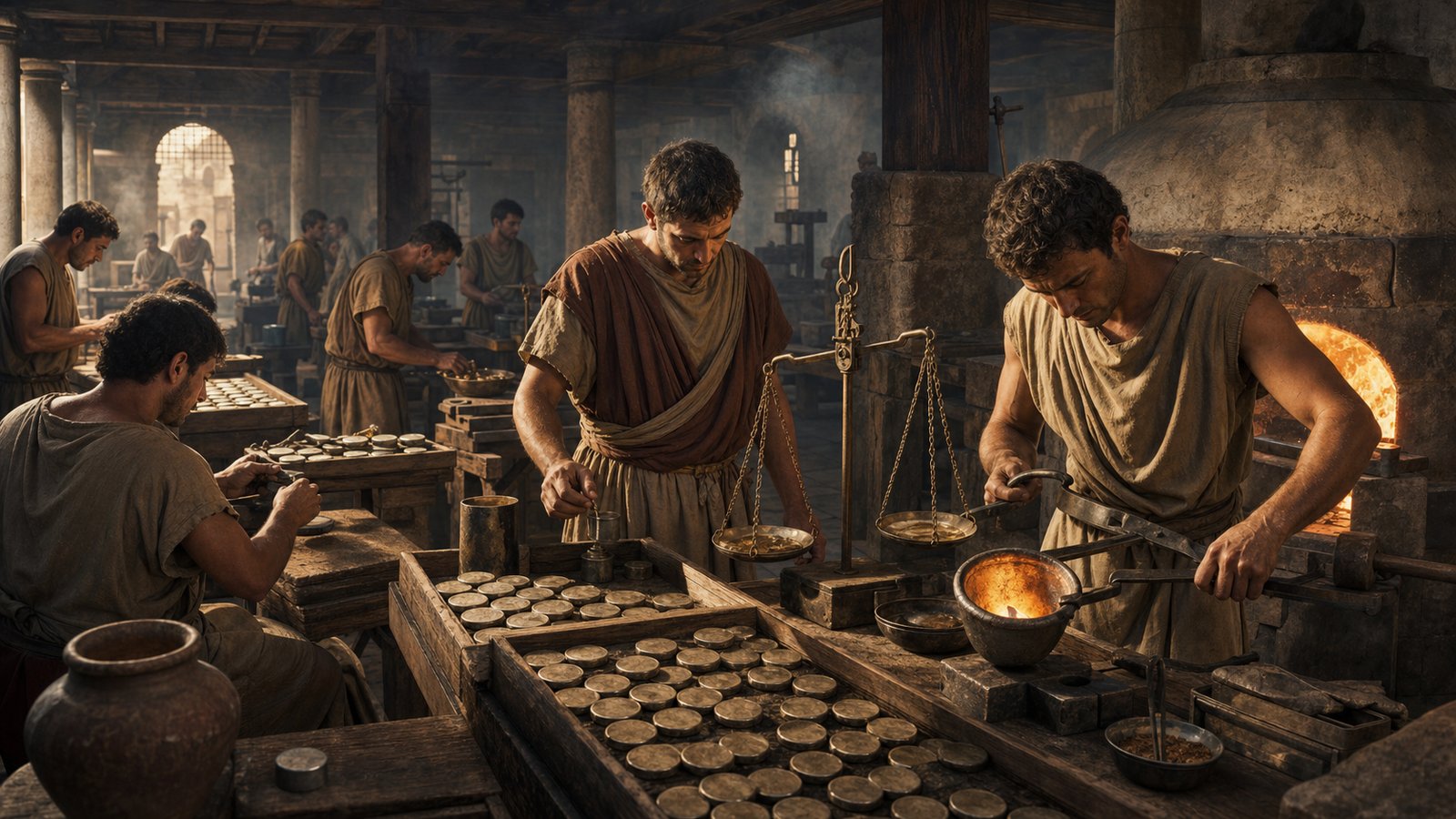
Gold, silver, copper and copper alloys presented different costs and working properties. Authorities specified denominations, but actual production had to turn metal into batches with acceptable composition. Melting and alloying could combine new bullion, older coins and scrap while losses, contamination and fraud remained constant concerns.
Control of metal was political as well as technical. A change in weight or precious-metal content affected how far a reserve could be stretched and how users judged the issue. The workshop could not separate metallurgy from public trust, even if most people never saw a furnace.
The message discussed in Roman coin imagery therefore began with a material promise. A portrait could proclaim victory, but the flan beneath it still had to feel and weigh like money others would accept.Assaying and accounting framed the furnace. Metal entering a batch represented recoverable value, and sweepings or clipped waste could be collected for remelting. A mint floor was not ordinary rubbish: filings, droplets and rejected blanks all belonged to an inventory that officials had reason to watch.
Blanks Had to Be Made Before They Could Become Coins
Coin blanks, often called flans, could be cast in molds, cut from prepared metal or produced through methods that varied by place and period. Each needed enough volume to fill the dies without becoming so large or heavy that the issue exceeded its standard.
Workers trimmed, filed or otherwise adjusted pieces outside tolerance. Heating could soften a blank and make it flow more readily under the dies, though practices differed among metals and mints. Temperature also had to remain controlled: an overheated or oxidized surface did not guarantee a clean impression.
Blank preparation explains irregular edges. Ancient coins were not punched by a modern press from perfectly uniform sheet. Their circles can be broad, narrow, oval or cracked while still belonging to an official issue. The mint pursued a usable range, not machine-age sameness.Weight adjustment could leave physical marks before the design arrived. A flan that needed reduction might be clipped or filed; one outside acceptable limits might return to the melting process. Such correction cost time, so consistent molds and measured portions improved the rhythm of the striking team downstream.
An Engraver Cut Every Letter Backward
The die carried the design as an incuse negative. An engraver cut letters, symbols and portraits in reverse so the struck coin would read correctly. Relief depth mattered: shallow work disappeared quickly, while excessive recesses demanded more metal flow and could trap the blank.
Lower dies commonly sat fixed in an anvil or support. Upper dies received the hammer and therefore endured different stresses. A matched pair did not necessarily die together. When one failed or wore out, a replacement could create a new die combination that modern numismatists can trace.
Die cutting made style visible at human scale. Two issues could proclaim the same ruler yet show different hands, letter forms or proportions. Official authority supplied the type; an engraver translated it into steel or bronze small enough to fit beneath a thumb.Space forced compression. A long title had to curve around a portrait, symbols had to remain recognizable after wear, and the highest points could not demand impossible metal movement. The engraver designed not only an image but an image expected to survive impact, handling and thousands of impressions.
The Striking Team Had One Moment to Align the Design
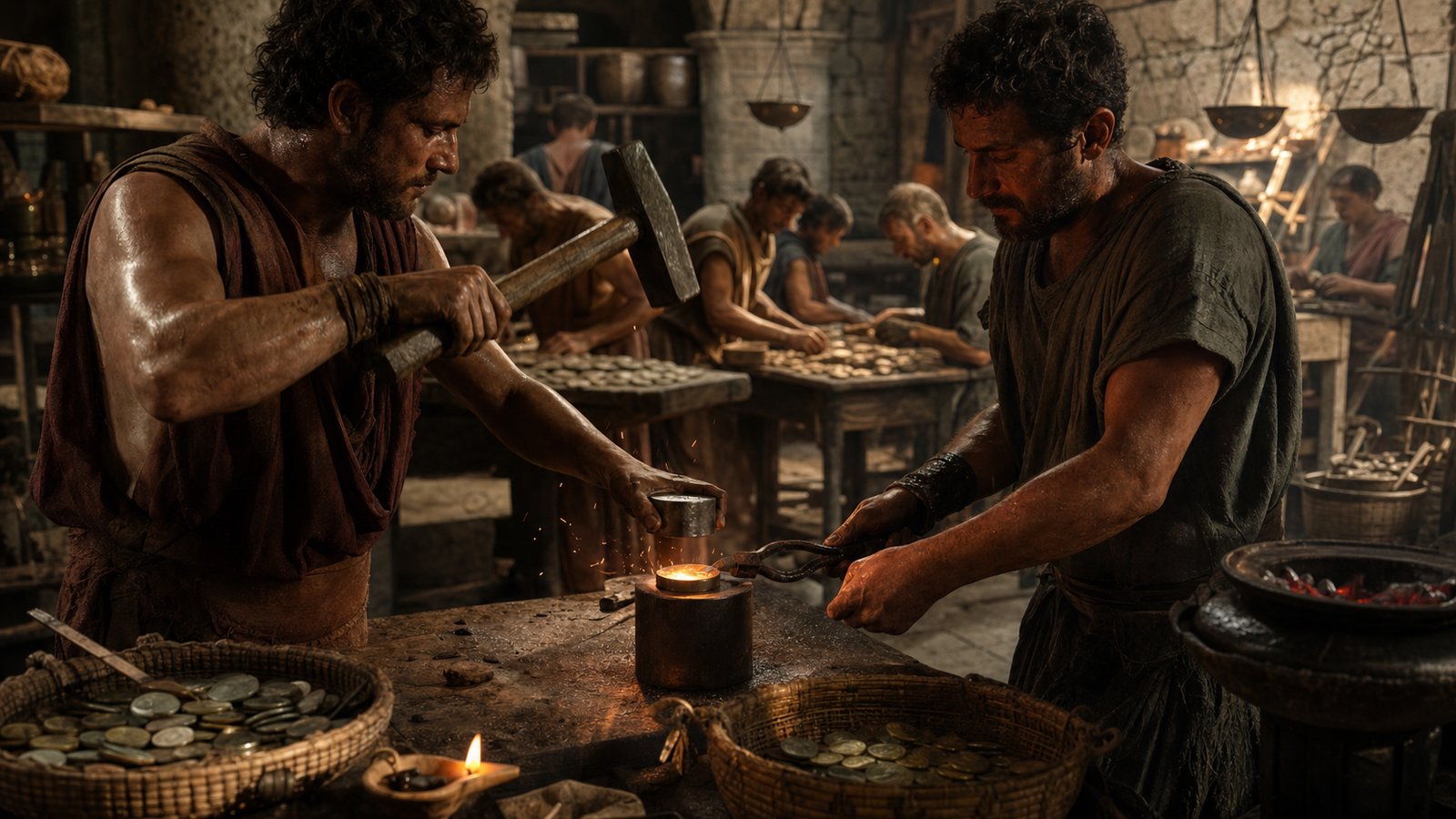
A worker placed the blank on the lower die. Another positioned the upper die, often with tongs or by a holder, and a striker delivered one or more blows. The metal spread into the engraved cavities, raising an image on both sides while also expanding toward the edge.
Alignment could slip. An off-center blank left part of the design beyond the metal. A moving upper die produced doubling. An uneven blow filled one area sharply and another weakly. These were not mysteries after circulation; they were frozen evidence of bodies, timing and tools at the striking station.
The hammer logic differed from the leverage of the Roman steelyard. The balance stretched judgment over a beam; the mint compressed force into an instant. Yet both required calibrated handling before an object could circulate with confidence.The team also managed pace. Striking too slowly reduced output, but hurried placement endangered fingers and multiplied poor alignments. Repeated roles allowed one worker to feed blanks, another to hold or position the die, and another to strike with a familiar arc and force.
Dies Wore Out While the Issue Continued
Repeated blows flattened fine details, widened cracks and stressed the upper die. A die could begin sharp and gradually produce softer coins. Cracks might print raised lines on later strikes, allowing scholars to reconstruct sequences from progressive damage.
Workers polished, repaired or retired tools according to condition. A broken die interrupted output and could injure the team. Production planning therefore included engravers and replacement dies, not just metal and hammer labor. High-volume issues consumed design tools as surely as they consumed fuel.
Die links connect coins struck from the same tool. If two coins share one side but differ on the other, the surviving common die reveals how pairs changed. Modern study can turn tiny repeated scratches into a map of ancient workshop organization.Wear was not perfectly smooth. Dirt, a chipped edge or metal adhering inside a recess could alter the next impression abruptly. Cleaning restored some clarity; recutting changed details more permanently. Coins from one die could therefore preserve several recognizable states rather than one fixed appearance.
Inspection Made a Struck Disk Officially Usable
After striking, workers checked weight, appearance and obvious defects. Some flawed pieces could be remelted; others entered circulation despite imperfect centering because their metal and recognizable type remained acceptable. Standards existed alongside practical tolerance.
Security depended on controlling dies and output. An engraved die was a compact instrument of authority, capable of making unofficial metal look official. Mints therefore operated within administrative structures, and marks or stylistic groups can point to places, workshops and production phases.
One hammer blow carried an empire only because everything around it had already been arranged: metal, weight, blank, reversed image, die pair and trained hands. The coin left with scars of that moment. Its repeatable authority was never effortless uniformity; it was disciplined variation made fast enough to fill purses, pay soldiers and cross provinces.Circulation then tested the workshop result. Raised hair, wreaths and letters wore first; edges received cuts and knocks; soil altered surfaces. Enough of the type had to remain legible after this damage. Mint design was successful when a small struck object stayed identifiable far beyond the building where the hammer fell.
Sources & Further Reading
- Encyclopaedia Britannica, “Coin”
- The British Museum, Money gallery
- Wikipedia, “Ancient Roman coinage”
- American Numismatic Society, Coin production