
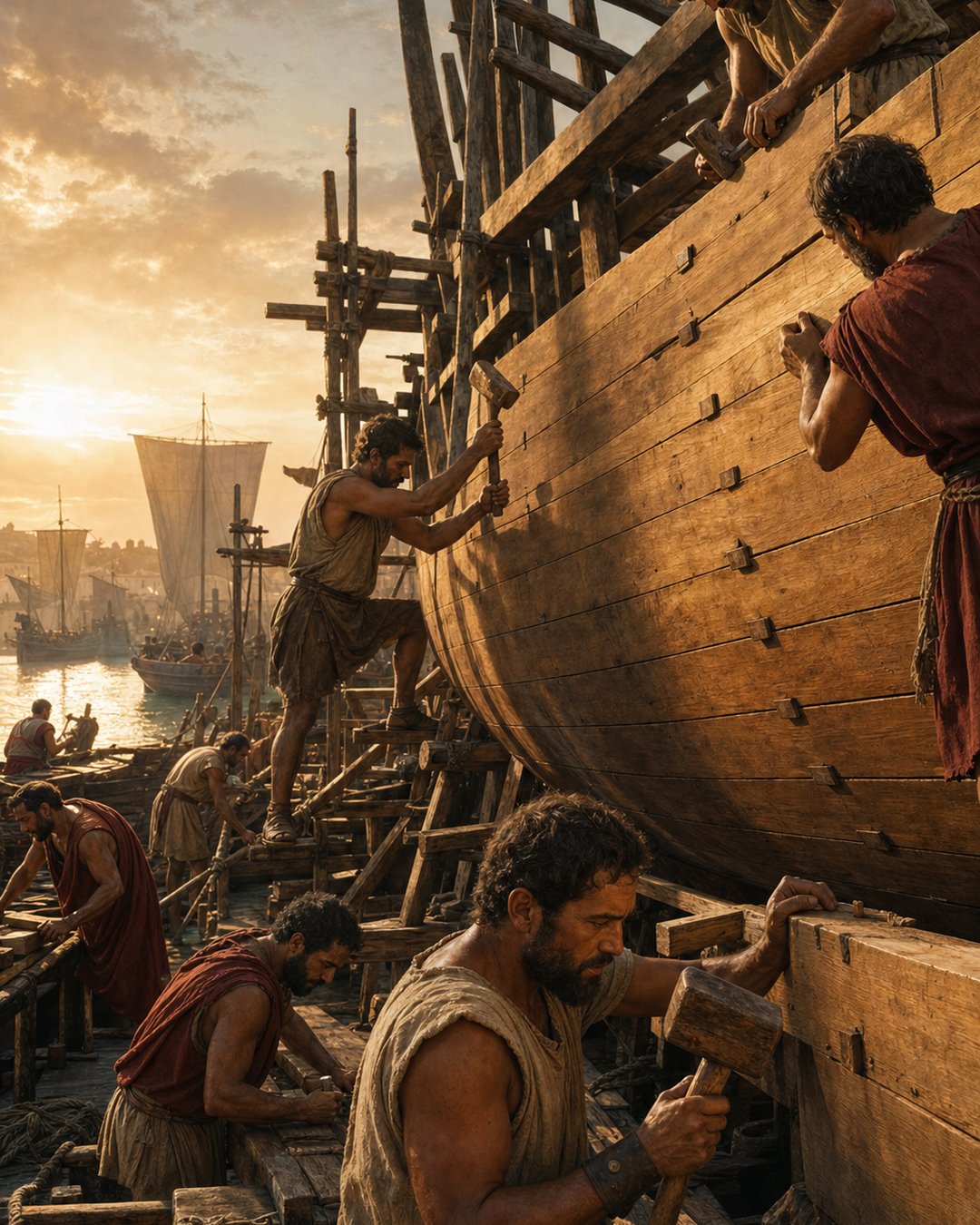
A Roman merchant hull could become a boat before it possessed the skeleton a modern observer expects. On a Mediterranean building shore, shipwrights set a keel, shaped heavy planks to its curve and locked each new strake to the one below. The fastenings disappeared as the shell rose, leaving a smooth wooden surface where the real labor was hidden.
The decisive pieces were smaller than a hand. Rectangular tenons slipped into paired mortises cut across adjoining plank edges. Wooden pegs driven through plank and tenon prevented withdrawal. Repeated hundreds or thousands of times, this joinery made neighboring boards behave less like loose siding and more like one continuous skin.
Frames still mattered, but the order reveals a different way of thinking about structure. Instead of erecting ribs and bending planks over them, many ancient Mediterranean builders established the hull form through planking, then fitted internal timbers to the shell already created. The ship began as a joined surface and acquired its reinforcement from within.
The Keel Supplied a Line, Not a Complete Skeleton
The keel and related longitudinal timbers established the lowest line of the vessel. They gave the first planks a reference and carried loads along the hull, but they did not dictate every later curve through a complete standing frame. The rising shell still depended on the shipwright’s control of plank shape, edge fit and symmetry.
Building supports held the work clear of uneven ground while wedges and shores resisted movement. A harbor beach or shipyard had to offer room for timber, shaping, lifting and eventual launch. The hull under construction was both product and workplace: every added strake changed where people could stand, brace and measure.
Timber selection began long before assembly. Keel pieces needed length and resistance to bending; planks needed sound grain and enough width to survive shaping; small fastenings demanded dense wood that would not crush immediately. Ancient shipbuilding used several species because one tree rarely offered every useful mechanical quality.
This production belonged beside, but was not identical to, the Roman navalia. A naval shed protected and serviced fleets. The joining process explains the physical object those institutions had to preserve: a shell made from many fitted pieces that seawater and motion tested together.
Each Plank Had to Meet a Curve Already in Motion
Carvel planking placed boards edge to edge to create a relatively smooth exterior. No plank was merely a flat strip. As it approached the bow or stern it had to twist, narrow or change curvature while maintaining contact with its neighbor. Heating, wetting, leverage and patient clamping helped timber accept the required form.
Shipwrights could not correct every error at the final seam. A slight mismatch repeated over several strakes distorted the hull and made later planks harder to fit. Templates, battens, sight lines and accumulated judgment allowed workers to compare the two sides while much of the form still existed only in their decisions.
The sensory test was immediate. A good edge fit presented continuous contact; a poor one admitted daylight, rocked under pressure or opened when clamps relaxed. Adzes and planes removed high spots in thin shavings. That careful work resembled Roman planing, but here flatness had to follow a compound curve.
Wide planks reduced the number of seams but demanded large trees and greater control during bending. Narrower pieces created more joints and more opportunities for cumulative error. The builder balanced timber supply, labor and the intended vessel, rather than following one universal plank width for every Roman ship.
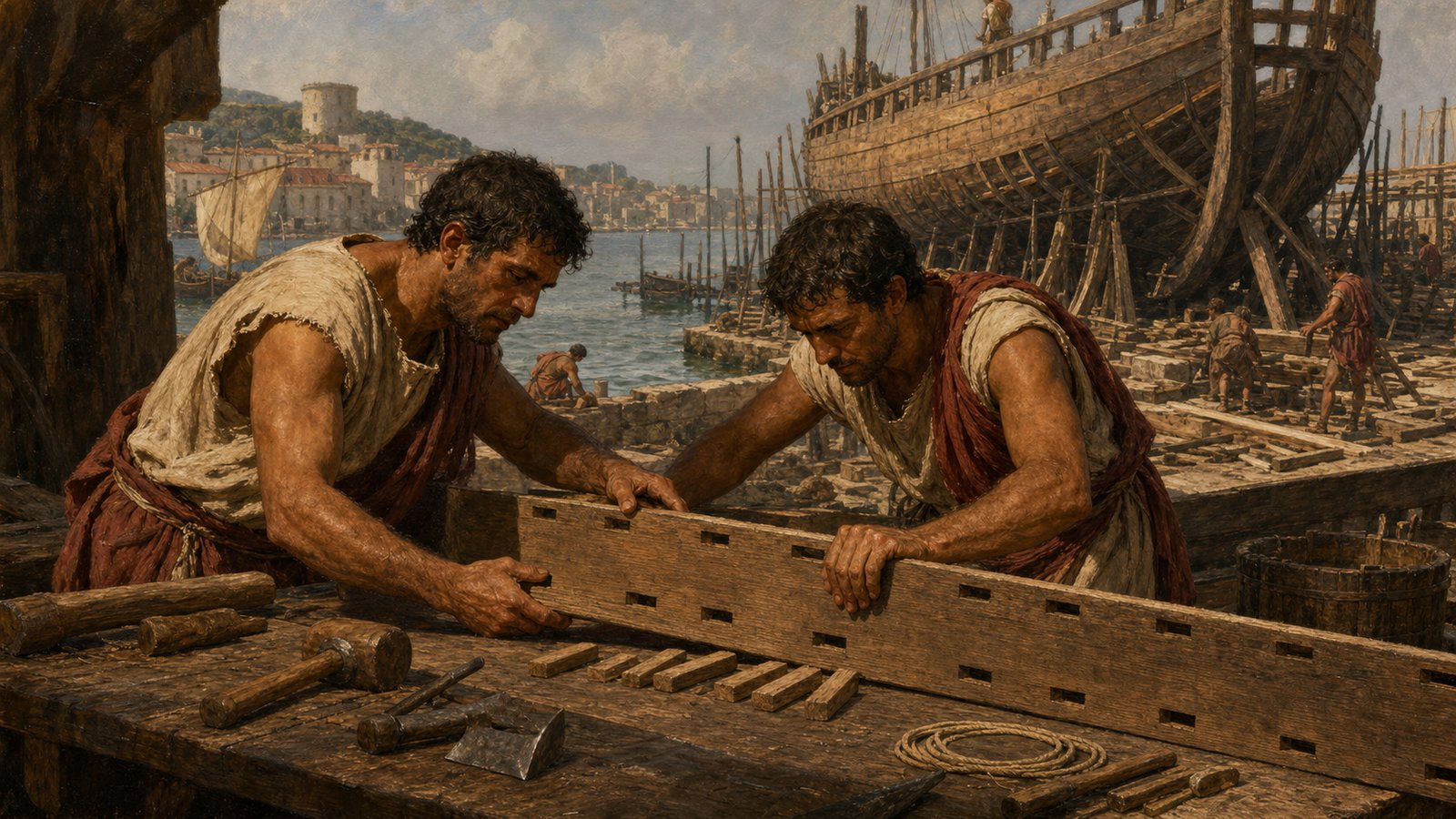
Mortises Turned Two Edges into One Working Seam
Along a plank edge, workers cut a row of rectangular mortises. Matching cavities in the adjoining plank had to align when the boards met. A hardwood tenon occupied both openings, bridging the seam internally. The exterior gave little sign of this repeated joinery after the plank faces were dressed.
Alignment mattered in three directions. A mortise cut too high failed to meet its partner; one too deep weakened the remaining plank; irregular spacing changed how force traveled along the seam. Gauges and practiced cutting kept a repetitive operation consistent even though every board followed a different curve.
The tenons were not decorative biscuits. They resisted relative movement between planks and helped transmit force across the hull surface. Dense arrays created a labor cost that archaeology can count through surviving mortises. A smooth hull therefore represented an extraordinary quantity of measured cutting hidden beneath it.
Mortise-and-tenon construction was an older Mediterranean tradition that Roman-period shipwrights inherited and adapted. Dates, regions and vessel types differed, and no single wreck represents every Roman hull. The secure point is the mechanism visible in excavated planking: edge joints could organize the shell before the inner framing was complete.
Wooden Pegs Locked the Tenons Where Iron Was Not Needed
After a tenon entered aligned mortises, a small hole through plank and tenon accepted a wooden peg. Driven tight, the peg prevented the tenon from sliding free when the hull flexed. The fastening worked across the joint while remaining compatible with the surrounding timber.
Wood moved as moisture changed. A dry peg that swelled after contact with water could tighten, but poor grain, splitting or an oversized hole could damage the joint. Shipwrights selected and oriented these small pieces with the same seriousness given to visible planks because failure at many minor points weakened an entire seam.
Iron fasteners existed in ancient shipbuilding, yet timber joinery reduced dependence on large quantities of metal and avoided placing iron at every plank edge. The system used geometry, friction and swelling. It was slow at the yard and economical at sea only when the concealed work had been done consistently.
A team could divide the rhythm: one worker marked, another cut mortises, another prepared tenons, and others lifted and clamped the plank before pegging. The finished ship erased those stations. Archaeological disassembly restores them by exposing tool marks, peg holes and sequences that were never intended for a passenger to see.
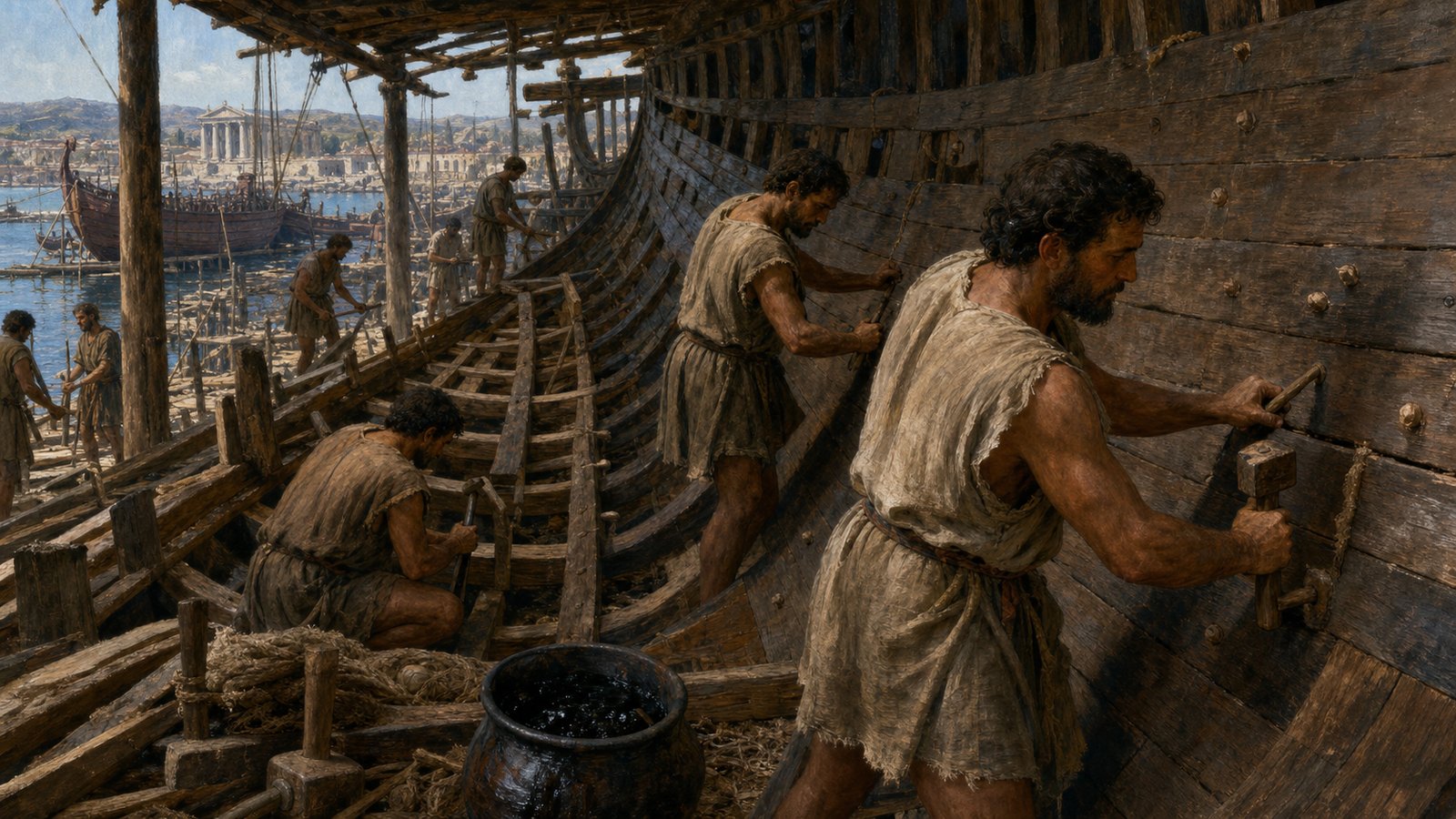
Frames Reinforced a Shape the Shell Had Already Found
Once enough shell existed, internal frames were fitted against its curve. Their role was substantial: they supported transverse shape, distributed loads and provided attachment points. Yet in shell-first practice they followed the geometry of planking rather than serving as a complete mold over which every strake had been laid.
Fitting a frame to an irregular interior required scribing and repeated trimming. Gaps reduced contact; excessive removal wasted strength. Floor timbers crossed the lower hull while futtocks continued upward in arrangements that varied by ship. Fasteners connected this reinforcement to a skin already held together at its seams.
This order helps explain why ancient wreck timbers must be read as sequences, not a pile of parts. A joint covered by a later frame was made first. A fastening driven from one side reveals access at that stage. Construction archaeology turns overlap and tool direction into a record of vanished workshop decisions.
The relationship also differs from the emergency represented by a Roman bilge pump. The pump managed water after it entered. Shell joinery, frames and seam treatment were the prior defense, intended to keep the moving hull coherent enough that leakage remained manageable.
Caulking, Pitch, and Launching Tested Every Hidden Decision
Even tightly fitted timber seams could admit water. Fibrous material and resinous compounds helped seal joints, with methods varying across time and construction tradition. Waterproofing did not replace structural joinery: a soft seal could fill a narrow path, but it could not make two badly secured planks share the forces of a working sea.
Inside the completed hull, ceilings, partitions and cargo fittings concealed more of the primary structure. Outside, protective coatings and marine growth altered the surface. The merchant saw capacity; the sailor felt motion; the shipwright remembered the mortises now inaccessible between water and cargo.
Launching converted the yard’s assumptions into a floating test. Supports were removed in sequence, the hull entered water and buoyancy redistributed its weight. Seams swelled, rigging loads arrived and waves began twisting a structure that had previously rested on land. Correction remained possible, but the easiest access had ended.
A Roman ship held together before its frames went in because its shell was already an engineered network. Keel, shaped plank, mortise, tenon and peg formed an ordered chain. The achievement was not one spectacular fastening. It was the repetition of hidden joints accurately enough that a wooden surface could carry an ancient economy across open water.
Sources & Further Reading
- Encyclopaedia Britannica, “Ship construction”
- Wikipedia, “Ancient shipbuilding techniques”
- Wikipedia, “Mortise and tenon”
- World History Encyclopedia, “Roman Navy”