
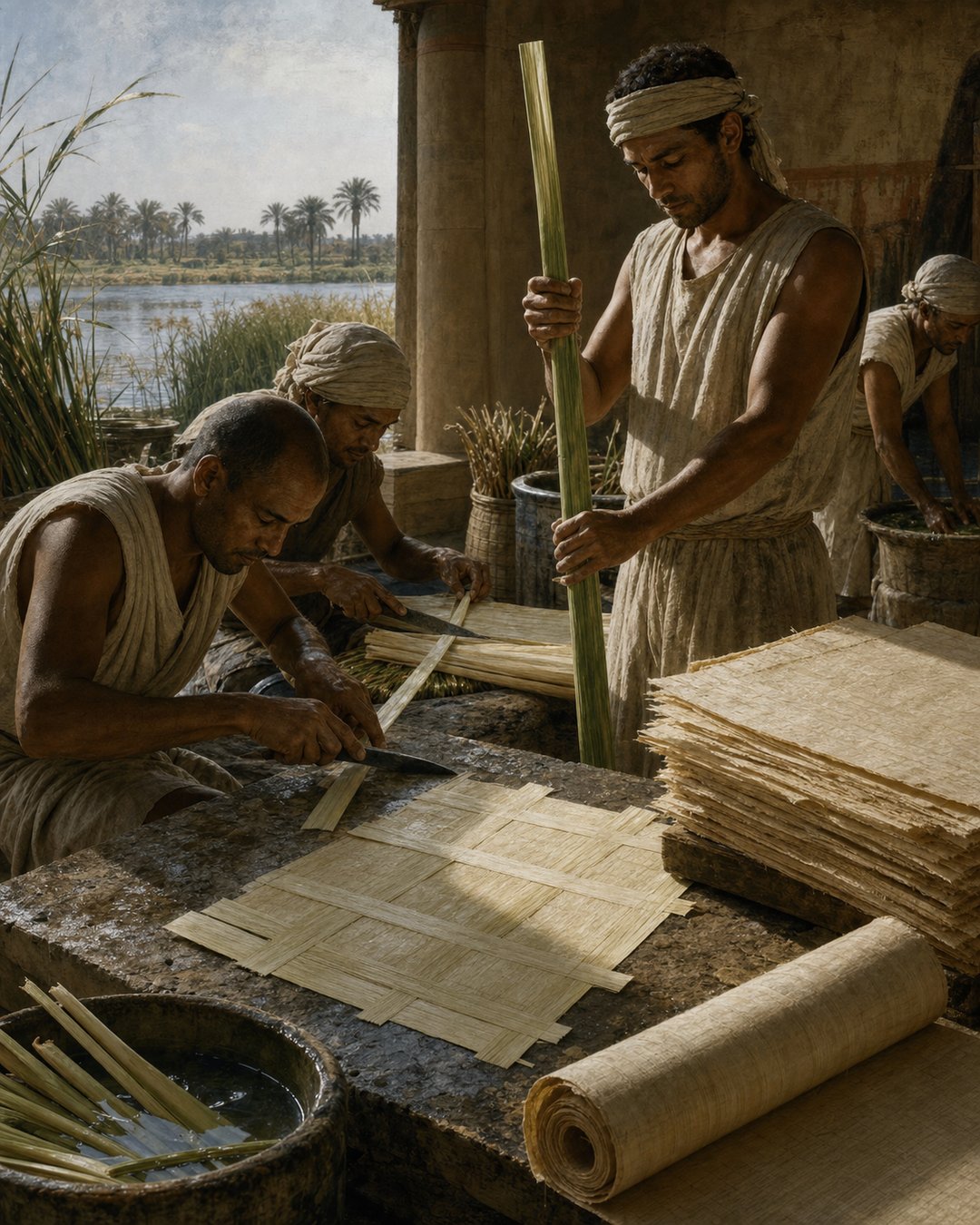
Before a Roman letter could travel, someone in Egypt had to split a wet green stalk. The triangular stem of papyrus concealed a pale pith that could be cut into long strips. Placed side by side, crossed with another layer and pressed as it dried, those fragile ribbons became a sheet strong enough to carry ink across the empire.
Writing usually occupies our attention because words survive. The blank support disappears behind them. Yet papyrus manufacture determined width, texture, fiber direction, joins and the way a roll opened under the hand. A scribe’s smooth line began with agricultural cutting, wet preparation and careful pressure.
Roman demand connected Nile marshes and workshops to officials, merchants, soldiers, poets and households far away. Not every document used papyrus, and wax tablets, wooden leaves and parchment had their own advantages. Papyrus nevertheless made an enormous share of Mediterranean writing possible because makers could turn a tall sedge into repeatable sheets.
The Useful Writing Surface Was Hidden in the Stem
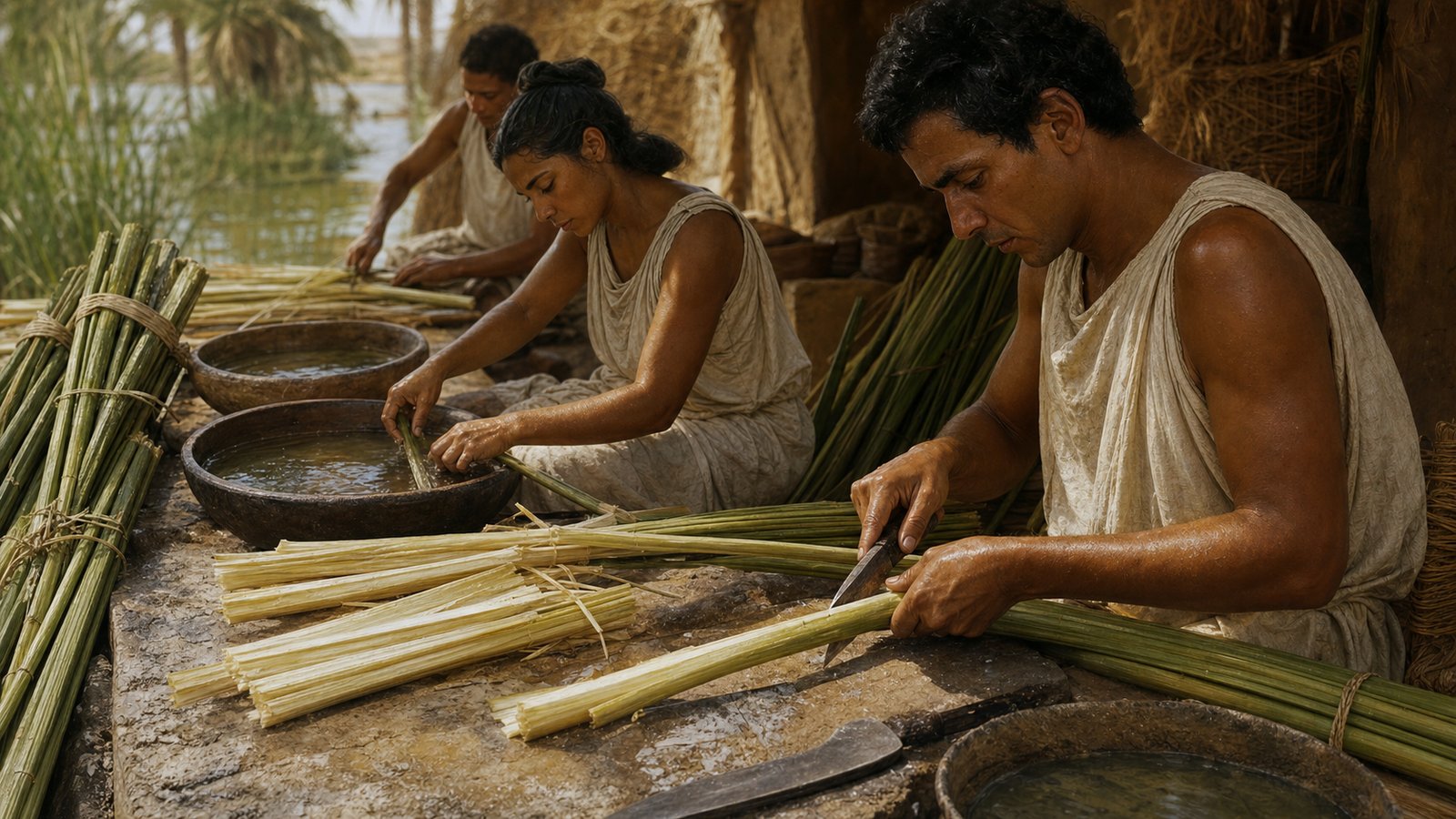
Papyrus grew in wet environments, especially associated with the Nile. Its tall stem had a tough green outer rind and a softer white pith. Makers harvested usable lengths and worked while the material retained moisture, because dry pith became harder to slice and arrange without cracking.
Stalk diameter and straightness affected the strips available. The broad inner pith could yield useful ribbons, while narrow or damaged portions suited lesser work. Sorting at the workshop prevented one poor piece from disturbing a layer expected to dry evenly.
Removing the rind exposed the cellular interior. Simple knives had to cut long pieces with reasonably consistent thickness. A strip too thick dried slowly and made a raised ridge; one cut too thin tore under handling. The craft began as controlled slicing rather than as writing.
The material chain differed from the Roman reed pen. Pen makers valued a hollow stem that could be cut into a nib. Papyrus makers valued pith that could become a broad plane. Two wetland plants—or different uses of reeds and sedges—met only when ink reached the finished surface.
Parallel Strips Created the First Direction of the Page
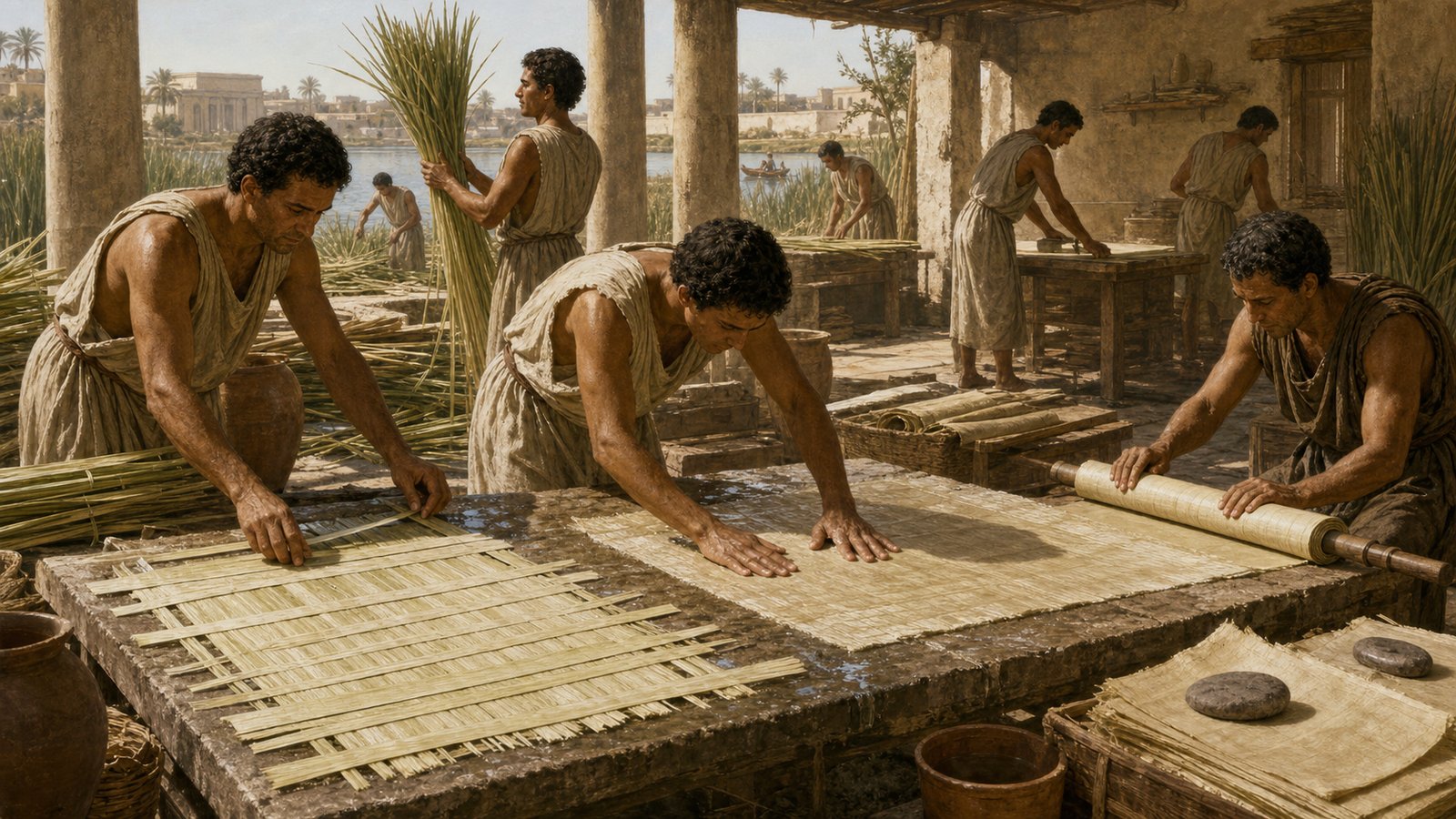
Workers laid strips close together in one direction, overlapping or butting edges according to technique and desired quality. This first layer established the grain most visible on the writing face of many sheets. Its regularity depended on straight strips and patient alignment.
Natural moisture helped the pieces remain flat while arranged. Ancient descriptions and modern reconstructions disagree on some details of soaking, pounding and adhesive use, so one universal recipe should not be invented. The secure structure is the layered mat of papyrus tissue compressed into a sheet.
Gaps became thin places; excessive overlaps became ridges. The maker corrected alignment before pressure fixed the arrangement. Fingers and simple tools could feel differences that a distant visual check missed, especially on pale wet material reflecting workshop light.
Width was constrained by stalk and handling. A page was not peeled whole from a plant like bark. It was assembled from many narrow elements. Its apparent unity was manufactured, much as a Roman basket gained a surface from repeated rods, although papyrus relied on lamination rather than weaving.
A Crossed Layer Stopped the Sheet from Being One-Way
A second set of strips was laid perpendicular to the first. Crossing fiber directions gave the sheet more balanced strength and reduced the tendency for every weakness to run along one set of parallel seams. The two layers formed a simple laminate before the term existed.
Orientation also influenced use. On a roll, scribes generally preferred the side where horizontal fibers ran with the writing line, while the reverse presented vertical fibers. Both sides could carry text, but their texture and the resistance felt by a nib differed.
The crossed mat remained vulnerable until consolidated. A misplaced strip could wrinkle or shift while another was added. Water, plant juices and pressure helped surfaces make close contact. Whether extra paste was used in particular workshops is less certain than the finished evidence of two bonded directions.
This small engineering decision scaled across archives. Each sheet combined lengthwise and crosswise fibers; each roll combined multiple sheets; each library combined rolls. The vast Roman written world rested on an elementary repeated act performed over a table: turn the next layer ninety degrees.
Pressure, Drying, and Smoothing Made a Page
The wet layers were pressed or beaten so they flattened together and expelled excess moisture. Pressure brought cell surfaces into contact and reduced the thickness of overlaps. Too little left a loose uneven mat; rough treatment tore edges or displaced the carefully arranged pattern.
Drying fixed the sheet but created new risks. Uneven moisture encouraged curling and distortion. Flat boards, stones or other weights could restrain the material while air and warmth removed water. Workshop pace depended on weather and space as well as on cutting skill.
After drying, makers trimmed edges and polished the surface with a hard smooth object. Rubbing reduced projecting fibers that might catch a pen. It could not turn a poor sheet into perfect material, but it improved the contact between ink-bearing nib and plant texture.
The result retained a visible memory of manufacture. Fibers, joins, repairs and thickness variations can still be seen under transmitted light. A blank papyrus sheet was not neutral emptiness. It was a compressed map of stalks, hands, pressure and drying.
Sheets Became Rolls Through Deliberate Joins
One sheet was useful for a note, account or letter, but longer works required more surface. Makers joined sheets edge to edge, usually arranging overlaps so the writing hand and rolling direction encountered them as smoothly as possible. A sequence of joined sheets formed a roll.
The joins, called kolleseis in Greek terminology, remained physical features. A scribe crossing one could feel a change beneath the nib. Careful manufacture made the transition modest, while a lifted edge interrupted writing and later rolling.
Roll dimensions varied with purpose and quality. Text could be arranged in columns, with readers unrolling one portion and rerolling another. The object therefore presented only part of its contents at once, unlike the Roman codex, which allowed leaves farther apart to be reached by turning.
Joining also encouraged quality grading. Fine central strips and smooth sheets could serve prestigious writing; coarser material remained useful for accounts, wrapping or other tasks. Ancient labels and grades changed, so neat modern categories should be avoided, but buyers plainly encountered differences in surface and workmanship.
The Blank Sheet Carried Egypt into Roman Administration
Finished rolls traveled away from production areas through merchants and state supply. Dry storage mattered because damp encouraged damage and distortion, while rough handling crushed edges. A light writing material became valuable only when packaging and transport preserved the smooth surface created in the workshop.
Papyrus supported contracts, tax records, military correspondence, petitions, literary copies and private letters. The Vindolanda writing tablets show that wood served brilliantly at a northern frontier; papyrus evidence shows a complementary system whose strongest production base lay in Egypt.
Pliny the Elder described papyrus and its manufacture, although his terminology and recipe have prompted debate. His attention itself is revealing: Romans knew that writing material possessed grades, dimensions and a production history. The page was a traded manufactured good, not merely a plant leaf collected ready-made.
A Roman-era papyrus page began inside a wet green stalk and reached the writer only after subtraction and reconstruction. Rind was removed, pith divided, strips crossed, moisture pressed out, surfaces polished and sheets joined. Words could then look effortless because the page had already solved the harder problem of becoming one piece.
Sources & Further Reading
- Pliny the Elder, Natural History, Book 13
- Encyclopaedia Britannica, “Papyrus”
- Wikipedia, “Papyrus”
- World History Encyclopedia, “Papyrus”
- The Metropolitan Museum of Art, papyrus collection record