
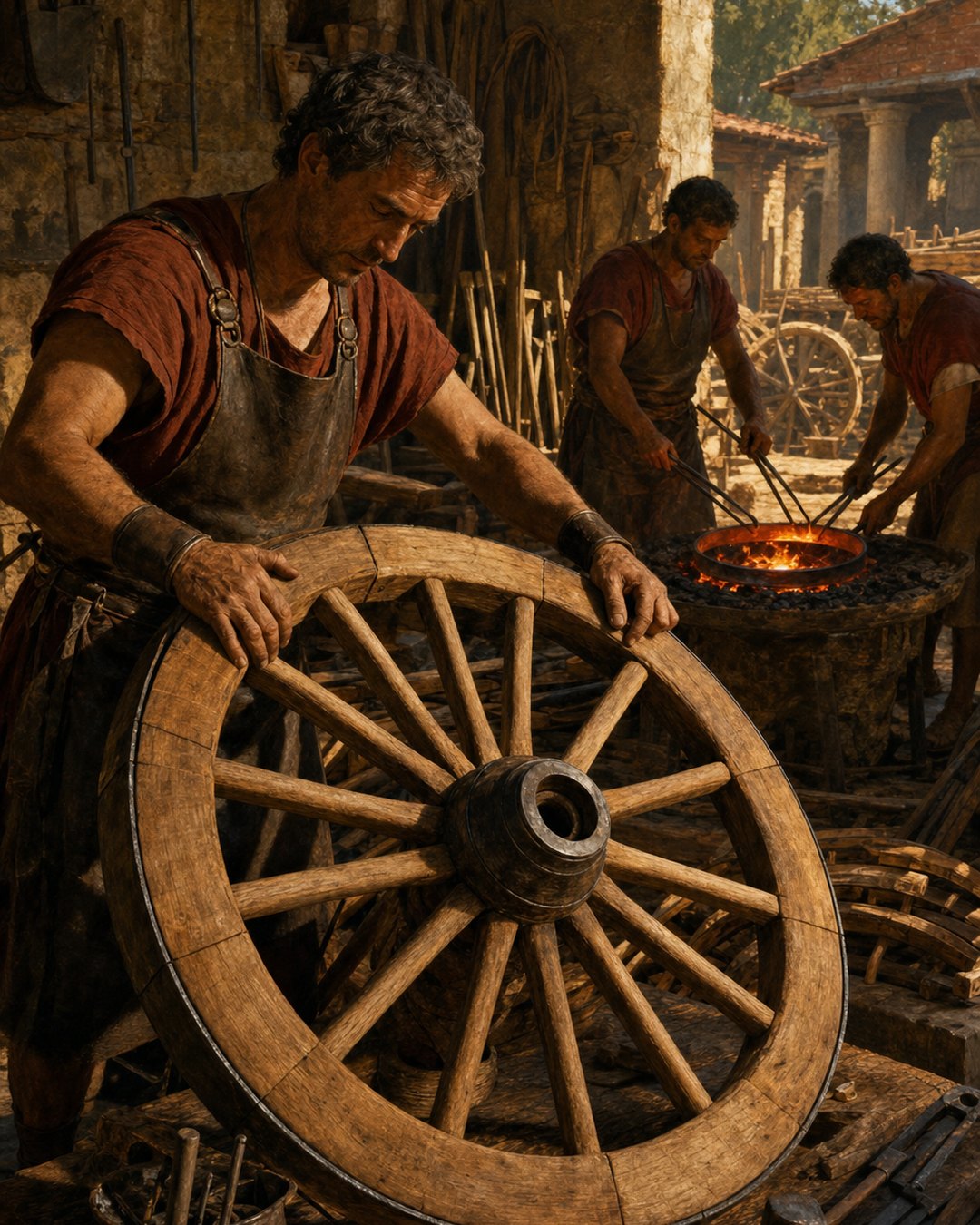
A wheel beside a Roman road looked simple only after the wheelwright had hidden every disagreement inside it. The hub wanted to split around its axle hole. Spokes wanted to loosen when timber dried. Felloe segments wanted to become a polygon instead of a circle. An iron tire had to fit tightly enough to bind the rim without crushing or scorching the wood.
The finished wheel carried a moving load through a small patch of ground. Each stone delivered a brief upward blow; each turn moved that blow from spoke to spoke. A wheel that was merely round in the workshop could still wobble, shed its tire or work its joints loose after miles of ruts. Geometry had to become durable structure.
Roman wheelwrights solved that problem by making several materials do different jobs. A tough hub received the axle and spoke ends, resilient spokes carried changing compression, curved wooden felloes made the rim, and a shrunk iron band held the circumference together. Travel began with tension and compression deliberately installed before departure.
The Hub Concentrated the Whole Vehicle onto One Opening
A wheel turned around an axle, so the central bore had to remain smooth, aligned and strong while the vehicle pressed downward. The hub was made thick because every spoke ended there and every jolt travelled toward it. A split starting at one mortise could connect with the axle hole and threaten the whole assembly.
Wheelwrights bored and shaped the hub before final assembly. The opening needed clearance for rotation and lubricant, but excessive play let the wheel knock against the axle and wander sideways. Heat, dirt and wear changed the fit during travel. A sound hub was therefore both a structural block and a bearing surface that required inspection.
Wood choice mattered because density alone was not enough. The hub had to resist splitting across many closely spaced spoke mortises. Grain direction, knots and seasoning affected whether repeated loads stayed distributed or found a weak line. The craft began by reading a log for stresses that would appear only after it became the center of motion.
The archive’s article on Roman lathes explains how rotation could create repeated symmetry. A wheel hub demanded the inverse discipline: symmetry had to be built into a piece that would later rotate, because an eccentric bore made every revolution lift and drop the vehicle.
Spokes Turned a Heavy Ring into a Light Structure
A solid wooden disc could roll, but a spoked wheel reduced weight while preserving distance between hub and rim. Each spoke occupied a radial line and transferred load as the wheel turned. The spokes below the hub commonly carried strong compression, while the pattern around them stabilized the rim and resisted distortion.
Tenons at the inner ends entered mortises in the hub. Outer ends fitted the felloe segments. Those joints had to align in two directions: around the circumference and across the wheel’s width. One spoke cut long pushed the rim outward; one cut short left a gap that its neighbors could not permanently disguise.
The wheelwright assembled a temporary geometry. Opposed spokes helped keep the hub centered while additional pieces closed the pattern. Measuring from hub to rim at several points exposed ovality. Looking across the face exposed wobble. The circle was not accepted because its parts touched; it was corrected until each revolution would repeat the same path.
Spokes also made local repair possible. A damaged member could sometimes be replaced without discarding every sound part, though removing a tight tire and opening the rim required labor. The segmented design traded the simplicity of one slab for a structure whose pieces could be selected, fitted and renewed according to their particular failure.
Felloe Segments Had to Pretend They Were One Circle
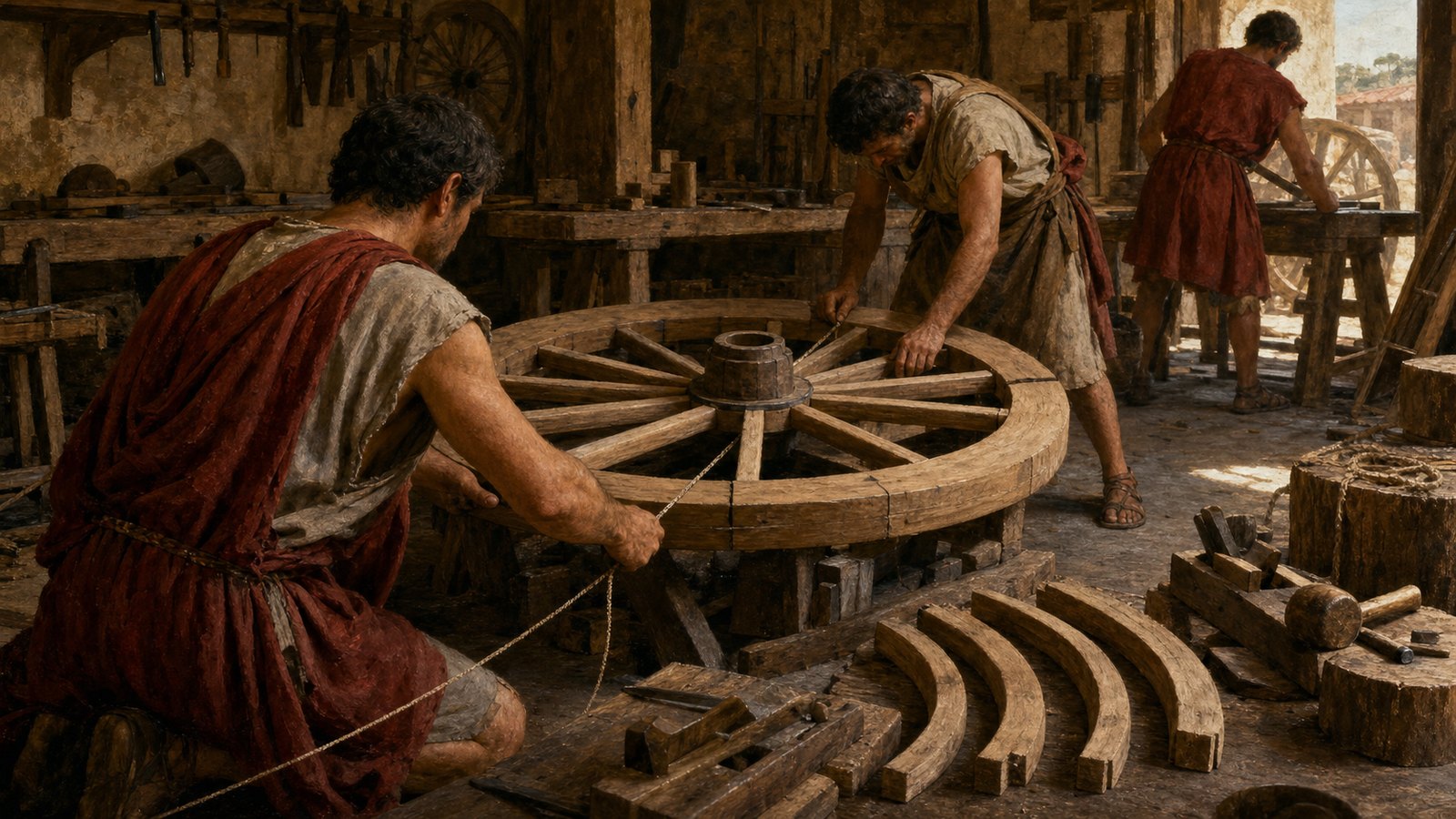
The outer wooden rim was often built from curved felloe segments. Their joints fell between spoke connections so that the radial structure supported the circumference. Each arc had to continue the curve of its neighbors. A proud corner struck the road first; a hollow section shifted load abruptly toward adjacent spokes.
Shaping the inner and outer curves demanded templates, axes, saws, planes and repeated trial fitting. The article on Roman planes follows a tool designed to make straight surfaces. The wheelwright used comparable controlled shaving toward a different result: a fair curve whose errors revealed themselves only when several pieces met.
The mini-scene came at dry assembly. The hub lay supported at working height. Spokes radiated outward, and workers tapped felloe sections onto their ends. A cord or measuring rod crossed the diameter. Someone spun the unfinished wheel slowly, watching the rim approach and retreat from a fixed point while chalk or a blade marked the high places.
At this stage the wooden ring could hold its form gently, but road shocks would pull the joints apart. The felloes needed a continuous restraint stronger than pegs at isolated seams. Iron supplied that restraint, but only if its circumference was calculated against the wood rather than made as a loose protective strip.
A Hot Tire Installed Pressure That Cooling Made Permanent
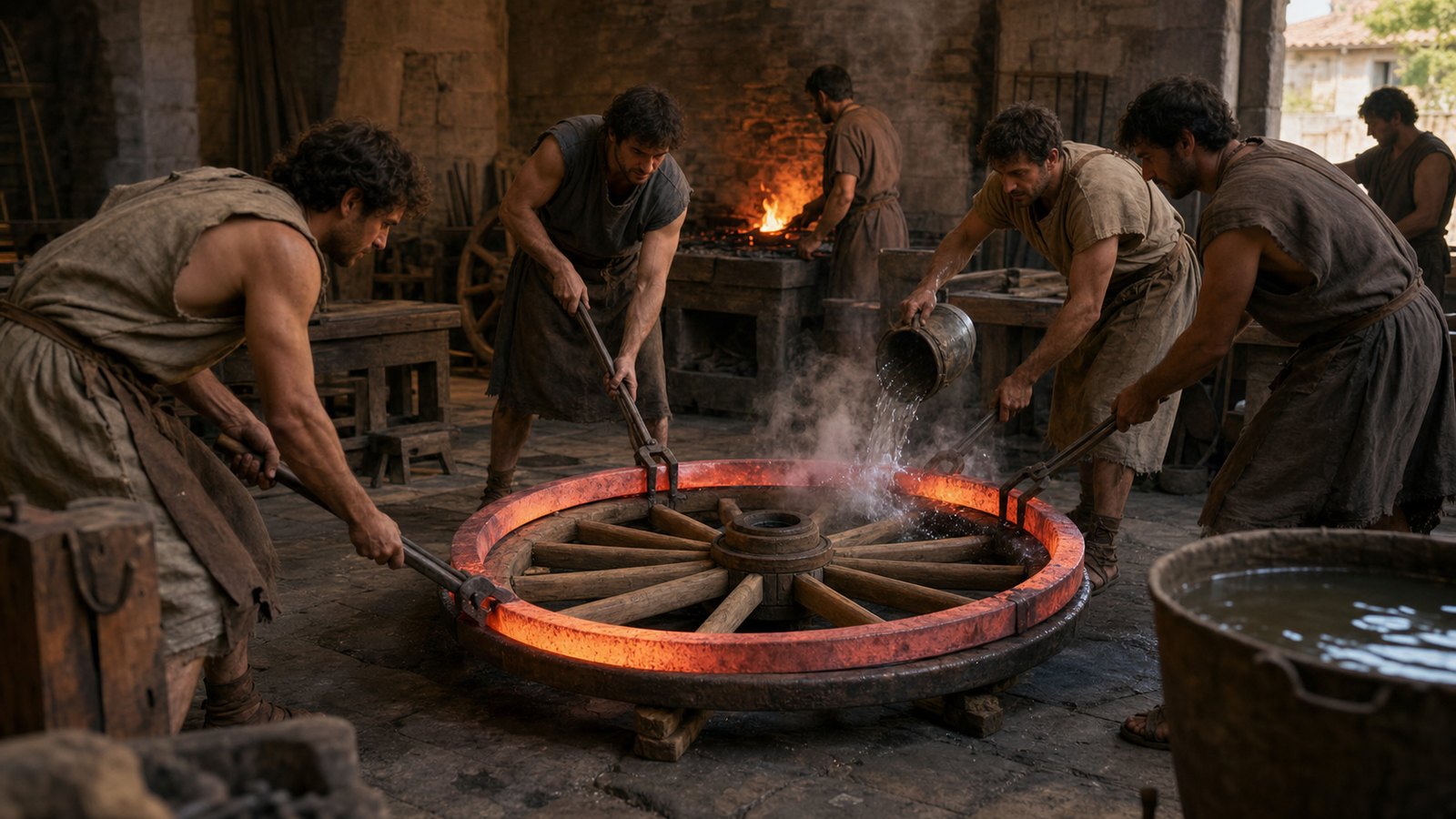
The iron tire was formed as a ring slightly smaller than the wooden rim it would bind when cold. Heating expanded the metal enough for workers to place it over the felloes. The operation required coordination: a glowing ring lost heat quickly, and one edge caught on the wood could prevent the rest from seating evenly.
Workers carried the heated tire with tongs, lowered it around the wheel and drove it into position. Water cooled the iron and protected the wood from prolonged scorching. As temperature fell, the metal contracted. Because the wooden circumference prevented it from returning freely to its smaller size, the tire gripped the rim under tension and compressed the assembled wood.
That shrink fit did more than protect the road surface from wear. It pulled felloe joints together, held spoke ends in place and made the circumference act as one band. Too loose a tire crept and rattled. Too tight a tire could crush joints, distort the wheel or split the rim. The dramatic fire stage depended on accurate cold woodworking completed earlier.
Iron expansion and contraction were visible workshop facts even without modern coefficients. Wheelwrights learned how color, heating time, ring size and speed affected the fit. The successful result announced itself as the tire cooled firmly against every segment rather than hanging at one point or leaving daylight at another.
The Road Reopened Every Joint the Workshop Had Closed
Once mounted, a wheel met dust, water, heat and repeated impact. Timber swelled in damp weather and shrank in dry conditions. Lubricant leaked or collected grit at the hub. An iron tire wore against stone and could loosen as the wooden rim lost moisture. Maintenance was part of the mechanism, not evidence that the original craft had failed.
Drivers listened for knocks and squeals, watched for lateral wobble and felt unusual vibration through the vehicle. A loose tire might be tightened temporarily or refitted; worn axle contact demanded lubrication or repair; cracked spokes required unloading before damage travelled. The wheel translated many small defects into motion a practiced traveller could notice.
Roman roads improved routes but did not make them smooth in the modern sense. Paving joints, ruts, unpaved approaches and steep gradients kept wheel loads irregular. The archive’s account of Roman roads as instruments of movement and control gains a workshop counterpart here: the network functioned only because ordinary wheels repeatedly survived its surfaces.
A Roman wheel became tight before it travelled. The hub concentrated the load, spokes distributed it, felloes created the running circle, and the cooling tire locked separate parts into a prestressed system. Every mile tested that agreement anew. Motion looked continuous because the wheelwright had taught discontinuous pieces to share each blow.
Sources & Further Reading
- Encyclopaedia Britannica, “Wheel”
- Wikipedia, “Wheelwright”
- Wikipedia, “Spoke”