
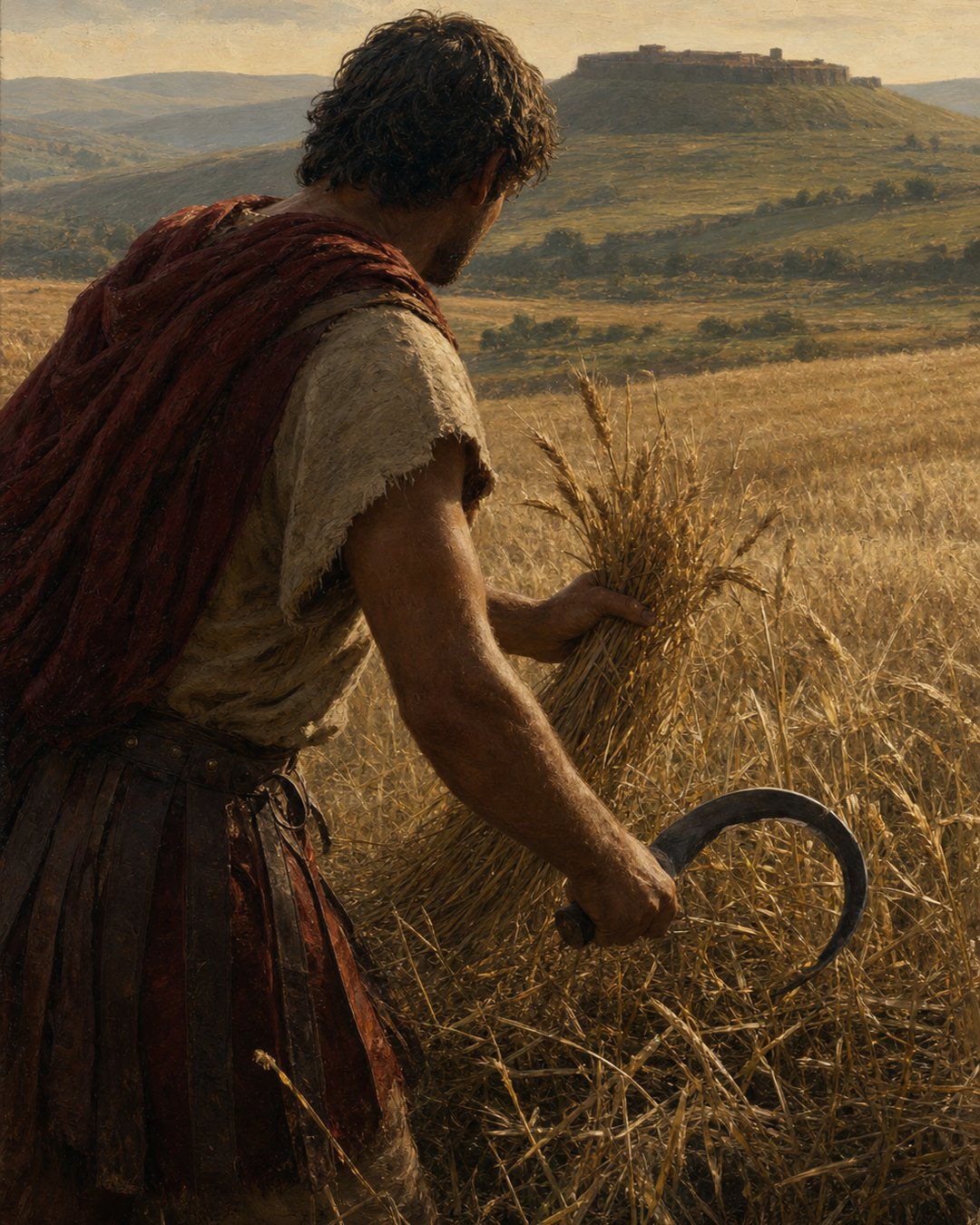
A straight blade pushed through a standing field tends to scatter what it meets. Stems bend away, separate and escape around the edge. A sickle changes that encounter. Its blade curves inward toward the hand, so a pulling stroke gathers stalks into the cutting path. The crop is not merely struck; it is collected against the edge before it is severed.
Museum Wales preserves a Roman iron sickle from Dinorben hillfort in north Wales. The asymmetrically curving blade has a square-sectioned tang. It is 228 millimetres long, reaches 85 millimetres in maximum width and weighs 83.7 grams. The tool is light enough for repeated one-handed use but broad enough for its curve to do visible work.
The object was found one foot deep in a Romano-British layer overlying a hut floor, behind the north-east rampart. It dates to 260–355 CE. Those details place harvesting geometry inside a particular occupied landscape rather than leaving the sickle as a timeless agricultural symbol.
The Inside Edge Gathered Before It Cut
A sickle is a single-handed agricultural tool with a curved blade, commonly used to harvest grain or cut succulent forage. Its cutting edge lies on the inside of the curve. As the user draws the blade inward, stems that might slide off a straight edge are guided deeper toward the portion where movement and sharpness can sever them.
The curve does two jobs in one gesture. It enlarges the region that can encounter standing material and gives that material fewer routes to escape during the pull. The worker can use the other hand to hold or arrange stems, but the blade itself begins gathering before the fingers close around the cut bundle.
This mechanism belongs earlier than the archive’s Roman bakery. Bread requires grain already separated from a field, processed and transported. The sickle occupies the first compression in that chain: many individual stalks become a handled bundle because one curve brings them together.
The Dinorben Blade Makes the Working Scale Measurable
Museum Wales describes the Dinorben tool as iron, with an asymmetrically curving blade and a square-sectioned tang. The tang is the portion fitted into a handle. Its square section resists rotation better than a smooth round spike, helping the blade keep its intended orientation when the pull loads it sideways.
The surviving length is 228 millimetres and maximum width 85 millimetres. Maximum thickness is recorded as 8 millimetres, while the object weighs 83.7 grams. Those numbers describe neither a giant scythe nor a tiny knife. They fit a hand tool intended to be swung and drawn repeatedly through resistant plant material.
The London Museum records another Roman iron sickle with a curved blade and a tang ending in a loop. Its catalogue says the tool was for cutting and harvesting cereal crops, reeds and other tall-stemmed plants. The modern wooden haft must not be mistaken for surviving Roman wood, but the iron records how a handle joined the blade.
Harvesting Was a Repeated Grip, Pull and Release
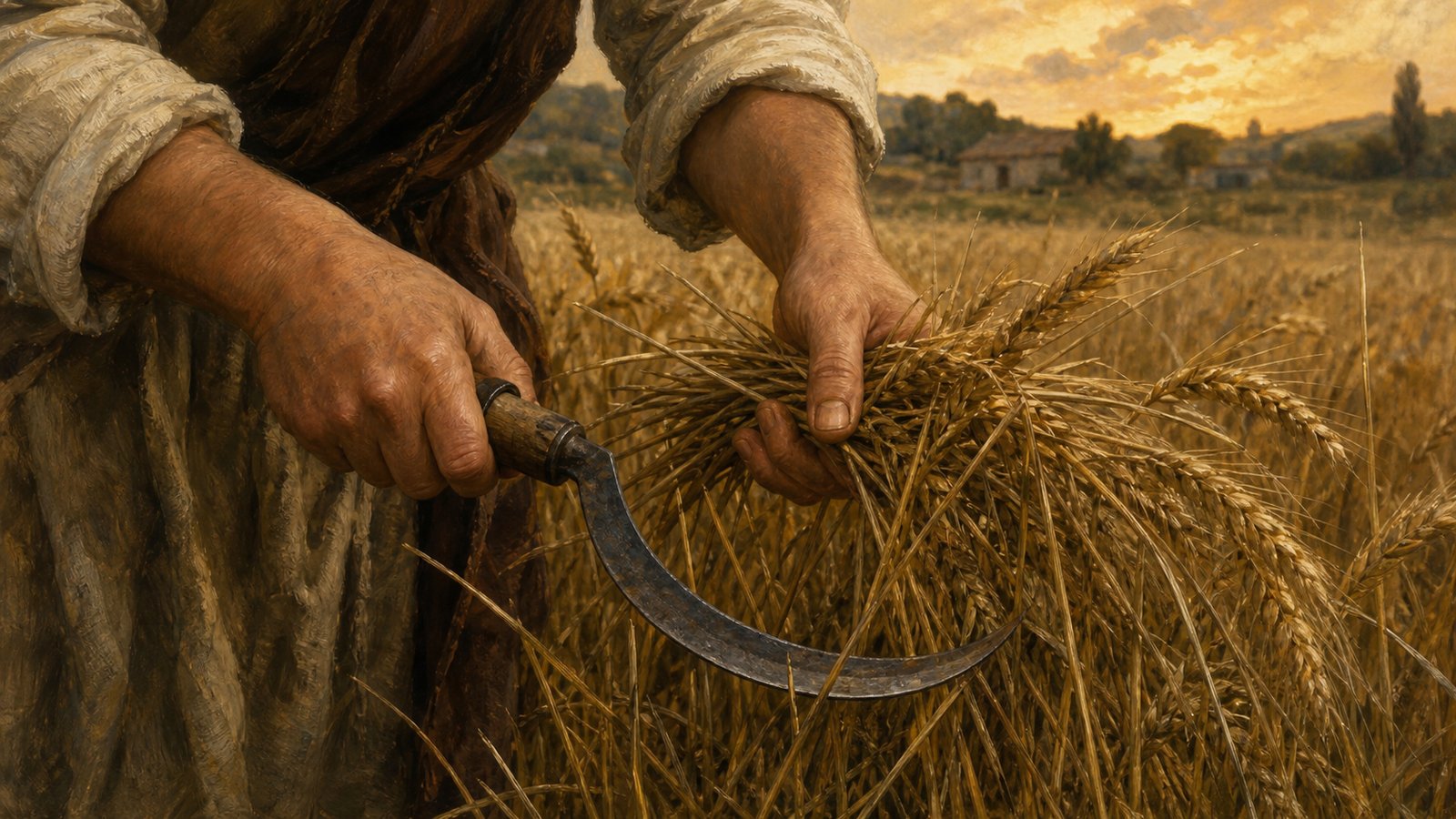
Imagine a worker closing one hand around a small group of stalks below the ears. The other hand brings the sickle behind them and pulls. Stems collect along the inner edge; resistance rises; sharpened iron slides and presses until the fibers part. The cut bundle remains in the first hand while the blade opens for another stroke.
The sequence is efficient only when the hands cooperate. Grasp too much and the blade stalls or crushes stems. Grasp too little and labor is wasted in tiny bundles. Pull at a poor angle and stalks fold instead of meeting the edge. The sickle’s curve creates an opportunity, not an automatic harvest.
The cut height also changes what remains in the field. A stroke close to the ground takes more straw with the grain but brings the edge nearer soil and stones; a higher stroke protects the blade and leaves longer stubble. The worker balances desired material, edge wear, crop posture and the ease of holding a bundle. Even before threshing, one hand’s placement affects what the household carries away, what remains available as stubble, and how quickly the next stroke can begin.
A one-handed blade also leaves the crop-controlling hand exposed. Edge direction, handle security and body position matter through thousands of repetitions. Fatigue makes those relationships harder to maintain. Agricultural output depended on sustained skilled motion, not simply ownership of iron tools.
An Edge Could Fail Long Before the Whole Tool Broke
Plant fibers, soil and accidental contact with stone dull a cutting edge. A sickle that remains visibly complete can become inefficient as its bevel rounds. The user must pull harder, increasing fatigue and bending more stems before they separate. Sharpening restores geometry by removing a small amount of metal.
The archive’s article on Roman files and removable error shows the wider logic of controlled abrasion. Edge maintenance is another version of it: sacrifice a little iron to recover the thin meeting line that does the cutting. Repeated sharpening eventually changes blade shape, so maintenance also consumes the tool it preserves.
Handle fit is equally important. A loose tang lets the blade twist during the stroke, while a cracked haft can release sharp iron under load. The Dinorben square-sectioned tang and the London loop-ended tang show two physical strategies for joining hand to blade. The perishable grip may vanish, but attachment remains part of the iron’s design.
The Find Context Connects a Field Tool to a Fortified Hill
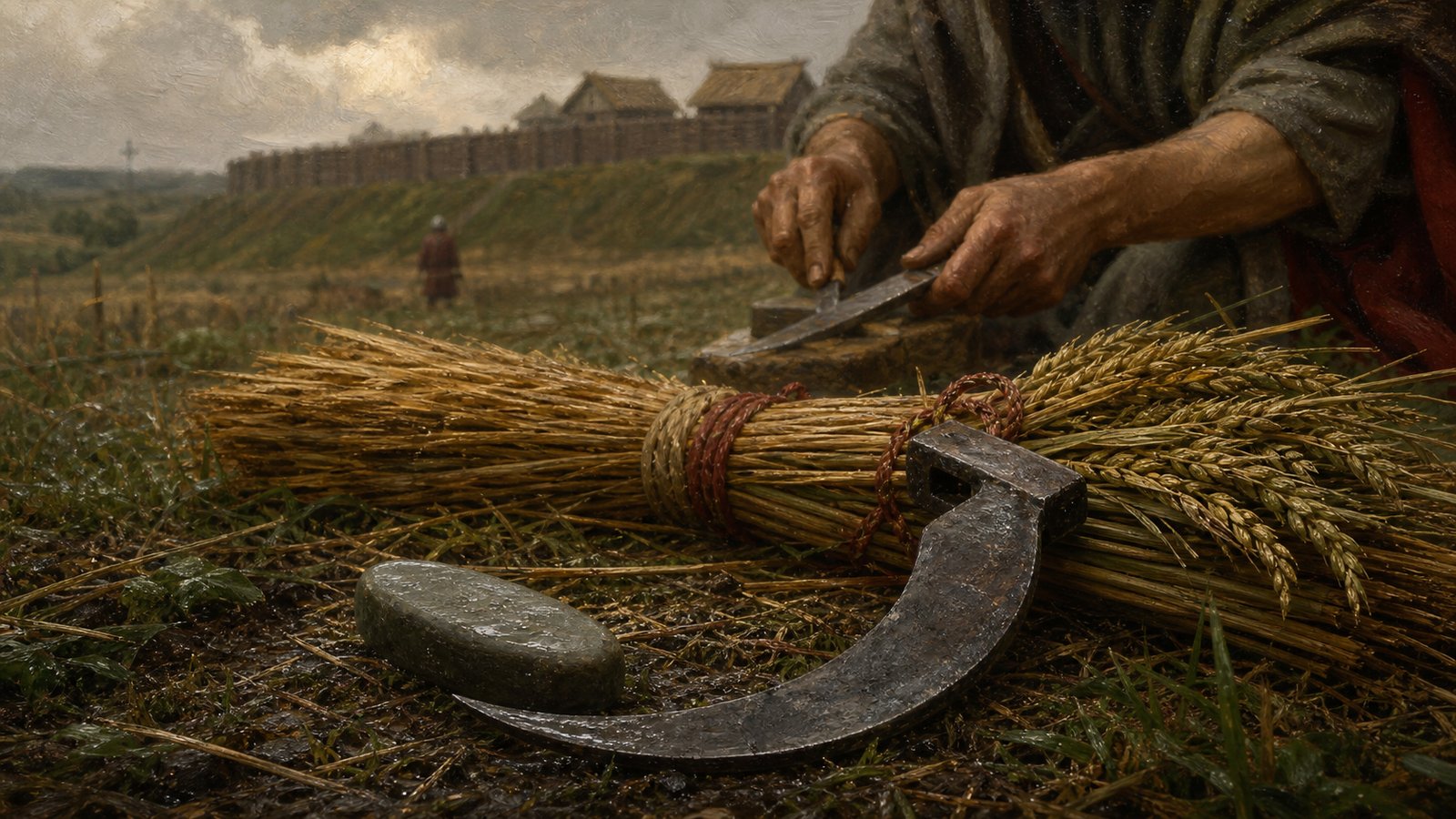
The Dinorben sickle was excavated in 1956 at Parc-y-meirch. Museum Wales places it at a depth of one foot in the Romano-British layer over hut floor 3, behind the north-east rampart in area SVIIc. The institution dates the object to 260–355 CE.
That context does not prove who swung it or exactly which crop it cut. It does establish that an agricultural tool entered the archaeological record within a fortified settlement landscape. Hillfort occupation and routine plant work were not separate worlds: people within defenses still required food, fodder, roofing materials and maintenance of surrounding resources.
The London catalogue broadens the plausible plants without assigning them all to Dinorben. Its Roman sickle is described for cereal crops, reeds and other tall-stemmed plants. Similar curvature can serve several materials because the core task remains gathering flexible stems against an inward edge during a controlled pull.
A Field Became Portable in Bundles
Harvesting is often remembered at the scale of acres and seasons. The sickle returns it to a sequence no larger than an arm’s reach. Each stroke selects, gathers and severs a fraction of the standing crop. Bundles accumulate because that local act can be repeated with similar geometry across the field.
The result then enters the systems described in Roman watermills. Milling could reduce dependence on muscle during grinding, but it could not cut the grain from the earth. Mechanization at one stage rested on concentrated hand labor at another.
The Dinorben blade survives as 83.7 grams of corroded iron, detached from its handle and season. Its curve still explains its purpose. Roman farmers did not conquer a field with one sweeping motion. They made the harvest portable by repeatedly pulling scattered stalks into a sharpened arc, leaving one hand free to hold what the other had just cut.
Sources & Further Reading
- Museum Wales, “Roman iron sickle”
- London Museum, “Sickle”
- Wikipedia, “Sickle”