
A thumb and forefinger can pinch, but they cannot become arbitrarily small. A splinter ends beneath the skin; one hair stands apart from the rest; a fragment lies in a recess too narrow for a nail. Roman tweezers solved those little failures without adding a hinge. The tool was often only a strip of metal bent back upon itself.
The Metropolitan Museum of Art holds Roman bronze tweezers dated to the first or second century CE. They measure 11.3 centimetres. That scale is long enough to rest in the hand while narrowing toward a working end, and small enough to belong among grooming or personal implements rather than heavy workshop tongs.
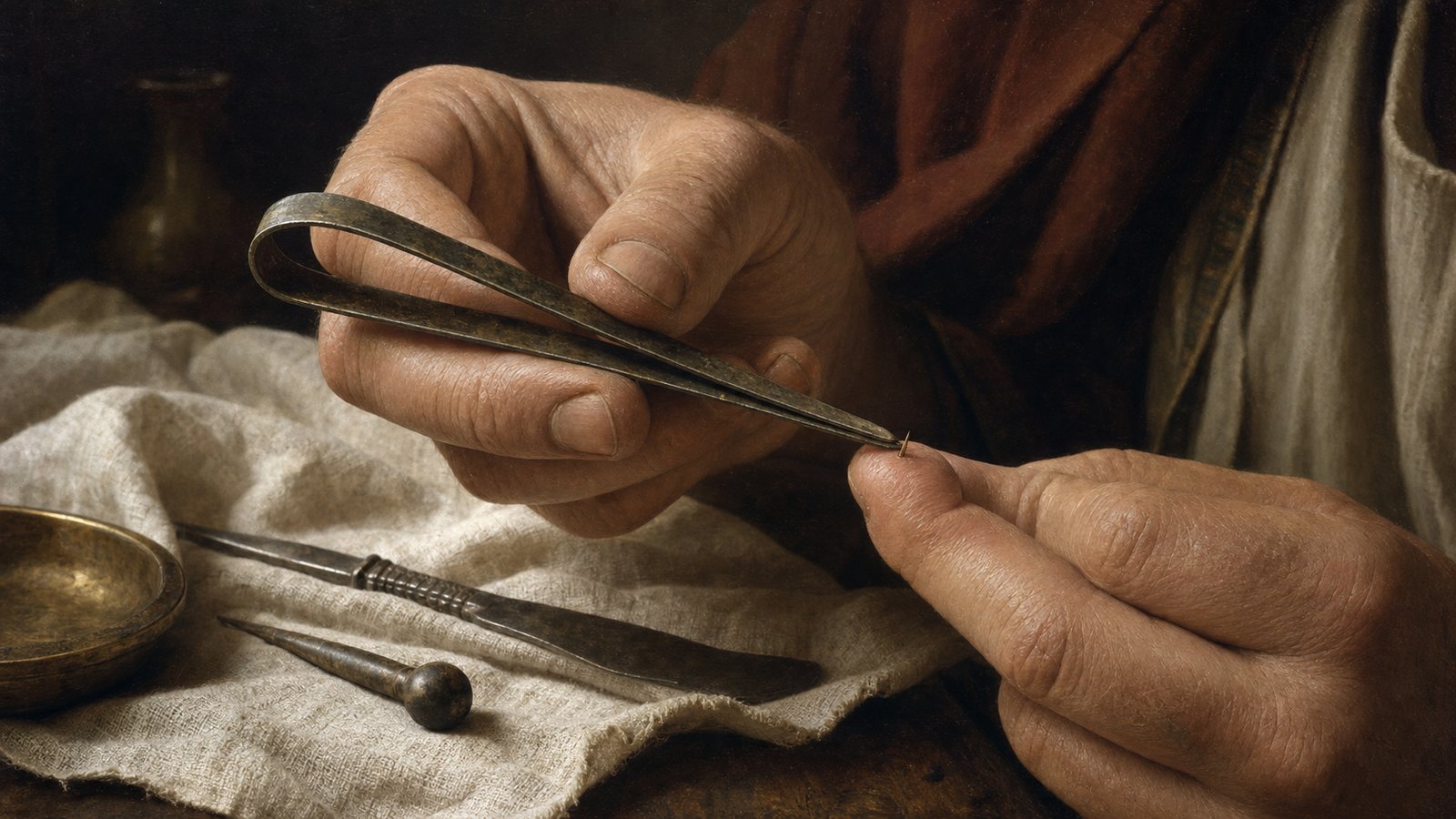
The mechanism is almost invisible because the hand completes it. Two arms join at one fixed end. Their spring tension keeps the tips apart until finger pressure closes them. Release the pressure and the metal opens again. The user gains an extended pinch, a clearer view of the target and more control over how firmly it is held.
Bent Bronze Remembered the Open Position
Tweezers do not need a separate spring because the joined arms are themselves elastic. Bending the strip establishes a preferred open shape. Squeezing stores a small amount of energy in the arms; releasing lets that stored energy restore the gap. The tool resets itself after every pinch.
This simplicity reduces the number of pieces that can loosen. There is no pin to lose and no hinge that must remain aligned. The important geometry lies in the bend, the taper and the meeting tips. If the arms have unequal stiffness or the tips miss one another, finger pressure arrives beside the target rather than upon it.
Modern reference descriptions classify the two arms as third-class levers joined at their fulcrum end. The hand applies effort along the arms between that fixed bend and the tips. The arrangement trades mechanical force for travel and control, appropriate when the object is delicate or extremely small.
The Met Object Restores a Roman Scale
The Met catalogues its object simply as “Bronze tweezers.” The culture is Roman, the date first–second century CE, and the medium bronze. Its recorded length is 4 7/16 inches, or 11.3 centimetres. Those details are modest, but they prevent the tool from dissolving into a timeless diagram.
Bronze brings both durability and useful flex when formed into thin arms. The museum record does not identify the owner, exact city or every task performed. It therefore cannot prove that this particular pair removed a specific hair or thorn. What it establishes is the Roman object type, material, date and physical reach.
Manufacture required restraint. The joined bend had to remain thick enough to survive repeated flexing, while the arms needed enough thinness to move under ordinary finger pressure. The maker then had to bring both tips into the same plane. A visually elegant taper that closed crookedly would fail at the only point where precision mattered.
At 11.3 centimetres, the joined end can rest against the hand while the tips remain visible beyond the fingers. That distance matters. A bare pinch hides much of a tiny target beneath the fingertips; extended tips let the eye watch contact from a less crowded angle.
Variable Pressure Protected Small Things
A tweezer grip is not simply open or closed. The user can increase pressure gradually and feel whether the target moves. A brittle fragment may need barely enough force to lift; a stubborn hair requires a firmer hold close to the skin. The same tool answers both by transmitting a variable pinch.
The Wikipedia account notes the common pen-like grip between thumb and index finger, sometimes supported by the middle finger. That posture aligns sight, hand and tips along one axis. It also allows quick release: relaxing the fingers opens the arms without a second deliberate movement.
This controlled grasp differs from the force in Roman tooth extraction. Dental forceps had to seize and move something firmly rooted. Tweezers worked where too much force could crush, snap or launch the target. Their achievement was sensitivity rather than multiplication of strength.
Grooming Made Precision Socially Visible
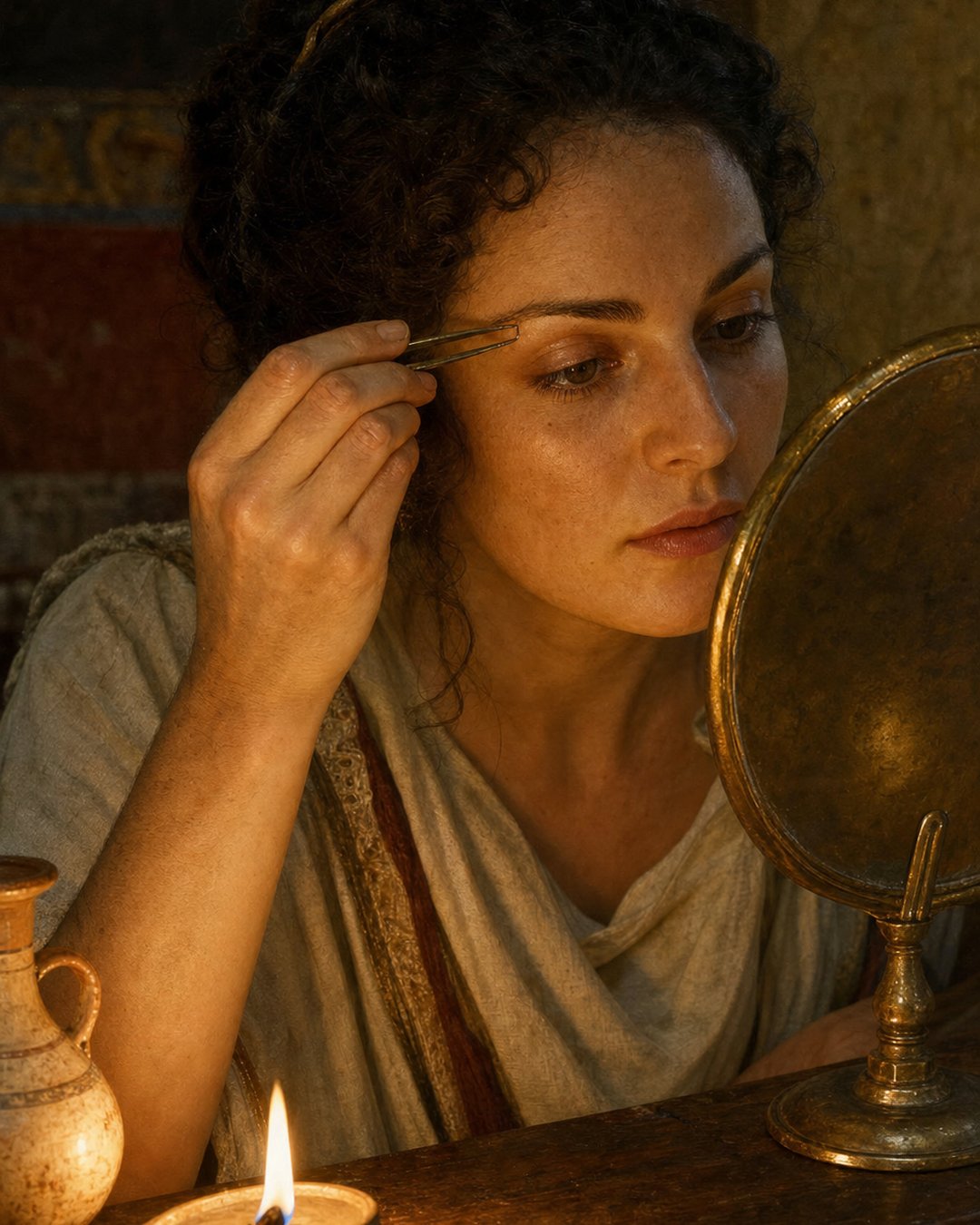
Tweezers are commonly associated with removing facial or eyebrow hair. In a Roman grooming setting they could sit beside a mirror, comb, oil container or strigil, although one archaeological association should not be invented for every isolated find. The form itself supports precise plucking because narrow aligned tips can close around one hair.
The operation is a tiny sequence. The user finds a single target in reflected light, sets the open tips around it, closes near the root and pulls along a controlled line. Missing the hair pinches skin; gripping too far from the root can break it. The mirror shows placement while spring metal executes the narrower pinch.
Light and posture mattered as much as metal. A polished mirror needed a useful angle, the hand needed support, and the face had to remain still while the tips approached. Lamplight could throw deep shadows across a hair-thin target, so a doorway or courtyard offered a different working condition. The object concentrated touch, but the user still organized sight.
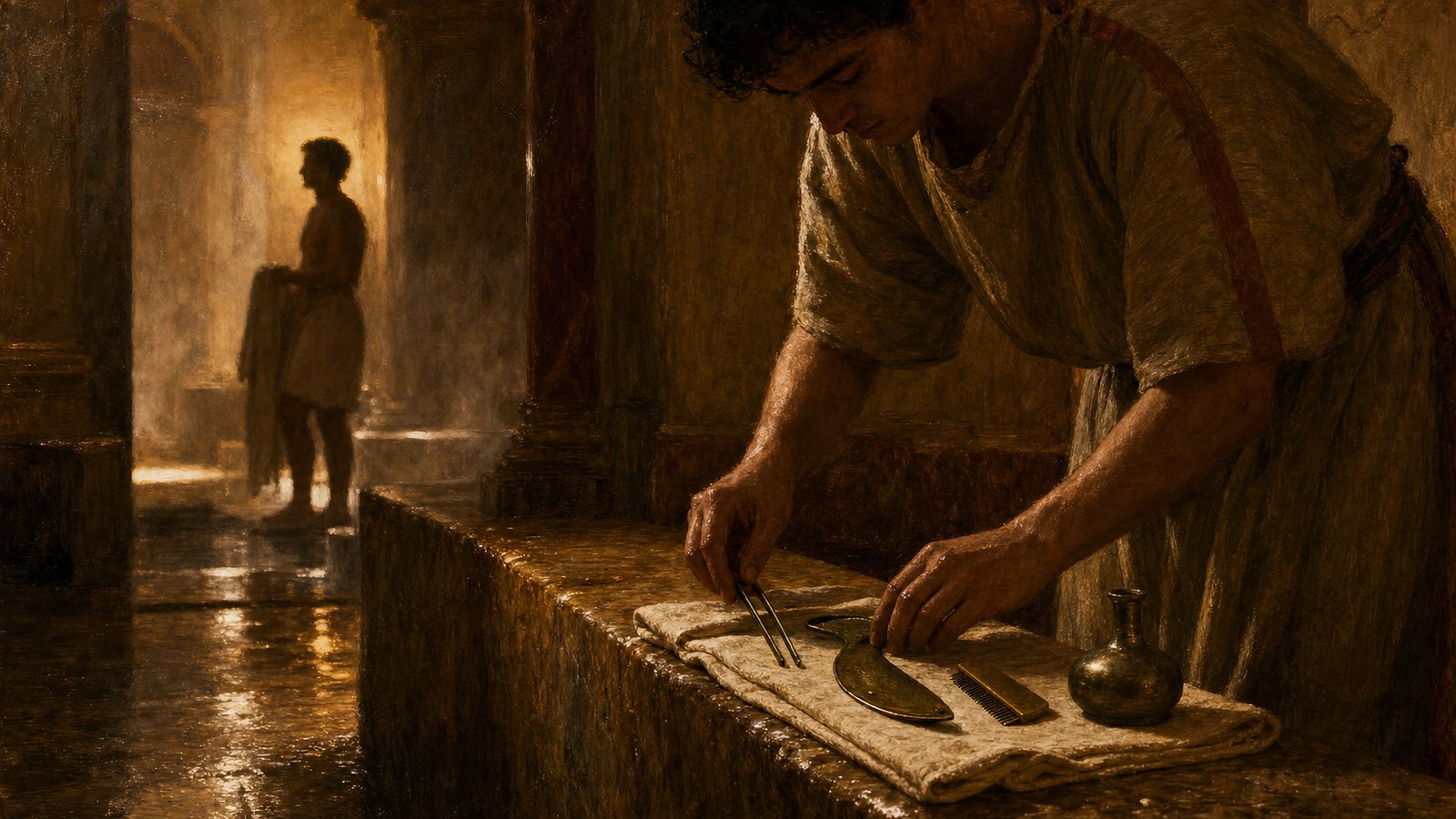
The contrast becomes sharper beside Roman strigils. A strigil scraped oil and debris across a broad surface. Tweezers selected one point. Roman grooming ranged from sweeping strokes to interventions scarcely wider than a hair.
The Same Tips Could Answer a Workshop or Wound
The general definition of tweezers is deliberately broad: small hand tools for grasping things that fingers cannot easily handle. That can include a thorn, a splinter, a fine wire or a fragment during careful assembly. Context determines the task more securely than shape alone.
A tiny object presents two problems at once. It is hard to reach and easy to lose. Narrow tips solve access, while the spring opening lets the user release deliberately above a tray, cloth or prepared surface. The tool manages both capture and surrender.
Release is part of precision because the target may be more vulnerable after capture. A splinter should be laid where it cannot return to skin; a bead or fitting must reach its intended recess rather than bounce from a hard bench. By opening automatically when pressure relaxes, the arms make surrender gradual and visible instead of requiring the hand to pry the tips apart.
Roman medicine also used forceps in several forms, but it is safer not to turn every bronze tweezer into a surgical instrument. A museum record that says only “tweezers” should remain only that. The mechanical range is real; a diagnosis of its final use requires find context or a more explicit catalogue.
Wear Began at the Place Where Almost Nothing Fit
Tips suffer even when the rest of the tool survives. Repeated contact can round an edge; a sideways twist can bend one arm; corrosion can roughen surfaces that once met cleanly. A pair may still look complete while losing the alignment that made it precise.
A craftsperson could test the meeting point against light. If a gap remained, the tool would hold only larger objects or grip them unevenly. Cleaning protected movement and surfaces; careful bending might restore alignment, but excessive correction risked fatigue or fracture in the bronze.
The article on Roman mirrors describes a broad metal surface refined until it returned an image. Tweezers refined metal toward the opposite scale: two narrow lines had to meet. Roman precision did not always announce itself in monuments. Sometimes it ended at a point small enough to pull one thorn free.
Sources & Further Reading
- The Metropolitan Museum of Art, “Bronze tweezers”
- Wikipedia, “Tweezers”