
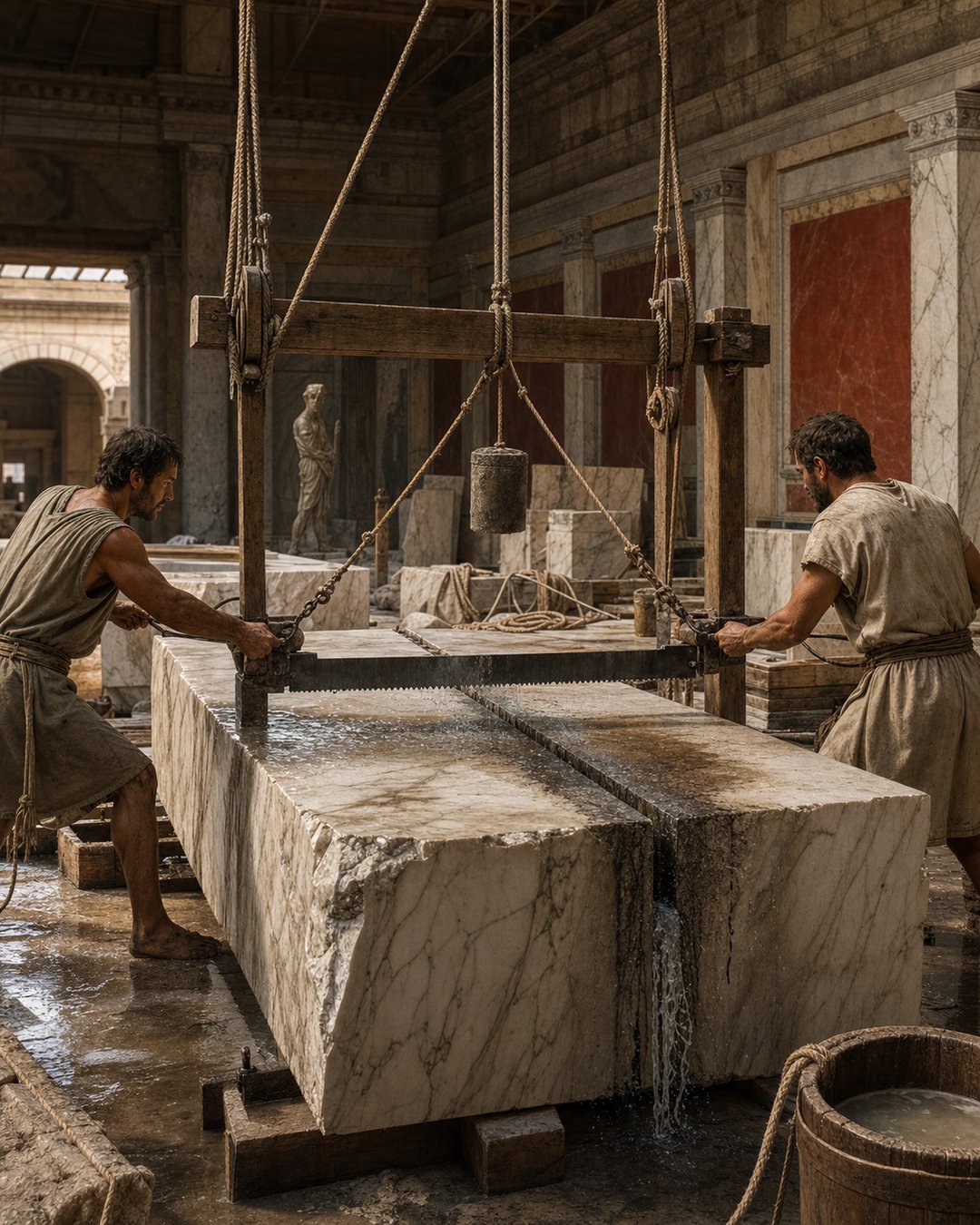
A Roman stone saw could be longer than the two people assigned to pull it. The Art of Making project describes blades often more than two metres long yet typically no more than five millimetres wide. That combination looks fragile until the rest of the system appears: the blade was not asked to carry itself, choose its own depth and bite hard marble with teeth at the same time.
On softer limestone, sandstone or tuff, a toothed blade could remove stone directly. Hard stone demanded a different arrangement. The blade was flat. Water carried abrasive particles into the cut, and the repeated stroke moved that gritty mixture under the iron. Marble disappeared because loose grains ground it away while the blade kept them travelling through one narrow route.
The familiar picture of a saw as a row of teeth therefore misses the most Roman part of the hard-stone operation. Workers, frame, weights, water, grit and blade divided one difficult task into controllable motions. The polished panel at the end hid a process that began with wet slurry, synchronized pulling and careful pressure.
A Five-Millimetre Blade Could Guide a Two-Metre Cut
The proportions identified by Art of Making are specific: stone-saw blades were commonly no more than five millimetres wide and often exceeded two metres in length. A broad tool would waste valuable stone by opening a thick kerf. A narrow blade conserved material, but its length made alignment and support essential.
Two workers normally pulled in sequence from opposite ends. Each stroke had to continue the same line rather than twist the blade sideways. One worker receiving the pull as the other released it created reciprocation without requiring either body to circle the block. Rhythm protected the cut because a sudden unequal tug could bow the metal or rub one wall of the kerf.
The scale also changed the view of labor. The workers could stand beyond the edges of the block while the active cut remained between them. They felt drag through handles and watched water and grit at the opening, but much of the removal happened below the blade where neither could inspect it continuously. The straight line itself became their shared reference.
This followed the work described in Roman quarry splitting. Wedges divided a mass along planned fractures; the saw addressed a later problem, taking a block that had survived extraction and turning it into thinner, more regular pieces without shattering the valuable stone.
Hard Stone Turned the Blade into an Abrasive Carrier
Art of Making distinguishes soft from hard stone. Soft limestone, sandstone and tuff could be worked by smaller toothed saws, sometimes by one carver. Harder stone used a flat blade with abrasives mixed into water. The iron supplied direction and motion while the abrasive supplied the cutting contacts.
Every back-and-forth stroke dragged hard particles over the bottom of the groove. Individual grains pressed against microscopic high points, broke or loosened them, then moved aside for other grains. Water distributed the mixture, carried some waste and stopped the working material from behaving like a dry heap that could not circulate.
The gap mattered as much as the grit. Art of Making explains that the suspended system let the blade rest gently enough to leave room for water and abrasive between iron and stone. Excessive pressure could squeeze the mixture away and make metal rub rather than grind. Too little pressure would allow motion without useful contact. The operator needed a wet, renewing boundary.
This mechanism differs from Roman filing. A file fixes cutting teeth to the moving tool. The hard-stone saw used loose cutters in slurry. Both relied on repeated strokes, but one carried its abrasive geometry in iron while the other continually replenished it from water and grit.
Pulleys and Weights Removed One Decision from Every Stroke
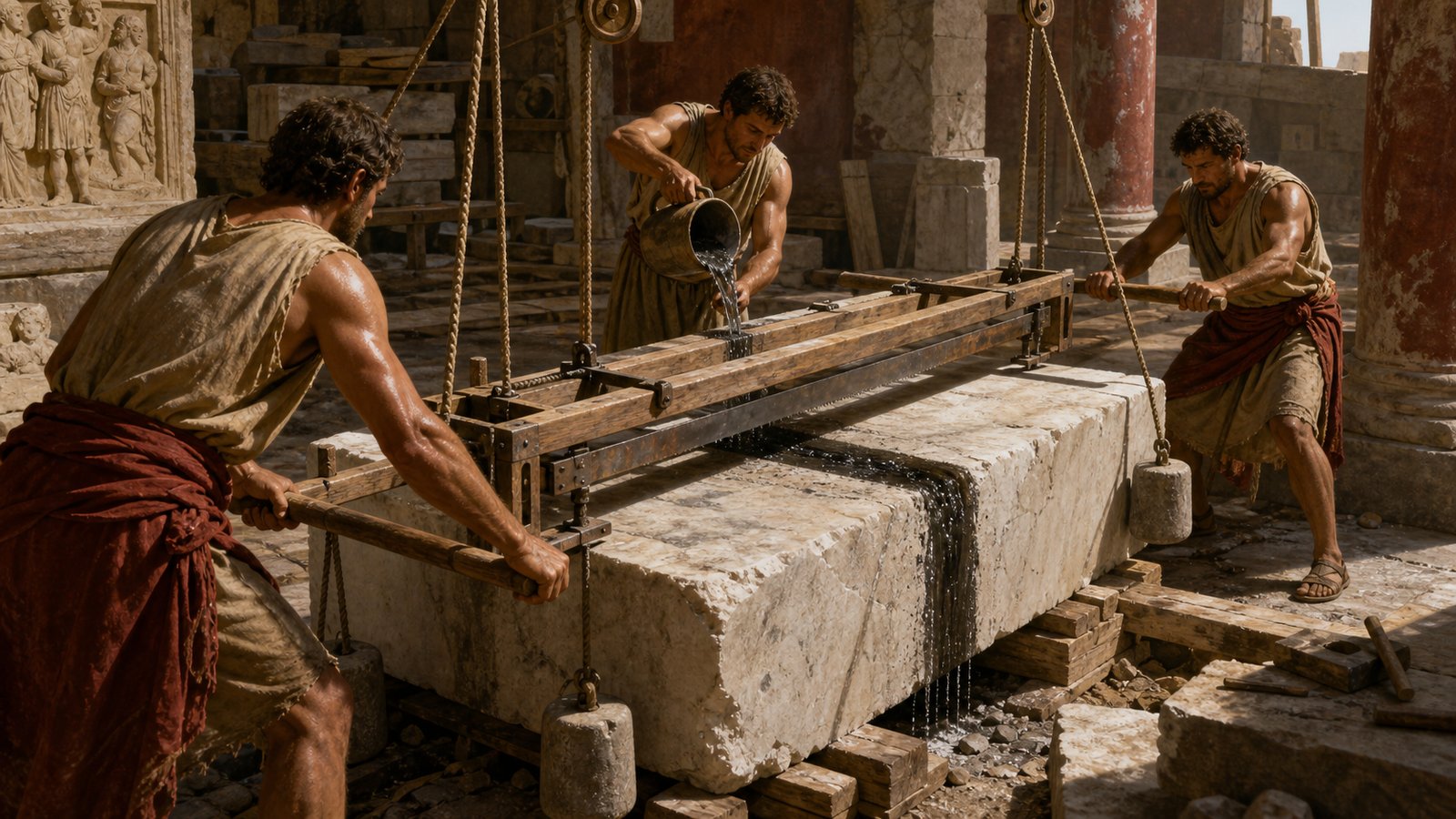
The largest blades were fixed to wooden frames suspended above the stone by pulleys and weights. The frame kept the long blade organized; suspension helped keep it level; weight supplied gentle downward contact. The pullers could then concentrate on horizontal movement instead of lifting and lowering a flexible strip during every pass.
This division was a practical control system. Sideways force came from alternating bodies. Downward force came from gravity moderated by the suspension. Level came from the frame geometry. Abrasive supply remained a separate human responsibility. If each variable had depended on the same pair of hands, one tiring worker could change depth, angle and speed at once.
The sound and feel would change as the cut deepened. A shallow groove guides the blade less than a deep kerf, while accumulated waste increases drag. The workers did not need a modern gauge to notice a stroke becoming heavy or slurry failing to reach the cutting floor. Their repeated motion produced feedback through the handles.
A controlled frame also protected the thin panel forming beside the cut. Uneven pressure could taper the slab or leave ridges that required more finishing. Suspending the saw did not automate judgment; it moved the most repetitive burden into wood, rope, pulleys and weights so judgment could focus on alignment and feed.
A Smooth Ripple Was the Scar of Repeated Motion
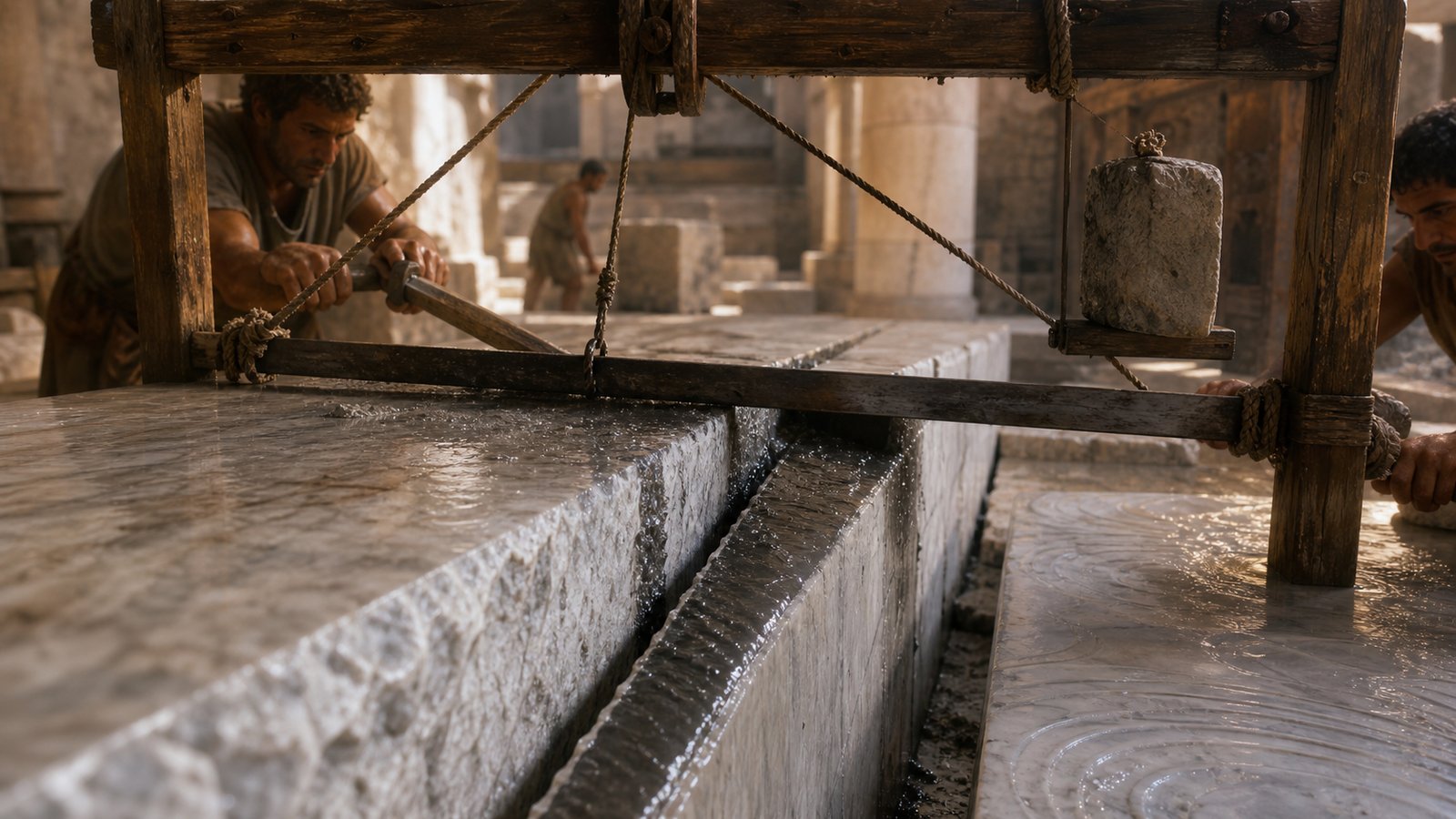
Hard-stone sawing left surprisingly restrained traces. Art of Making notes very smooth surfaces, sometimes with ripples caused by blade movement, and occasional long straight lines. A violent-looking operation could therefore finish with evidence more like a faint current than a field of tooth marks.
Those traces record sequence. The long line marks the blade path; the ripple records variations within repeated strokes. Later abrasion or polishing could erase both, so an unfinished or hidden face often tells more about production than the exposed surface selected for display.
Thin panels made the method economically significant. Wall revetment and flooring could show a prized colored stone across a larger area than one solid block would cover. Every millimetre lost to the kerf reduced that advantage. A controlled narrow cut turned geological rarity into architectural surface.
The result could then enter decorative systems like Roman mosaic and pavement design. Sawn slabs and small tesserae were not the same product, but both demonstrate how prepared stone surfaces could organize color, route and status beneath a visitor’s feet.
Water Power Multiplied the Stroke in Late Antiquity
Art of Making records archaeological evidence for water-powered stone saws at Ephesos and Jerash in Jordan, dated to the fifth or sixth centuries CE. The poet Ausonius also described the noise of such saws in the Moselle valley. These examples place mechanized stone cutting firmly in late antiquity rather than in a timeless industrial afterword.
Channels delivered continual water to wheels. The known machines used multiple blades arranged on two arms, allowing two blocks to be sawn at once into multiple panels. Water power repeated the lateral movement that pairs of workers had supplied, while the production layout multiplied parallel cuts.
Mechanization did not remove the operator. Art of Making emphasizes the need to maintain water and abrasives. A wheel could continue moving a badly supplied blade, wasting motion or damaging the cut. The human task shifted from providing every stroke to feeding and watching a system whose strokes arrived continuously.
Roman watermills reveal a related transfer of effort. In both cases, flowing water replaced repeated muscle at the power stage. Grain milling and stone sawing remained different crafts, yet each depended on maintaining contact, feed and the path through which water became useful motion.
The Finished Panel Concealed a Wet Cooperative Machine
A marble revetment panel looks still, dry and effortless once fixed to a wall. Its production was none of those things. The blade travelled thousands of alternating strokes; abrasive grains entered and left; workers corrected rhythm; the suspension paid out depth; water carried the active material into a slot that narrowed access as it grew.
The system worked because no element pretended to do everything. Iron defined the line. Grit removed stone. Water transported grit. Weight maintained contact. Wood kept the blade level. People supplied reciprocation and renewed the mixture. Late antique mills replaced the pullers’ muscles while preserving nearly every other dependency.
That distributed mechanism explains why a flat blade could cut hard stone. Teeth were optional because the true cutting edge was a moving population of abrasive particles. The Roman achievement lay less in one miraculous material than in arranging ordinary forces so they met at the bottom of a five-millimetre groove.
When the panel finally received polish and entered a floor or wall, the watery mud vanished from view. Yet without that mud between iron and marble, the valuable slab would have remained trapped inside the block. Roman luxury surface began with a controlled slurry and the patience to keep it moving.
Sources & Further Reading
- Art of Making, “Tool: Saw”
- Wikipedia, “Saw”