
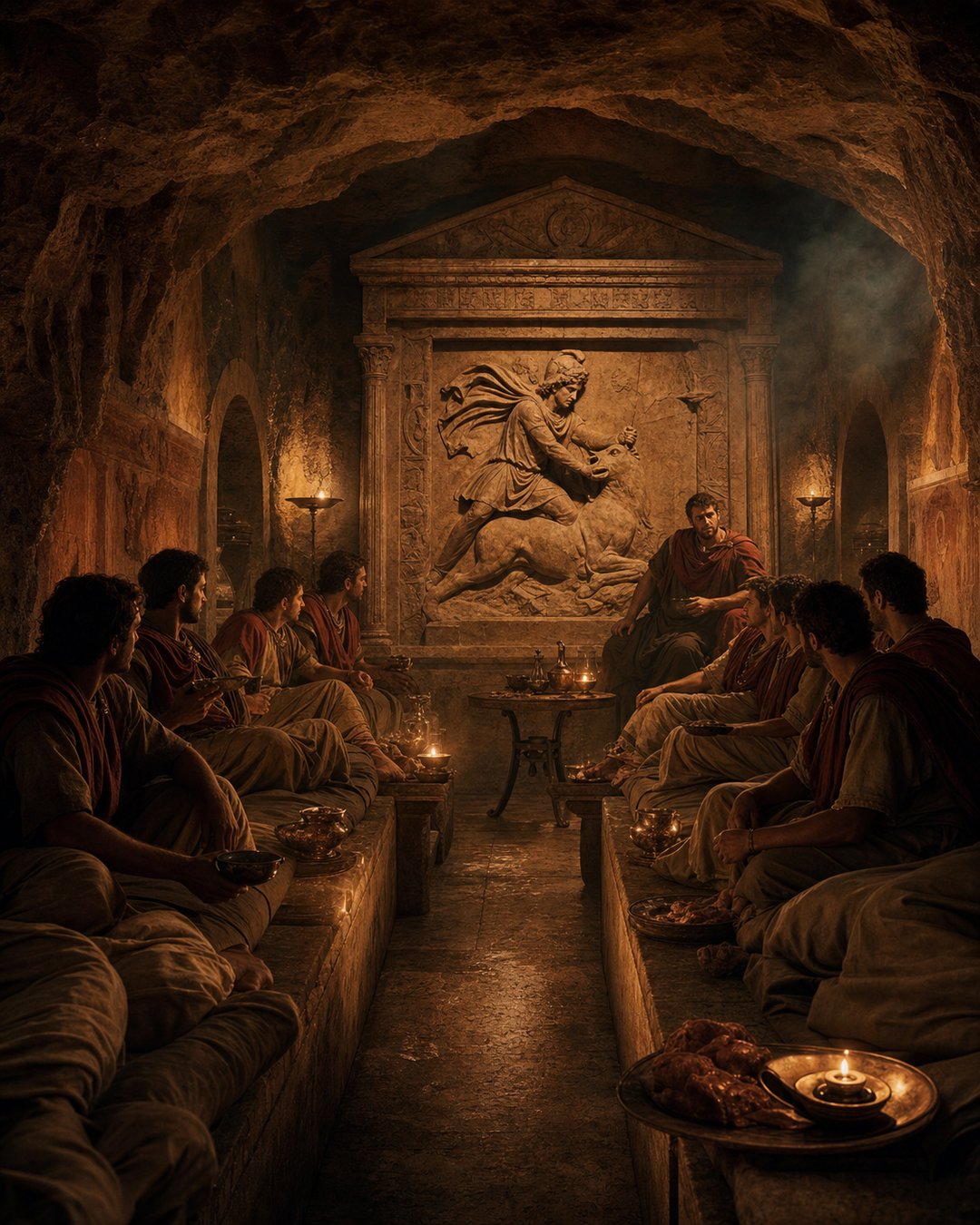
A worshipper entering a Roman mithraeum did not step into a sunlit public temple. He descended or passed into a narrow, dim room. Raised benches flanked a central aisle. At the far end, the god Mithras drove a blade into a bull while a dog, snake and scorpion crowded the carved scene. The architecture pointed every body toward that image.
The cult’s secrecy has often made it sound almost unknowable. No handbook written by an initiate survives, and later Christian critics are hostile witnesses. Archaeology, however, preserves a repeated social mechanism. Mithraea were small dining rooms as much as sanctuaries. Dishes, animal bones, wine containers and benches show groups eating where the cosmic killing dominated the view.
The meal did not reveal a single hidden doctrine to modern observers. It reveals how membership worked. Men reclined together in a bounded space, performed ranks, served one another and imitated a divine banquet shared by Mithras and Sol. Intimacy was built through repeated bodily practice rather than advertised to the street.
A Secret Cult Left Hundreds of Material Traces
The Roman cult of Mithras appeared in the later first century CE and spread widely during the imperial period. More than two hundred mithraea have been identified across regions from Syria to Britain, with especially strong concentrations in Italy and along the Rhine and Danube frontiers.
The distribution explains the cult’s association with soldiers, but military men were never the entire membership. Inscriptions identify officials, merchants and freedmen as well. Mobility through army service, administration and trade helped a compact ritual form travel between forts, ports and cities.
Women appear to have been excluded from initiation. The surviving membership was male, and the rooms accommodated small groups rather than urban crowds. That scale gave the cult a different social texture from public processions that filled Roman streets. Belonging was defined partly by who could not enter.
Secrecy also shaped the evidence. Initiates left dedications and images but no surviving explanatory scripture. Modern interpretation must therefore resist turning every symbol into a decoded sentence. Repetition across many sites establishes shared visual and spatial habits; it does not guarantee one unchanged theology in every province.
The Room Was Built Like a Stretched Dining Chamber
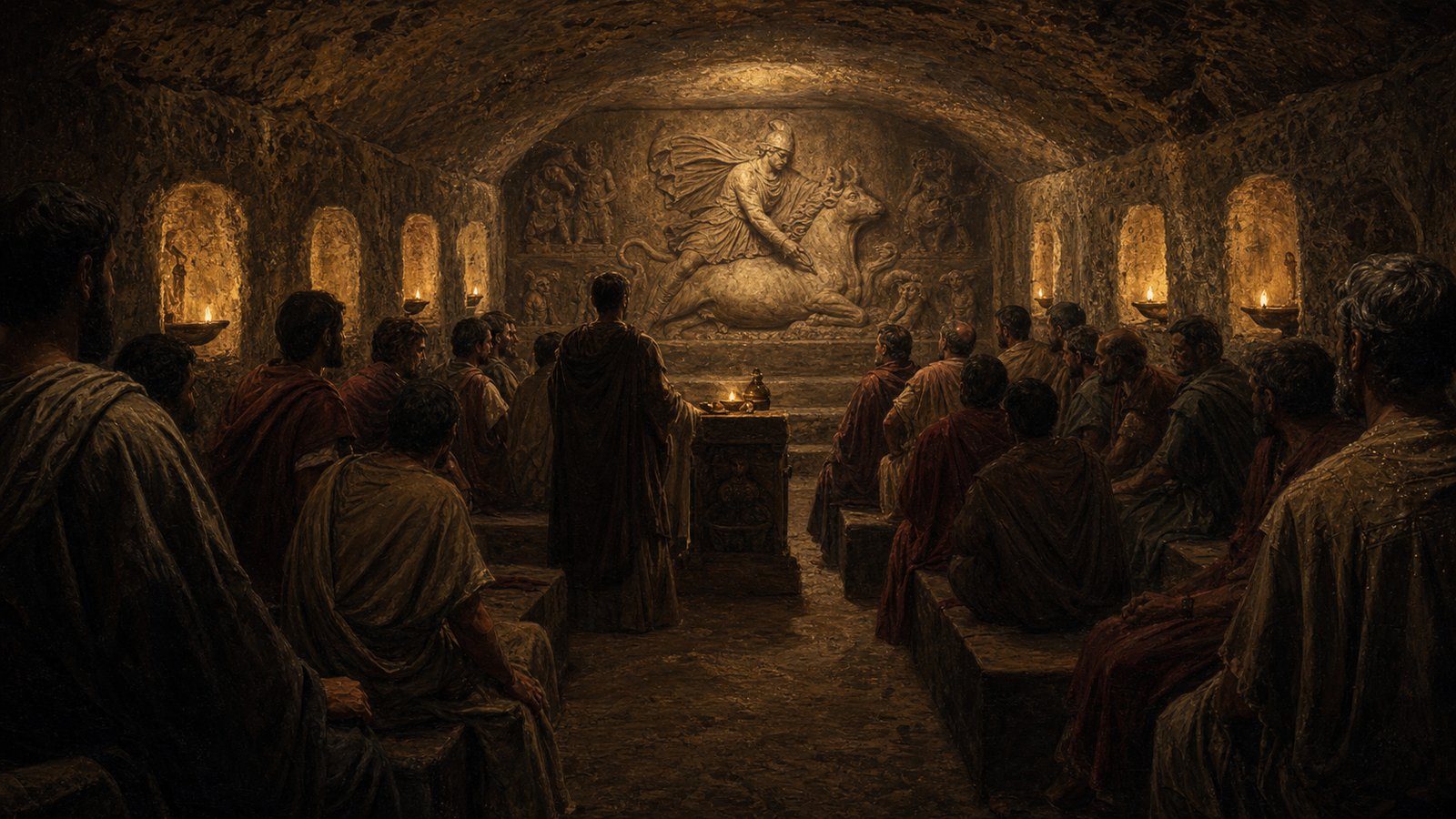
A typical mithraeum was rectangular and low, sometimes underground or constructed to resemble a cave. Two broad raised benches ran along the long sides, leaving a central aisle. The arrangement echoes the Roman dining room, but enlarges its social geometry: two groups could face inward toward ritual action and the cult image.
The bull-killing relief, or tauroctony, normally occupied the focal end. Mithras wears trousers and a Phrygian cap, kneels on the bull and turns his face away while stabbing it. A dog and snake reach toward the wound, a scorpion grips below, and signs of sun, moon or zodiac may frame the event.
The visual program was remarkably stable even though local details varied. Hundreds of reliefs present the central killing in recognizable form. The worshipper did not need to read a long inscription to know where attention belonged. Light, aisle and reclining bodies all directed vision toward the god’s controlled violence.
This inward design contrasts with household religion around the Lares, which tied cult to family and domestic continuity. A mithraeum created a second, chosen household. Its members assembled away from ordinary kinship and practiced loyalty inside a room deliberately separated from public view.
Bones and Broken Dishes Recover the Missing Meal
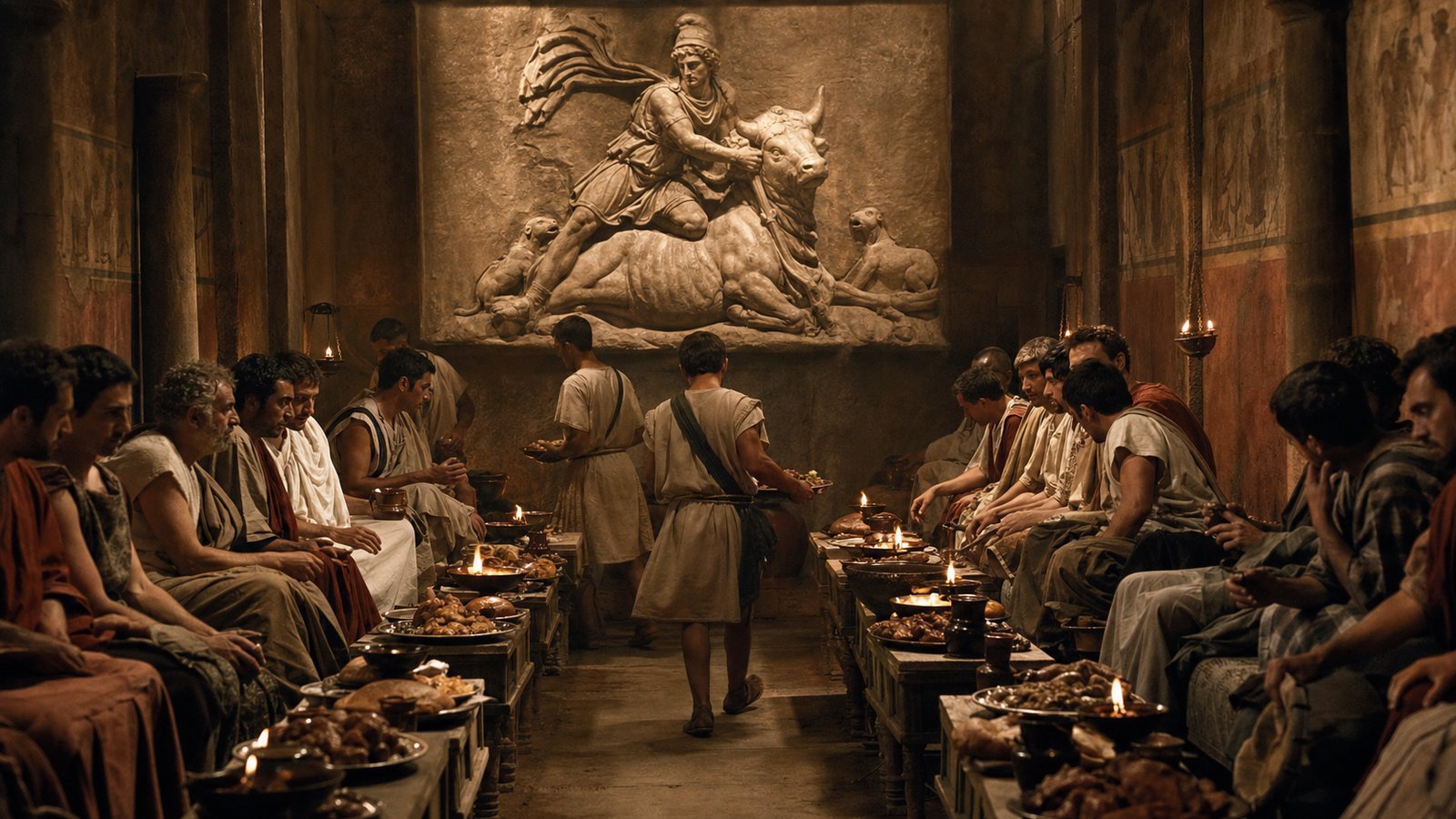
The relief’s bull was not usually slaughtered literally inside every sanctuary. Archaeological deposits instead preserve the remains of feasible meals: pork, chicken and other animal bones, ceramics and abundant evidence for wine. The divine feast was imitated without reproducing the impossible central act at full scale.
One important image shows Mithras sharing a banquet with the sun god Sol after the killing. Human diners reclining below the tauroctony could understand their meal as participation in that sacred model. Food joined myth to muscle: initiates tasted, poured, passed and cleaned within the god’s ordered space.
Quality mattered. Some deposits indicate substantial cuts of meat and plentiful drink rather than token crumbs. A feast redistributed expense into fellowship. Whoever supplied an animal, wine or vessels made generosity visible, while the group consumed the offering until status became a shared sensory event.
The narrow room intensified contact. Smoke from lamps, the smell of cooked meat, echoing voices and elbows near the central aisle produced an experience unavailable in a large civic temple precinct. Archaeology cannot recover every prayer, but it can recover the closeness that made the rite socially persuasive.The benches also fixed a repeated orientation. An initiate could not wander through the sanctuary as through an open precinct. Reclining placed him beside companions and opposite another row, while the god’s image closed the long view. Each feast rehearsed the same social map: members within, outsiders beyond the walls, and Mithras at the room’s visual end.
Seven Ranks Turned Membership into a Ladder
Literary and visual evidence identifies seven grades: Raven, Bridegroom, Soldier, Lion, Persian, Sun-Runner and Father. The exact operation of the system varied and remains debated, but rank gave initiates named positions within the small community. “Father” marked senior authority rather than biological kinship.
Mosaics from the mithraeum at Ostia associated with Felicissimus display symbols of the grades. Other paintings show candidates blindfolded, kneeling or subjected to staged ordeals. Such images should not be inflated into modern tales of torture. They do indicate controlled vulnerability and dramatic changes of status.
Service was built into rank. The Raven could be associated with carrying food, while higher grades performed other ritual roles. A banquet required labor: lighting, pouring, bringing dishes and maintaining order. Hierarchy became practical whenever members assembled to eat.
Initiation also gave memory a sequence. A man could remember when he entered, who guided him and which objects marked his grade. Progress through ranks transformed a secret from information possessed into a career enacted. The cult offered another ladder of recognition beside office, household position or army promotion.That ladder could matter especially to men whose public status was constrained. A freedman might lack an old family name, and a soldier far from home might lack local kin. Inside the mithraeum, service, sponsorship and advancement supplied relationships with their own vocabulary. This does not prove equality; it shows that the cult offered a structured arena in which another form of standing could be earned and displayed.
The Bull Scene Created Unity Without a Surviving Creed
The tauroctony is often interpreted cosmically because zodiac signs, sun and moon accompany it, and scholars have proposed astronomical readings. The bull’s tail may end in grain, suggesting renewed fertility. Yet no initiate’s text explains the complete image, so certainty must stop before reconstruction becomes invention.
The cult’s possible Persian connections are similarly disputed. Mithras bears a name related to the Iranian Mithra and wears clothing Romans considered eastern, but the Roman mysteries are archaeologically concentrated inside the empire and do not simply reproduce an attested Persian institution. Exotic imagery could be part of a Roman creation or transformation.
What survives most securely is the combination of image, room and gathering. The bull-slayer established a shared visual world. Benches arranged bodies. Grades distributed roles. Meat and wine rewarded attendance. Secrecy protected the group’s boundary, but repeated sociability gave that boundary value.
Mithraism declined as the religious landscape changed in late antiquity, and sanctuaries were abandoned, filled or destroyed. Their compact interiors preserved an accidental record. A secret community left no catechism, yet its floors and refuse show the ordinary technology of devotion: men came back because cosmic order was served at a table they could share.
Sources & Further Reading
- World History Encyclopedia, Mithraism
- Encyclopaedia Britannica, Mithraism
- Manfred Clauss, The Roman Cult of Mithras