
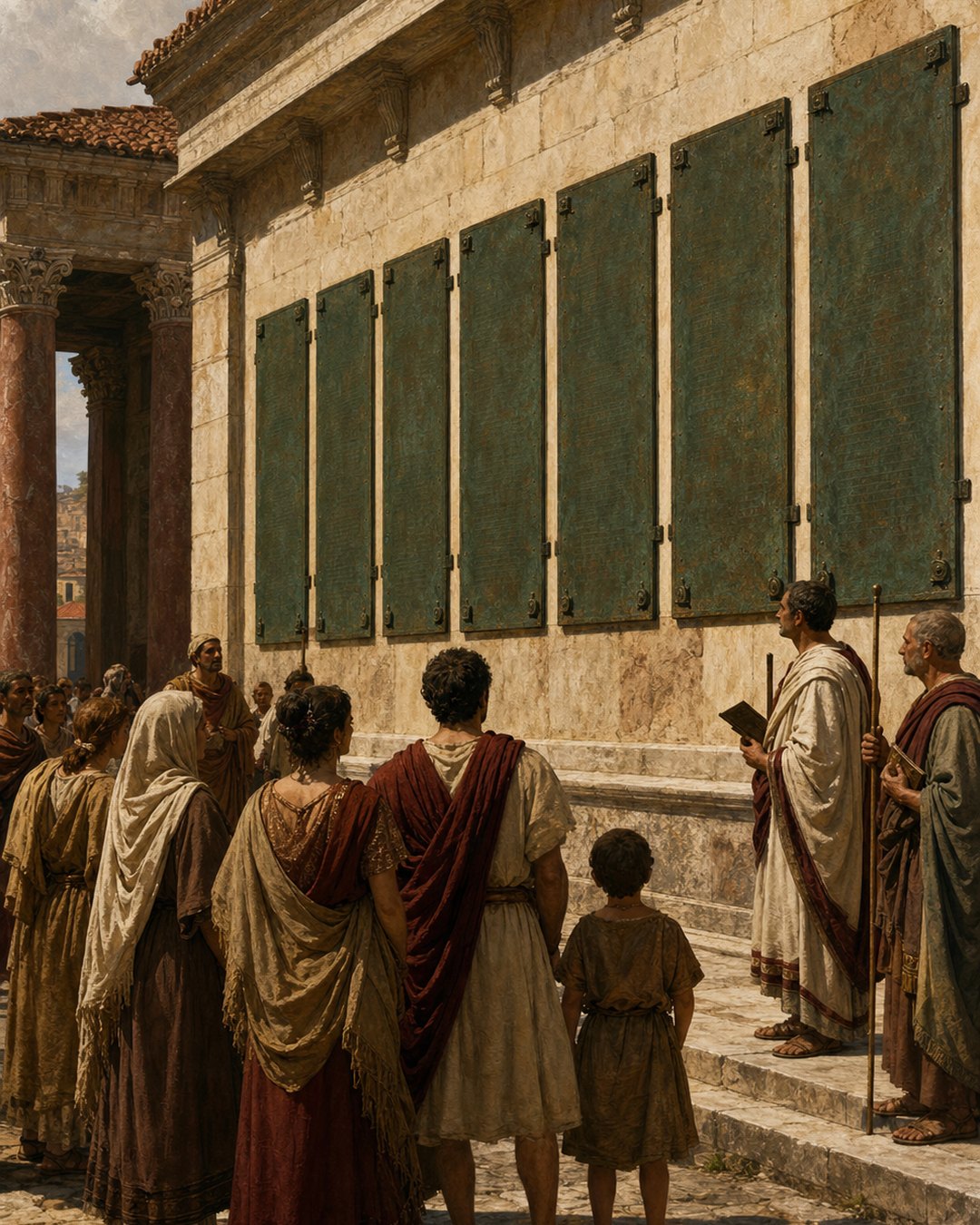
In 1981, six bronze plates recovered in southern Spain opened a town hall that had been silent for nearly nineteen centuries. They belonged to the Municipium Flavium Irnitanum, a community in the modern province of Seville that was scarcely known before its municipal charter appeared. The metal did not preserve a heroic speech. It preserved rules for work.
The surviving chapters move from magistrates and elections to public money, judges and civil cases. One clause assigns responsibility for roads, sewers, baths, markets, weights and emergency watches. Another explains when local office could carry Roman citizenship into a magistrate’s household. The charter’s scale is striking because it treats government as a chain of repeatable decisions rather than a distant emperor’s mood.
That is the real value of the Lex Irnitana. Its bronze made imperial order local without making local officials unlimited. A town could elect, spend, maintain, judge and administer, but each power arrived with a boundary. The tablets turned self-government into something citizens could point to on a public wall.
The Charter Survived in Pieces, Not in a Palace
The six plates were discovered in 1981 and preserve the statute of the Municipium Flavium Irnitanum in Roman Baetica. Milan Lovenjak’s study places the town in what is now the province of Seville. The surviving object is therefore both provincial law and an archaeological accident: a local charter became one of the fullest witnesses to a wider Flavian municipal model.
Comparison made the reconstruction possible. Parts of the statutes from Salpensa and Malaca overlap substantially with Irni. Together they show communities using versions of the same law rather than inventing every office from nothing. Lovenjak counts seventy-three known chapters out of ninety-seven; the missing opening probably dealt with the assembly and council.
The text belongs to the reign of Domitian and the year AD 91. Its survival on bronze matters. A scroll could be copied, stored or lost in an archive. Large metal panels fixed to civic architecture made the rules part of the town’s visible fabric. Law occupied physical space near the people expected to use it.
The find also changes the scale at which Roman politics can be studied. An imperial biography follows courts, armies and succession. Irni offers another view: who watches a market, who handles public cash, how candidates enter an election and where a civil dispute belongs. Empire becomes a timetable of municipal obligations.
Aediles Had Sewers, Markets, Baths and Weights to Watch
Chapter 19 gives the aediles a practical portfolio. The Latin text lists the food supply, sacred buildings and places, the town, roads, streets, sewers, baths, the market, weights and measures. It also allows them to require watches when circumstances demanded. These are not ornamental duties. They are the systems through which a settlement stayed usable.
The list joins activities modern readers often separate. A false weight in the market, an obstructed street, a neglected drain and an unguarded night all sit inside civic administration. The aedile’s office linked commercial trust, movement, sanitation and security because town life made those problems collide every day.
Power came with limits. The chapter specifies the aediles’ authority and places their actions beneath higher laws, decrees and imperial constitutions. A local officer could seize a pledge or impose a fine within stated bounds, but municipal office was not a license to improvise a private government.
This routine layer complements the lex Gabinia’s grant of extraordinary command. Pompey’s commission answered a crisis across the Mediterranean. Irni’s charter answered the opposite problem: how ordinary authority should continue after the excitement had passed.
Office Could Turn a Local Family Roman
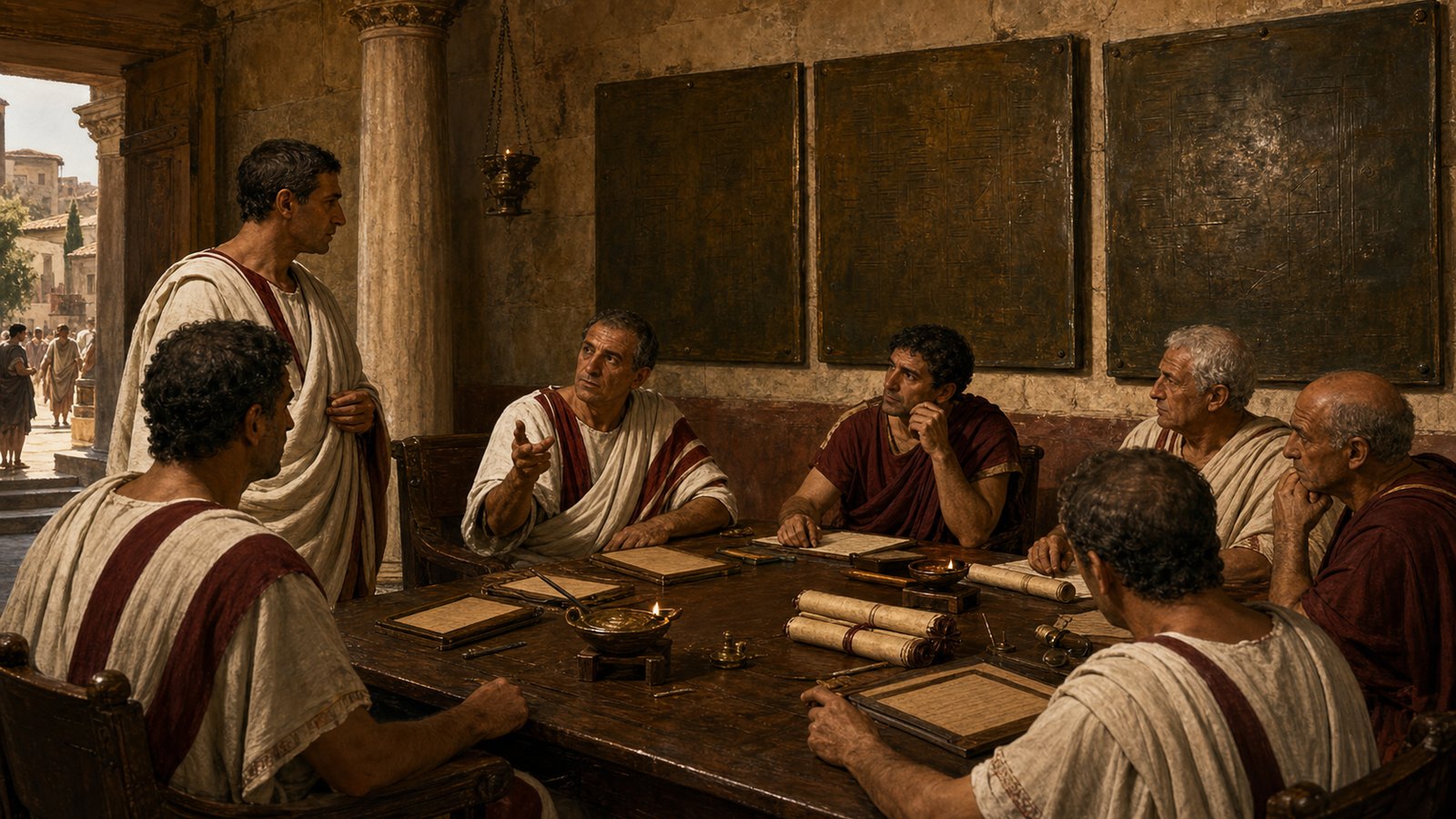
Chapter 20 assigns quaestors responsibility for municipal money. They could collect, disburse, keep and administer the community’s funds under the direction of the duumvirs. The wording reveals a small chain of accountability: money had designated custodians, but those custodians operated inside a hierarchy rather than as independent treasurers.
The next chapter ties office to status. Men chosen as magistrates from the local senators or decurions were to become Roman citizens after completing the honor. The grant extended, under stated conditions, to parents, spouses, legitimate children and certain grandchildren who remained under family power.
This was not citizenship floating free of municipal structure. Service in a recognized office became a route through which a local elite and household entered Roman civic status. The town supplied candidates and offices; the charter defined the legal consequence. Local ambition and imperial integration reinforced each other.
The household provisions also show why a municipal law cannot be reduced to a chart of job titles. A year in office could alter inheritance, family standing and future opportunity. Public administration reached into private legal identity, while the rule’s detailed limits kept the privilege connected to the number of magistrates the charter allowed.
Election Rules Converted Rivalry into Procedure
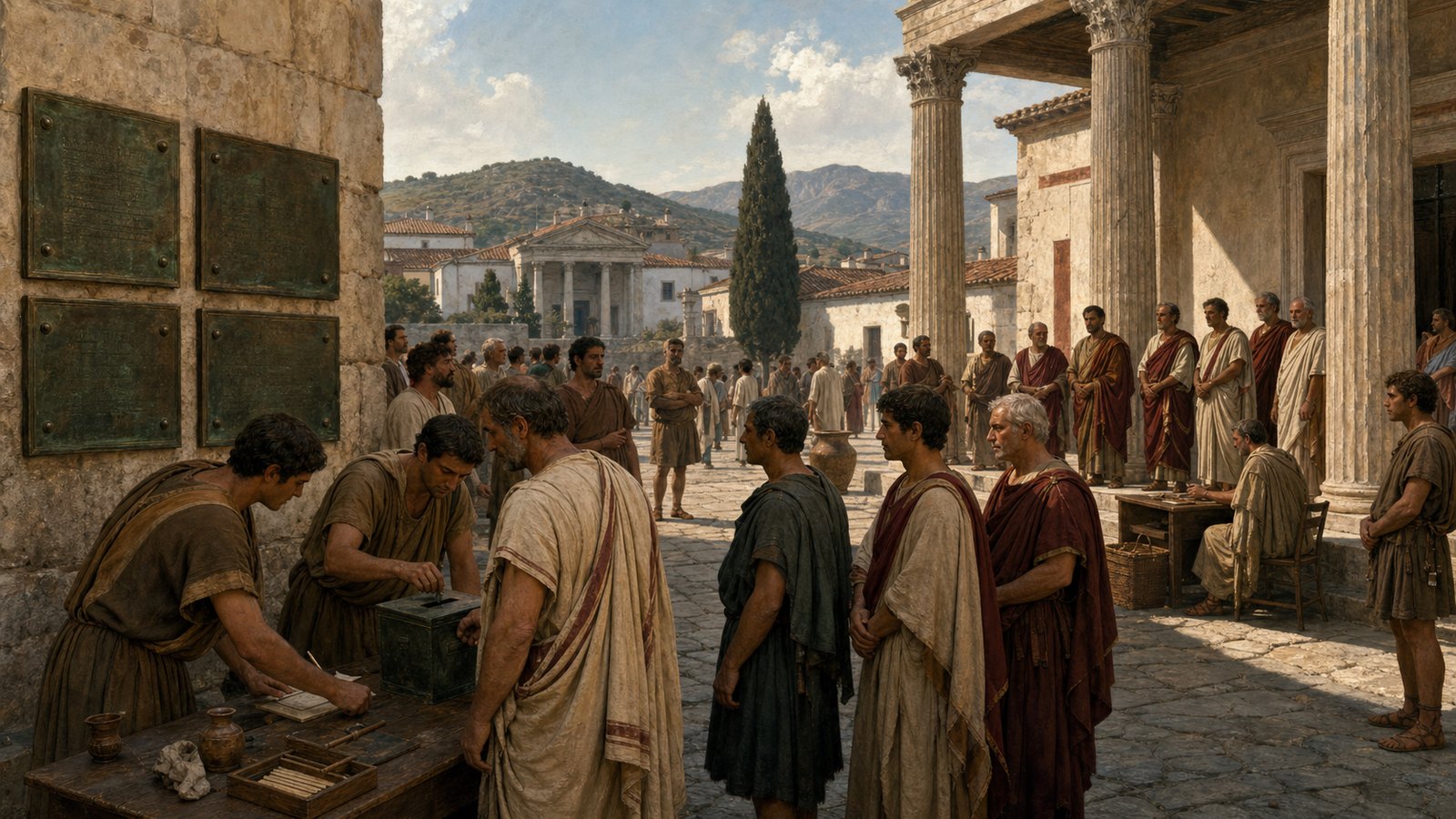
Lovenjak identifies different forms of election among the surviving subjects. The charter had to turn competition for duumvir, aedile and quaestor into recognized outcomes. Candidate qualifications, nomination, voting and the filling of offices were not left to a crowd’s memory. Procedure made rivalry governable.
That distinction is useful beside Pompeii’s painted election notices. Wall advertisements show neighbors, associations and trades urging support for candidates. The Lex Irnitana stands behind that visible persuasion with a different question: after endorsements and reputation had done their work, what rules made the result valid?
Written election rules could not remove influence, kinship or status. They could establish the sequence through which influence had to pass. A candidate needed more than admirers; the town needed offices filled in a way the charter recognized. Repetition mattered because municipal government returned to the same problem each year.
The result was neither modern democracy nor empty ceremony. It was a local political machine with Roman legal parts. Citizens encountered candidates and voted within their community, while the charter standardized the frame. Local voices supplied choice; bronze supplied continuity.
Civil Disputes Defined the Edge of Autonomy
The longest surviving concentration concerns local jurisdiction. Lovenjak notes that chapters 84 through 92 occupy more space than any other subject and describes local jurisdiction as the real criterion of autonomy. A town that could maintain streets but not resolve disputes would possess administration without a full civic legal life.
The charter addresses judges, civil proceedings and the circumstances under which local magistrates could act. Jurisdiction is fundamentally a boundary question: which dispute may stay in the municipality, who may hear it and when does a matter move beyond local authority? Detailed rules protected both the town’s competence and the larger Roman order.
Those chapters expose a practical truth about self-government. Autonomy is not simply freedom from interference. It is the burden of producing decisions that other participants accept as lawful. Selecting judges, summoning parties and following recognized procedure transformed conflict from personal pressure into a civic case.
Bronze did not guarantee fairness in every courtroom. It did provide a common reference against which conduct could be challenged. The more carefully jurisdiction was defined, the less easily a magistrate could treat a private quarrel as whatever kind of case suited him that morning.
Public Bronze Made Administration Answerable
The Lex Irnitana combined standardization with a named place. Irni did not cease to be local because its charter resembled those of Salpensa and Malaca. The shared framework gave its magistrates familiar Roman offices, while the inscribed copy attached those offices to this municipality, its council, money and disputes.
Public display changed the relationship between rule and official. The charter was not merely advice held by experts. Mounted bronze announced that powers had sources and edges. An aedile responsible for bad measures, a quaestor handling common funds or a duumvir directing a case operated beneath language that outlasted one officeholder.
The physical object also explains why the discovery is so productive. Six plates preserve the texture of administration: lists, qualifications, exceptions and sequences. Grand political narratives compress a province into conquest and loyalty. Municipal law restores the repeated acts that made conquest governable decades later.
Irni’s tablets made a town govern itself by refusing to leave government undefined. They assigned drains and markets, elections and money, citizenship and courts to procedures that could be repeated after every official had gone home. Rome’s reach was not only a road or legion. It was a bronze operating manual fixed where local power had to see it.