
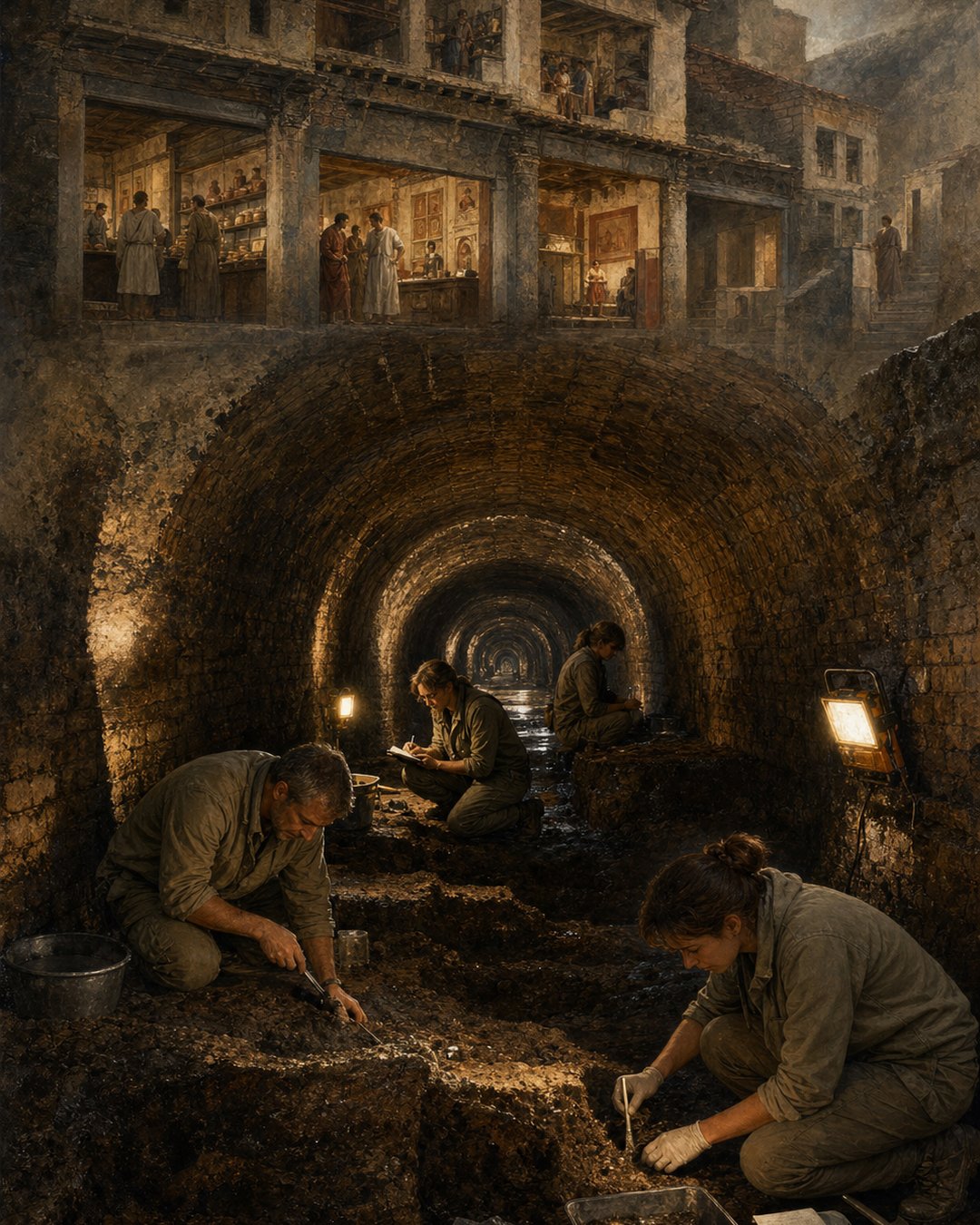
Beneath one block of Herculaneum, archaeologists entered a tunnel eighty-six metres long and began bagging what the city had tried to flush away. The work eventually produced about 750 sacks of ancient sewage. Mixed through it were food remains, pottery, coins, beads, a lamp and a gold ring set with a gemstone.
The deposit had been sealed when Vesuvius overwhelmed Herculaneum in AD 79. Unlike a recipe book or a painted banquet, it did not present meals as Romans wished them to be seen. It collected what bodies had digested, what kitchens discarded and what residents accidentally lost into drains serving shops and apartments above.
The result is more than a list of unpleasant curiosities. Because excavators could relate sections of the sewer to particular buildings, the Cardo V deposit gave waste an urban position. The same tunnel could answer questions about vegetables, disease, commerce, plumbing and inequality. Roman daily life survived because its least prestigious material stayed together.
An Eighty-Six-Metre Tunnel Became a Sealed Archive
Herculaneum stood on the Bay of Naples near Pompeii. The eruption of Vesuvius in AD 79 killed residents and buried structures beneath volcanic material. That catastrophe destroyed the functioning town, but it also closed contexts that ordinary rebuilding, cleaning and scavenging would usually disperse.
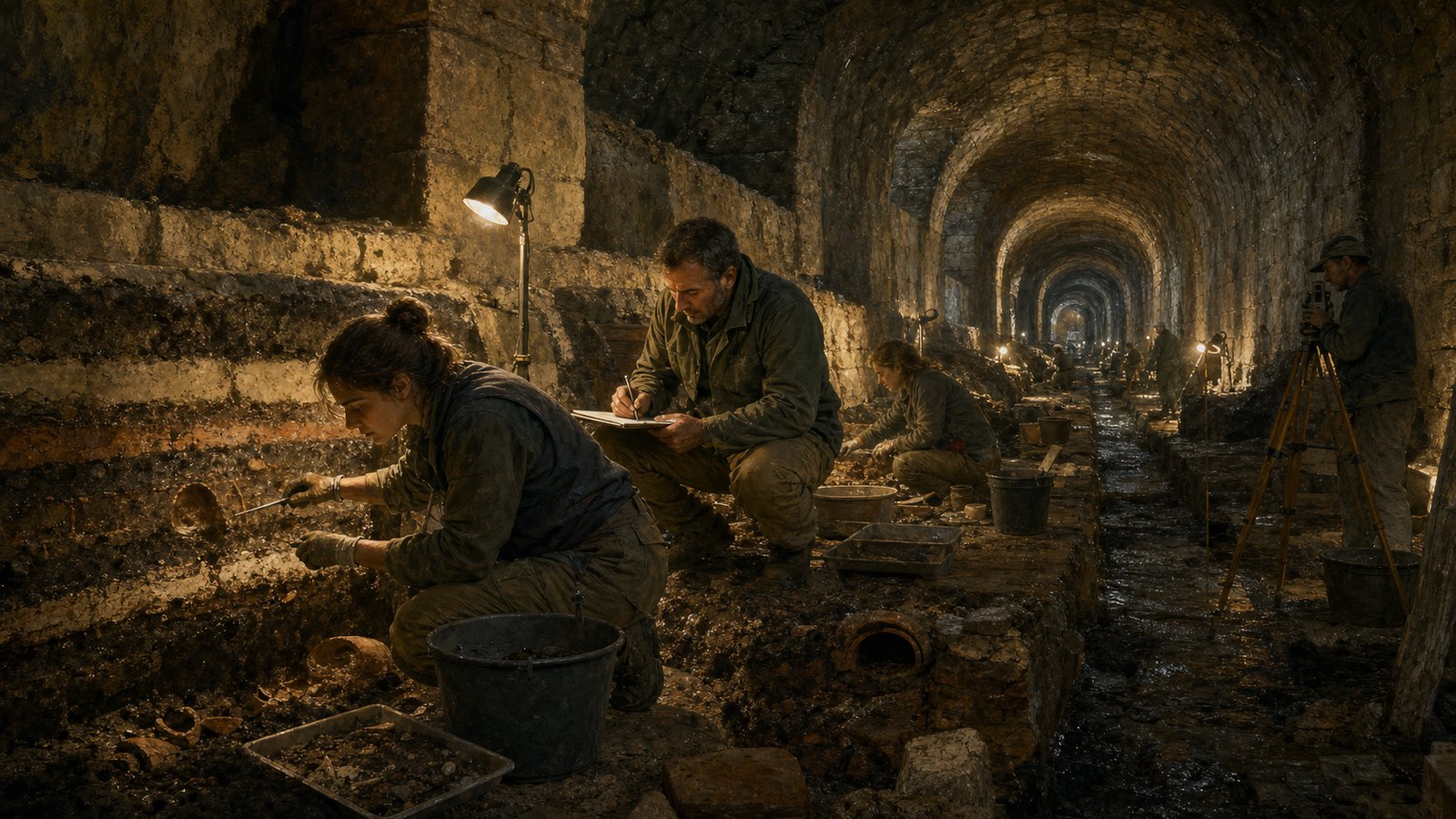
The sewer ran for eighty-six metres beneath the Cardo V area. Researchers described its contents as the largest deposit of human waste yet found from the Roman world. Removing and sorting it required hundreds of sacks, a scale that changed the evidence from an isolated sample into the accumulated output of a neighborhood.
A sewer is not a neat archive. Water moves small objects; pits are cleaned; drains receive kitchen rubbish as well as excrement. Archaeologists therefore had to record where material came from rather than assuming that every seed or coin represented the same family or day.
The volcanic seal supplied an endpoint. Everything in the functioning drain belonged before the destruction in AD 79, even when the exact day or resident remained unknowable. The tunnel thus held many small acts of disposal inside one unusually firm historical boundary.
Shops and Homes Above Gave the Waste an Address
The most important feature was vertical. Buildings stood directly above different portions of the sewer, including shops and dwellings. By matching deposits to those structures, the project could look for variation along the block instead of blending every sample into a generic Roman diet.
That relationship does not identify a seed with a named eater. Waste can travel and households can share facilities. It does, however, narrow the social setting. A cluster beneath a commercial space may reflect preparation or sale as well as consumption, while material beneath apartments speaks to repeated domestic routines.
This is a different urban story from the Roman shops that turned streets into marketplaces. A shopfront shows exchange facing the street. The sewer catches the hidden remainder after goods were trimmed, eaten, spilled or rejected.
Mapping below and above also prevents an easy mistake: treating Herculaneum as one household frozen in time. The city contained people with different resources, tastes and work. The sewer preserves mixture, but its route lets researchers test where that mixture changed.
Vegetables Survived Better Than the Banquet Story
Reports from the excavation emphasize the quantity of vegetables in the samples. That observation matters because elite Roman literature often gives disproportionate attention to elaborate dishes, rare fish and dining performance. Sewage records repeated consumption without requiring anyone to boast about it.
Plant remains do not automatically measure portion size. Seeds, skins and pits survive differently, and preparation can remove evidence before food reaches the table. Researchers must distinguish abundance in a deposit from abundance on a plate. The sewer is direct evidence of eating, but not a transparent menu.
Its strength comes from accumulation. One literary joke can exaggerate; one carbonized meal can be exceptional. A long drain serving many people gathers ordinary acts until patterns become visible. Vegetables appear not as moral symbols of rustic simplicity but as physical remains passing through an urban population.
The evidence complements the bakeries that made bread an urban routine. Ovens and mills reveal production capacity. The sewer reveals what entered bodies and what preparation left behind. Together they connect infrastructure to appetite.
White Blood Cells Turned Waste into a Health Record
One sample contained a high concentration of white blood cells. Researchers interpreted this as evidence consistent with bacterial infection. The finding is striking because no skeleton, physician’s note or named patient was required. Inflammation left a microscopic trace in material discarded by the body.
The conclusion must remain narrow. It does not diagnose a particular resident with a named disease, and a single sample cannot establish the health of the whole city. Contamination, preservation and the mixture of waste all limit certainty. The responsible claim is that illness indicators existed within this block’s sewage.
Even that limited result expands the kinds of people visible in ancient history. Most residents never commissioned inscriptions or appeared in court speeches. Their digestive health entered the record unintentionally. Archaeology can recover population experience from biological traces precisely because no ancient author selected them for preservation.
Diet and disease also interact. Food quality, water, parasites, crowding and seasonal stress shape the body together. The Cardo V evidence cannot separate all those causes, but it turns the sewer from plumbing into a place where urban systems met human tissue.
Coins, Beads and a Gold Ring Fell into the Same Darkness
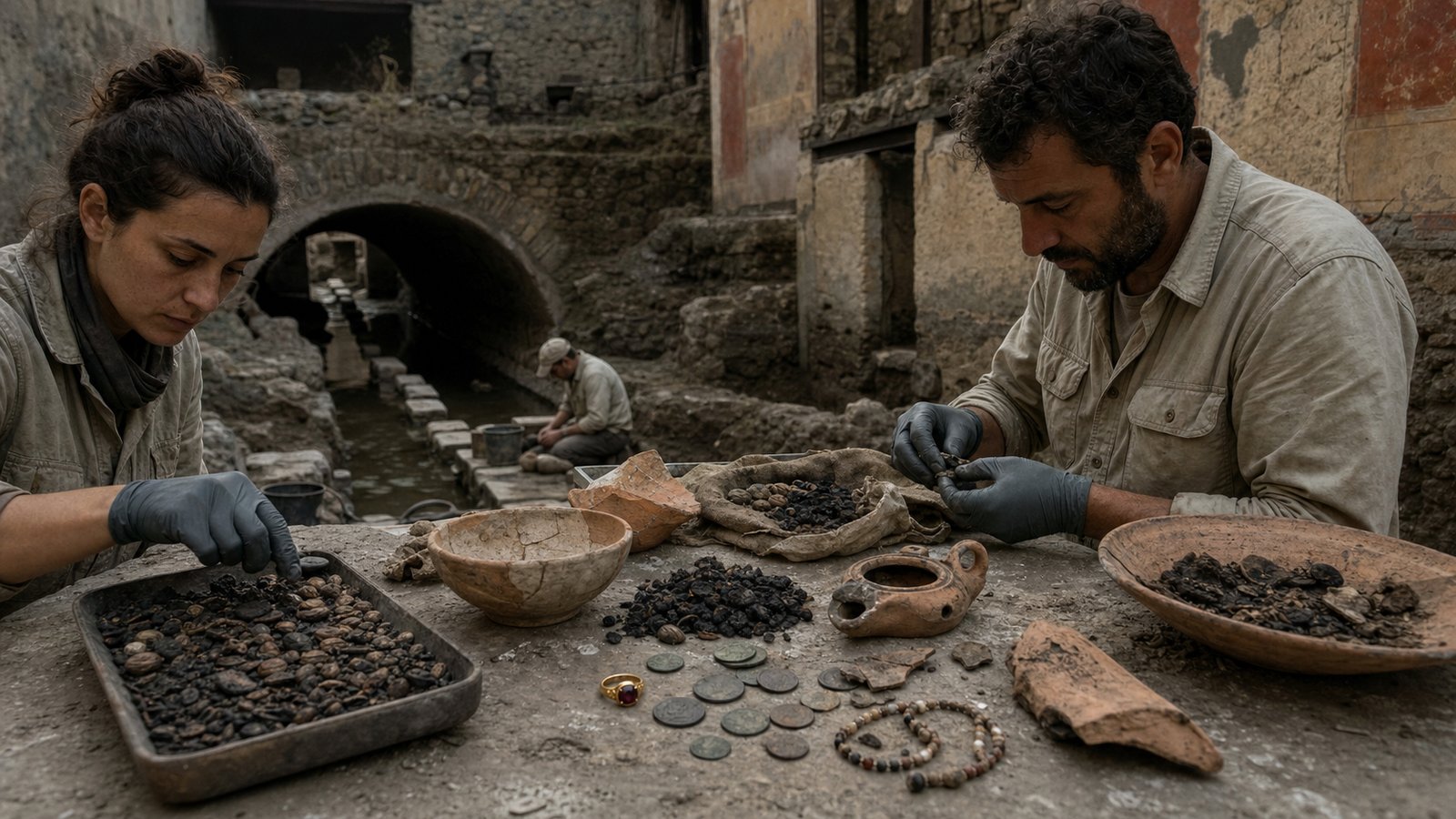
The deposit produced more than biological remains. Reports list pottery, a lamp, sixty coins, necklace beads and a gold ring with a decorated gemstone. Some objects may have been swept in with rubbish. Others could have slipped through a floor, drain or latrine opening and become impossible to retrieve.
Those losses make the tunnel physically vivid. A coin is small enough to disappear in dirty water; a bead can break free from a string; a lamp fragment can be discarded after use. The gold ring is different in value but not in destination. Once below the building, precious and worthless objects entered the same archaeological layer.
Object counts should not be converted directly into wealth estimates. Sixty coins across a large accumulated deposit may represent many episodes, and ownership cannot be assigned. Their value lies in showing how circulation above leaked into waste below.
The jumble also explains why excavation required patient sorting. Human waste, food remains and artifacts answer different questions, yet removing one category destroys the relationships among them. The Cardo V project treated the deposit as an assemblage rather than as a hunt for display pieces.
The Sewer Corrects Both Disgust and Romance
Ancient Rome is often approached through marble monuments or through sensational filth. The Herculaneum sewer resists both habits. Its material is unpleasant, but the research is exacting: length measured, sacks numbered, deposits located, samples examined and buildings mapped.
It also resists the romance of a perfectly frozen day. The eruption supplied a final date, not a single moment for every object in the tunnel. Waste had accumulated over time, moved through water and mixed across users. The best reconstructions preserve those limits instead of making every item part of one last meal.
Herculaneum’s destruction has already yielded dramatic human remains. The sewer adds lives without faces. It records shopping, cooking, digestion, infection, cleaning and accidental loss—the repetitive processes that made a town function before disaster turned it into an archaeological site.
The deepest lesson is methodological. Ordinary people often survive historically through systems rather than names. A drain linked bodies to buildings; volcanic burial kept the link from being cleaned away; excavation translated sacks of refuse into patterns. What the city rejected became evidence because its context endured.