
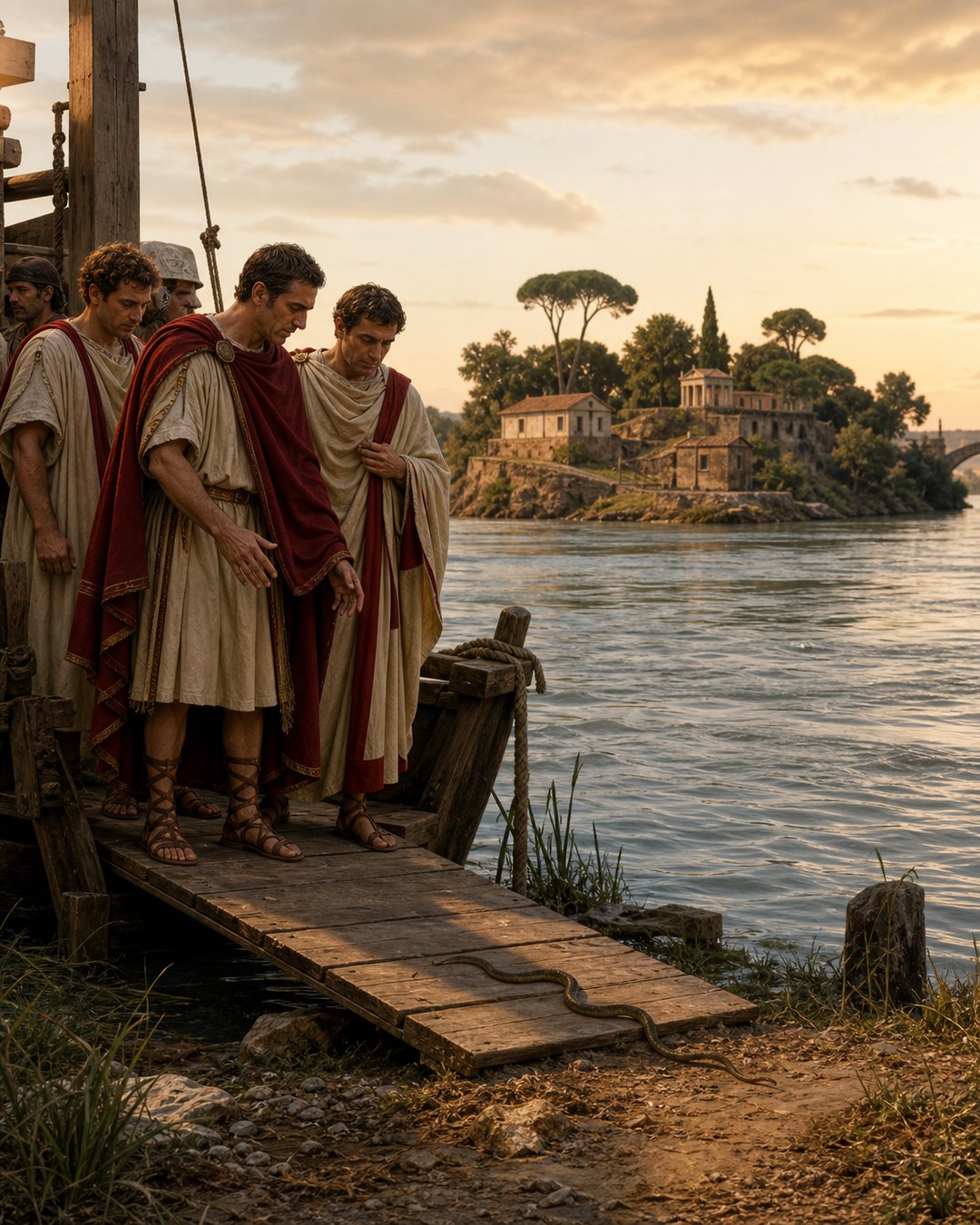
A Roman ship came up the Tiber carrying an answer to an epidemic. According to the story preserved most vividly by Ovid, a sacred serpent had boarded at the Greek healing sanctuary of Epidaurus. As the vessel reached Rome, the snake slid onto the island in midstream, coiled among the reeds and chose the place where its god would live.
The god was Asclepius to the Greeks and Aesculapius to the Romans. Rome had turned to him after consulting the Sibylline Books during a plague in 293 BC. A temple followed on Tiber Island, traditionally dedicated in 291 BC. The epidemic response became a permanent point on the city map.
No historian can treat Ovid’s traveling serpent as a ship’s log. Its importance lies in what the tale accomplished. A foreign cult did not merely arrive; the god appeared to select a site that was inside Rome yet divided from it by water. Illness, ritual and urban geography became one story.
A Plague Sent Rome Looking Beyond Italy
In 293 BC, disease was severe enough for Roman authorities to seek a sacred remedy. The summary of Livy’s lost eleventh book and later authors connect the crisis with a consultation of the Sibylline Books. The prescribed response was to bring Aesculapius from Epidaurus, the renowned sanctuary in the Greek Peloponnese.
This was not a rejection of practical care in favor of magic. Ancient healing did not divide cleanly into modern categories of medicine and religion. Families used diet, drugs, surgery, nursing, vows and divine help in overlapping ways. Importing a healing god gave the state a public response when ordinary households could not control a citywide threat.
The consultation also followed an established Roman mechanism. In moments interpreted as prodigious or dangerous, officials could ask the guarded Greek verses for a remedy and then authorize an unfamiliar rite or cult. Rome’s use of the Sibylline Books during crises made adaptation look like obedience to an ancient institution rather than improvisation.
Epidaurus supplied more than a divine name. It offered a prestigious sanctuary, ritual practice and a living community of healers and worshippers. An embassy could observe the cult, negotiate its transfer and return with a symbol convincing enough to make a Greek god publicly Roman.
Ovid Turned the Embassy into a Serpent’s Voyage
Ovid tells the fullest surviving voyage in Book 15 of the Metamorphoses. In his version, the Roman envoys reach Epidaurus but the local council hesitates to surrender its god. That night, Aesculapius appears in a dream and promises to travel in a larger form, recognizable by the serpent that winds around his staff.
The next day, an enormous sacred snake emerges from the sanctuary and moves through the city to the harbor. It boards the Roman ship and rests in the cabin of the envoys. The language is epic and miraculous. Ovid is giving bodily movement to a process that, in administrative terms, involved permission, ritual objects and a long sea journey.
The ship follows the Italian coast and pauses at Antium, where the serpent visits a sanctuary before returning aboard. When the vessel finally enters the Tiber, crowds meet it with incense and sacrificial fires. The narrative converts an imported cult into a public arrival witnessed along the river.
At Tiber Island, the snake leaves the ship and disappears into the new sacred ground. The god has not been assigned a random vacant plot by officials. He has selected it. That plot device gives divine approval to the embassy, the transfer and the exact location in one continuous scene.
The Island Was Separate Without Being Remote
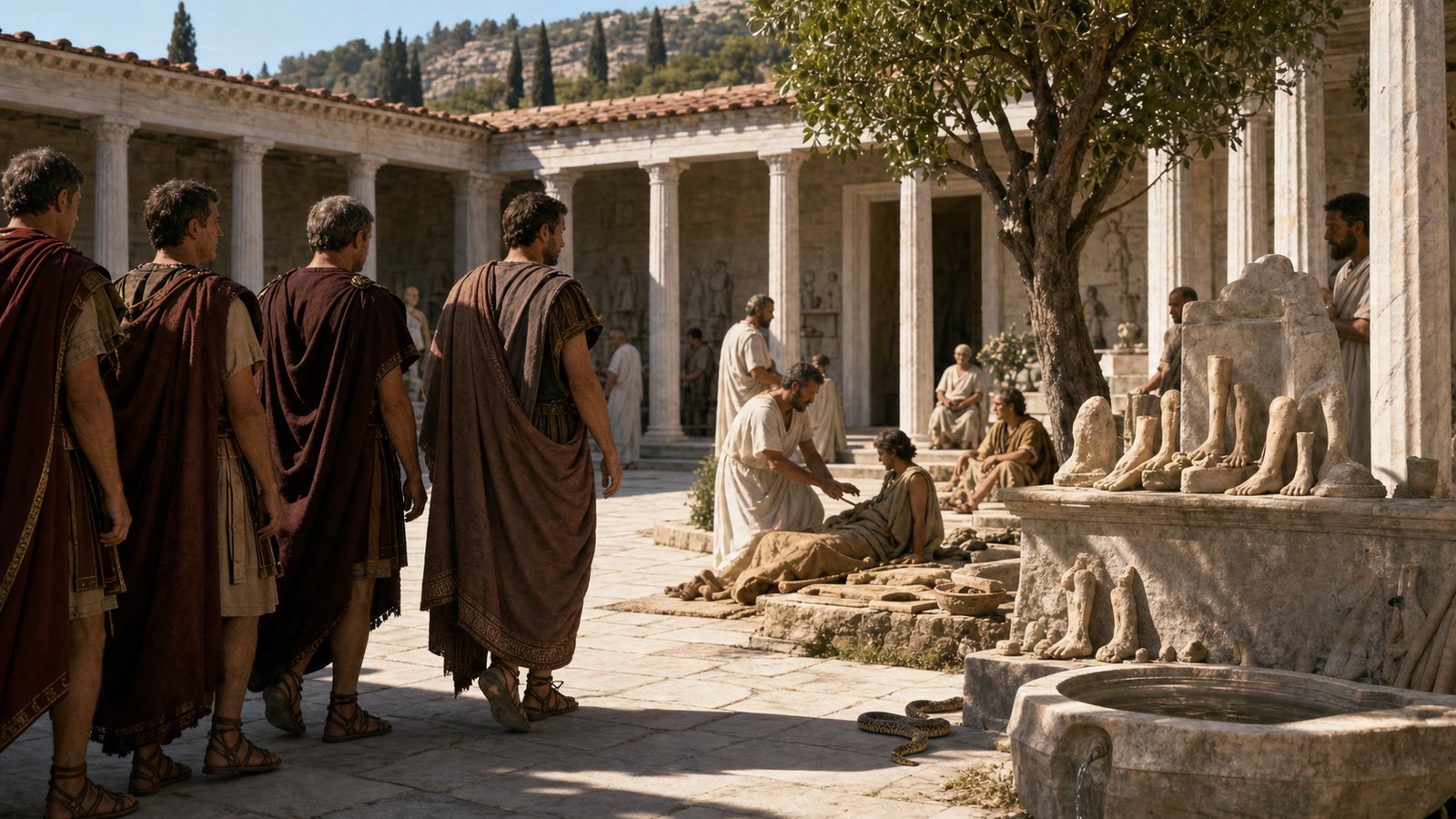
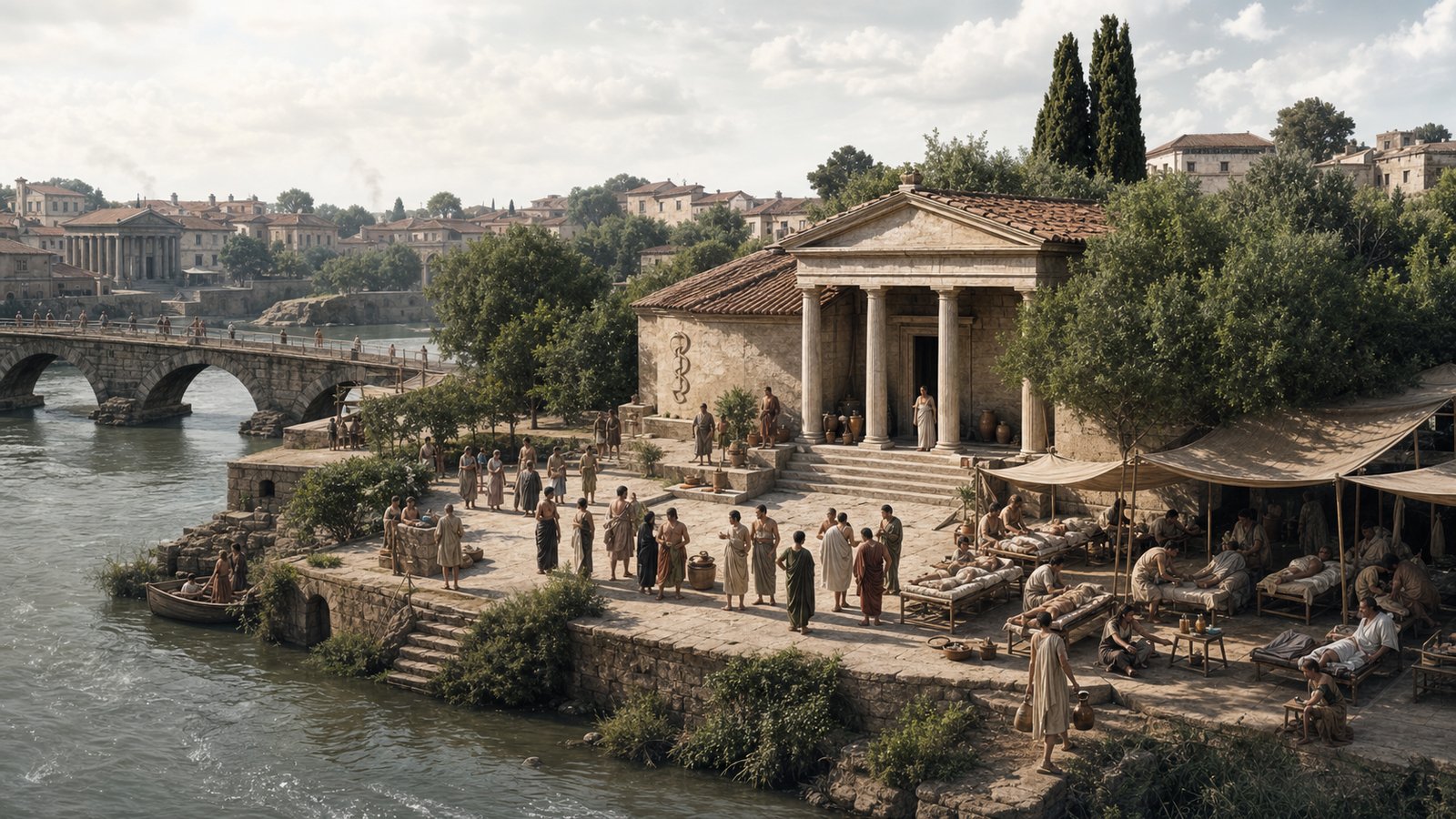
Tiber Island lies in the river between the central city and Trastevere. It is close to Rome’s busiest districts, but water marks its edges. For a healing sanctuary, that position joined access with separation. Visitors could reach it without leaving Rome while the sick occupied a space visibly set apart from ordinary streets and houses.
It is easy to impose modern quarantine logic too neatly on the ancient site. The sources do not say that the temple began as an isolation hospital designed from germ theory. The stronger claim is spatial: an island naturally bounded movement and gave the healing cult a distinct environment beside flowing water.
The temple was traditionally dedicated in 291 BC. Its precinct made care public and repeatable. Worshippers could pray, make vows, offer thanks and seek the god’s favor in a recognized place rather than inventing a new response for each household emergency.
Such ritual care coexisted with skilled hands. Roman surgical practice depended on training, tools and judgment, while a sanctuary addressed fear, hope and obligations to the divine. Patients and families did not have to choose one explanatory world exclusively.
Stone Eventually Made the Island Resemble Its Founding Ship
Centuries after the cult arrived, Roman builders emphasized the island’s connection with the voyage. Travertine facing shaped part of its downstream end like the prow of a ship. A relief showed a serpent wound around a staff, the identifying sign of Aesculapius. An obelisk on the island evoked a mast.
The stonework did not prove that a miraculous snake had landed there. It made the story architectural. Anyone approaching along the river could read island, ship and healing symbol as a single composition even without hearing Ovid’s poem.
This is memory operating through resemblance. The original embassy vessel had vanished, but the destination took its form. The island became a permanent ship that never completed its journey because arrival was the event Rome wanted to preserve.
Some remains of the ship-shaped revetment and its serpent-and-staff relief survived into later Rome. They anchor the cult story in physical fabric without erasing the gap between archaeology and legend. Stone verifies the importance of the tradition, not the biology of its sacred passenger.
Claudius Exposed the Cruel Side of a Healing Refuge
Tiber Island remained associated with illness long after the Republican foundation. Suetonius records a decree of the emperor Claudius concerning enslaved people who were left there sick because owners wanted to avoid the cost of treatment. If they recovered, Claudius ruled, they were to be free rather than returned to those who had abandoned them.
The decree reveals an institution through abuse. The island could receive people whom a household no longer intended to support, but refuge and disposal could occupy the same space. A place dedicated to healing did not guarantee equal care or humane motives.
Suetonius adds a harsher penalty: an owner who killed an enslaved person rather than send the sufferer away could be prosecuted for murder. Whatever the enforcement looked like, the rule recognized that property claims had limits when an owner discarded the obligations attached to them.
This later evidence should not be projected unchanged back to 291 BC. It belongs to the first century AD, nearly three hundred years after the temple’s foundation. Its value is chronological: the association between the island, sickness and removal from the household proved durable enough to acquire new legal consequences.
The Serpent Made a Foreign God Look Chosen, Not Borrowed
Rome repeatedly absorbed gods, rites and expertise from elsewhere. The difficult part was not movement alone but legitimacy. Why this god, from this sanctuary, in this place? The serpent story answers each question. Epidemic need justified the mission, Epidaurus supplied authority and the god selected Tiber Island by leaving the ship himself.
The tale also gives the frightened city a clean ending. A plague is diffuse: bodies fail in different houses for reasons no one can see. The voyage turns that uncertainty into a route with stages, witnesses and an arrival. Disease receives a counter-narrative that can be walked, sailed and built in stone.
Plain source names keep the evidence in proportion. Livy’s surviving summary supports the plague consultation and import; Ovid supplies the elaborate voyage; topographical records place and date the temple; Suetonius documents the later decree. They do not all describe the same century or make the same kind of claim.
Tiber Island became Rome’s place of healing because story and site reinforced each other. Water set the precinct apart, ritual gave suffering a destination, law later acknowledged the people abandoned there, and ship-shaped masonry kept the founding journey visible. The sacred snake is unverifiable as an animal passenger. As an explanation for why healing belonged on that island, it endured.