
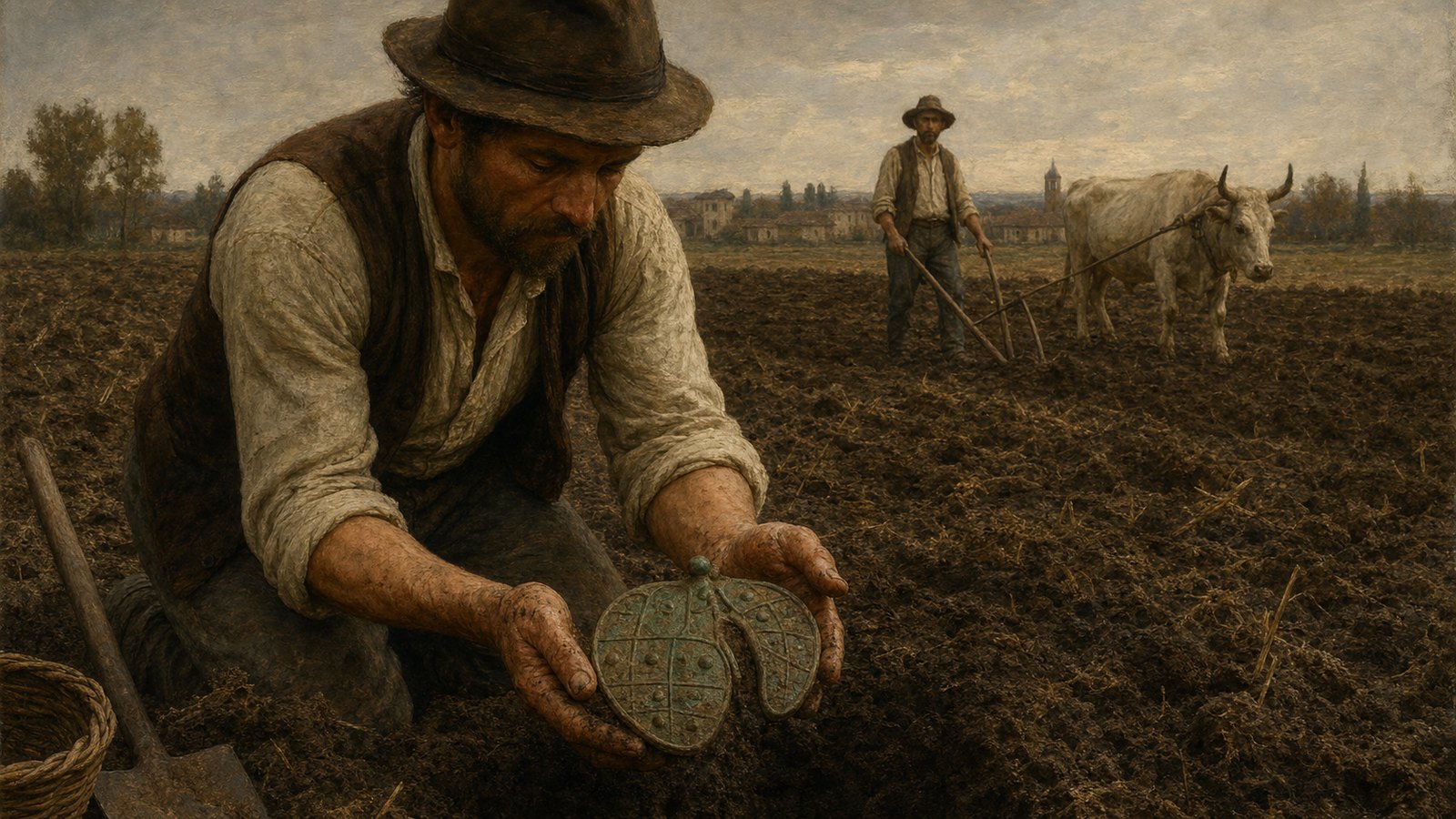
A farm worker near Gossolengo lifted a strange piece of bronze from the soil on 26 September 1877. It was small enough to hold in two hands, roughly the length of a modern pencil case, yet its swelling lobes and central protrusions copied a sheep’s liver. Fine lines cut the upper surface into compartments. Short Etruscan names occupied those zones like labels on a map whose country no longer existed.
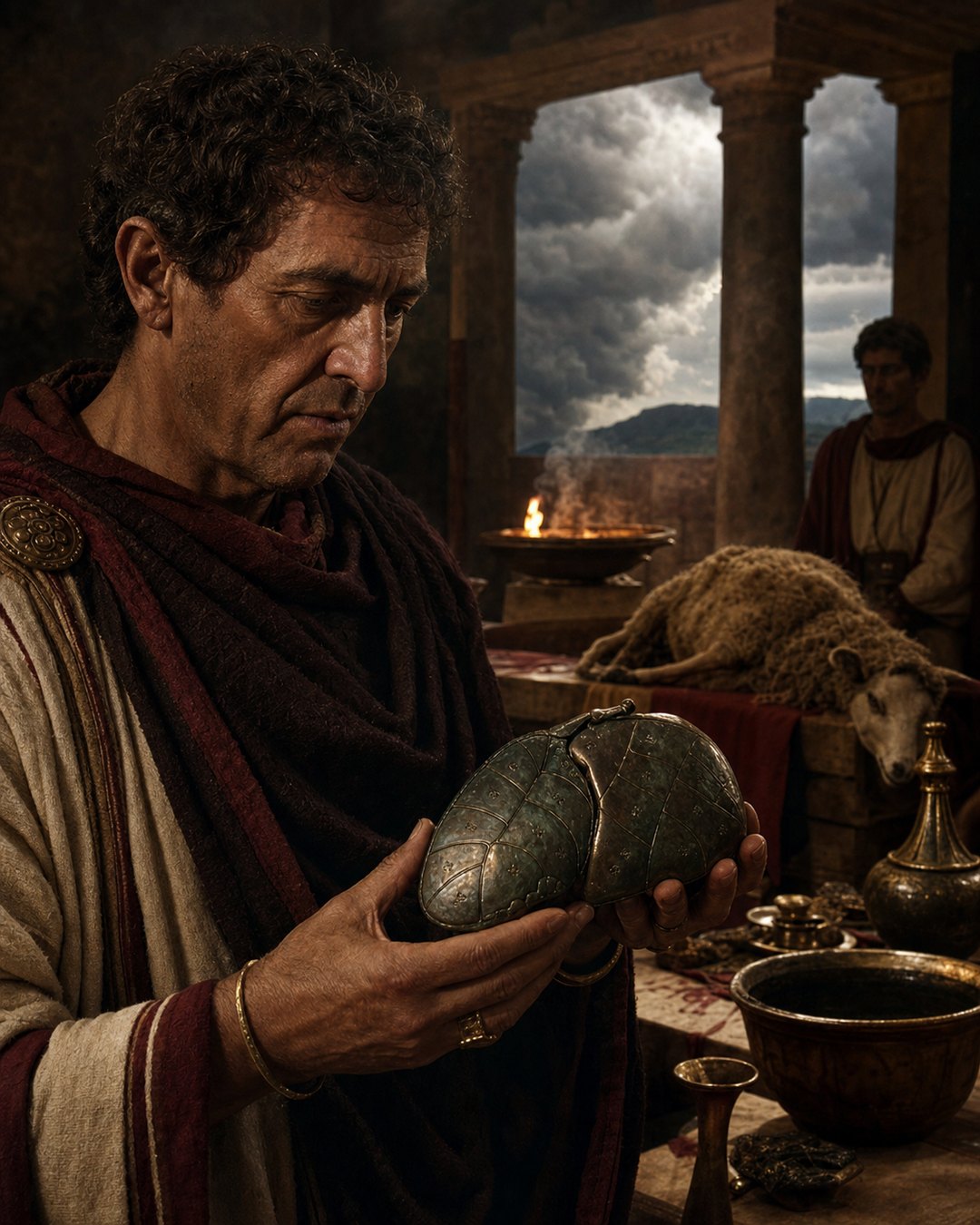
The object now called the Liver of Piacenza dates to the end of the second or beginning of the first century BC. By then nearby Placentia had been a Roman colony for more than a century. The bronze model nevertheless preserved a distinctly Etruscan way of organising divine knowledge: a sacrificed animal’s liver could be read because its parts corresponded to powers arranged across the cosmos.
This was not a miniature offered merely for display. Its useful anatomy, repeated divine names and divided rim make best sense as an instrument for thought and instruction. A haruspex could compare the warm, irregular organ before him with a durable bronze scheme, locate an unusual mark, and place that observation within a disciplined vocabulary. The model turned a perishable ritual moment into knowledge that could be taught.
The Furrow Revealed a Tool, Not a Statue
The Palazzo Farnese museum identifies the bronze as the most famous object in Piacenza’s civic collection. It was found a few kilometres from the city in 1877 and is dated between the late second and early first century BC. At about 126 by 76 by 60 millimetres, it is life-sized for a sheep liver rather than monumental. That scale invites handling and close comparison.
Its shape is not generic. Raised forms correspond to major features of the organ, including the gall bladder and lobes. Lines subdivide the convex face, while the perimeter is organised into sixteen sectors. Etruscan deity names, often abbreviated, are incised within the scheme. Even scholars who dispute individual readings can see that anatomy and divine classification occupy the same object.
That combination changes how the find should be imagined. A figurine represents something; a working model also arranges decisions. The bronze could remain stable while actual livers differed in colour, shape and surface marks. It offered a reference against which a specialist might describe where an anomaly appeared and which divine region it touched.
The discovery date belongs to modern archaeology, but the object’s original setting remains uncertain. No classroom furniture or priest’s notes survived with it. Its form nevertheless supports a cautious conclusion: the maker expected users to look closely, recognise anatomical landmarks and navigate named compartments rather than admire the bronze from a distance.
A Sheep’s Organ Became a Map of Divine Neighbours
The museum’s description calls the piece a direct witness to hepatoscopy, divination through inspection of the liver. Etruscan haruspices examined sacrificed animals to interpret divine will. Their task was not simply to declare an organ lucky or unlucky. Location mattered, because a feature in one zone did not carry the same associations as a feature in another.
The outer rim’s sixteen divisions connect the model to the Etruscan partition of the heavens reported by later Roman authors. In that logic, orientation joined earth, organ and sky. Divine powers occupied neighbouring regions; an observed sign could be placed within a structured field rather than treated as an isolated marvel. The liver became a small terrestrial counterpart to a larger cosmic order.
Tinia, the leading Etruscan sky and lightning god, appears in several abbreviated forms on the bronze. Other names have been connected with Uni, Nethuns, Fufluns, Hercle and additional powers, although many readings remain debated. Repetition is informative. It suggests that one deity’s influence could touch more than a single anatomical patch and that borders within the system were meaningful.
The earlier account of how Roman omens constrained a decision before battle follows signs into action. The Piacenza liver takes us one step earlier, into the classification that made a sign discussable at all. Before advice could reach a commander or magistrate, a specialist needed a language for what he had seen.
Bronze Made a Perishable Lesson Repeatable
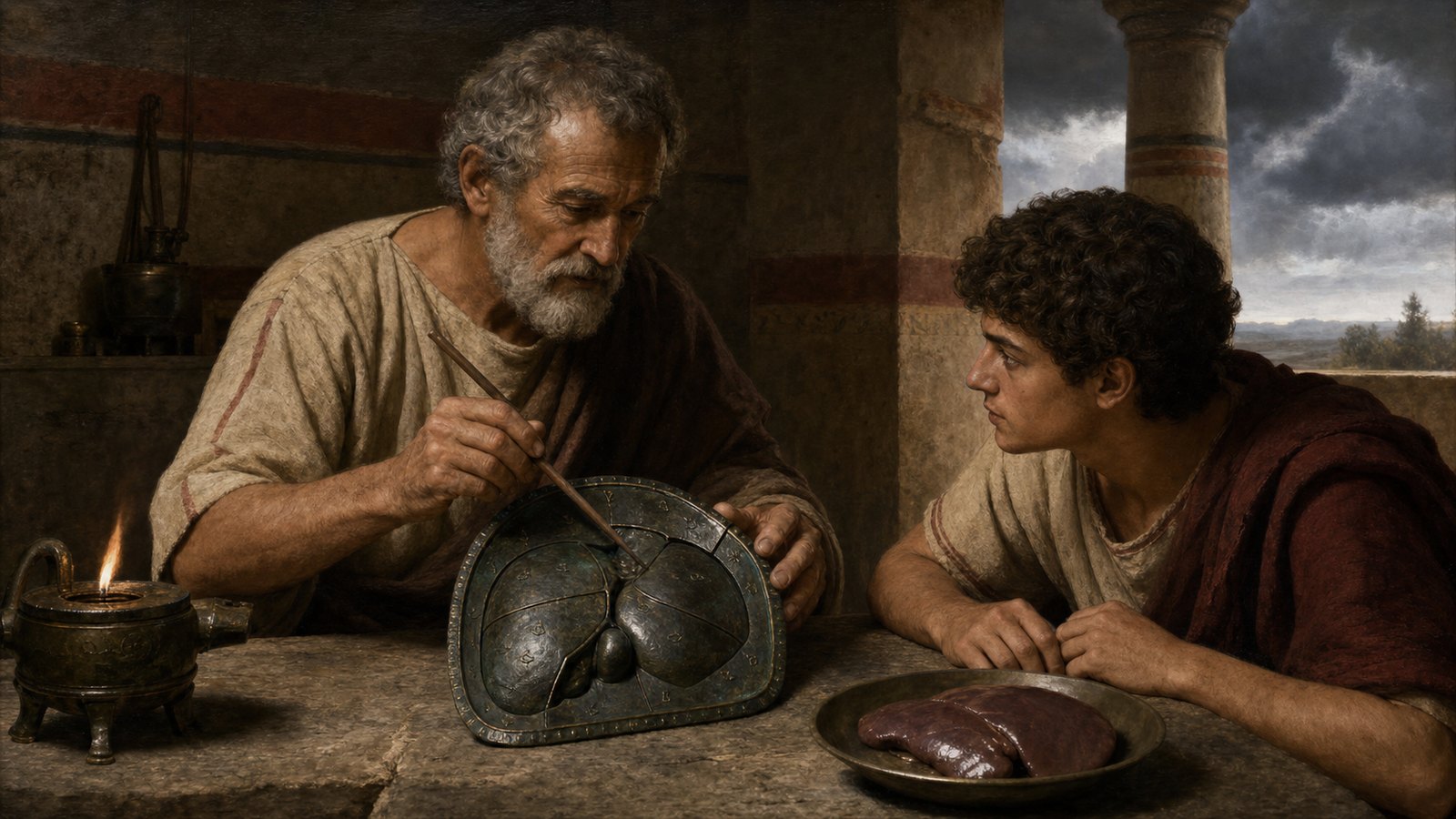
A real liver changes rapidly. It is warm, wet, soft and unique to one sacrificed animal. A bronze liver is cool, durable and available before or after any ceremony. Those physical differences explain the model’s teaching value. An instructor could point to a lobe, boundary or divine name repeatedly without waiting for another sacrifice or losing the example to decay.
Ancient Near Eastern sites have produced clay sheep-liver models used in divinatory instruction, including an Old Babylonian example in the British Museum divided into fifty-five sections. The Piacenza bronze is not evidence that a single lesson travelled unchanged across many centuries. It does show that modelling an organ was a practical solution in more than one tradition where specialists had to preserve and transmit a complex reading system.
The bronze surface also imposed discipline. A novice faced with a real organ could be distracted by endless irregularities. The model selected landmarks and boundaries that the tradition considered significant. What it omitted mattered as much as what it included: this was not a medical atlas intended to explain every vessel or disease, but a ritual map designed to organise signs.
That distinction keeps the object from being reduced to primitive anatomy. Etruscan specialists plainly knew the liver’s form well enough to model recognisable structures. Their purpose, however, was divinatory rather than clinical. Anatomical accuracy served a second framework in which place, orientation and divine ownership turned a physical feature into counsel.
Rome Kept Calling the Etruscan Specialists
Roman expansion absorbed Etruscan cities, but it did not erase the reputation of Etruscan religious expertise. Haruspices remained available when public events seemed to demand specialised interpretation. Roman authorities could consult them over prodigies, lightning damage and troubling sacrificial signs even while Roman magistrates retained responsibility for political action.
Cicero’s dialogue On Divination shows both the familiarity and the controversy surrounding the craft. He knew the argument that a fissure or projection in a victim’s entrails could announce danger, yet his skeptical speaker pressed hard on how one liver could be physically connected to a future event. The attack is valuable evidence: a practice did not need universal philosophical agreement to remain institutionally recognisable.
The model belongs near the hinge between Etruscan continuity and Roman power. Its late date places it in a landscape already dominated by Rome, while its inscriptions preserve Etruscan divine names rather than translating the entire scheme into Latin. Knowledge could therefore survive conquest through specialists, objects and consultation, not only through independent temples or states.
As the article on Roman altars and public vows shows, ritual objects made obligations and sequences visible. The bronze liver performed a related but more technical service. It did not display a promise to a crowd. It made a specialist’s interpretive field visible to other specialists.
The Model Preserves a Method More Clearly Than an Answer
No surviving note tells us which pupil held the bronze, which sanctuary owned it or what verdict followed a particular sacrifice. The inscriptions are abbreviated, and the identification of several divine names remains contested. Attempts to rotate the object against compass points or reconstruct a complete Etruscan theology necessarily go beyond what the bronze alone can prove.
What survives securely is the architecture of attention. The user had to notice anatomical position, distinguish one compartment from another, recognise divine names and understand orientation. The answer did not emerge from a random glance at entrails. It depended on trained comparison within a map whose rules were learned in advance.
The object also captures two kinds of time. A sacrificed liver lasted for a single consultation. Bronze carried the classification across generations. Then burial hid it until a nineteenth-century furrow returned it to view. The model outlived both the animals whose organs it clarified and the political world in which Etruscan priests first learned its zones.
That is why the Piacenza find feels more intimate than a surviving literary summary. Cicero gives arguments about whether divination can be true. The bronze shows hands at work: turning an object, finding a boundary, naming a region and teaching another observer where to look. It preserves no prophecy, yet it preserves the apparatus that made prophecy systematic.
Sixteen sectors around the edge did not make the future mechanical. They made interpretation shareable. In a palm-sized object, the Etruscan liver joined animal anatomy, divine neighbourhoods, specialist memory and the ordered sky—then carried that intellectual system into a Roman age that continued to ask its custodians for answers.