
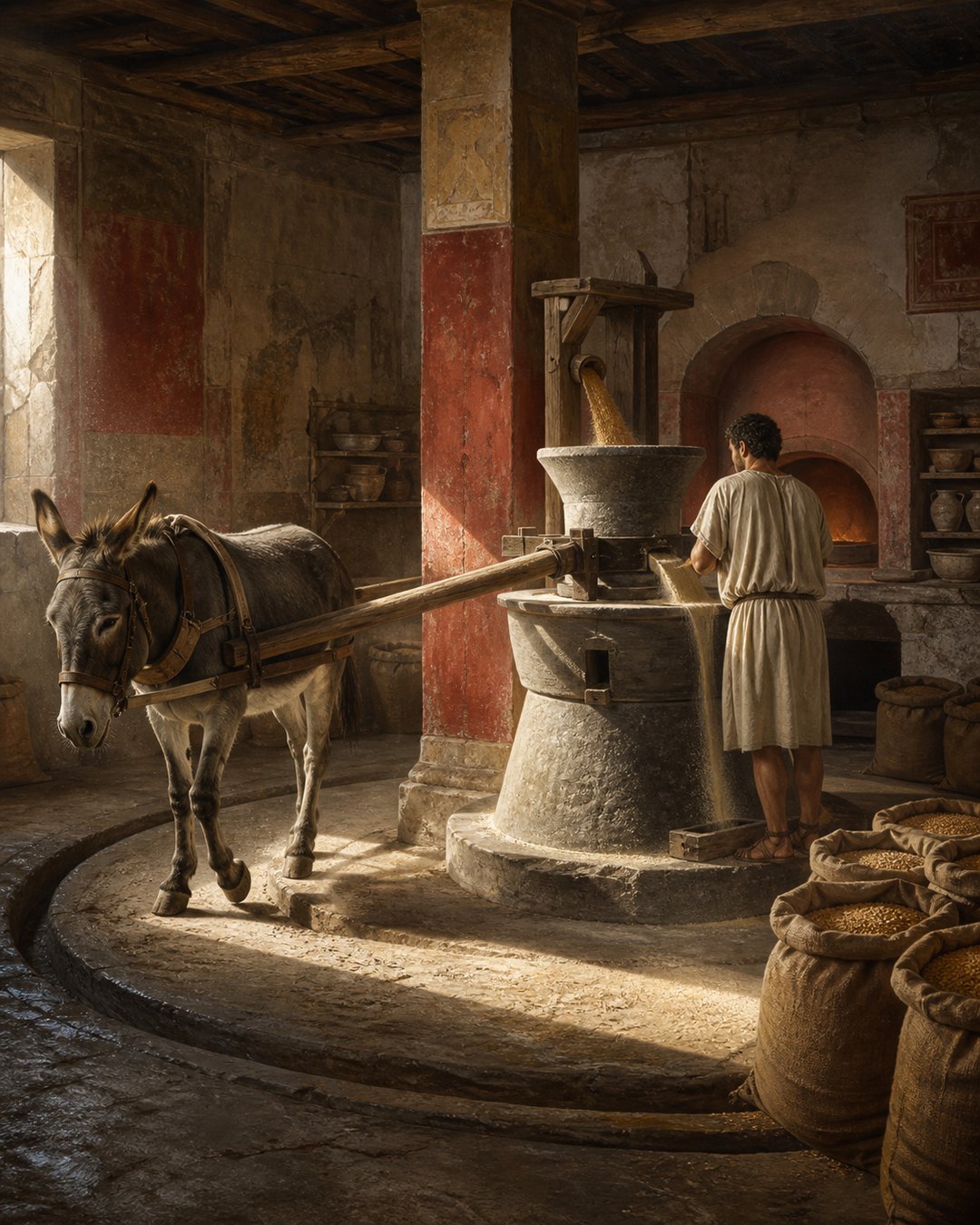
The stone does not look like a wheel. In Pompeii’s bakeries, the fixed lower piece rose like a blunt cone, while the upper piece narrowed at the middle and opened again above it. Put together, the pair looked closer to an hourglass than to the flat millstones familiar from later windmills. Grain entered at the top. Meal escaped below. Between those two points, an animal or person had to keep walking in a circle.
That shape made a bakery into a machine room. A beam projecting from the upper stone gave the mover leverage. The upper stone rotated around the fixed core, drawing kernels into the narrowing gap and crushing them against rough volcanic surfaces. Each circuit repeated the same conversion: stored grain became flour fine enough to sift, mix, shape and bake.
The surviving mills are impressive because their mechanism can still be read without gears or written instructions. They are also uncomfortable evidence. Archaeology records stone, paving, troughs, ovens and doorways more readily than exhaustion. Apuleius supplies a literary counter-image of dusty workers and injured mill animals. Read together, the bakery is neither a picturesque shop nor an abstract invention. It is a production chain built from rock, food, movement and unequal labour.
Two Stones Created a Moving Funnel
Roman rotary milling existed at several scales, but the tall Pompeian form made its logic unusually visible. The lower stone was the meta, planted so that its conical surface remained still. The catillus sat over it. Its interior fitted around the cone with enough space for grain to descend and be ground, while its outer waist helped support sockets or a wooden framework for turning.
The upper opening acted as a hopper. Grain poured into it did not fall directly to the floor. Rotation carried kernels into the working gap between catillus and meta. The rough faces crushed and abraded them as gravity moved the material downward. Flour and fragments emerged around the base, where they could be collected for further processing.
This was not precision gearing. Millers adjusted a stubborn relationship among stone weight, spacing, grain flow and speed. If the gap was wrong, the mill could produce coarse meal, waste grain or grind stone against stone. If feed arrived too quickly, kernels could choke the path. The bakery therefore depended on judgement even when the animal supplied most of the force.
The mechanism complements the larger shift from household breadmaking to commercial bakery routine. The hourglass mill explains how that routine acquired throughput. One worker could feed grain and monitor meal while rotary power came from a body walking beyond the stone’s edge.
A Beam Converted Walking into Torque
Sockets in the upper stone accepted horizontal timbers or a frame. The farther the point of effort stood from the mill’s centre, the more leverage it provided against the catillus’s weight and friction. That is why the mover did not push close to the rock. A projecting beam turned a broad circular path into rotation at the grinding surface.
Equids are commonly associated with the larger mills, although human labour also belonged to Roman milling. A donkey or mule could be harnessed to the beam and led around the same track. The circuit needed no new destination: forward motion ended where it began, then began again. The architecture converted travel into stationary production.
Repeated movement left traces outside the stone itself. Bakery floors had to keep the route clear. Tethering points, basins and stable areas could place animals close to the mill room. Entrances had to admit sacks and remove bread while preventing the production space from becoming a street. A bakery was arranged around flows of grain, bodies, water, fuel and finished loaves.
The same animal economy appears from another angle in the pack animals that kept Roman armies moving. In a pistrinum, however, strength was captured without distance. Hooves described hundreds of small circles so customers outside could buy a product whose hardest mechanical stage remained behind the shopfront.
Stone Choice Added Teeth without Metal
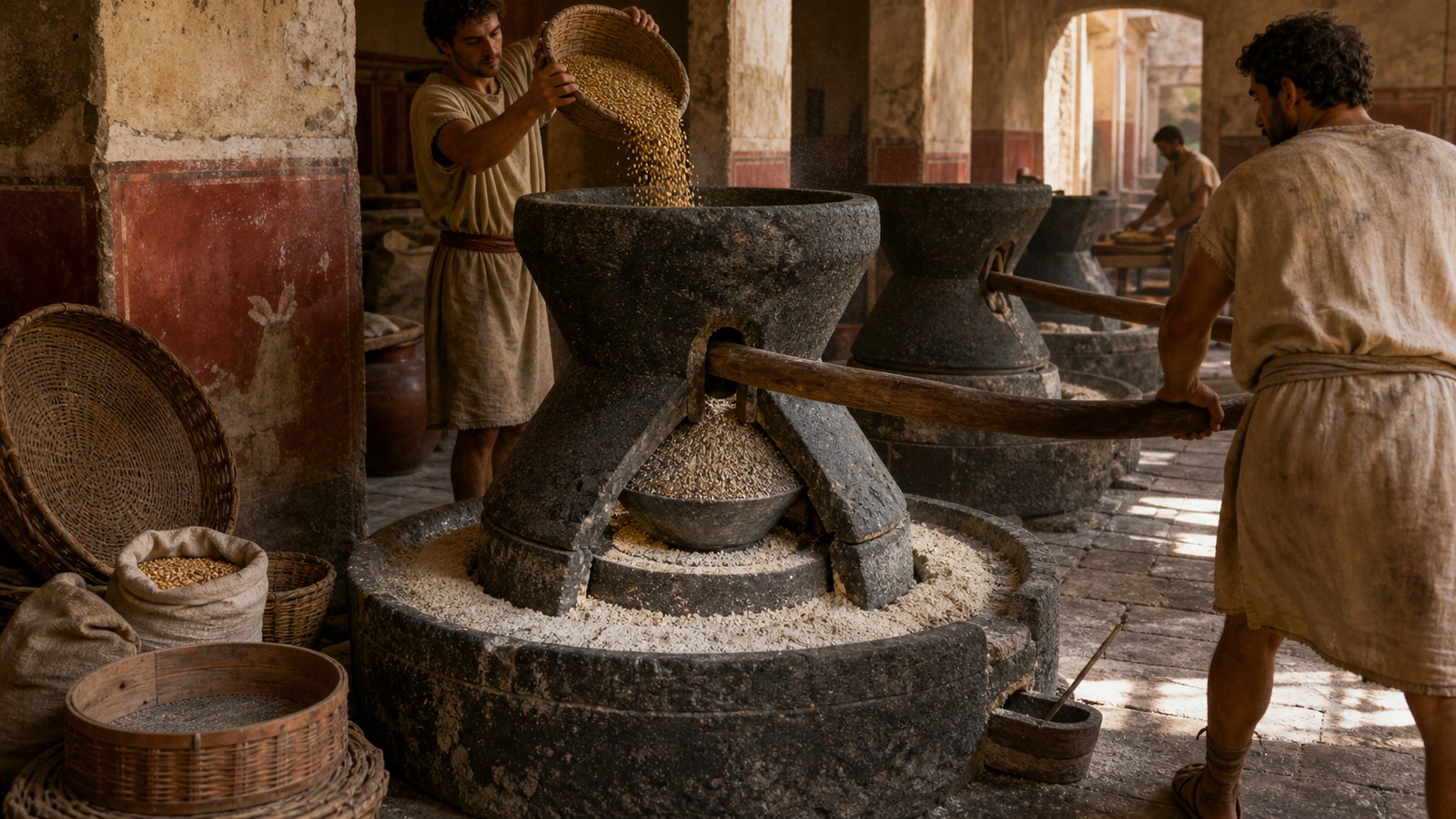
The grinding surfaces needed hardness and texture. Volcanic stone was valuable because pores and sharp mineral edges could bite grain rather than merely polish it. The material still wore, but its uneven surface renewed useful cutting points as tiny grains fractured. A smooth decorative marble would have looked grand and performed badly.
Large stones also represented transport and skilled shaping before they reached a bakery. Quarrying had to select blocks without fatal flaws. Stoneworkers hollowed the catillus, formed the meta and cut sockets that would accept timber. The paired pieces then had to sit in a workable relationship. A mill was therefore the endpoint of another supply chain before it processed its first sack of wheat.
Wear was not neutral. Abrasion could contribute mineral grit to flour, and surfaces eventually needed attention or replacement. Wooden beams split; fittings loosened; grain dust entered joints and lungs. The apparent simplicity of two stones concealed maintenance distributed among quarry workers, haulers, carpenters, mill hands and bakers.
This material logic differs from the wet clay that recorded traffic through a Roman tile yard. Clay preserved an instant by accident. Millstone recorded duration through loss. Rounded edges and polished paths accumulated because the same movements happened too many times for any one circuit to matter.
The Mill Room Fed an Oven and a Shop
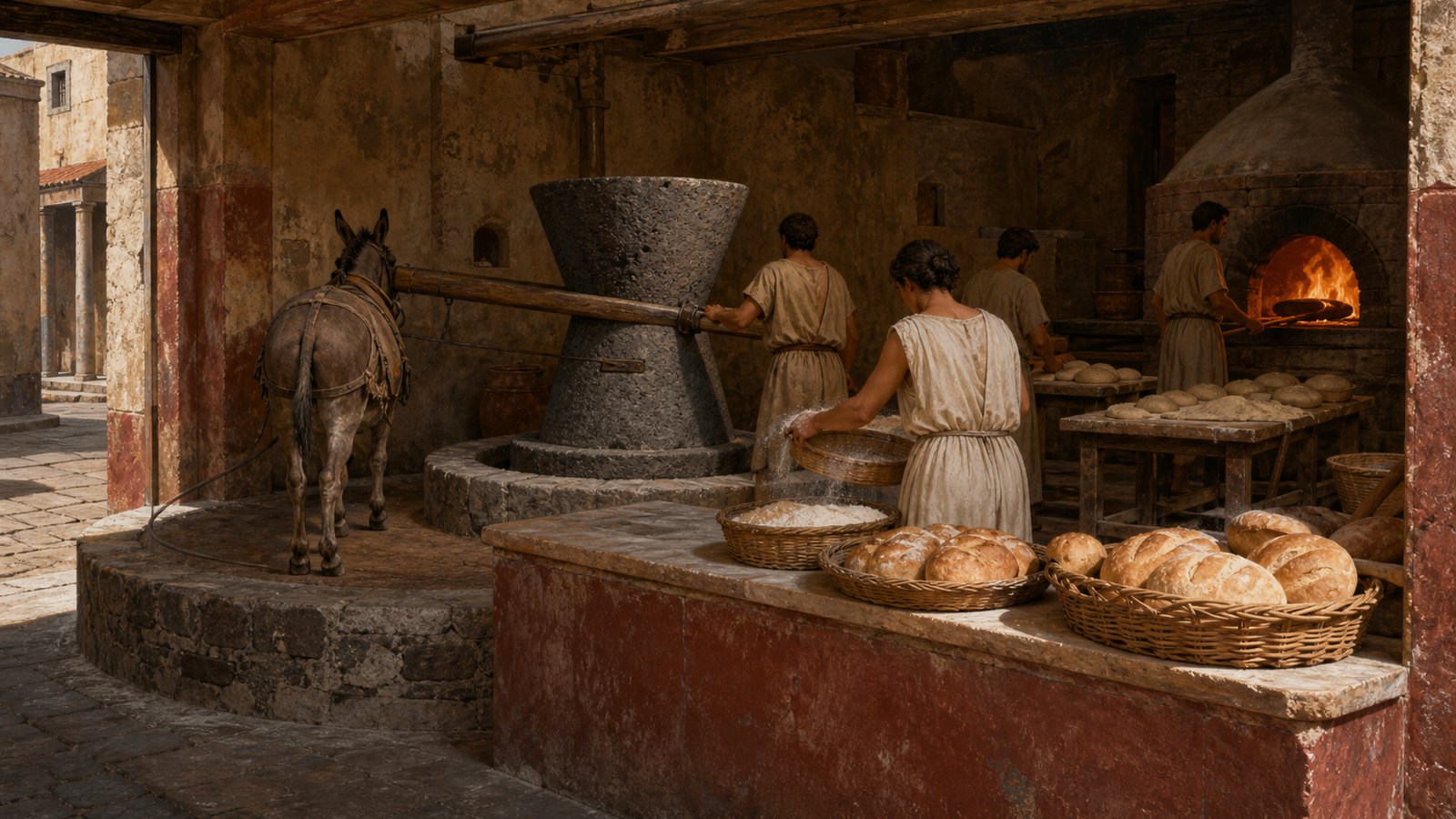
At Pompeii, some pistrina combine mills with work surfaces, water provision, ovens and spaces interpreted as sales rooms. The arrangement does not prove that every loaf followed an identical route, but it makes production stages legible. Grain arrived as a durable commodity. Grinding made it perishable flour. Mixing and shaping prepared dough. Heat turned that dough into bread that had to move toward customers.
The bakery of T. Terentius Proculus on the Via Stabiana preserves this spatial relationship particularly clearly in its archaeological catalogue: a street-facing shop, the bakery behind it and milling installations within the complex. The customer’s encounter with bread occurred at one end of a building whose rear rooms managed noise, dust, animals and fire.
That separation mattered commercially. A buyer did not need to own a mill, secure fuel for a large oven or spend hours grinding a household ration. The pistrinum concentrated equipment and labour, then sold the result. Its scale made maintenance and provisioning expensive, but repeated sales could keep costly stone and ovens working across many batches.
Bread’s ordinary appearance can therefore hide capital. The building, millstones, animals, storage, water and fuel all had to be assembled before a loaf reached a counter. Pompeii’s preservation freezes those investments together. What appears to be a row of bulky stones is really the centre of a neighbourhood system for transforming harvests into daily purchases.
Apuleius Made the Power Source Impossible to Ignore
Archaeological plans can make a bakery look clean because they preserve durable boundaries after flour, sweat and smell have vanished. Apuleius’s Metamorphoses offers the opposite kind of evidence. In Book 9, the narrator enters a mill and describes workers coated in flour dust, scarred bodies, torn clothing and animals damaged by labour. The passage is literary and deliberately harsh, not an inspection report for one excavated Pompeian building.
Its value lies in restoring what stone alone cannot show. Rotary mills required continuous force. Whether supplied by enslaved people, condemned workers or animals, that force tired, needed food and could be punished. A beam records leverage; it does not record who was allowed to stop pushing. Apuleius turns mechanism back into social history by dwelling on bodies the machine consumed.
The text should not be pasted indiscriminately over every bakery. Ownership and labour arrangements varied, and an ancient novel intensifies scenes for narrative effect. Yet dismissing it would be equally misleading. Roman readers recognized the mill as a place where degradation, dust and relentless repetition could be imagined without explanation. The setting already carried a reputation.
That is the final lesson of the hourglass stones. Their design deserves attention: a fixed cone, rotating shell, controlled feed and long lever made grain processing repeatable at commercial scale. But efficiency had a human and animal denominator. Pompeii preserves the production line; Apuleius preserves the dread attached to powering it. Bread left the shop light enough to carry in one hand because heavy stone and circling bodies had already done the work.