
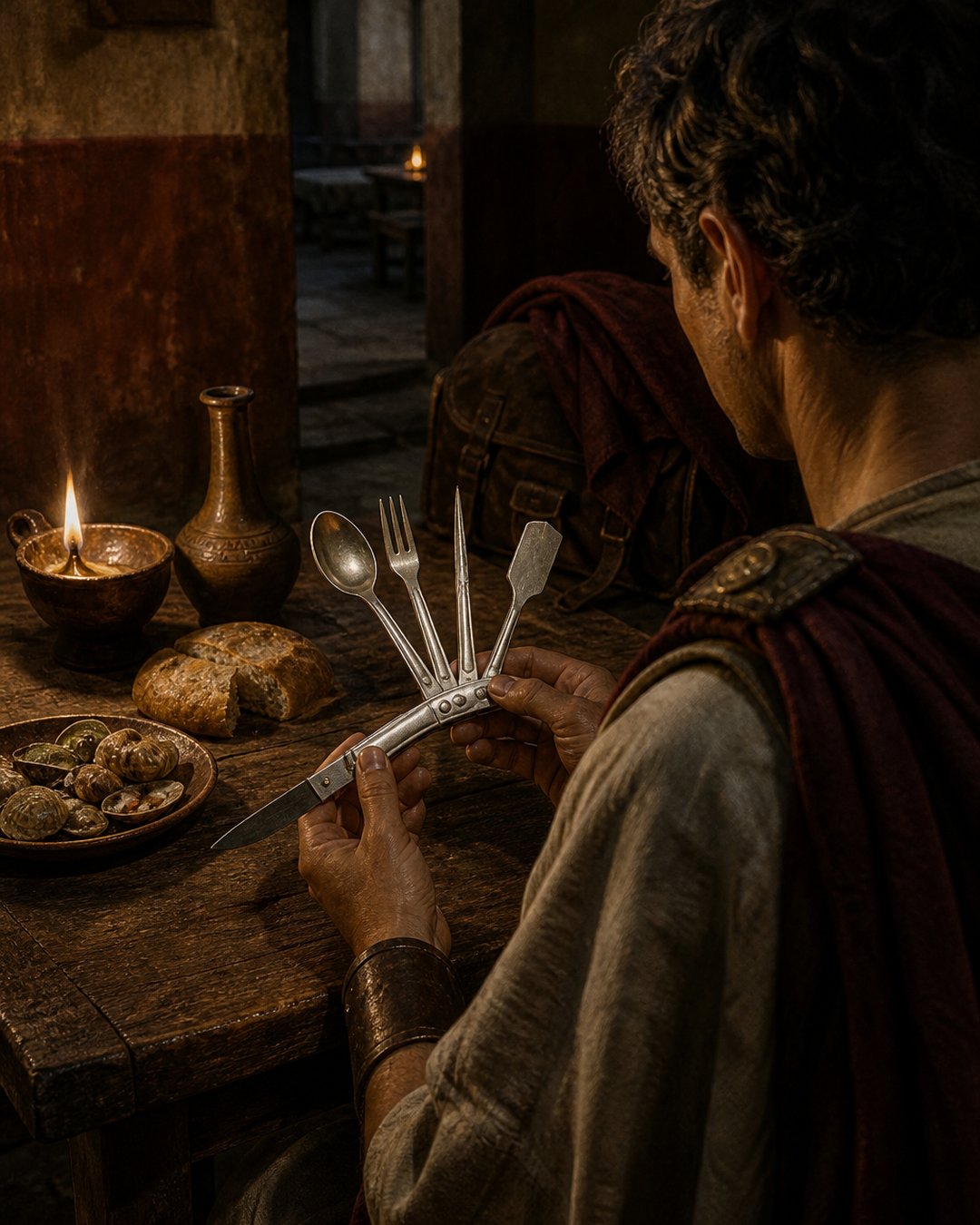
Closed, it is only a small bar of silver hardware. Open it, and a table setting seems to unfold from a traveller’s hand. A three-pronged fork swings away from the body. So do a spoon, a spatula, a narrow pick and a spike. An iron knife once completed the set, but its blade has largely vanished through corrosion. The surviving object is compact enough to invite an irresistible modern nickname: the Roman ‘Swiss Army knife.’
That nickname is useful only if it does not become the explanation. The implement in the Fitzwilliam Museum is not a general toolbox packed with screwdrivers and saws. It is a Middle Roman compound utensil, dated to AD 201–300, built around eating, serving and perhaps personal care. Its ingenuity lies in making unlike tips occupy the same handle without pretending they all did the same job.
The most interesting question is therefore not whether Romans ‘invented’ a familiar modern brand. It is what portability looked like when silver, hinges and dining habits met. The answer survives unevenly: dimensions and materials are firm, some functions are plausible, and the owner, findspot and actual meals remain absent from the public museum record. That mixture of precision and silence is exactly what makes the object worth unfolding slowly.
Begin with the Object, Not Its Modern Nickname
The Fitzwilliam Museum catalogues the piece as a compound eating implement. Its accession number is GR.1.1991, and the museum dates it to the Middle Roman period, AD 201–300. The record gives a height of 88 millimetres and a width of 155 millimetres. Those measurements describe an opened arrangement rather than a chest of equipment: the entire composition fits within the span of a hand and forearm.
The secure inventory is already unusual. The museum identifies a three-pronged fork, spoon, spatula, pick, spike and knife. Silver forms the surviving body and most of the tools; the knife component was iron. The educational description notes that the iron blade has eroded away, leaving the rest of the design to show how it once fitted among the folding parts.
Calling it a ‘Swiss Army knife’ makes that cluster instantly imaginable, but it also imports expectations the evidence cannot bear. The object has no documented Roman product name in the museum entry. It was not manufactured by a modern firm, and the comparison says nothing by itself about how often it was carried. The nickname should open the door to inspection, not close the case.
What survives is more specific than a slogan. Different materials were chosen for different demands. Iron offered a cutting edge; silver supplied the handle and the other implements. Corrosion has reversed their ancient visual balance. The blade that probably did the hardest cutting is now the least complete part, while the softer precious metal preserves the compact idea around it.
One Hinge Collapsed Several Table Movements
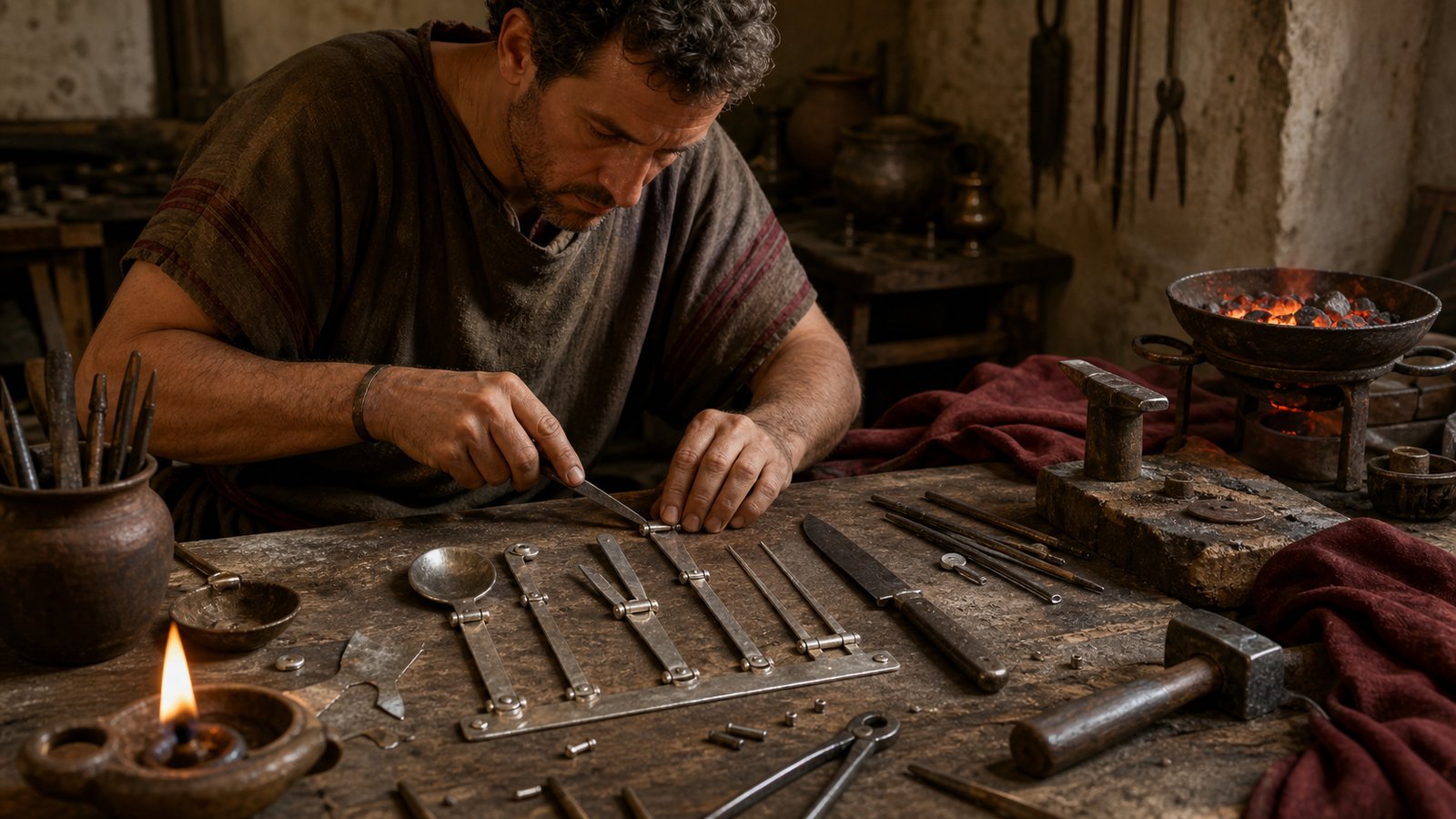
The museum’s learning page describes a hinge that allowed each item to be folded out when needed and folded away for transport. Museum Crush adds that the sections were hinged and riveted onto a flat silver handle. The mechanism did not miniaturise one tool. It organised a sequence: select a tip, swing it into working position, use it, then return it to the shared body.
That sequence matters because a spoon and fork move differently. One lifts liquid or soft food; the other pins or separates. A knife cuts against resistance. A narrow implement reaches where fingers cannot. By letting each part pivot from a common core, the maker traded the stability of a single-piece utensil for compactness and choice.
The design belongs beside the fuller silver service hidden in the House of the Menander’s cellar, but the social problem is almost opposite. A chest-sized table set equips a room and a group. This folding utensil concentrates several actions in one owner’s hand. One advertises abundance through multiplication; the other advertises control through compression.
The hinge also imposed limits. Every pivot and rivet introduced movement, and the Fitzwilliam cautions that silver is soft and pliable. A lavish folding implement could be clever without being suited to constant heavy pressure. Its compactness was not free: the maker had to balance thinness, clearance, strength and enough space for neighbouring tools to fold without colliding.
A Spike and Spatula Point toward Awkward Foods
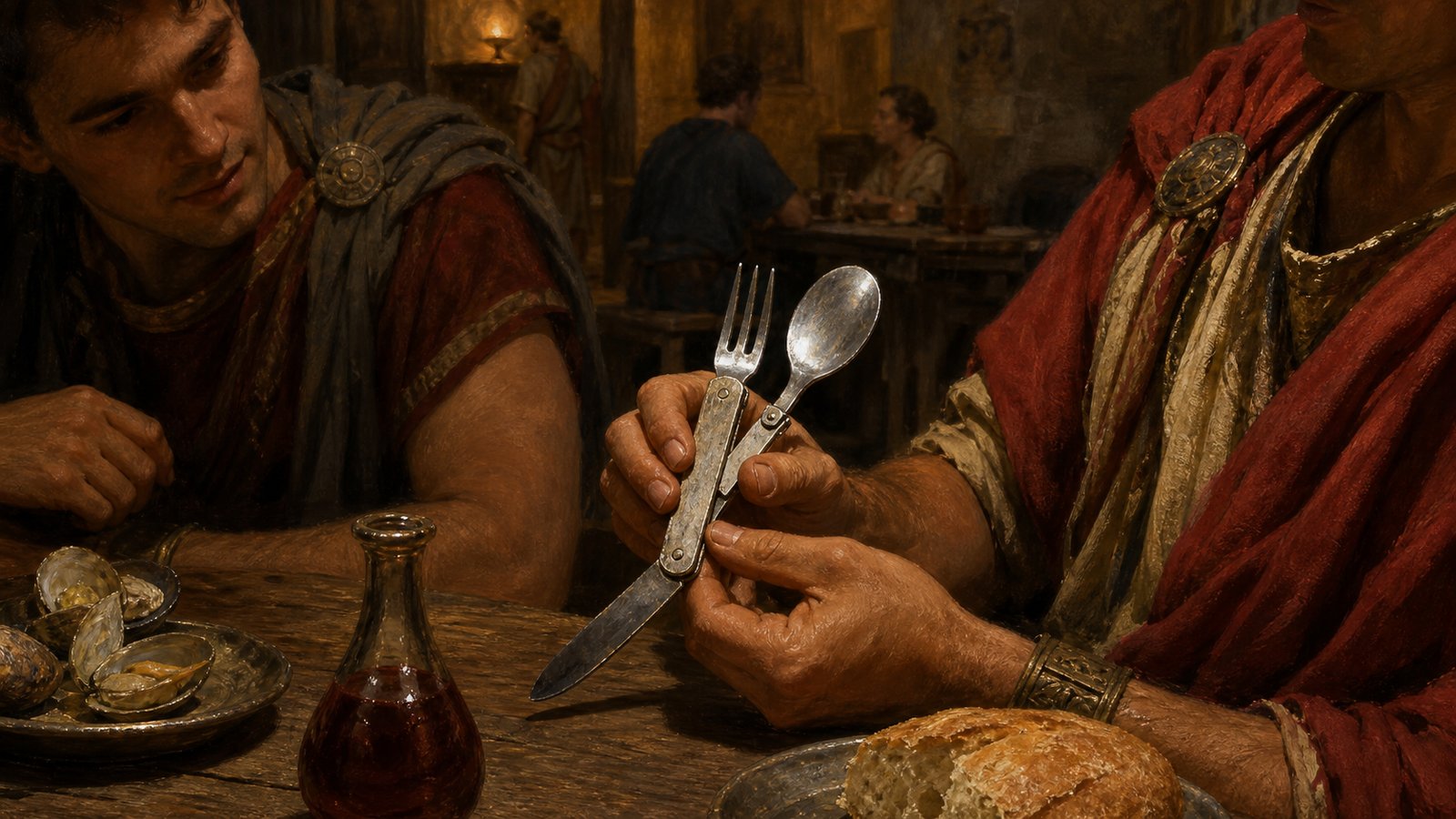
The spoon, fork and knife are easy to recognise because their broad functions remain familiar. The odd narrow pieces demand more caution. The Fitzwilliam suggests that the spike might have helped extract meat from snails. It also proposes that the spatula could scrape sauce from narrow-necked bottles. These are possibilities offered by the museum, not a surviving instruction manual.
Museum Crush extends the culinary range to lobster, crab, snails and walnuts, drawing on curatorial discussion of what the tips could do. Such examples make mechanical sense: shells, narrow openings and small morsels reward a pointed or flattened implement. They do not prove that this particular owner ate each listed food, or that every tip had only one purpose.
The tiny pick is the most unstable part of the interpretation. The collections record says it could have served as a toothpick. The learning page mentions the more surprising suggestion that a small spoon-like end might remove earwax. Museum Crush reports that the spatula has also been compared to a toothbrush. Multiple plausible readings are evidence of uncertainty, not permission to select the most colourful one as fact.
Snails nevertheless provide a useful comparison because Fulvius Hirpinus’s specialised snail farming shows that Roman diners and producers could care about species, feeding and serving such food. A dedicated point for extracting flesh would fit that dining world. The responsible wording remains conditional: the form could answer that task, but no residue or owner’s testimony links this implement to a recorded snail course.
Silver Made Portability into Social Display
Many less elaborate folding knives survive in bronze, according to the Fitzwilliam. This example stands apart because of its complexity and silver construction. The museum calls it a luxury item and imagines it as a useful gadget for a wealthy traveller. Museum Crush quotes the curatorial comparison to a desirable new possession brought out at an inn partly to be admired.
That interpretation begins with material rather than fantasy. Silver cost more than ordinary bronze or iron and demanded skilled work to shape a flat body, hinges, rivets and multiple functional ends. The object did not hide expense beneath decoration. Its very neatness—the ability to reveal one tool after another—made craftsmanship perform each time it opened.
Display and use are not opposites. A wealthy owner could genuinely need utensils while travelling and still enjoy the attention their mechanism attracted. The most effective luxury goods often solve a problem in a conspicuously refined way. Here the problem was carrying several small implements; the display was the elegant choreography that made them emerge from silver.
Yet silver complicates the claim of rugged practicality. The Fitzwilliam explicitly notes that the metal is soft and pliable and says the piece was probably not intended for heavy use. A fork can lift food without levering hard; a spatula can scrape sauce without splitting wood. The iron knife handled cutting. Material hierarchy divided labour inside the object while warning us not to picture it as an all-purpose camp tool.
Travel Is the Best Context, but Not a Preserved Biography
Portability is the strongest contextual inference. The parts fold inward, the handle gathers them together, and comparable objects are called travelling cutlery in German museum language. Museum Crush reports parallels in a Swiss private collection, a Bulgarian tomb and northern Italy. The type was not limited to one isolated workshop, even though this silver example is unusually elaborate.
Travel, however, does not identify a traveller. The Fitzwilliam’s public record lists the object as bought in 1990 and currently in storage. It does not give a named ancient owner or a secure findspot on the page. No inscription in the record dedicates the utensil to a soldier, merchant, official or tourist. Any such profession would be a costume placed over missing evidence.
The date is broader than a single journey as well. AD 201–300 spans a century of changing emperors, routes and military conditions. The implement cannot be pinned to one campaign merely because portable equipment suited movement. Its most defensible biography is technical: made in the Middle Roman period, constructed from silver and iron, assembled to fold, later losing much of its blade, bought by the museum in 1990 and catalogued under GR.1.1991.
That restraint makes the object more, not less, revealing. A complete adventure story would belong to one imagined owner. The surviving utensil instead exposes a design choice shared by maker and purchaser: several intimate acts of eating and grooming could be reduced to pivots around a precious-metal spine. Portability had become a craft problem worth solving beautifully.
The Missing Blade Keeps the Gadget Honest
The corroded iron knife is a final corrective to the object’s polished modern image. Photographs foreground bright silver forms, while the vanished edge must be reconstructed from the museum’s component record. Ancient objects do not reach us with every material equally intact. Preservation can make the decorative and soft look primary while removing the part that once absorbed sharper work.
The same unevenness governs interpretation. We can count the implements, measure the object, identify silver and iron, observe folding joints and accept a third-century date. We can describe the museum’s proposed uses. We cannot recover the owner’s favourite meal, decide whether the pick cleaned teeth or ears on a particular day, or measure how often the object left a baggage chest.
This is why the modern multitool comparison should remain playful rather than triumphant. Romans did not need to anticipate a later trademark to value compact design. They faced their own practical and social questions: how to carry utensils, how to work around shells and narrow vessels, how to protect points, and how to turn precious metal into a conversation piece.
Opened, the implement is a fan of possibilities. Closed, it is an argument about possession. Six functions—or at least six recognisable forms—share one body because a third-century maker could coordinate iron, silver, pivots and space. The object’s achievement is not that it makes ancient Rome look modern. It makes a Roman preference visible: if dinner had to travel, ingenuity and status could travel with it.