
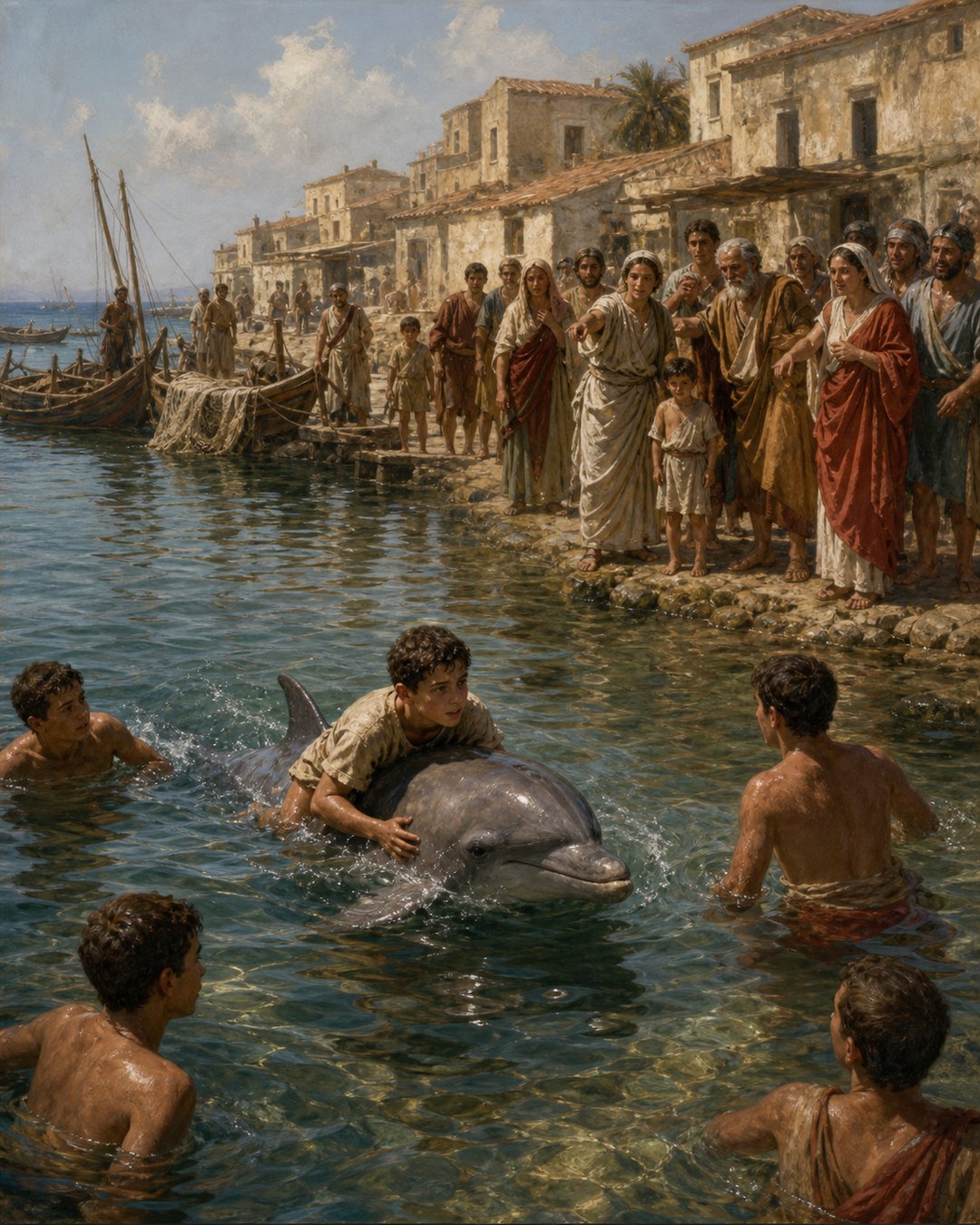
The dolphin did not die because it attacked the boy. In Pliny the Younger’s story, it died after carrying him safely, returning on later days, accepting human touch and attracting so many officials that a small town could no longer afford the attention. Kindness made the animal famous. Fame made it expensive.
Pliny sent the episode to his poet friend Caninius Rufus in a letter commonly numbered 9.33. He introduced it as a tale that looked like fiction even though his dinner companion vouched for it. That opening keeps two possibilities alive at once: the events may have been reported as true, and their shape was already irresistible to a literary craftsman.
The sequence matters more than a verdict about whether every movement happened exactly as written. A swimming contest produces fear; repetition produces trust; trust produces spectators; spectators draw magistrates; official visits burden municipal finances. By the end, the most astonishing creature in the story is not simply the dolphin. It is an economy of attention powerful enough to turn a local companion into a civic liability.
A Dinner Guest Supplied the First Witness
Pliny begins by telling Caninius that he has found material suited to an abundant and elevated poetic talent. The story reached him at dinner during a conversation about marvels. He describes the speaker as trustworthy, but immediately jokes that a poet need not be constrained in the same way as a historian. Evidence and embellishment enter the letter together.
That framing is not an apology hidden at the end. It is the doorway. Pliny does not claim that he visited Hippo, questioned the swimmers or examined a civic account. He offers a named destination for the tale—Caninius’s future poem—and a chain of transmission: an event in Africa, a reliable dinner companion, Pliny’s letter and the poet who might enlarge it.
This makes the letter different from the Androclus lion narrative preserved by Aulus Gellius. Both stories make an animal’s unexpected restraint demand explanation, but Gellius builds a chain through Apion’s claimed eyewitness account and a condemned man’s testimony. Pliny foregrounds sociable retelling. His marvel arrives with the dinner table still attached.
A cautious reading therefore need not choose between gullibility and dismissal. The letter is evidence that Pliny considered the tale worth circulating and that he expected readers to notice its almost fabulous construction. His own language marks the tension. He asks Caninius to trust the report while also inviting him to make literature from it.
Hippo’s Tidal Water Made a Stage
The setting is Hippo in Africa, close to the sea. Pliny describes a navigable body of water connected to the coast by a channel whose direction changed with the tide. Fishing, sailing and swimming belonged to ordinary local life. The marvel does not begin in an exotic enclosure. It interrupts a familiar waterside routine.
Boys made distance into a contest. The one who swam farthest from shore and left his companions behind counted as champion. During one such trial, a particularly daring boy met a dolphin. The animal moved before him, behind him and around him, then came underneath, carried him into deeper water and returned him to dry land.
The first ride is described through imbalance. The boy is frightened; the dolphin controls direction. Only the safe return allows the town to reinterpret danger as wonder. News spreads, and neighbours crowd around the swimmer as though the human child, not only the animal, has become a prodigy. They ask questions, listen and repeat what they have heard.
That transfer is the story’s first social mechanism. One private fright becomes a public identity. The boy who had sought status by swimming farther now acquires a different kind of distinction: he is the person the dolphin carried. Pliny shows reputation changing before he asks the reader to believe affection.
Repeated Returns Turned Fear into Familiarity
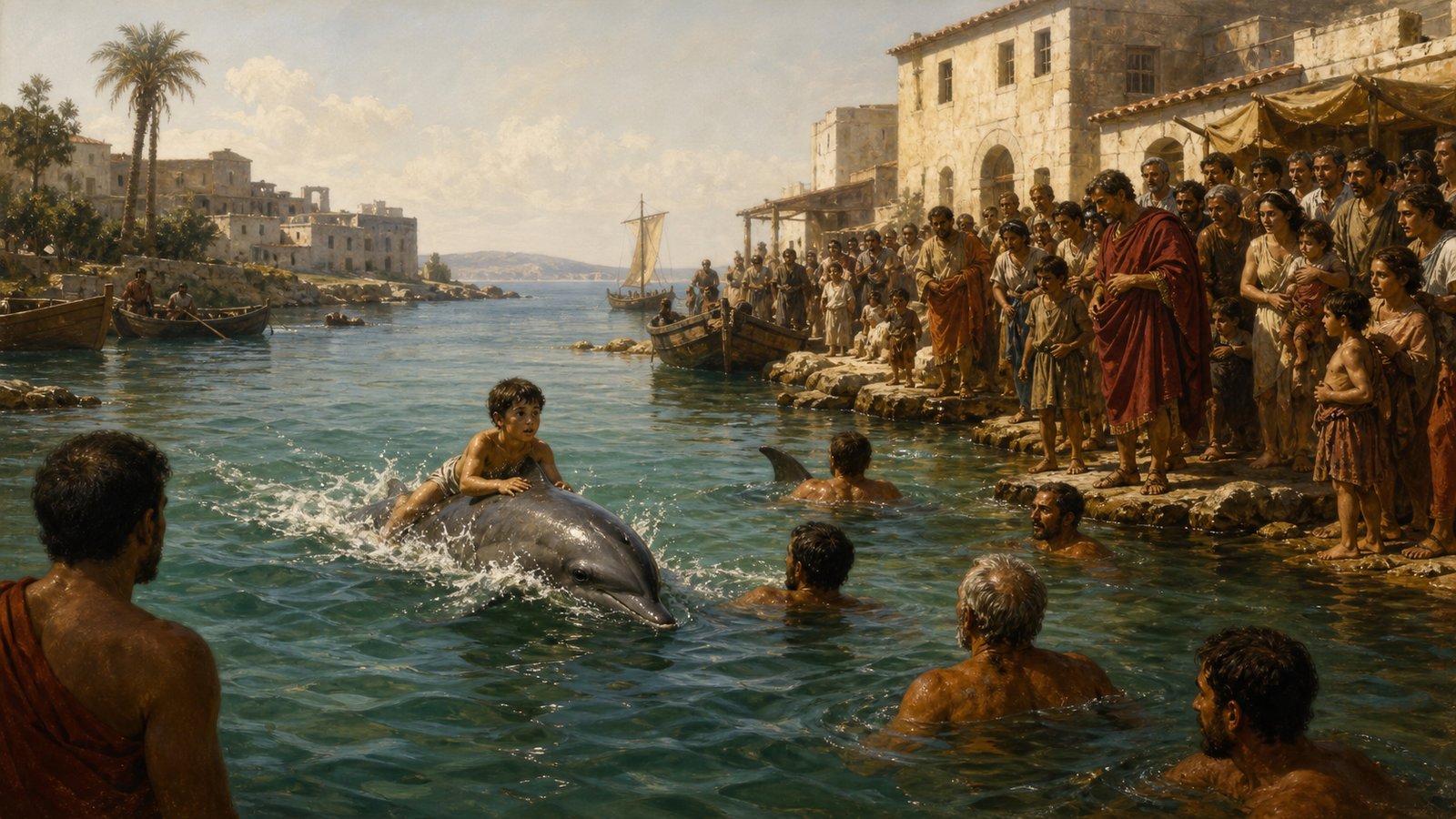
The next day, spectators gathered along both sea and lagoon. The boys entered the water again, but the central swimmer was less daring. When the dolphin returned at the same time, the children fled. Pliny interprets its leaps, dives and circling as invitations, yet the behaviour can be separated from that human gloss: the animal appeared repeatedly and approached swimmers who initially kept their distance.
This happened over successive days. Adults raised beside the sea eventually felt ashamed of their fear, moved closer, played with the dolphin, named it and touched it. Habit changed the meaning of proximity. An animal that had carried one terrified child became a body the community believed it could know through repeated contact.
The boy then swam beside the dolphin and climbed onto its back for journeys out and home. Pliny says the child thought the animal recognized and loved him, while the child grew attached in return. The language reports a human interpretation rather than proving access to the dolphin’s mind. Repetition, however, gives that interpretation a structure: return, approach, touch and another safe return.
A second dolphin accompanied the pair but did not submit to handling. That contrast prevents every animal in the scene from behaving identically. One remains at a distance like the other boys around their companion. Pliny also adds the most difficult physical claim: the familiar dolphin came onto land, warmed and dried itself on sand, then rolled back into the water. The episode asks for wonder even while the letter claims truth.
Perfume Showed How Officials Could Misread the Animal
Octavius Avitus, identified as a proconsular legate or deputy governor, encountered the dolphin on shore. Moved by what Pliny calls absurd superstition, he poured perfume or ointment over it. The unusual substance and smell drove the animal into deep water, where it disappeared for several days.
When it returned, Pliny says, it looked weak and melancholy. It later recovered and resumed its play and companionship. The sequence places official intervention between two periods of ordinary familiarity. Local swimmers had approached through repeated caution; the visiting officer transformed the animal into an object for a scented ritual and temporarily drove it away.
The anecdote resembles the Roman use of a torpedo ray’s numbing force only in its attention to animal effects on human choices. The mechanisms run in opposite directions. Medical writers tried to direct an animal property toward treatment; Avitus imposes a human substance on an animal and produces retreat.
Pliny does not explain the superstition or offer an administrative record of the legate’s visit. He uses the name and office to widen the tale’s social reach. The dolphin has moved beyond children and neighbours. Provincial authority now participates in the marvel, but authority does not bring better understanding.
Celebrity Broke the Town’s Budget
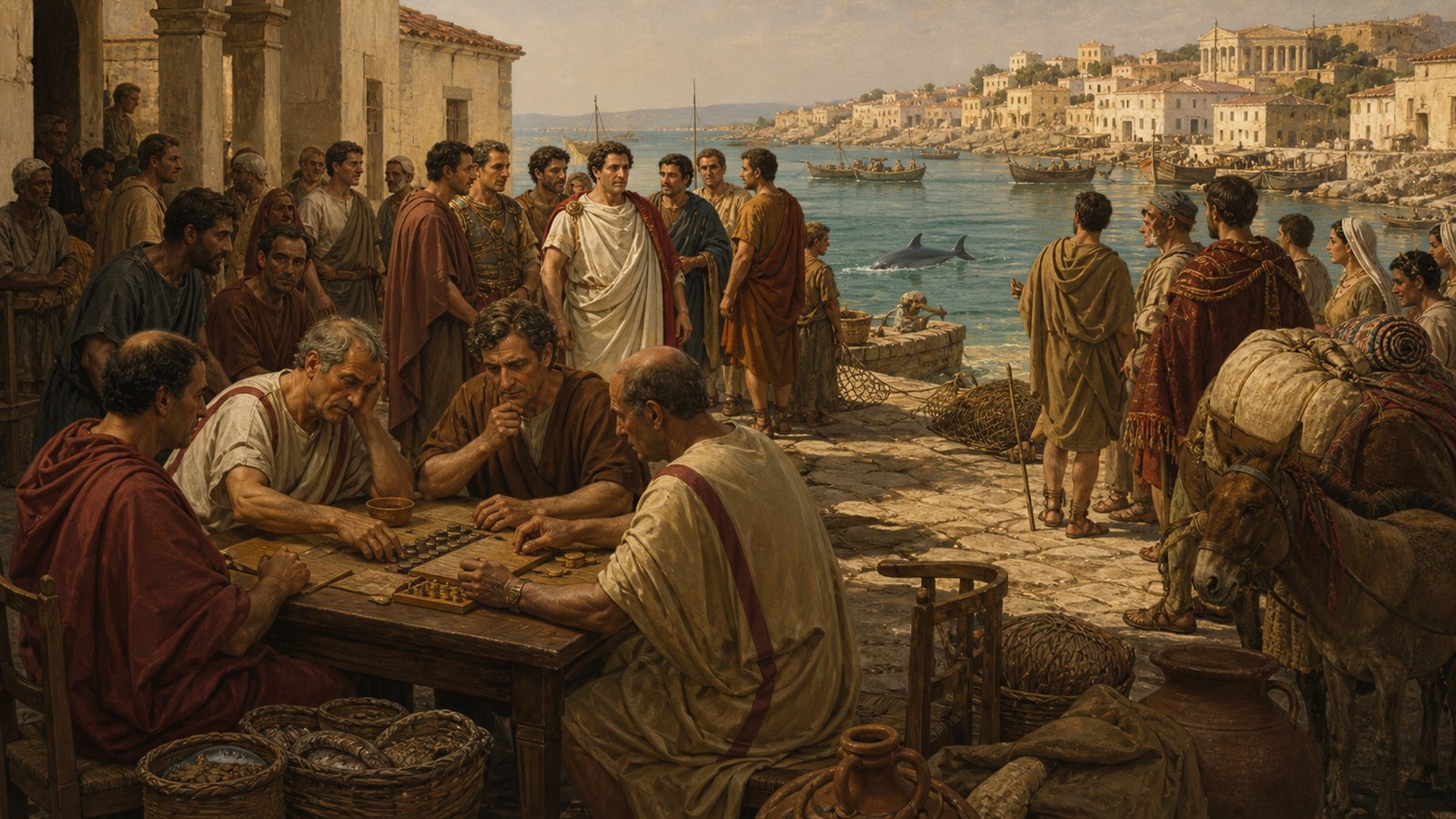
Magistrates began arriving to see the sight. Their presence was not free. Pliny says their coming and prolonged stays imposed new expenses on the small community and damaged the place’s quiet. The animal’s behaviour had created a destination, and official curiosity shifted the cost of wonder onto local finances.
The complaint exposes infrastructure usually absent from animal fables. Important visitors expected accommodation and support. A stream of observers could turn repetition into obligation. The dolphin did not need to consume public money directly; it only needed to attract people whose status made their visits expensive.
The town’s answer was secret killing. Pliny says the community decided to remove the cause that drew the crowds. The phrase is cold because it converts a living attraction into an administrative problem. Public affection and official fascination do not protect the animal once its celebrity threatens the budget and peace.
Pliny anticipates Caninius lamenting the ending, magnifying it and giving it emotional finish. Then he adds one final literary tease: invention is unnecessary, because no true detail should be omitted. The claim is impossible to verify from the letter alone, but it reveals the author’s design. A tale that looks like fable insists on completeness precisely when it hands itself to a poet.
The dolphin’s route through the letter is therefore social as much as aquatic. It carries a boy, then carries a reputation through Hippo, then carries officials toward the town and expenses into its accounts. The final violence is caused not by fear of the animal but by the human systems gathered around it. Pliny’s marvel survives because the town ended the spectacle; writing restored the attraction without making Hippo pay for another visitor.