
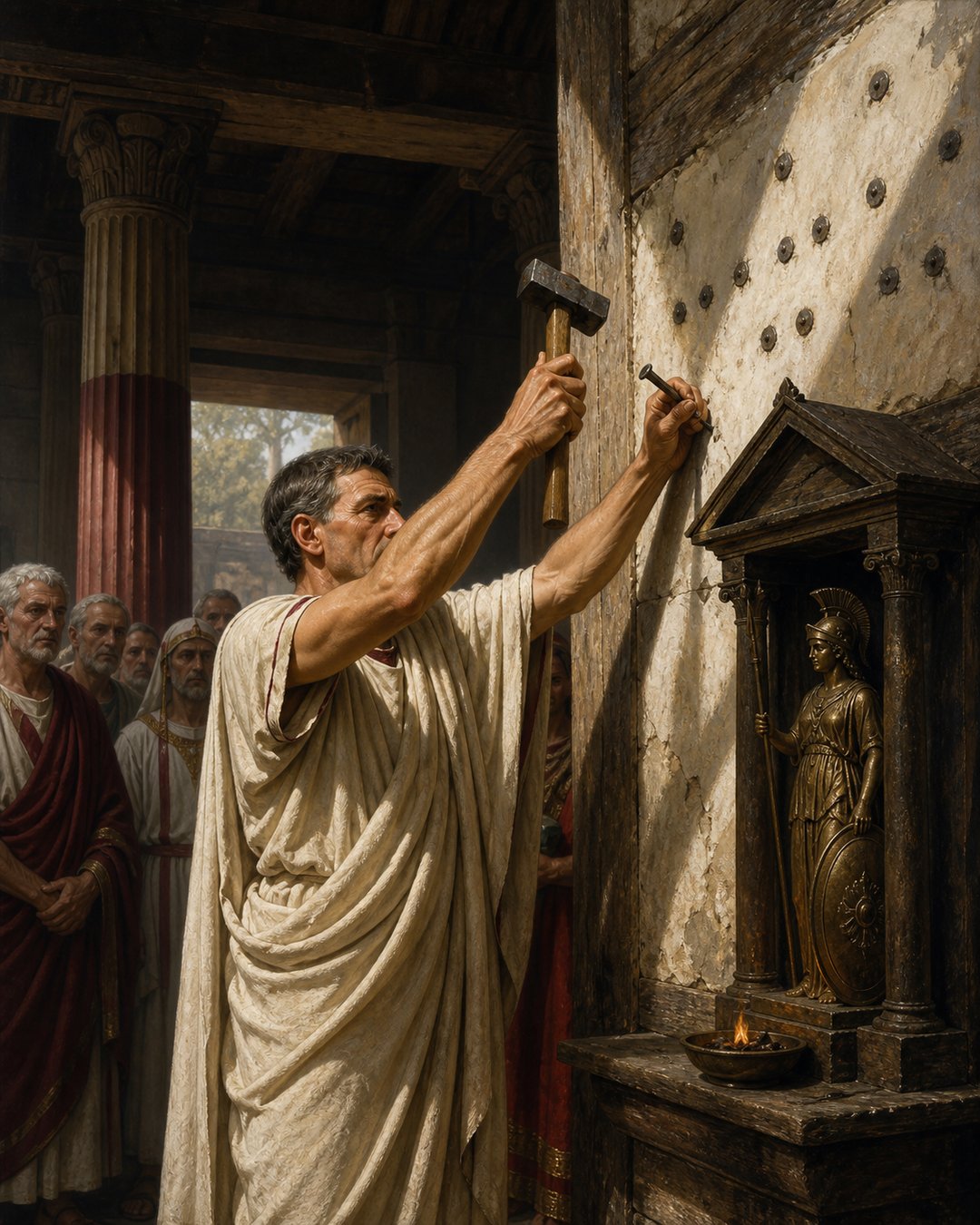
On the Ides of September, an official was supposed to hammer a nail into a wall of Jupiter’s great Capitoline temple. Livy says an old instruction, written in archaic words and letters, ordered the praetor maximus to do it. The nail stood beside Minerva’s chapel, where counting and divine protection met in one small mark of metal.
By 363 BC, however, Rome was not calmly keeping a calendar. A pestilence had resisted repeated attempts at religious expiation. Older men remembered—or were said to remember—that a dictator had once checked disease by driving a nail. The senate revived the act and appointed Lucius Manlius Imperiosus for that single purpose.
What follows makes the episode more than an odd survival. Livy moves from plague to archive, from archive to ritual, and from ritual to a political overreach. Manlius tried to use the prestige of dictatorship to raise troops for war with the Hernici. The tribunes of the plebs resisted, and he laid down the office. One nail exposes how Romans could use inherited ceremony to authorize emergency action while still disputing the limits of the person chosen to perform it.
The Games Failed Before the Nail Returned
Livy places the nail episode after a sequence of failed remedies. Stage performances had been introduced as a religious expiation, yet fear and disease continued. Then the Tiber flooded the Circus during the games. Instead of looking like an ordinary interruption, the inundation intensified dread: Romans could read it as evidence that the gods rejected the community’s efforts.
The details matter because the senate’s later decision did not emerge from an orderly annual calendar. It came after public ritual had visibly failed to produce reassurance. Disease harmed bodies, Livy says, but the fruitless search for effective propitiation worked even more strongly on people’s minds. The political community faced an interpretive crisis as well as a medical one.
This is the same civic habit explored in the priests who guarded Rome’s dangerous prophecies: extraordinary danger triggered a search for an authorized precedent. Yet Livy’s nail is not an oracle delivering new instructions. It is an old practice recovered from memory, a remembered action whose age itself made it useful.
Livy carefully attributes the crucial recollection. It was said that older men remembered a previous pestilence being assuaged when a dictator drove a nail. That wording does not give us a medical claim to accept. It shows what Roman decision-makers treated as actionable evidence when normal rites had failed: ancestral memory could become a constitutional reason to create an extraordinary magistrate.
An Archaic Sentence Fixed Time to a Temple
Livy interrupts the crisis narrative to quote the ancient instruction: whoever held the position of praetor maximus was to fasten a nail on the Ides of September. The notice stood on the right side of the temple of Jupiter Optimus Maximus, next to Minerva’s chapel. Date, office and location were all specified.
He explains that nails had once marked the number of years when written records were scarce. The account imagines chronology as accumulation. No reader needed to trust a later list of names if successive metal marks remained attached to a sacred wall. Each year added a physical unit to the city’s memory.
Minerva’s presence supplied Livy’s reason for the location: she was regarded as the inventor of numbers. Jupiter’s temple gave the record civic and religious weight; Minerva gave counting an appropriate divine guardian. The nail therefore joined material durability to an explanation of why enumeration belonged in that exact part of the building.
The mechanism differs from the later public authority of Roman calendars. A displayed calendar organizes repeated days and permissions. Livy’s nail does something barer. It converts the passing of a year into one irreversible impact—hammer, metal, wall—so that time leaves a countable scar inside the city’s principal temple.
Volsinii Gave the Custom an Etruscan Parallel
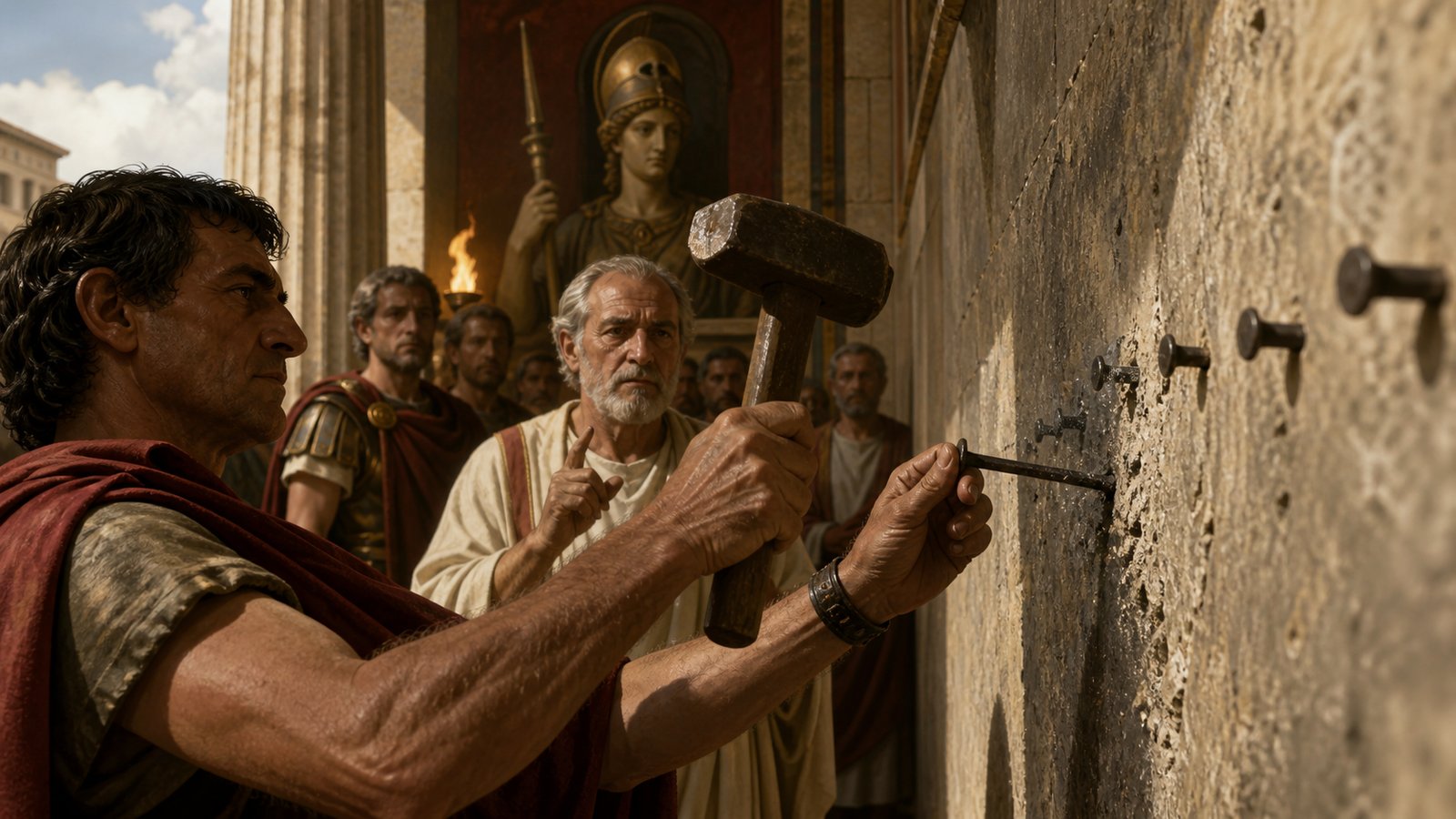
Livy names Cincius as a careful investigator of monuments of this kind. Cincius reported that nails were also fixed at Volsinii in the temple of Nortia, an Etruscan goddess, to indicate the number of years. The parallel widens the custom beyond Rome without making the two practices identical in every respect.
That attribution is important. Livy does not present every antiquarian detail as something he personally observed. He inserts a named researcher between his narrative and the Etruscan evidence. The reader sees an ancient historian working with earlier claims about monuments whose first use lay far beyond living memory.
The Volsinii comparison also complicates any temptation to call the nail uniquely Roman. Early Roman religion and political practice developed beside Etruscan cities, symbols and institutions. Livy’s digression preserves a Roman story of continuity while admitting that an analogous annual count belonged to Nortia’s temple.
A nail could carry several associations at once: fastening, finality, repeated count and sacred location. Livy’s passage securely gives us the yearly record and the emergency rite; it does not require every later symbolic theory attached to nails. Keeping those layers separate makes the episode stronger. Its documented power comes from what officials did with a specific remembered rule.
A Narrow Appointment Opened a Wider Ambition
Livy says the ceremony initially belonged to consuls after the temple of Jupiter Optimus Maximus was dedicated. It later passed to dictators because their authority was greater. When the custom fell out of use, its revival seemed important enough to require a dictator again. This is Livy’s reconstruction of institutional movement, not a surviving sequence of annual nails we can inspect.
The senate nominated Lucius Manlius Imperiosus, and he appointed Lucius Pinarius as master of the horse. His mandate was expressed through purpose: dictator clavi figendi causa, dictator for driving the nail. The office was extraordinary, but the stated job was strikingly narrow.
Manlius did not keep it narrow. Livy says he treated the appointment as political rather than merely religious and became eager to command the war against the Hernici. He began an enlistment, conducting it so harshly that men liable for service became angry. Emergency prestige was being converted into manpower and a campaign.
The shift reveals why procedure mattered. Rome had not simply selected a strong man during plague. It had created a dictator to perform one recovered act. Manlius’s attempt to extend that authority forced a second question into view: did the office’s general power follow the holder, or did the declared purpose continue to bind what he could legitimately do?
The Tribunes Stopped the Crisis from Changing Shape
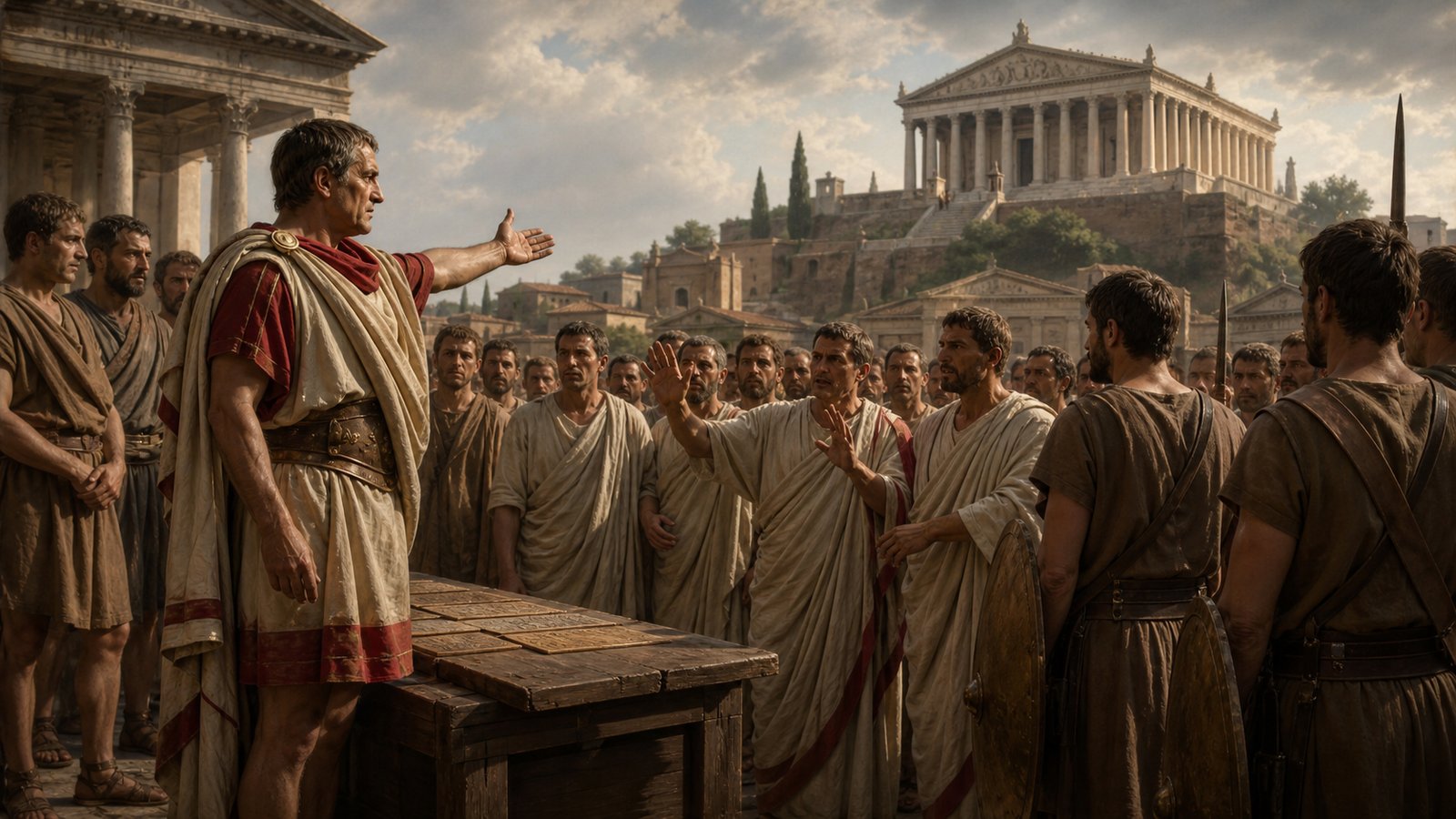
The tribunes of the plebs resisted Manlius unanimously. Livy does not provide a long constitutional debate in this passage. He gives the practical result: faced by opposition, Manlius yielded, whether voluntarily or under compulsion, and resigned the dictatorship.
That ending prevents the nail from becoming a simple celebration of emergency power. The senate’s religious solution produced an office whose holder tried to redirect it toward war; another institution then checked him. Plague, ritual, recruitment and plebeian protection occupy one short narrative because authority moved through all four.
The nearby logic resembles the fetial procedure that turned grievance into declared war. In both cases, a physical act gave public form to a decision. But the nail story ends by showing that ceremony did not erase contest. A legitimate blow against a temple wall did not automatically legitimate every order issued afterward.
Livy wrote centuries after the early Republic and shaped old material into a meaningful history. His annual nail should not be treated as a complete administrative archive or his plague story as proof of causation. What the text does preserve is a Roman argument about memory. An archaic sentence could be retrieved when newer rituals failed; a mark once used to count years could be asked to end disease; and the official summoned to wield the hammer could still be resisted when he tried to make one emergency become another.
The nail’s force came from limitation. It fixed one date, one place and one act. Manlius’s failure came when he tried to turn that bounded act into an open command. Livy leaves the metal in Jupiter’s wall but removes the dictator from office—a compact lesson in how inherited authority could be activated without being allowed to decide its own reach.