

A Roman who admitted a debt did not go straight into chains. In the version of the Twelve Tables quoted by Aulus Gellius, thirty lawful days came first. They formed a pause in enforcement: time to raise the money, find help or reach a settlement before the creditor could lay hands on the debtor.
When the pause ended, the procedure became physical. The creditor brought the debtor before the praetor, took him home if payment or a surety still failed, and fastened him with at least fifteen pounds of fetters. A pound of meal per day was the stated minimum if the prisoner could not feed himself. Sixty more days and three market-day appearances turned private default into repeated public exposure.
Only at the end does Gellius reach the line that has eclipsed everything before it: when several creditors held the same debtor, the law allowed them to cut him into parts. Yet the chapter is not evidence that creditors actually performed a dismemberment. It is a second-century debate between the philosopher Favorinus and the jurist Sextus Caecilius. One calls the rule barbarous; the other says its horror prevented its use and that he had never read or heard of anyone being cut. The countdown matters because it shows how Roman legal memory built terror into procedure—and then argued about what that terror meant.
A Palatine Conversation Put Old Law on Trial
Gellius sets the discussion in the Palatine square while a group waited to pay respects to Caesar. Favorinus met Sextus Caecilius there, and Gellius says he was present with several others. The setting gives us neither a courtroom judgment nor a lecture transcript. It is a literary conversation among learned men beside the centre of imperial power.
Caecilius enters as an authority on Roman jurisprudence and legal interpretation. He praises the laws written by the decemvirs on twelve tablets for their concise and choice language. Favorinus answers as a reader who admires much of them but finds some provisions obscure, cruel, overly mild or impossible to take exactly as written.
The disagreement is about historical distance as much as morality. Caecilius says six centuries separated the original compilation from their own day. Old words and customs had become obsolete, so readers could mistake the sense by applying later meanings. The law had to be interpreted through a vanished social world.
This differs from the six bronze tablets that organized a Roman town, where surviving text lets us inspect municipal machinery in material form. Gellius gives us a later author preserving fragments inside argument. Every quoted rule reaches us through selection, explanation and controversy.
Thirty Lawful Days Delayed the Creditor’s Hand
Caecilius’s defense begins with the value Romans placed on trust in private agreements. Borrowing answered temporary need within ordinary social exchange, he argues, and that aid would disappear if debtors could break faith with only a light consequence. His language is a moral justification offered centuries after the Twelve Tables, not a neutral economic report.
For an acknowledged debt or a judgment already pronounced, the rule allowed thirty days. Caecilius calls them legitimate days and explains them as a moratorium—a break in judicial action. During that interval, no enforcement could proceed against the debtor.
The pause complicates the image of instant creditor violence. The process began with a measured opportunity to satisfy the obligation. Settlement remained possible later too. The severity lay not in the absence of stages but in what happened when every stage passed without money, compromise or a supporter willing to intervene.
Our article on why Roman law courts made conflict public follows the civic visibility of disputes. The debt sequence turns that principle into a clock. An admitted private obligation moved toward public coercion only after a named interval expired.
Fifteen Pounds of Iron Made Judgment Tangible
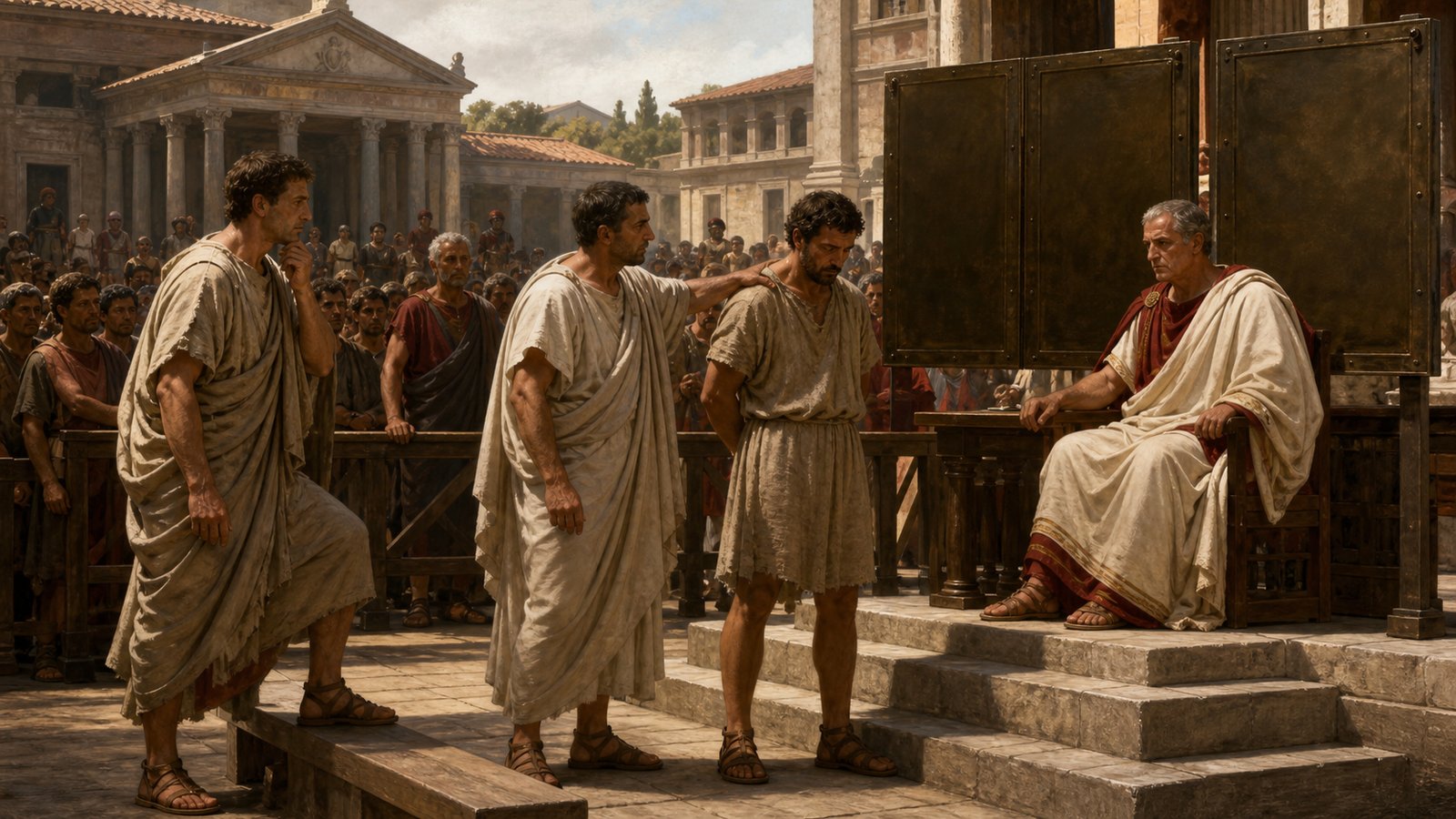
After thirty days, the creditor could summon the debtor before the praetor and perform the laying on of hands. If the judgment remained unsatisfied and nobody appeared before the magistrate as surety, the creditor could take the debtor home. Legal liability crossed into custody.
Gellius quotes a minimum weight for the restraint: not less than fifteen pounds in stocks or fetters. The creditor could use more. The number made power measurable, but it protected no comfortable maximum. The text sets a floor beneath the prisoner’s burden rather than a ceiling above the creditor’s severity.
Food was measured too. A prisoner could live at his own expense. If he could not, the creditor owed him one pound of meal per day and was free to provide more. The same rule that authorized confinement therefore specified a minimum ration, binding physical maintenance to physical restraint.
The praetor’s presence did not make the relationship impersonal. As praetorian justice displayed its rules publicly, it also depended on actions carried out by litigants: summons, seizure, surety and custody. Gellius’s debtor leaves the magistrate’s space in a creditor’s hands, carrying the judgment as iron on his body.
Three Market Days Turned Confinement into Spectacle
Settlement was still allowed during confinement. If no compromise came, debtors remained held for sixty days. The next stage required repetition in public rather than quiet disappearance into a household prison.
On three successive market days, the debtor was brought before the praetor. The amount of the judgment was announced. Market days gathered people for exchange and civic business, so the procedure put the unpaid sum before a recurring audience while leaving time for intervention.
The third appearance marked the edge. Caecilius says debtors then faced capital condemnation or were sent across the Tiber to be sold abroad. Crossing the river made the movement out of Roman civic protection geographically legible: the debtor could be converted from a bound citizen into a person sold beyond the community.
This procedure should not be collapsed into the sophisticated maritime credit visible in the Muziris cargo and loan contract. The texts belong to different periods and commercial worlds. Their connection is narrower: both make obligation concrete by attaching money to enforceable steps, but Gellius’s archaic sequence puts the debtor’s body at the centre of enforcement.

The Cutting Clause Survived as an Argument, Not a Body
Favorinus calls division of the debtor the worst cruelty. He imagines a poor man’s limbs butchered and distributed as goods might be divided and sold. His disgust is part of Gellius’s evidence: a learned Roman of the author’s own era could treat the ancestral provision as shameful rather than automatically venerable.
Caecilius does not deny the words. He quotes the rule for several creditors: on the third market day they may cut; if they cut more or less, they incur no liability. He then argues that the show of cruelty made the threat effective precisely because nobody wished to reach it.
His proof is negative and carefully framed. Caecilius says he had never read or heard of anyone being cut in ancient times. That is not proof that it never happened, but neither does the quoted law prove an execution. The chapter preserves a legal permission, a philosopher’s horrified reading and a jurist’s claim about absent precedent.
Caecilius extends the deterrence argument by comparing false witnesses once threatened with being thrown from the Tarpeian Rock. Severe penalties, he claims, lose force when they become obsolete. His defense asks the audience to judge archaic law by the behaviour it supposedly prevented rather than only by the violence it authorized.
That move tells us as much about later Roman legal culture as about the fifth century BC. Gellius’s speakers inherit old words but cannot leave them uninterpreted. Favorinus tests them against humanity; Caecilius reconstructs vocabulary, procedure and purpose; Gellius turns their clash into a chapter about reading law across six hundred years.
The debtor’s descent is therefore both precise and uncertain. Thirty days, fifteen pounds, one pound of meal, sixty days and three market appearances give the rule a hard procedural skeleton. At its end stands a body that the text permits creditors to divide but that Caecilius insists history never showed him. The most notorious clause survives not as a recorded dismemberment, but as the point where Roman reverence for ancestral law had to explain its own terror.