
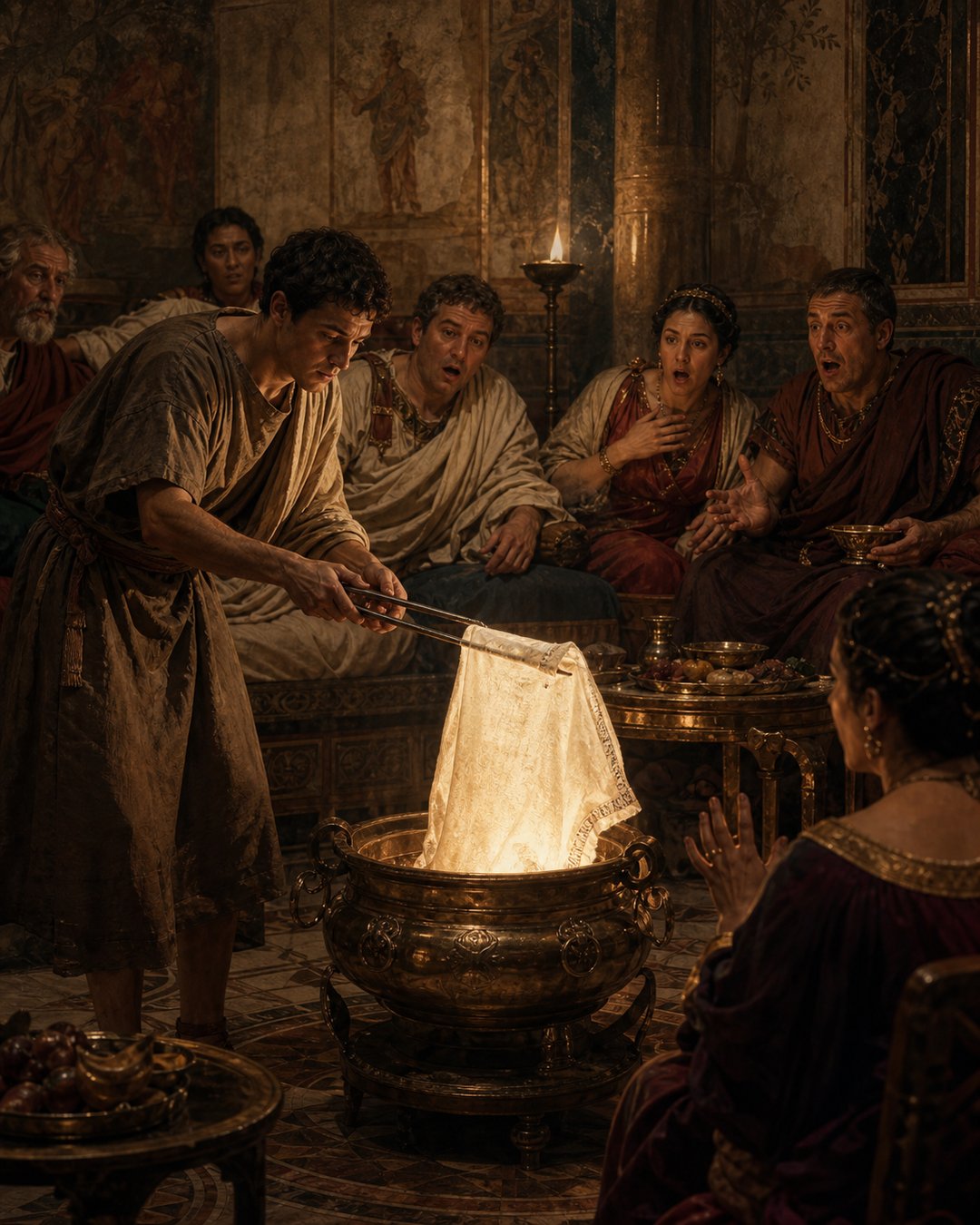
At a Roman banquet, a stained napkin could be thrown into the hearth instead of a wash basin. Pliny the Elder says he saw cloth of this kind glow among the coals and emerge cleaner than water could make it. The spectacle inverted everything a diner knew about linen. Ordinary flax burned. This fabric used flame as a laundry.
Pliny calls it “living linen” and gives its Greek name as asbestinon. His description is only one compact section of the Natural History, but it moves through an extraordinary sequence: a banquet demonstration, a royal funeral, a remote habitat, a difficult loom and a price compared with fine pearls. The object’s value came from linking those settings together.
Modern readers recognize asbestos in the name, but Pliny presents the substance as a plant fibre from India. That mistake is part of the evidence rather than an embarrassment to erase. It shows a Roman observer accurately recording what fire did to a rare cloth while fitting its origin into the textile categories available to him. The napkin was real enough to test at a hearth; the supply chain remained distant enough to become botanical legend.
Ordinary Linen Reached the Loom Through Repeated Violence
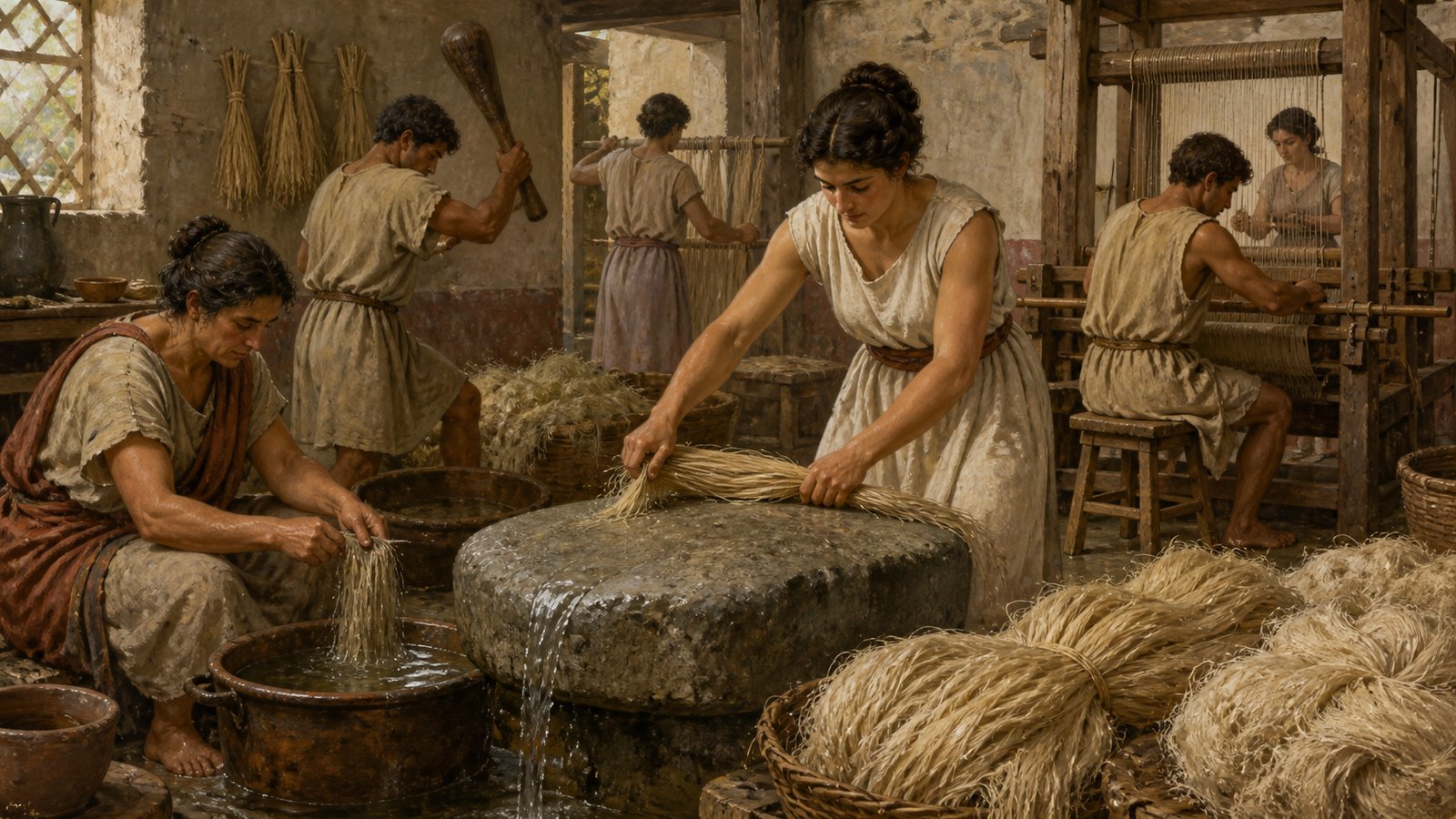
Pliny introduces the fireproof fabric immediately after describing the hard treatment required by ordinary flax. Bundles were processed into usable fibre, spun into thread, soaked in water and beaten repeatedly against stone. After weaving, the cloth was beaten again with clubs. In his blunt summary, linen became better through rough handling.
This sequence matters because it establishes the normal rules. Water softened and cleaned. Beating separated and refined. The plant passed through several stages before it became a surface suitable for a sail, garment or napkin. Fire belonged at the dangerous edge of that process, capable of destroying in moments what many hands had prepared.
The “living” linen entered as an exception to those rules. Pliny does not begin with a mine, quarry or workshop. He begins with behaviour: the cloth would not be consumed. Calling it linen made the marvel legible, even if the fibres were not flax. The material looked close enough to woven cloth to be folded, handled and stained, yet it answered heat in the wrong way.
Roman readers knew that textile labour accumulated slowly. Our account of the spindle whorl’s stored motion shows how much repeated handwork sat inside thread before weaving began. A fabric that resisted the instant destruction of all that labour could appear almost alive.
A Banquet Hearth Became a Public Test
Pliny anchors the claim in eyewitness experience. He had seen napkins made from the material glowing on hearths at banquets. They were not merely exposed to a cautious spark. They were placed where the fire could burn away whatever had soiled them, and Pliny says they came out more brilliantly clean than washing in water could have achieved.
The dining room was an ideal theatre for such a demonstration. Guests understood napkins, stains and flame without technical explanation. A host could turn cleaning into a moment of astonishment: the fire brightened, the dirt vanished, and the woven object remained. Luxury appeared not as an abstract price but as matter breaking an everyday expectation in front of witnesses.
Fire-cleaning also gave the cloth a repeatable performance. An exotic object locked in a cabinet could be admired only by description. A napkin could be tested again whenever a meal produced grime. Each return from the coals renewed the story of rarity and mastery, and every successful test distinguished the genuine substance from an ordinary imitation that would disappear.
Pliny’s wording does not tell us how large the napkins were, who owned the set or how often they endured this treatment. Those limits matter. What the passage securely gives is a witnessed use and a comparison: flame cleaned better than water. The claim is vivid precisely because it rests on a simple action rather than a long explanation of material science.
A Royal Shroud Kept One Body’s Ashes Apart
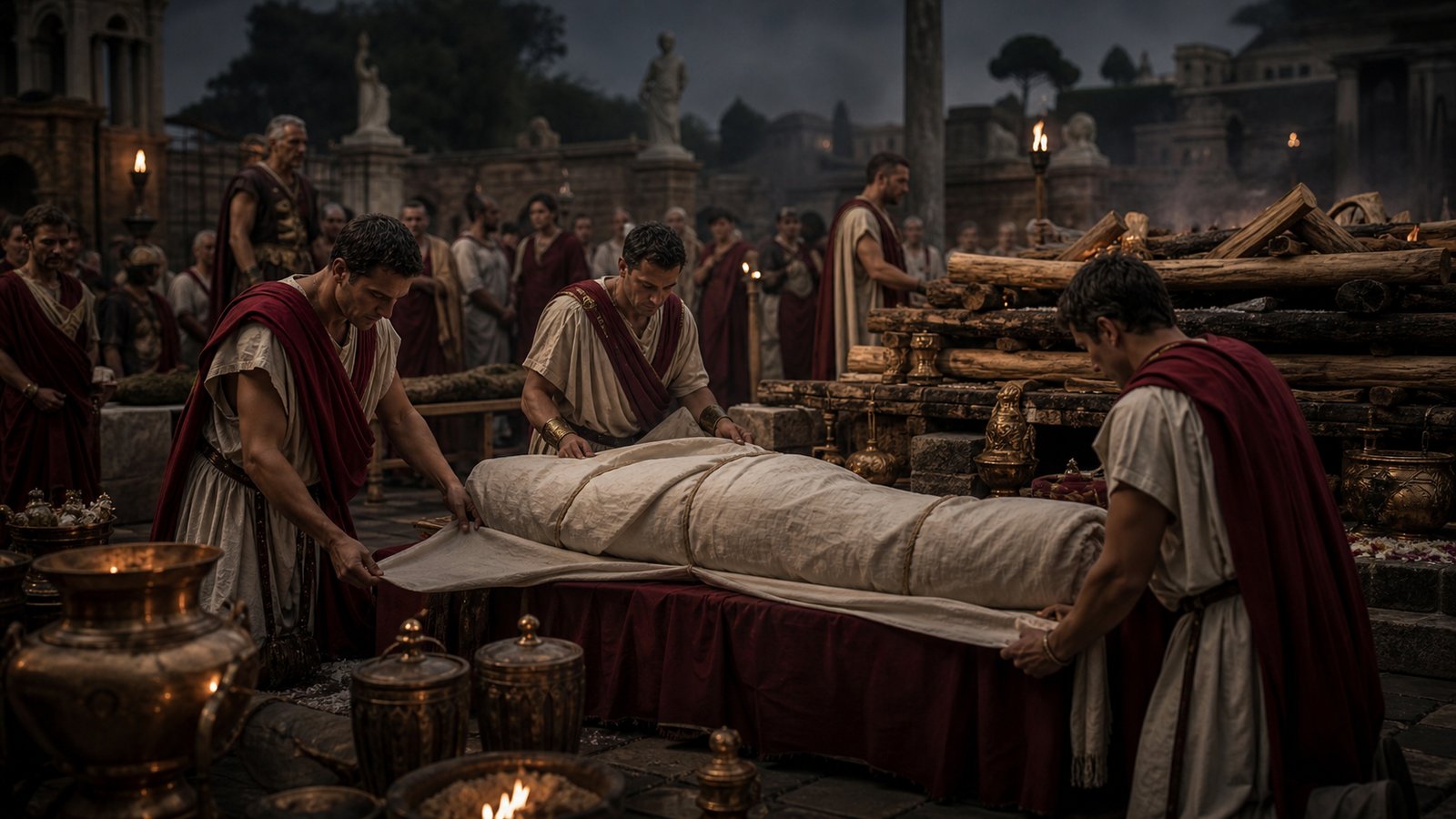
The same resistance to fire carried a more solemn purpose. Pliny says the fabric was used for royal shrouds so that the ashes of the corpse remained separate from the rest of the funeral pyre. Timber, offerings and other materials could collapse into a mixed bed of residue. The incombustible wrapping marked a boundary around the body while everything around it burned.
Here the cloth did not defeat cremation. It organized the result. The pyre could consume the corpse while the shroud helped preserve a distinction between human remains and fuel. That practical separation also suited royal status: even after flame had reduced the spectacle, the ruler’s ashes were not to become anonymous among the debris.
Roman elite funerals already used objects and performances to control memory. ancestral masks brought dead officeholders back into the procession; living linen worked at the opposite end of the ceremony, when public forms gave way to ash. One made lineage visible before the crowd. The other protected identity inside the physical remains.
Pliny does not name the kings whose bodies received these shrouds, and the phrase should not be expanded into an unsupported Roman custom. He describes a use for royalty, not a universal rule. Even so, the pairing of banquet and pyre is revealing. The cloth could advertise wealth among diners and perform careful separation at death because the same property mattered in radically different rooms.
Short Fibres and a Distant Desert Made Rarity Plausible
To explain the supply, Pliny sends the material far from Rome. He says it grew in the deserts and sun-scorched regions of India, in places without rain and among deadly snakes. A thing accustomed to burning heat could, in his account, produce a cloth comfortable in fire. Habitat became an explanation for behaviour.
The story is botanically wrong, but its logic is internally clear. Roman natural history often connected the character of a substance to the place that formed it. Distance, heat and danger made the material’s survival seem less arbitrary. They also made scarcity believable to readers who could not inspect the source.
Pliny adds a workshop difficulty: the substance was rarely found and hard to weave because of the shortness of its fibres. That detail moves the bottleneck from transport alone to manufacture. Even after the raw material reached a craftsperson, it resisted the long, cooperative strands expected at the loom. The finished fabric therefore condensed several kinds of difficulty—finding, moving and joining.
Its normal colour, Pliny says, was red, but fire made it white. The change turned cleaning into transformation rather than mere survival. The hearth did not leave the cloth untouched; it revealed a brighter state. A diner watching red-tinged grime and residue disappear could read whiteness as proof that the object had passed the test.
A Pearl-Level Price Turned Misunderstanding into Luxury
When any of the material was found, Pliny says, it rivalled exceptionally fine pearls in price. He then ranks it above every other kind of linen in the world. The second place went to fine flax from around Elis in Achaia, especially associated with women’s finery. His hierarchy joins a fireproof mineral fabric and the best conventional plant textile under one market category.
That category error did not prevent practical knowledge. Users knew the cloth could be woven, soiled, heated and reused. They knew its fibres were troublesome and its supply rare. What they lacked was a modern account of mineral structure and health risk. Pliny’s passage preserves capable observation and mistaken explanation in the same paragraph.
He also reports a claim from Anaxilaus that wrapping the cloth around a tree deadened the sound of felling blows. The statement extends the material’s strangeness from fire to sound, but Pliny offers no eyewitness test for it. It belongs in the article as attributed testimony, not as established acoustics.
The napkin in the hearth remains the strongest scene because Pliny puts himself there. Fire, not origin theory, supplied the demonstration. Rome’s most expensive cloth became valuable by doing what linen should not do: entering flame, growing cleaner, and returning to the table. The same refusal to burn could then follow a royal body into the pyre and keep its ashes apart.