
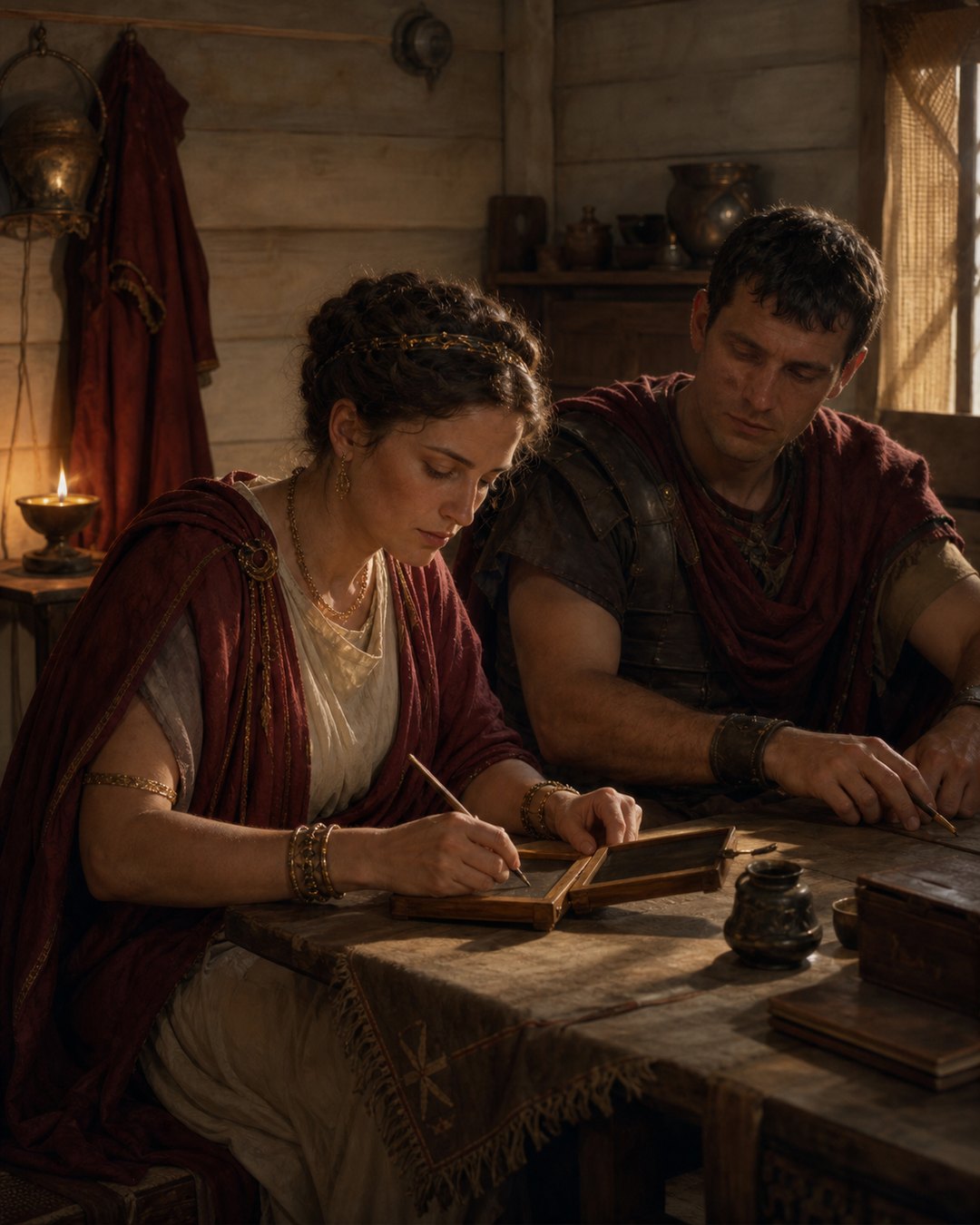
A birthday invitation reached Sulpicia Lepidina with a precise request: come on 11 September and make the day happier by being present. The main message was written in an elegant professional-looking hand. Near the end, however, the script changed. Claudia Severa herself added that she would expect her “sister,” called her “my dearest soul,” and said farewell.
That small change in handwriting is what makes Vindolanda Tablet 291 exceptional. The invitation was not a casual note scratched into wax. It was an inked wooden diptych, 223 millimetres wide and 96 millimetres high, prepared as a private letter and addressed on the back. Its production could involve more than one hand, yet Severa found room to make the ending visibly hers.
The tablet is usually celebrated as the earliest known surviving Latin writing by a woman. The stronger story lies inside that description. A household could use a skilled writer for the body of a message without surrendering the sender’s voice. Severa’s autograph did not replace the formal letter. It entered it at exactly the point where affection, expectation and presence mattered most.
A Wooden Diptych Carried One Exact Day
Roman Inscriptions of Britain identifies the object as an ink writing tablet made from wood. It was found at Vindolanda in 1985, in a context assigned to the fort’s third site period, and is dated to AD 97–105. The surviving object is now in the British Museum. Those dry catalogue facts place a personal invitation inside a military-frontier settlement at the turn of the second century.
The message names the occasion with unusual precision. Severa asks Lepidina to come three days before the Ides of September: 11 September. It is the day appointed for the celebration of Severa’s birthday. She does not merely announce a feast. She says Lepidina’s arrival will make the day more enjoyable for her.
That phrasing gives the invitation a purpose beyond attendance. A birthday could be marked on the calendar, but the quality of the occasion depended on who crossed the threshold. The date organized movement; affection supplied the reason. An exact day therefore survived because one woman wanted another woman physically present.
The archive’s broader introduction to the Vindolanda tablets at Rome’s northern edge shows how scraps of routine complicate the image of an isolated fort. Tablet 291 narrows that principle to a single appointment. Administrative time and family time occupied the same wooden medium.
The Invitation Included Two Households
Severa opens by naming herself and greeting “her Lepidina.” She addresses Lepidina as “sister,” a language of intimacy rather than proof of biological kinship. The invitation then widens into a chain of greetings. Lepidina is to greet her Cerialis; Severa refers to “my Aelius,” and her little son also sends a greeting.
Roman Inscriptions of Britain identifies Severa as the wife of Aelius Brocchus and Lepidina as the wife of Cerialis. The tablet therefore connects named women, named men and a child without turning any of them into a list of ranks. The occasion is Severa’s birthday, but the social exchange embraces both households.
The wording also preserves uncertainty honestly. Damage affects part of the sentence about Aelius and the little son, and editors discuss the precise object of their greeting. The secure point is the family sequence itself. The invitation does not move directly from request to farewell; it performs the reciprocal work of remembering the people attached to each correspondent.
That is a different kind of evidence from an official roster. A strength report can count absent soldiers, while a private letter shows how people were socially present to one another through names and greetings. The tablet makes a frontier household visible not by inventorying possessions but by tracing who should be remembered when two women exchanged news.

A Skilled Hand Built the Formal Message
The principal script is described as elegant, with slim letters, pronounced ascenders and descenders, and little use of ligature. Editors recognize the same handwriting in several other Vindolanda tablets. That repetition suggests a person accustomed to preparing correspondence rather than a writer improvising this single message.
Nothing about using another hand makes Severa less responsible for the invitation. Dictation, copying or scribal assistance could separate authorship from physical inscription. The main hand establishes names, occasion, date, request and greetings in an orderly form. It gives the letter the shape required to travel and be read.
Material details mattered to that work. Ink had to sit clearly on a thin wooden surface, and narrow letter forms helped fit a complete social message onto the diptych. Our article on Roman reed pens and controlled ink strokes explains the broader writing mechanism. Tablet 291 lets us see the social result: a polished hand carrying another person’s invitation.
The professional appearance also makes the change near the close easier to detect. If the entire tablet had been written unevenly, a second hand might be ambiguous. Here the contrast is meaningful because the first script has a stable style. The body creates the visual baseline against which Severa’s intervention can be recognized.
Severa Entered at the Point of Expectation
After the household greetings, a second hand writes the intimate close. Severa says, “I shall expect you, sister.” She follows with farewell, calls Lepidina her “dearest soul,” and adds another greeting. The editors are confident this is Severa’s own hand, as they are for personal additions in two related letters.
The placement is revealing. Severa did not sign only a bare name beneath a completed text. Her addition repeats the emotional demand of the invitation. The formal hand has already asked Lepidina to come; Severa’s hand turns that request into expectation. The shift in script becomes part of the message even though neither woman could have known how closely modern readers would study it.
The phrase translated as “my dearest soul” belongs to a wider language of endearment, and the commentary compares similar expressions in Roman literature. Its significance here is physical as well as verbal. Affection appears in words that survive in the hand attributed to the person expressing it.
Editors describe these additions as almost certainly the earliest known examples of a woman writing Latin. “Known” is important: the archaeological survival of writing is uneven, and Severa was not necessarily the first Roman woman to take up a pen. The claim concerns surviving, identifiable evidence. This wooden diptych lets a named woman’s script be distinguished inside a dated private letter.
The Back Turned Affection into an Address
The reverse carried the information needed to identify the recipient: Sulpicia Lepidina, wife of Cerialis, from Severa. The address is brief compared with the front, but it completes the object’s job. Intimacy inside required legibility outside. Before Lepidina could read “my dearest soul,” someone had to know whose letter this was.
Front and back therefore performed different social tasks. The outer address placed the tablet in a network of recognized names and households. The inner text fixed an occasion, exchanged greetings and invited a visit. The autograph close then made the sender’s presence visible at the end of a message another person had largely written.
We cannot reconstruct every step of delivery from this one tablet, and the surviving text does not tell us whether Lepidina attended the birthday. It preserves a request, not the result. That limit keeps the object from becoming a complete story of a party that may or may not have happened.
What did happen is enough. A wooden diptych crossed from formal inscription into personal handwriting. Eleven September became memorable because Severa wanted company, a skilled writer prepared the invitation, two households were greeted, and the sender took over the final lines herself. The smallest strokes on the tablet carry its largest claim: delegated writing could still end with a person entering the page.
Sources
Roman Inscriptions of Britain, Vindolanda Tablet 291; British Museum collection record 1986,1001.64.