
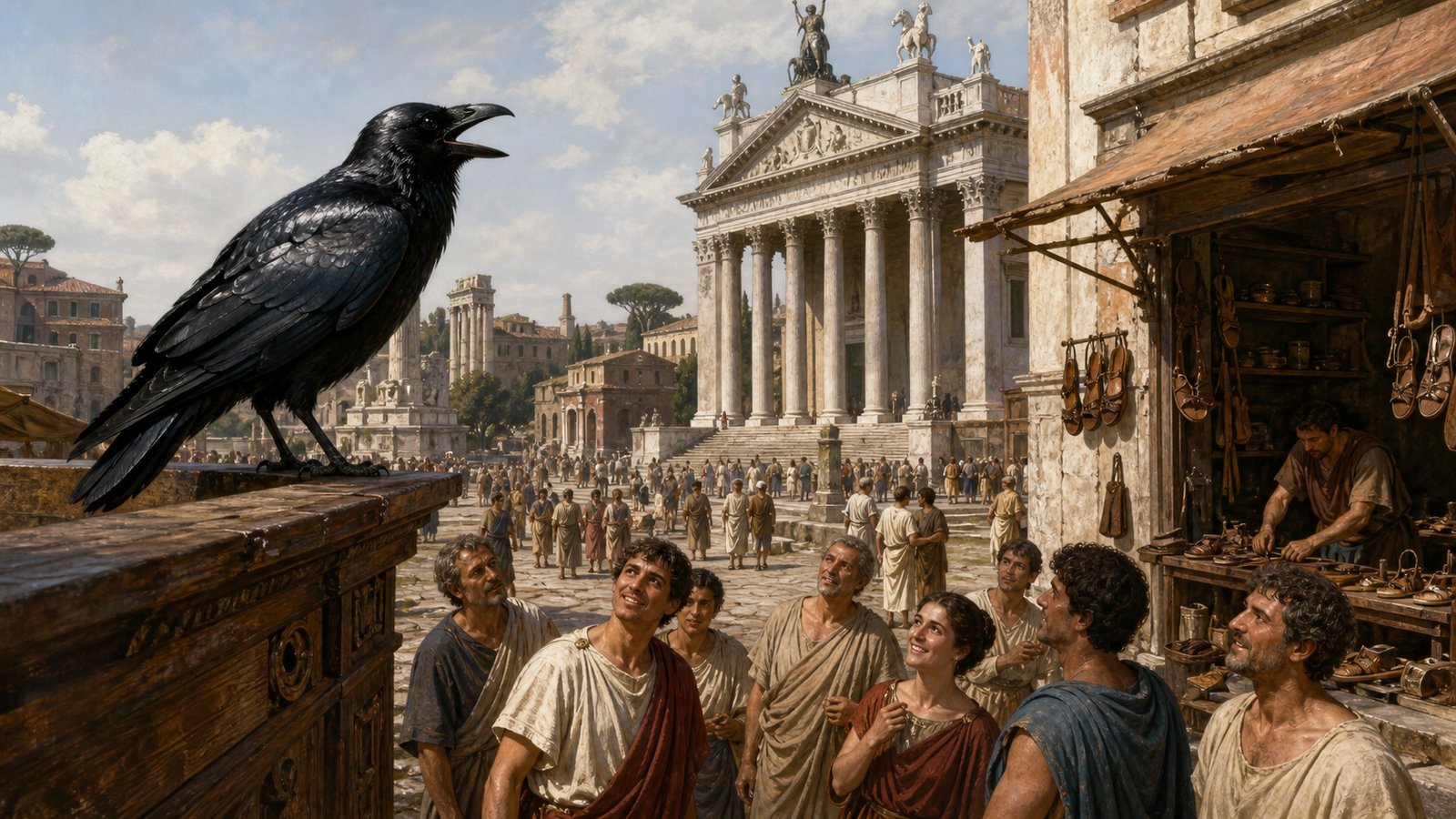
Every morning a raven left a shoemaker’s shop opposite the temple of Castor and flew toward the Rostra. Pliny says it greeted Tiberius by name, then Germanicus and Drusus, then the Roman people passing through the Forum. After completing that sequence, it returned to the shop.
The routine lasted for years. Rome did not merely hear a bird imitate speech once. People encountered a repeated performance tied to the same places and names. The shop, temple, Rostra and crowd formed its route; the imperial family and populace formed its spoken order.
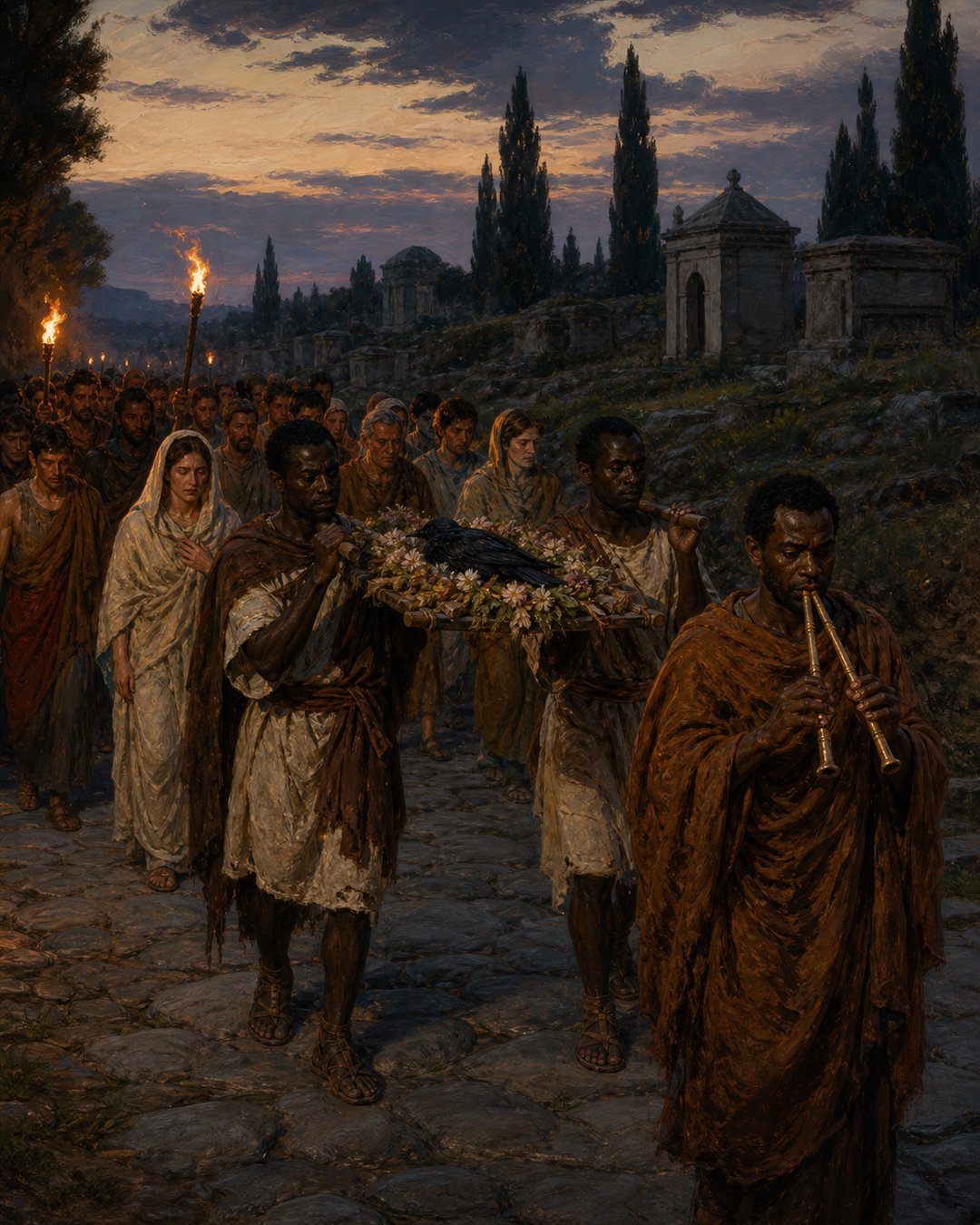
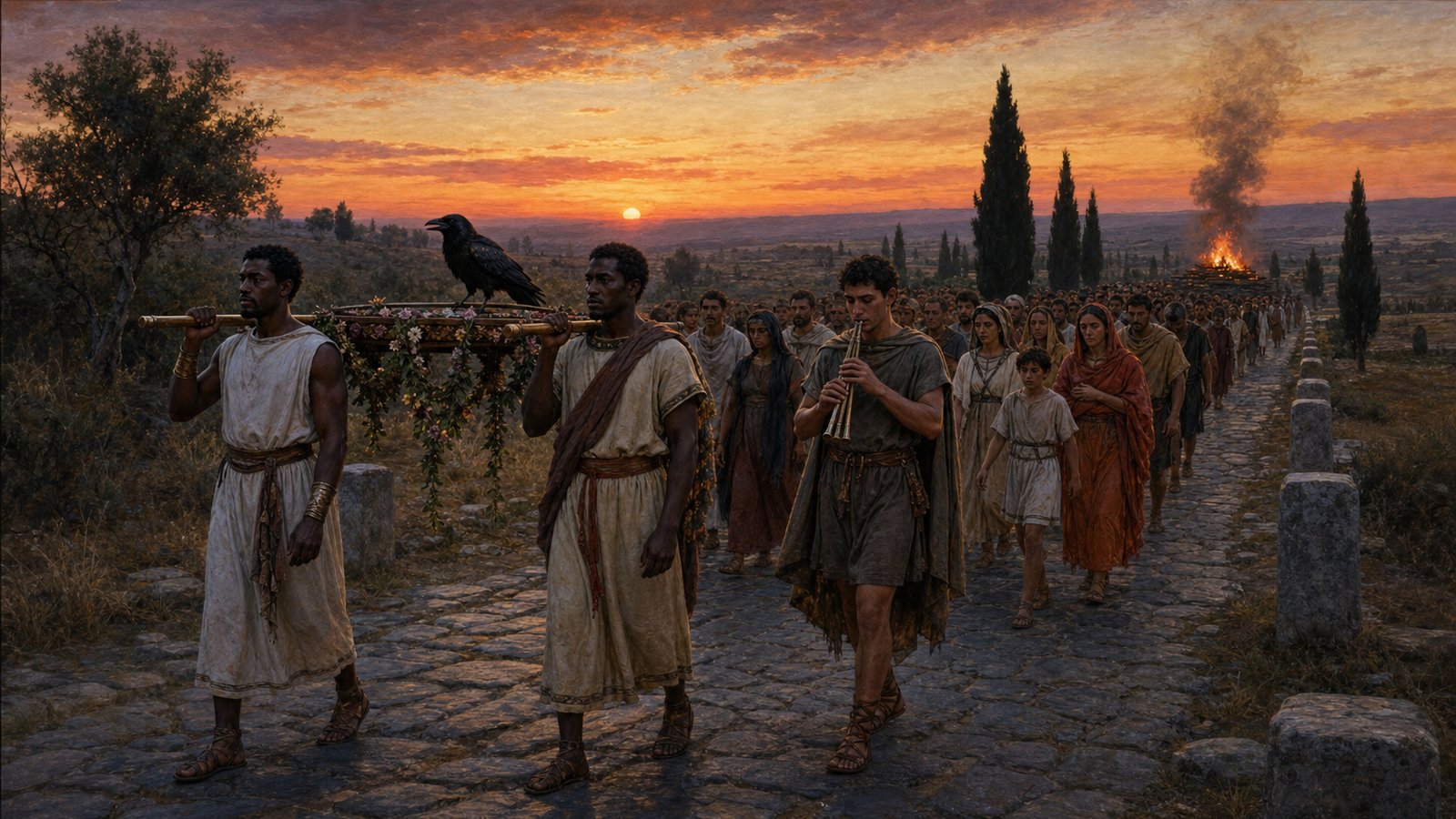
When another shoemaker killed the raven, allegedly because its droppings had soiled his shoes, the response exceeded a quarrel between neighbors. The crowd drove the killer from the district and soon put him to death. Then it gave the bird a procession: two Ethiopians carried its litter, a piper went before it, garlands surrounded it, and a pyre waited beside the Appian Way. Repetition had made a shop bird into a civic celebrity.
A Shop Opposite Castor Became the Raven’s School
Pliny begins the bird’s Roman life with an arrival. A raven from a group flying above the temple of Castor entered the shoemaker’s shop opposite. The owner regarded the event with religious reverence and treated the bird as doubly recommended by its association with the temple and its choice of his premises.
The shoemaker trained it while it was young. This detail keeps the story grounded in work rather than magic. The raven’s speech was a learned skill developed in an urban shop, where voices, customers and repeated names would have been readily available.
The location mattered. Castor’s temple stood near the Forum, and the Rostra faced the space through which political language moved. The bird’s short flight carried it from a craft shop into Rome’s most public setting. Its talent became visible because it crossed that boundary every day.
A Lost Eagles article about barbers and the social life of Roman shops follows another workplace that accumulated spectators and conversation. The raven’s shop did something similar through an animal whose daily departure advertised both its trainer and the neighborhood.
Four Greetings Gave the Flight a Public Order
Pliny preserves the greeting sequence. Tiberius came first. Germanicus and Drusus followed. Then came the Roman populace. The raven did not utter an undirected sound; it assigned recognition to named rulers and, finally, to the collective crowd.
The order made the act politically legible without turning the bird into a political thinker. Training supplied the names. Listeners supplied the significance. Hearing the same salutations near the Rostra let people recognize both the skill and the structure of the performance.
Constancy was essential. Pliny says the raven followed its routine for several years. A novelty can draw attention once, but a public habit requires reliability. The bird had to leave the shop, reach the same civic space, speak and come back often enough for strangers to expect it.
The return completed the route. It kept the raven attached to one owner and one shop even after its voice had become familiar across the Forum. The performance therefore linked private training and public fame: the city enjoyed the act, while the bird physically returned to the craft setting that had produced it.
Shoe Leather Supplied the Killer’s Excuse
The owner of a neighboring shoemaker’s shop killed the raven in a sudden burst of anger. He claimed that the bird’s droppings had dirtied some shoes. Pliny’s phrasing keeps distance from the excuse, presenting it as what the man wished to make appear.
The contrast is deliberately small and enormous. On one side stood soiled footwear in a competing shop. On the other stood a bird that had greeted emperors and people for years. The killer treated it as a nuisance crossing into his work; the crowd treated it as a recognized public performer.
Anger spread quickly enough to become what Pliny calls rage among the multitude. The man was driven from that part of Rome and soon killed. The source does not give us a court procedure or a measured sentence. It presents collective vengeance as part of the same remarkable episode as the speaking bird.
That violence should not be softened into a charming animal tale. The raven’s fame did not merely inspire affection. It gave the crowd a reason to punish a citizen without proportion to the material excuse preserved in the story. Public attachment could create honor for the bird and mortal danger for the man who destroyed it.
Two Bearers and a Piper Reversed the Usual Hierarchy
The funeral was elaborate. Pliny says the raven lay on a litter carried on the shoulders of two Ethiopians. A piper preceded it. Garlands of every size and description accompanied the body toward the pyre. These were not the private gestures of one grieving shopkeeper; they made death into a visible urban procession.
The two bearers are among the concrete details that made the event memorable to Pliny. The text labels their origin but does not give their names, status or reasons for participating. Responsible reconstruction cannot supply what the source withholds. What it can preserve is the deliberate visual arrangement: paired bearers, elevated body, music and garlands.
The procession carried a small animal with the grammar of human honor. An earlier article on Roman funerals as public statements explains why route, display and attendance mattered. The raven’s obsequies borrowed that language while making the mismatch between species and ceremony impossible to miss.
Pliny sharpens the reversal by comparing the crowd with funerals of distinguished men. In his telling, no such multitude had escorted any eminent Roman, and no avenger had appeared for Scipio Aemilianus. The comparison is rhetorical, but its target is clear: Rome could mobilize extraordinary emotion for a talented bird while failing its celebrated humans.
The Second Milestone Fixed Fame to the Appian Way
The pyre stood on the right side of the Appian Way at the second milestone from the city, in the field called Rediculus. Pliny does not let the ceremony dissolve into a general image of mourning. He supplies a side of the road, a measured distance and a named field.
He also dates the event to the consulship of Marcus Servilius and Gaius Cestius and to the fifth day before the Kalends of April. The old translation identifies that day as 28 March. Date and place turn urban anecdote into something closer to a remembered civic occurrence.
Pliny states the paradox directly. A rare talent in a bird seemed sufficient reason for funeral honors and for punishing a Roman citizen. The same learned voice generated both outcomes. The crowd’s response was not only love of animals; it was defense of a performance that had become part of how people experienced the Forum.
The precise route explains why the loss could feel collective. The raven did not perform behind a private dining-room door for invited guests. It crossed from a shop into a civic space and addressed anyone present after naming the imperial household. Repetition let thousands of separate encounters accumulate around one animal. When the neighboring tradesman killed it, he ended a habit shared by people who had never needed to know one another.
The raven became famous through a route measured in repetition before its last route was measured in milestones. For years it flew from a shop to the Rostra and returned. After its death, people carried it away from the city with music and garlands. The first journey made the crowd expect its voice. The second proved how completely that expectation had turned one trained bird into a piece of Rome’s public life.
Sources
Pliny the Elder, Natural History, 10.60.