
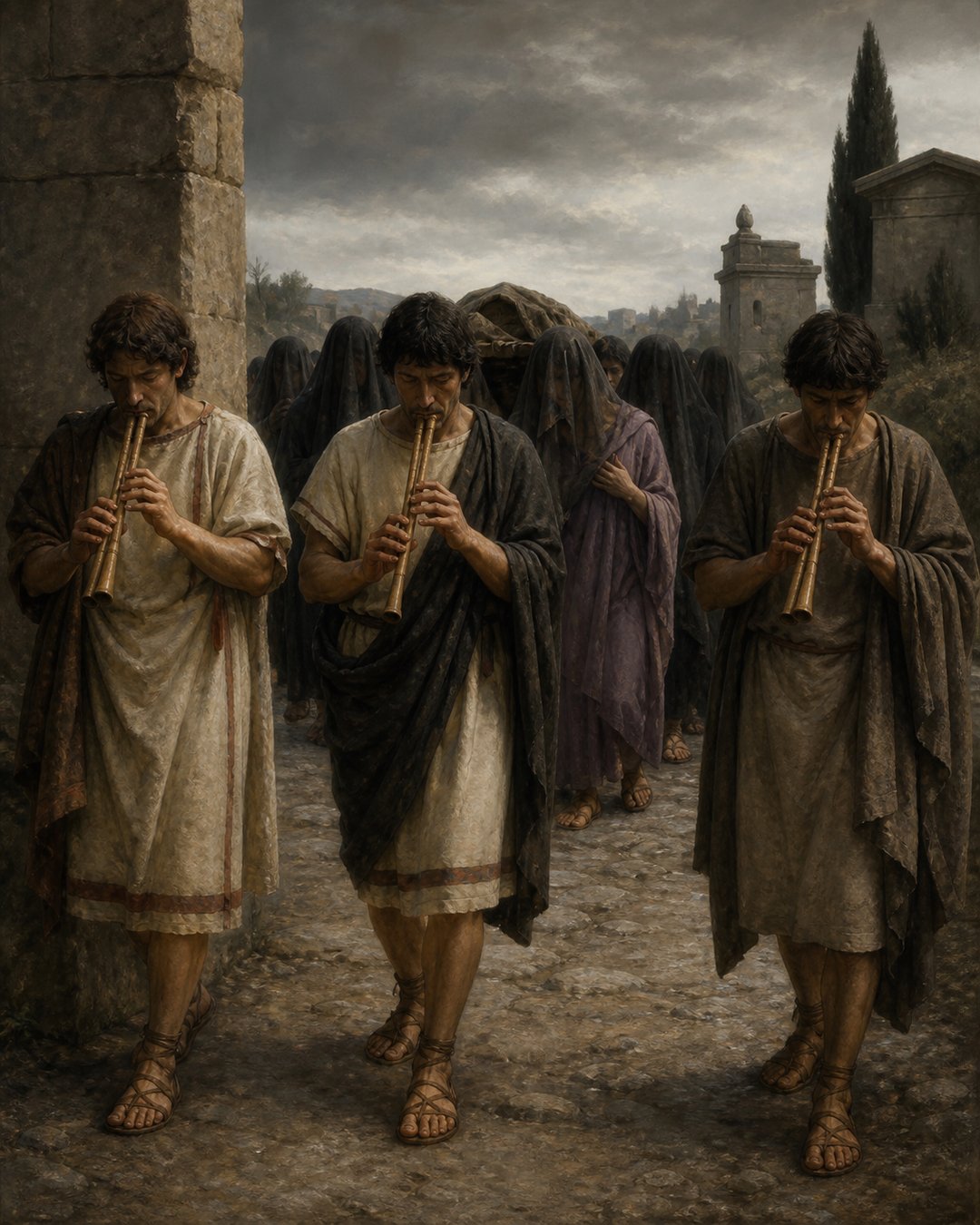
A Roman funeral could have music, mourning cloth and purple. It could display crowns that the dead had earned, and a gold bridge already fixed between the teeth did not have to be torn from the mouth. Yet an old legal memory drew lines through that display. Cicero quotes one limit with startling precision: no more than three mourning veils, one small purple tunic and ten flute players.
The numbers survive in his dialogue On the Laws, where he looks back to the Twelve Tables of the fifth century BC. His discussion does not preserve a complete funeral code in modern order. It gathers fragments, comments on their purpose and compares some of them with Greek legislation. The resulting list nevertheless reveals what Roman lawmakers believed could turn burial into a contest among households.
The rules targeted visible and repeatable acts. Cloth could multiply, musicians could fill a street, women’s lament could become a performance, bones could be gathered for another ceremony, gold could enter the fire, and a pyre could claim space within the city. Regulation made each of those choices answerable to a boundary.
Three Veils and Ten Musicians Made Expense Countable
Cicero introduces the funeral provisions as laws designed to reduce expense and lamentation. The surviving formula is concrete rather than philosophical. Three mourning veils, one small purple tunic and ten flute players were enough. The point was not that every funeral required those things. The list set an upper edge beyond which display became unlawful.
Textiles carried cost and rank into public view. Purple was never just a neutral color in Roman civic life; dyed cloth could advertise status, office and wealth. By allowing one small purple tunic, the rule acknowledged ceremonial distinction while refusing an unlimited field of costly fabric. Three veils similarly converted an expandable display into a fixed quantity.
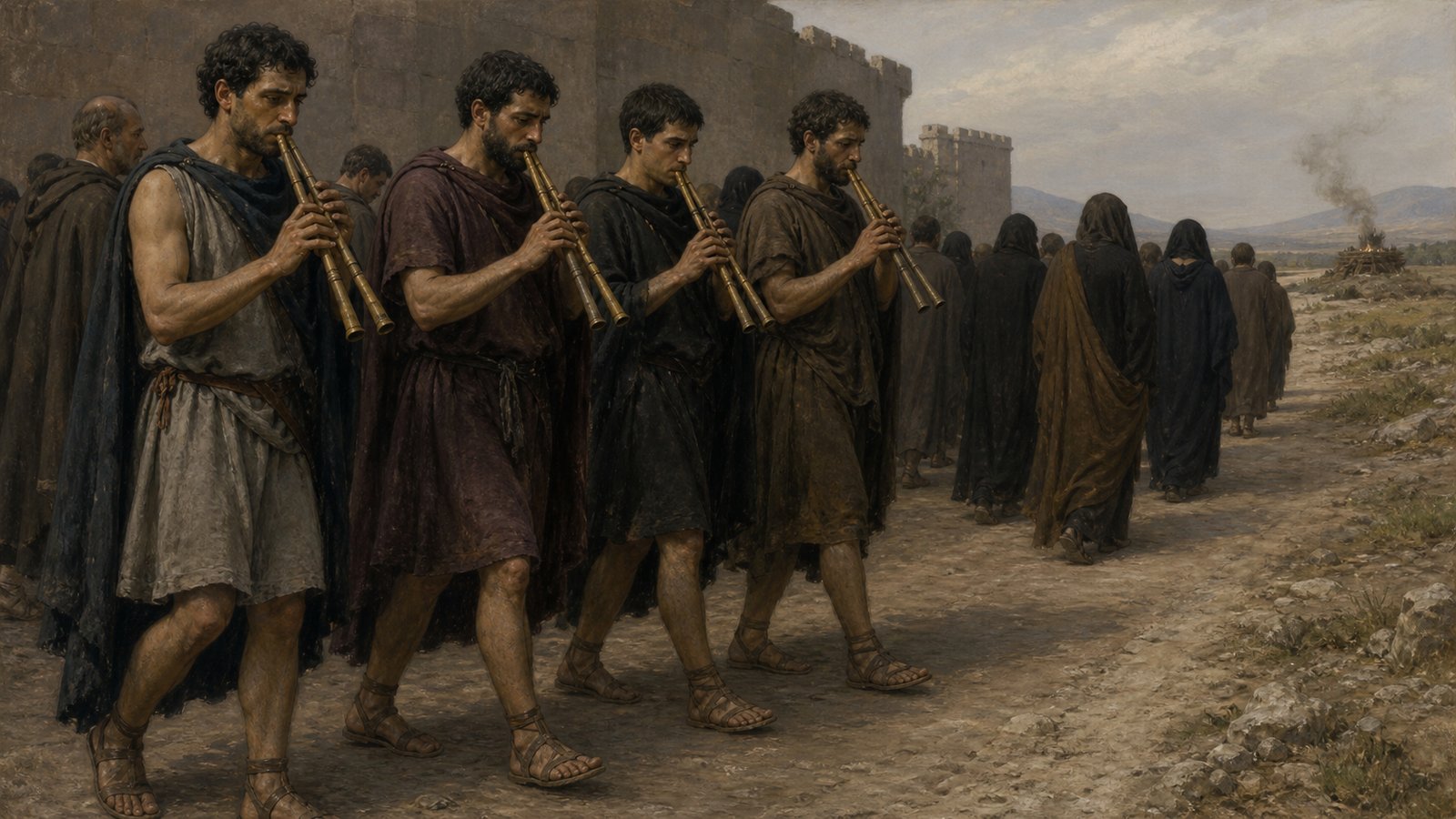
The flute players reveal how sound occupied civic space. A procession with ten musicians could already be heard and seen. An additional group did not make the dead more dead or the kin more bereaved. It made the household’s resources harder for rivals to ignore. A numerical ceiling restrained the scale of that audible claim.
This legal inventory complements the wider story of ambition in Roman funeral processions. Processions placed relatives, offices and inherited prestige before spectators. The Twelve Tables fragments show the counterpressure: a community attempting to keep the performance from expanding without limit.
Cicero connects the Roman provisions with an older reforming impulse that he associated with Greek law. Whatever the exact route of influence, his explanation is clear. Funeral rules belonged to the government of luxury and grief together. Cost was not private when a household displayed it through streets, music and crowds.
The Law Distinguished Grief from Injuring the Body
Another fragment addressed women’s mourning. Cicero gives the rule that women should not tear or scratch their cheeks and should not make the ritual lament called lessus. The precise range of that Latin word was already uncertain enough for Cicero’s speakers to discuss it, but the physical prohibition is plain.
The rule did not command indifference. Roman funerals still allowed sorrow, family presence, procession and commemoration. It singled out forms of lament that could be amplified, imitated and judged in public. Scratched cheeks transformed emotion into a visible wound; a formal cry transformed it into sound. Both could become measures in a competition over whose loss appeared greatest.
Cicero’s wording also preserves the gendered expectations surrounding funeral labour. Women were associated with prominent lament in the ritual memory he quotes. The law addressed their bodies and voices directly, while other provisions addressed household spending and the treatment of the corpse. Different participants encountered different limits inside the same event.
Modern readers should resist turning the clause into a diagnosis of individual mourners. Cicero gives a legal and ritual fragment, not case files about particular women. Its value lies in showing that lawmakers treated performed grief as an action with civic consequences. A funeral could gather enough people and attention for the manner of mourning to become a public concern.
The distinction helps explain why Roman funeral regulation was so detailed. A broad command to avoid excess would have left every family to define excess for itself. Cloth counts, musician counts and named bodily acts supplied visible tests. Witnesses could recognize ten flute players or a scratched face more readily than they could measure sincerity.
One Corpse Was Not to Generate a Second Spectacle
Cicero next discusses rules against collecting the bones of a dead person in order to hold another funeral. He notes exceptions when death occurred in war or abroad. Those exceptions illuminate the ordinary restriction: repeating the ceremony around recovered remains could duplicate display, expense and public gathering.
Travel and warfare made a single local burial impossible in ways that an ordinary death at home did not. A body might be unavailable, or remains might return after a first commemoration. The law’s exceptions recognized that problem without opening every funeral to a second performance.
Another provision rejected certain embellishments around the pyre, including anointing by slaves and a drinking bout. Cicero’s surviving discussion is compressed, so each phrase should be handled cautiously. Together, however, they point in the same direction as the numerical caps. Services, consumption and staged attendance could accumulate around cremation, and the law named practices that were not to be added.
Rules about the pyre also protected materials. Cicero mentions a ban associated with smoothing or working the funeral wood with an axe. The exact ritual logic is less transparent to a modern reader than the limit on musicians, but the clause demonstrates how far regulation entered the preparation of the cremation itself. The law did not stop at the procession’s public face.
Repeated rites mattered because Roman aristocratic commemoration could be politically useful. Wax ancestor masks could return dead officeholders to the Forum, creating a lineage in motion around the newest corpse. Preventing one death from producing multiple funerals limited the number of occasions on which a household could mobilize that theatre.
Gold Was Banned Until the Teeth Made Removal Absurd
The Twelve Tables tradition also restricted gold at burial. Precious metal placed on a corpse or burned with it converted wealth into deliberate destruction. A ban kept funerary rivalry from demanding that families sacrifice more metal simply because another household had done so.
Then came an exception memorable enough to survive: if the dead person’s teeth had been joined with gold, burial or cremation with that gold was not unlawful. The rule separated removable display from material already serving the body. Lawmakers did not require relatives to mutilate the mouth to recover a small dental fitting.
This exception is useful evidence precisely because it is narrow. It does not prove that gold dental work was common across Rome. It proves that the drafters or later transmitters considered the situation real enough to name. A general rule against gold met a practical object that could not be treated like a necklace laid on the corpse for show.
Cicero also preserves an allowance for crowns earned by the dead or by close family members through recognized merit. Such honors could be displayed because they represented an acknowledged distinction, not merely purchased funeral decoration. The code therefore sorted forms of inequality rather than abolishing them. Acquired honor could remain visible while raw expenditure faced restraint.
The contrast is sharp. Purple cloth was capped, gold display was restricted, but a legitimate crown had a route into the ceremony. Roman law protected a hierarchy of civic recognition even as it resisted a hierarchy built only from how much a family could consume at the pyre.

The City Boundary Put the Final Limit on the Dead
The most spatial rule prohibited burial or cremation inside the city. Fire, smoke and graves affected more than the bereaved household. A pyre threatened neighboring structures, while tombs claimed land and inserted permanent family monuments into shared urban space.
Moving funerary disposal beyond the city did not make death invisible. Roads outside Rome became lined with tombs that addressed travelers through architecture and inscriptions. The boundary changed where memory could be built. It kept corpse and pyre out of the civic interior while allowing commemoration to gather along approaches to the city.
This rule operated differently from the ten-player cap, but both managed scale. One limited how far a procession’s sound and spending could grow. The other limited where the irreversible acts of burning and burial could occur. Together they framed the funeral as a household duty performed under civic conditions.
Cicero admired the restraint he found in these fragments. His own late-Republic world knew enormous aristocratic competition, and his dialogue uses early law as a standard against excess. That perspective must be remembered: he was not a neutral archivist copying a complete tablet. He selected and explained old provisions inside an argument about good government.
Even through that filter, the objects remain unusually vivid. Three veils. One purple tunic. Ten flutes. Scratched cheeks. Gathered bones. A gold-bound tooth. A pyre outside the walls. They reveal lawmakers translating an unruly mixture of sorrow, status, religion and property into things that could be counted, seen and located.
Rome did not treat the funeral as wholly private because the performance occupied public sound, public streets and civic memory. The law allowed the dead to be honored. It tried to stop honor from becoming an arms race.
Sources
Cicero, On the Laws 2.59–69.
ToposText edition and translation of Cicero’s On the Laws.