
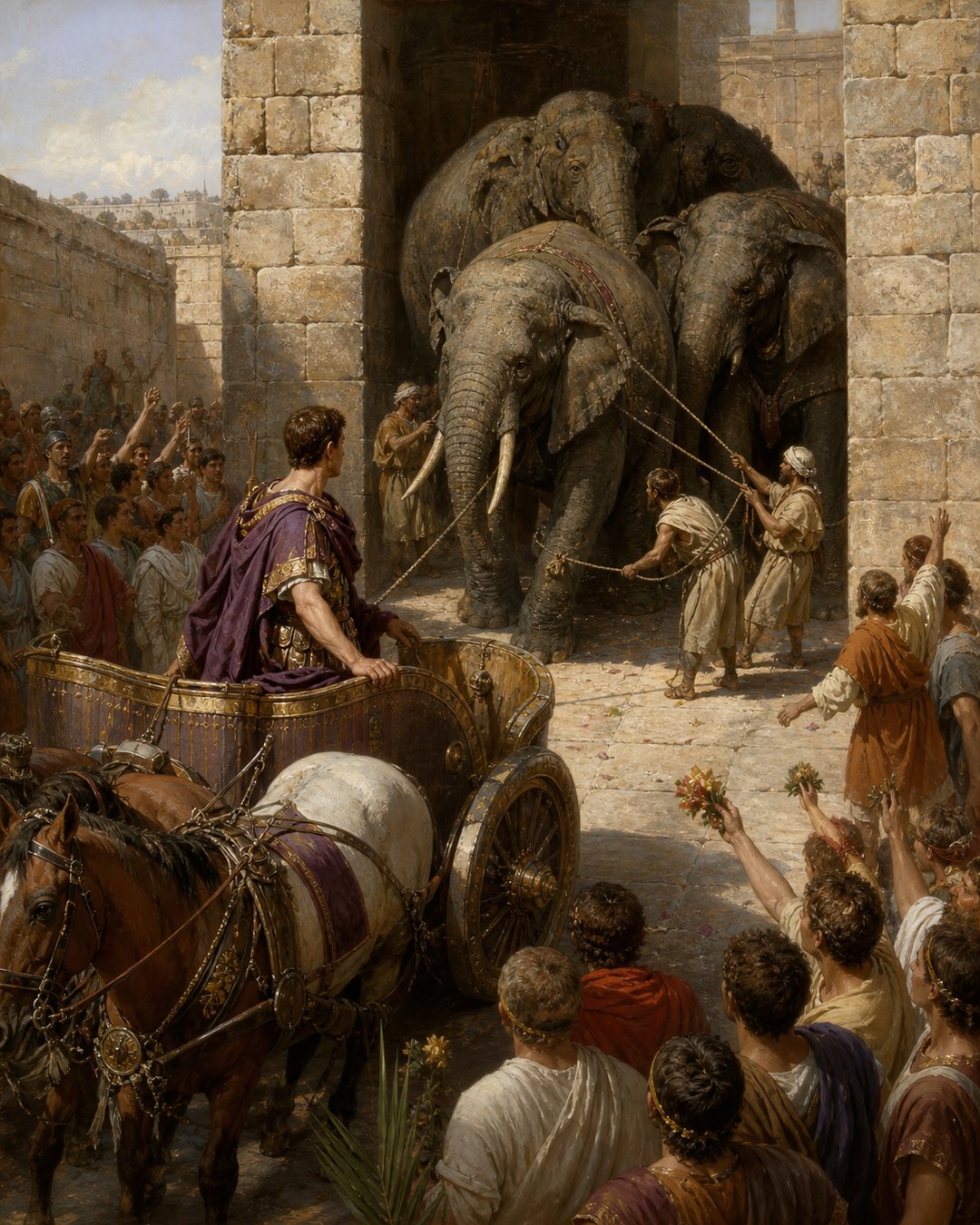
Pompey wanted four elephants to pull his triumphal chariot into Rome. He had brought the animals from Africa, and their size made the claim unmistakable: the young commander was returning with victory, kings and the living scale of another continent behind him.
The city answered with masonry. The gate was too narrow. Pompey abandoned the elephant team, changed to horses and continued the triumph.
Plutarch tells the episode after a political fight over whether Pompey should celebrate at all. The failed entrance was therefore more than comic inconvenience. A commander who had bent expectations of age and office still had to fit his performance through an inherited opening in Rome’s wall.
Forty Days in Africa Produced an Awkward Homecoming
Pompey’s campaign in Africa followed Sulla’s victory in the civil wars. Plutarch says he defeated opponents, settled the relations of kings and brought the region under control in forty days. The author gives his age as twenty-four, a number that intensifies the speed and precocity of the story.
The campaign also supplied the visual material for Pompey’s entrance. Plutarch says he hunted lions and elephants and later brought many captured elephants from African kings. The animals made distant victory present without requiring a spectator to understand a campaign map.
But the army’s return was already politically difficult. Sulla ordered Pompey to send most of his soldiers home and wait with one legion for a successor. The troops resisted leaving their commander. Pompey’s relationship with them gave him influence, yet it also made every celebration dependent on men who expected reward.
A triumph was not simply a commander deciding to stage a parade. It required recognition by the Roman state and carried rules about who qualified. Pompey’s age and unusual command made his request a challenge to ordinary sequence.
The broader ceremony appears in the ritual structure of the Roman triumph. Pompey’s entrance matters because it shows that structure under pressure from an individual determined to make an exceptional career visible early.
Sulla Said the Young Commander Was Not Eligible
Plutarch says Sulla initially opposed the triumph. The law, as the biographer presents the argument, allowed a consul or praetor to celebrate. Pompey had held neither office. He was not even old enough to sit in the Senate.
Sulla invoked precedent. Scipio had won greater conflicts in Spain but did not demand a triumph when he lacked the necessary magistracy. Allowing Pompey to ignore the same limit risked making Sulla’s regime look inconsistent and personally indulgent.
Pompey answered with a line about political time: more people worshipped the rising sun than the setting one. The remark compared his own growing power with Sulla’s decline. It was bold precisely because Sulla had recently dominated Rome through force.
After hearing what Pompey had said, Sulla called out twice that he should have his triumph. The exchange does not turn Pompey into an opponent of Sulla’s order. He had benefited from that order and campaigned for it. It shows him negotiating from a position created by military success and soldierly loyalty.
The first barrier therefore yielded. Normal office and age no longer stopped the ceremony. Pompey could enter as a triumphator before entering the Senate as an ordinary member.
Four Elephants Made the Claim Too Large for the Gate
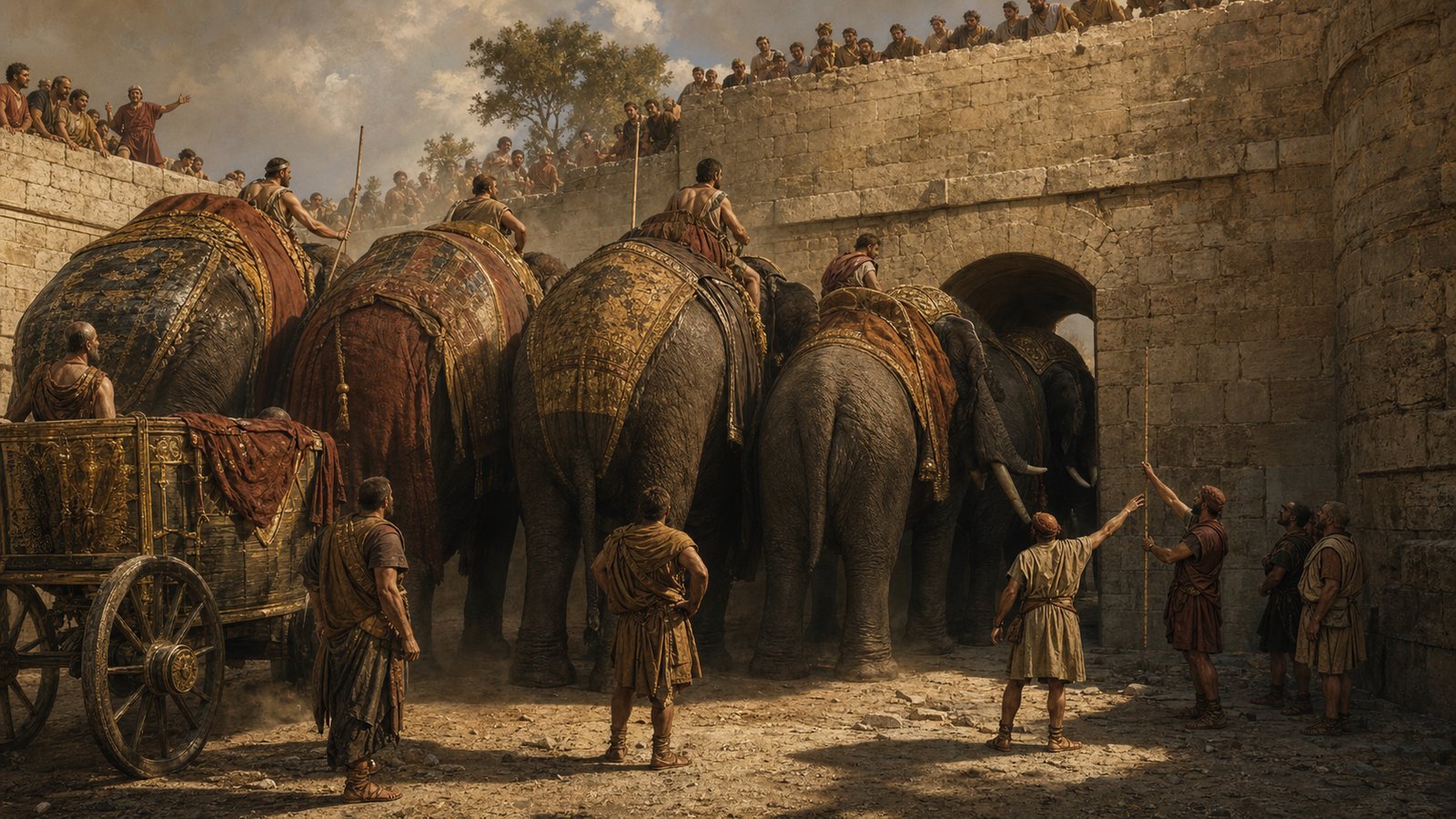
Pompey then tried to ride in a chariot drawn by four elephants. Plutarch says he had captured many from African kings. The team translated conquest into harness: animals associated with royal armies would pull a Roman commander before the city crowd.
Four elephants also created a practical geometry. A chariot team had to approach, align and pass through a gate built for the city’s traffic and defence, not for Pompey’s experiment in scale. The opening proved too narrow.
Plutarch’s sentence is spare. Pompey gave up the attempt and changed to horses. There is no extended disaster, no claim that the elephants panicked and no description of a damaged gate. Adding those details would turn a well-attested obstruction into invented theatre.
The restraint makes the moment sharper. Pompey had persuaded Sulla, outgrown expectations attached to age and assembled an exotic team, but stone width was not negotiable on parade day. The city’s existing fabric edited the spectacle.
The captured animals carried another implication. Plutarch had just connected Pompey’s African success with the defeat of enemies and the settlement of kings. Harnessing elephants from those kings to the victor’s vehicle would have compressed the campaign into a moving hierarchy: conquered royal power placed literally before a Roman chariot.
The source does not identify the gate, give its measurements or explain how far the team had advanced. Those absences matter. They prevent a confident reconstruction of the exact route while leaving the central physical mismatch clear. Four elephants and their harness demanded more lateral room than the chosen entrance offered.
Romans did display unfamiliar animals, as the first giraffe shown at Rome demonstrates. Pompey’s elephants served a different purpose. They were not merely creatures to be viewed; they were supposed to provide the movement and force carrying the victor himself.
Changing to Horses Saved the Ceremony
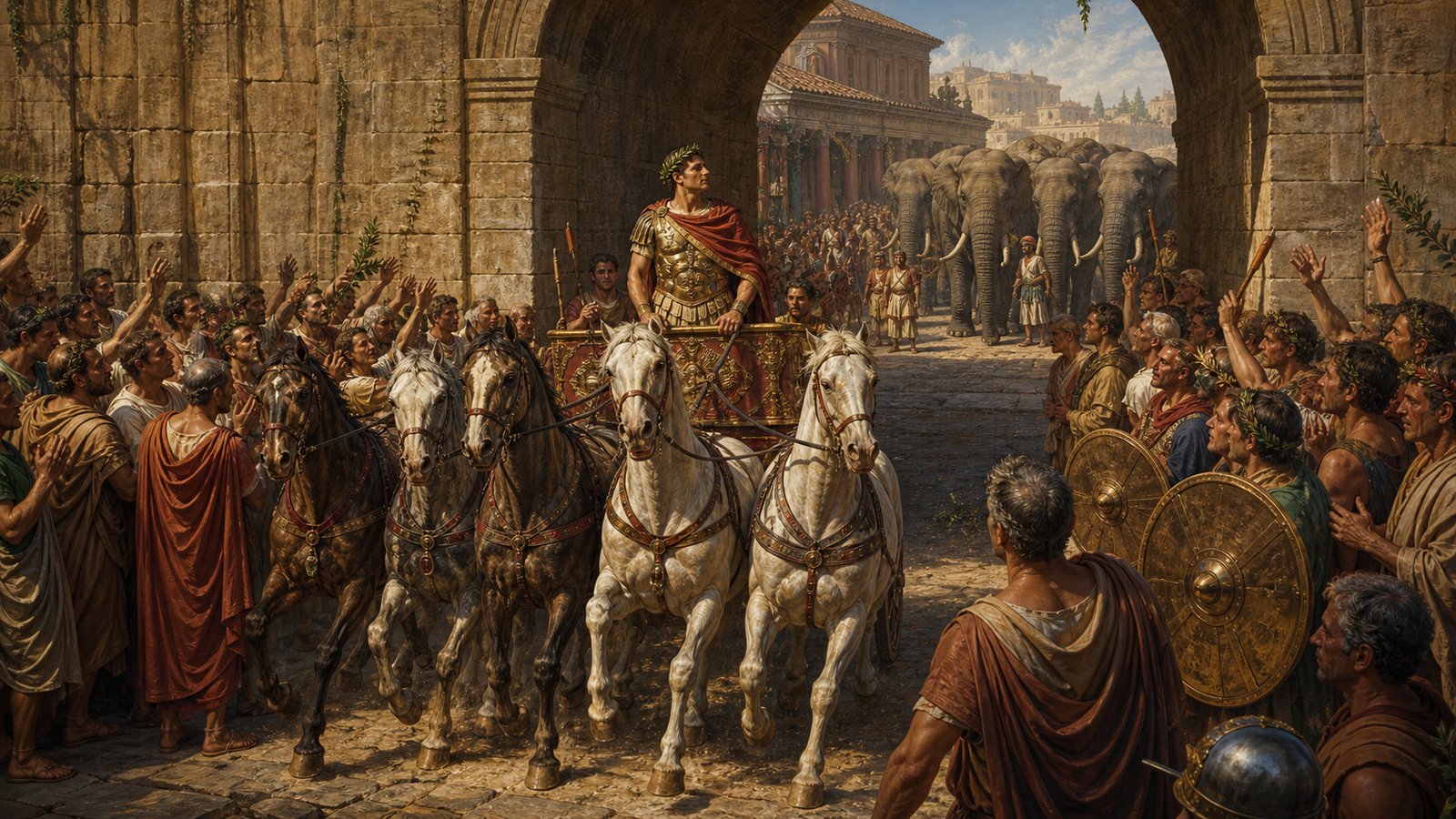
Pompey’s response was practical. He did not abandon the triumph when the most theatrical element failed. Horses replaced the elephants, allowing the procession to pass through the gate and continue.
That substitution separates the ceremony’s essential claim from one proposed prop. The elephants magnified victory, but they were not the legal or ritual basis of the triumph. Pompey could lose the oversized team while retaining the honour he had extracted from Sulla.
The soldiers posed another threat. Plutarch says they had received less than expected and were inclined to create a disturbance that could obstruct the triumph. Pompey declared that he would rather surrender the honour than flatter them.
Servilius, who had opposed the triumph, reportedly changed his assessment after hearing this. He now judged Pompey worthy because the commander appeared willing to give the ceremony up rather than yield to pressure from his own troops.
The story places two possible blockages beside each other. The gate physically stopped the elephants. The soldiers could have stopped the event politically. Pompey solved the first with horses and faced the second by presenting himself as independent of the army that had made his leverage possible.
A Triumph Before the Senate Became Its Own Credential
Plutarch observes that Pompey might have become a senator at this stage if he wanted. He preferred the rarer reputation of celebrating a triumph before reaching senatorial age. The reversed sequence was itself part of the display.
This helps explain why the elephants mattered even after they failed. Pompey’s early career repeatedly enlarged the expected order: command before normal office, triumph before Senate membership, captured royal animals before a conventional horse team. The gate scene condensed that pattern into an image anyone could understand.
Later Roman memory knew Pompey through far greater commands, a theatre, eastern settlements and civil war against Caesar. The first triumph can disappear beneath those later events. Plutarch restores the young commander at the moment when ambition still had to improvise in public.
The episode should not be polished into a moral that Rome always restrained individual glory. Sulla had already relaxed a major restriction, and the triumph proceeded. Nor did architecture defeat Pompey. It forced one adjustment inside a successful claim to exceptional status.
A triumph was built from permissions, people, animals, streets and entrances. Its meaning could be planned, but its final form emerged through friction. Pompey’s four elephants reached the city and proved the scale of his intention. The horses that replaced them proved he cared more about entering than about preserving every detail of the image.
Sources
Plutarch, Life of Pompey 12–14.
Pliny the Elder, Natural History 8.2.