
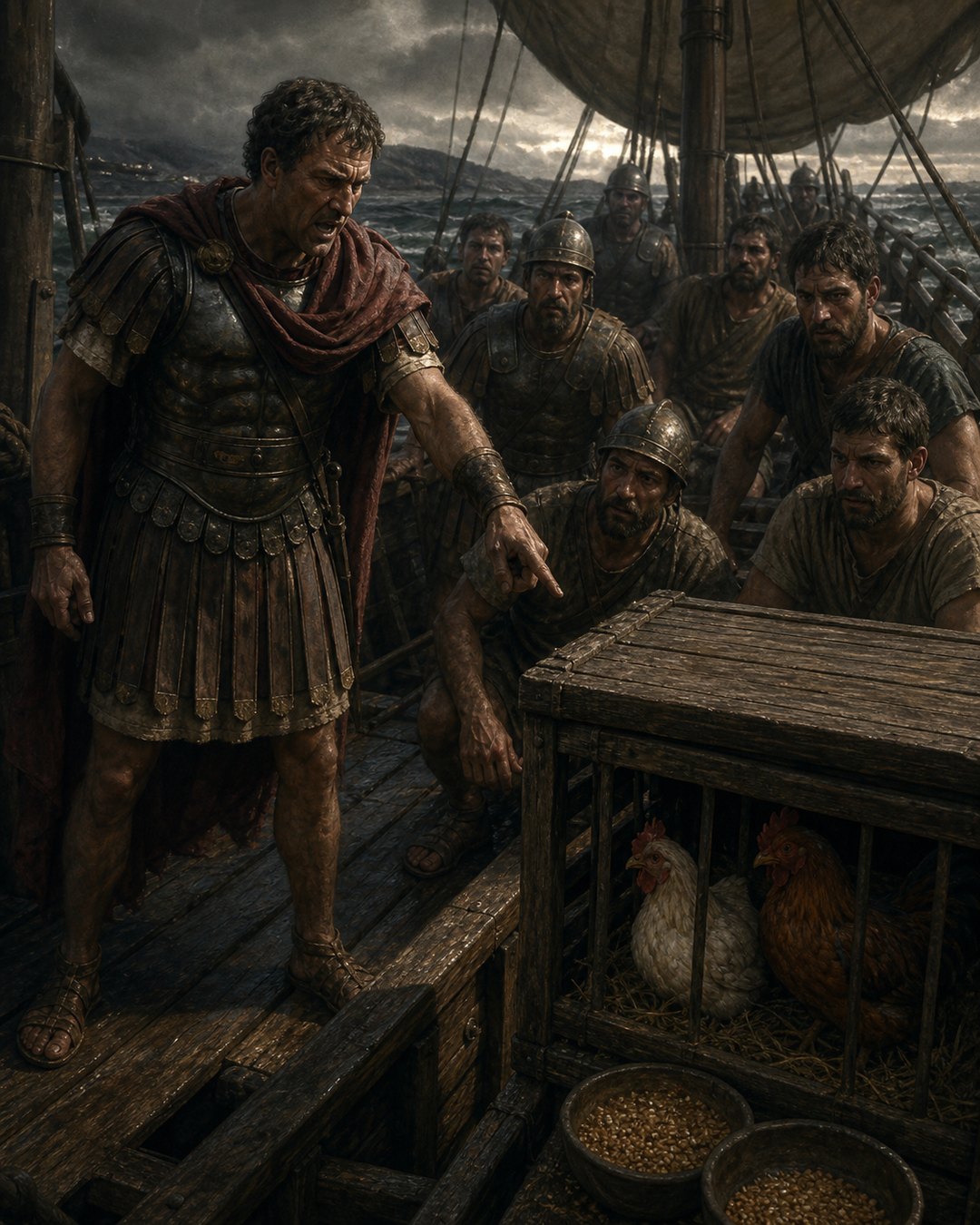
Before the Roman fleet attacked near Drepana, sacred chickens were offered grain. They would not eat. The consul Publius Claudius Pulcher had received a bad omen at the moment he wanted speed.
Later Roman writers gave him a line designed never to be forgotten. If the birds would not eat, he said, let them drink—and ordered them thrown into the sea.
The story is comic until the fleet moves. Carthaginian ships escaped the harbor, gained open water and defeated the Romans. The chickens then became more than birds. They became a compact explanation for what happens when a commander treats ritual procedure, counsel and unfavorable information as obstacles to his plan.
Chicken Feeding Was a Military Instrument
Roman magistrates did not bring chickens aboard because officers lacked eyes or seamanship. The birds belonged to a formal system of auspices through which public action was tested against divine approval.
A keeper released the sacred birds and offered feed. Eager eating, especially when food fell from their beaks, could produce the favorable tripudium solistimum. Refusal or hesitation warned against proceeding.
The sign did not calculate wind, oar strength or enemy formation. It structured decision and responsibility. A consul who acted after favorable auspices could present the campaign as properly authorized; a negative sign created a reason to delay, consult or change the moment.
Because the procedure was portable, it accompanied an army or fleet beyond Rome. Commanders did not leave civic religion behind when crossing the sea. The coop and keeper carried a recognizable decision ritual onto a deck crowded with ropes, rowers and weapons.
Ritual also made command less private. The keeper, witnesses and established interpretation stood between impulse and action. That did not prevent manipulation, but it gave Roman political culture a language for judging whether a magistrate had respected limits.
An account of the Capitoline geese awakening Manlius follows birds as physical alarms. The Drepana chickens served a different function. Their behavior mattered because institutions had already decided how to read it.
Pulcher Needed Surprise More Than Delay
In 249 BC, Rome was deep in the First Punic War. Naval operations around western Sicily demanded fleets, trained crews and difficult coordination. Drepana offered Pulcher a chance to strike the Carthaginian squadron under Adherbal.
Surprise was central. A commander hoping to trap ships in harbor could not wait indefinitely while the enemy learned his approach. The unfavorable feeding therefore arrived against a tactical preference for immediate action.
This conflict makes the episode more than a joke about irrational birds. Pulcher faced two systems of urgency. Strategy said move before the opportunity closed. Ritual said the moment was wrong.
A delay might cost surprise; an attack might proceed without expected reassurance. The sources preserve no council weighing those alternatives. Later memory collapses deliberation into Pulcher’s anger because the insulting gesture became the fact Romans wanted to judge.
Roman sources hostile to his memory present the choice as arrogance. He did not merely override the omen quietly; he mocked it. The reported order to let the birds drink transformed disagreement into contempt.
The exact words come through later authors and may have been sharpened by retelling. Their survival nevertheless shows what Romans thought the moral of Drepana was. A magistrate responsible for public auspices had treated a recognized warning as material for a pun.
Adherbal Turned the Harbor into a Trap for Rome
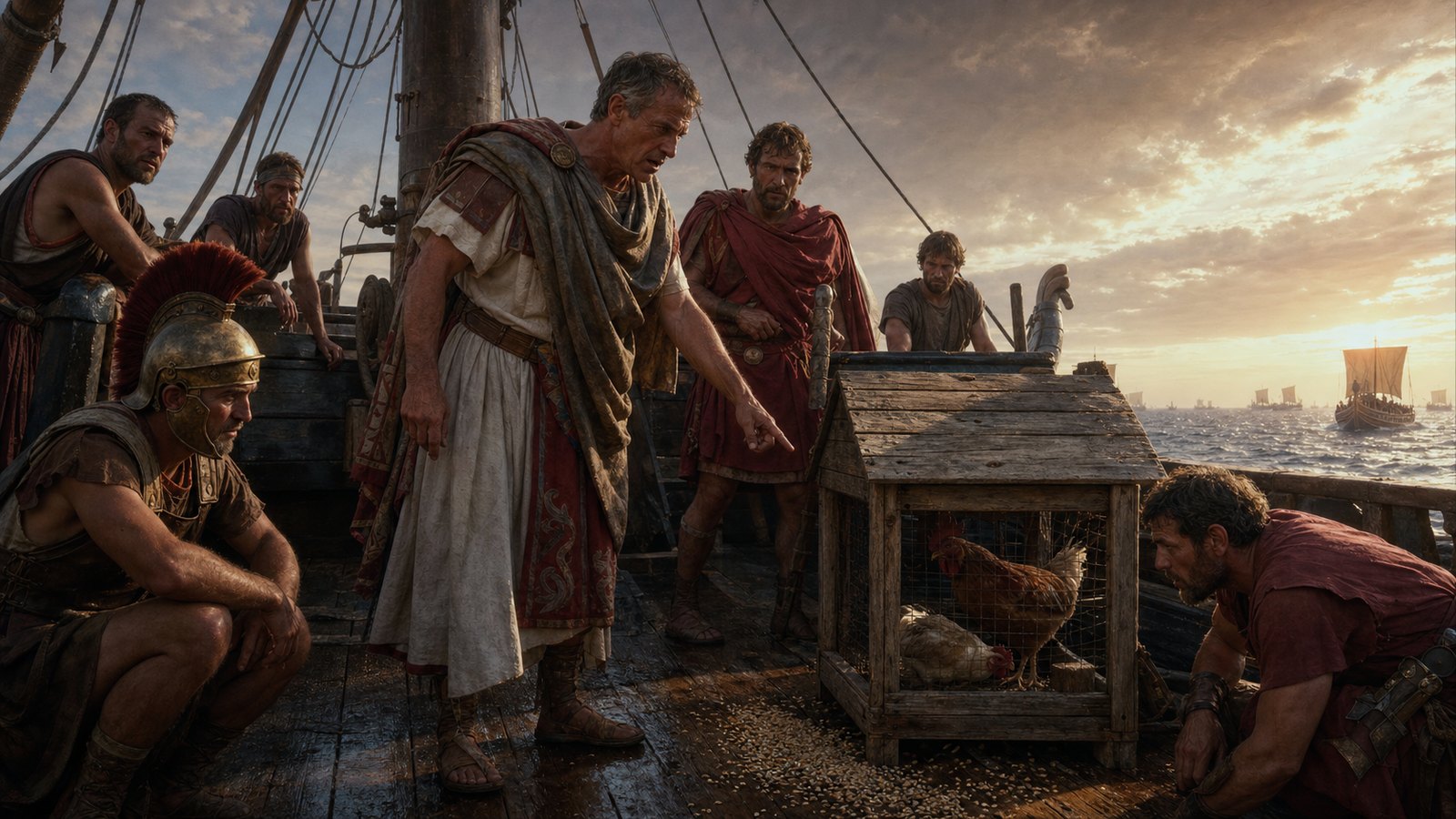
The Roman plan did not fail because chickens changed the sea. It failed through ships, timing and space. Adherbal got his fleet out of Drepana and into room where experienced Carthaginian crews could maneuver.
Roman ships approaching in imperfect order found their formation compressed near the coast. Once surprise disappeared, the attackers faced an opponent able to use speed and open water. The geometry Pulcher hoped to impose on Carthage turned against Rome.
Ancient numerical totals vary and should be treated cautiously, but the defeat was severe. Many Roman ships were captured or lost while the consul escaped with a reduced force.
Crews paid for the failed approach. Naval warfare demanded synchronized movement from rowers who could not see the whole battle, marines waiting to board and helmsmen responding through confusion. Once the Roman column lost order, individual courage could not restore the surprise on which the plan depended.
The omen story did not replace tactical explanation. It framed it. Pulcher’s unwillingness to accept one kind of adverse information made a memorable parallel to his failure to master the operational situation.
Roman warfare repeatedly joined engineering, discipline and religion. The story of elephants unable to fit through a triumphal gate shows physical space resisting ceremonial plans. At Drepana, harbor space resisted an attack whose commander had already rejected ritual resistance.
Defeat Made the Joke Evidence Against Its Speaker
Had Pulcher won, the birds might have survived as a tale of daring irreverence. Defeat changed the meaning of every earlier act. The quip became proof of impiety, rashness and unfitness for command.
Cicero cites the incident while discussing divination, assuming his audience knew it. Suetonius later preserves the family scandal in his life of Tiberius. The episode could travel across genres because it connected a vivid gesture to a public catastrophe.
Pulcher returned to political consequences. Accounts associate him with prosecution and penalty after the battle. Roman legal charges and narratives vary, but contempt for auspices belonged to the case made against his command.
The consequence shows why the omen was public rather than personal. Pulcher had not ignored a private dream. He was a consul performing a recognized act before men whose lives and state resources depended on his decision. Mocking the result could be remembered as misconduct in office.
This is an important boundary. We cannot prove that divine anger sank ships. Nor should we pretend Romans separated religious misconduct from military judgment as neatly as a modern investigation might.
For them, a consul’s authority was civic, military and sacred at once. Mishandling auspices could be evidence that the same character mishandled tactical advice and public trust.
The Birds Became Rome’s Memory of Rejected Advice
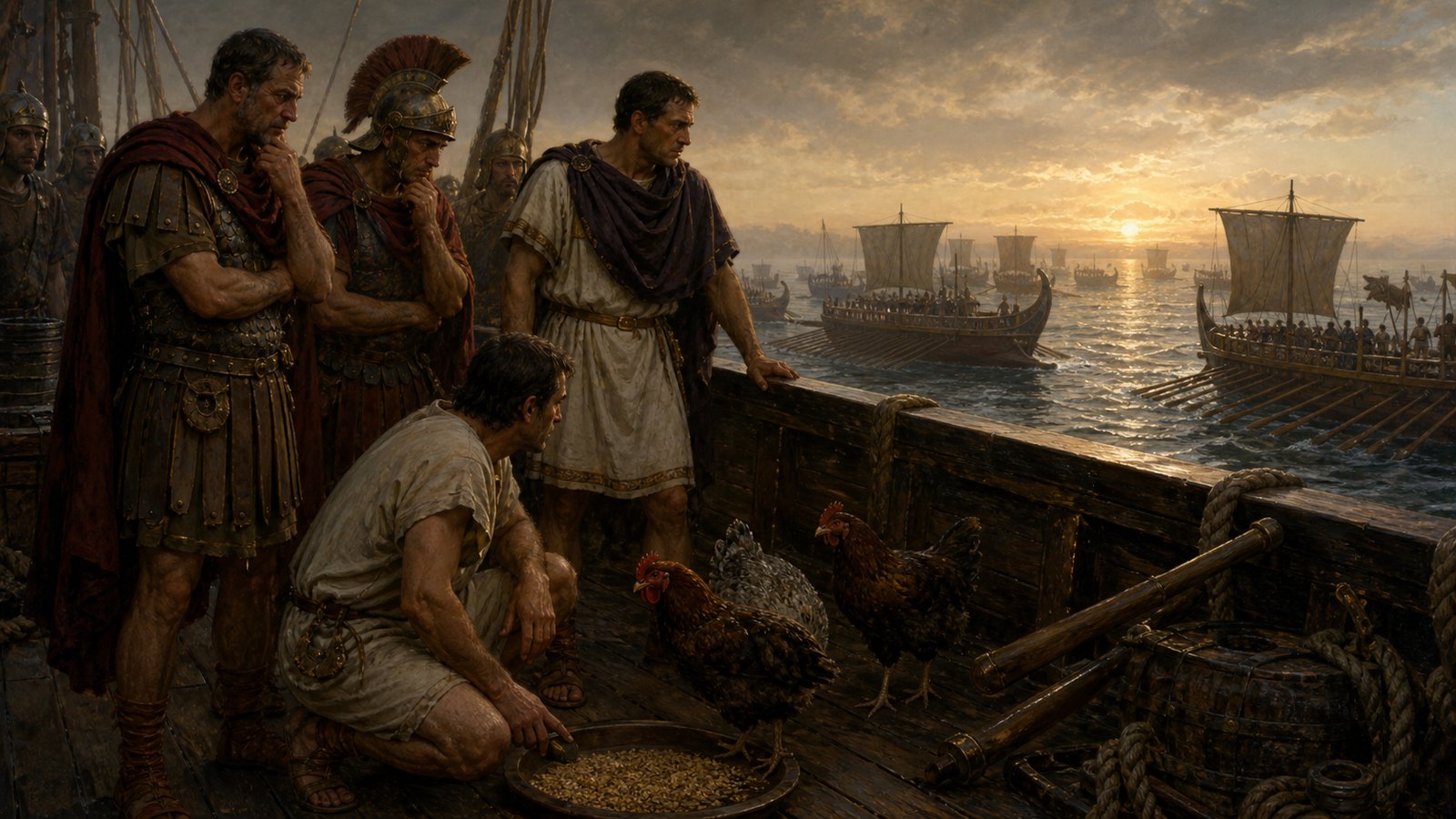
The sacred chickens remain famous because the scene is small enough to visualize. Grain lies untouched. A commander loses patience. Birds cross the rail. An entire fleet then enters battle beneath the shadow of that gesture.
The anecdote also warns against treating Roman religion as decoration applied to “real” military history. Auspices shaped when magistrates could claim legitimate action and how later citizens assigned responsibility.
At the same time, the tactical account prevents an opposite mistake. Drepana was not won by poultry. Carthaginian command, seamanship and positioning defeated a Roman attack. The omen became persuasive because the material failure supplied consequences.
Later writers fused both levels. Pulcher ignored a ritual warning and then made strategic errors. The birds offered a moral sequence without requiring readers to understand every turn of the naval engagement.
The quip’s elegance may itself be evidence of memory at work. “If they will not eat, let them drink” is exactly the line a culture preserves. Whether polished or verbatim, it captured a commander forcing an answer from signs he did not like.
Drepana therefore left Rome with two reports. The battle report counted ships and defeat. The chicken story judged the man who had chosen the hour.
The birds refused grain, but Pulcher refused delay. Roman memory made the second refusal the dangerous one.
The contrast remained useful because it joined belief to accountability. A commander could not control whether the birds ate or whether an enemy accepted battle, but he could control how he responded to unwelcome signals. Roman storytellers judged that response long after the ships and coop disappeared.
Sources
Cicero, On Divination 2.71. Suetonius, Tiberius 2. Polybius, Histories 1.49–51.