
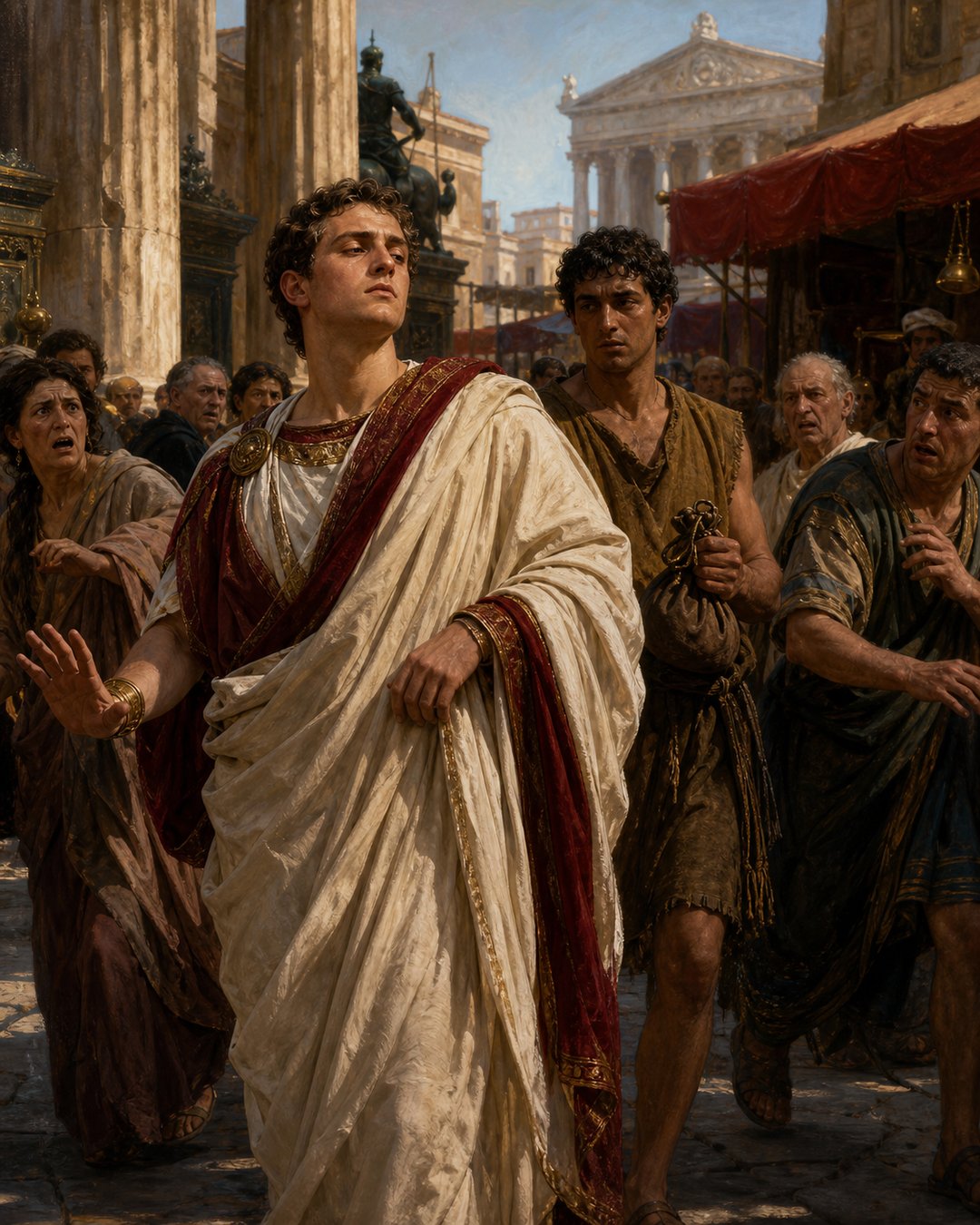
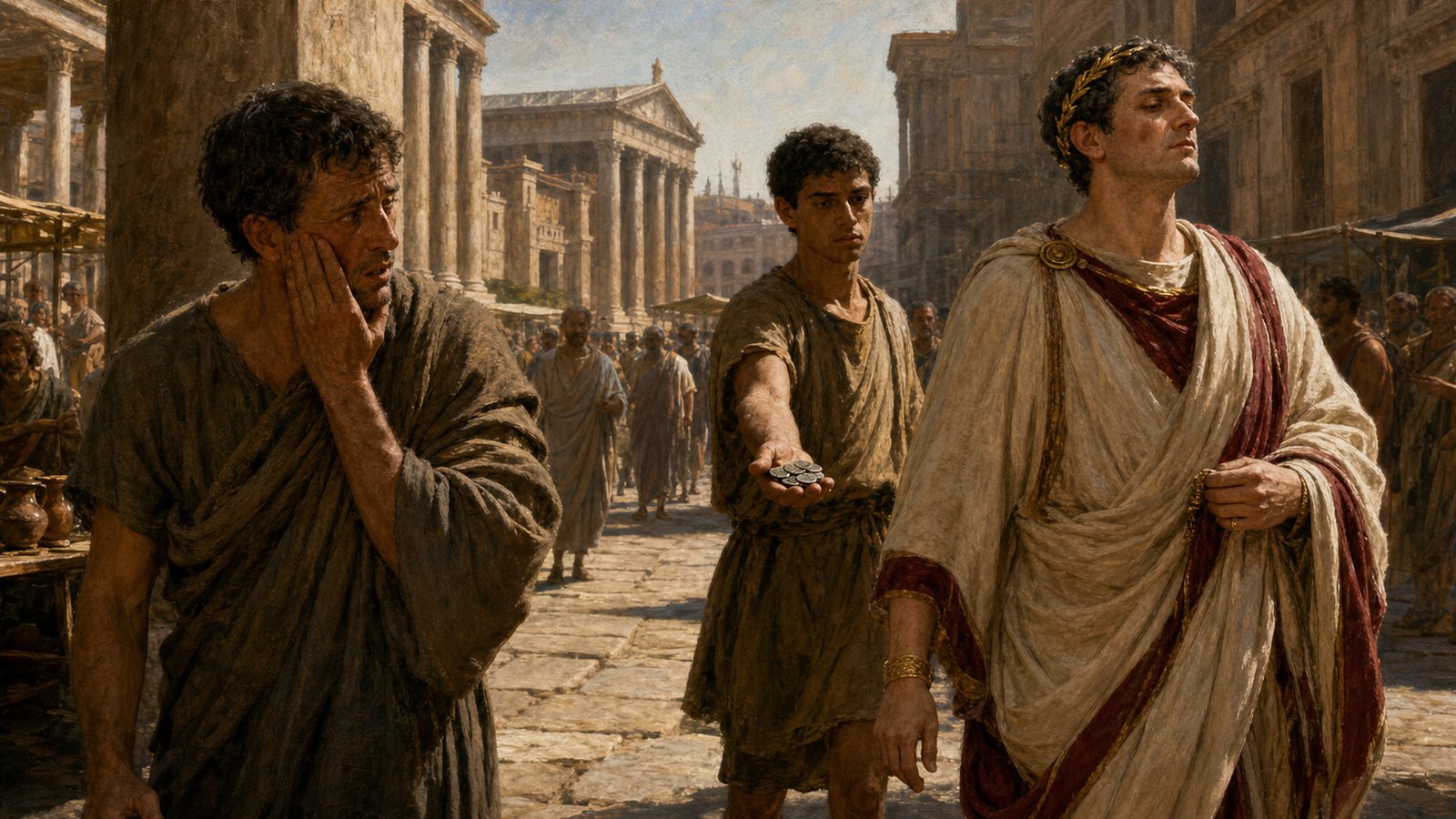
Lucius Veratius walked through Rome striking free citizens in the face. An enslaved attendant followed him with a purse. After each blow, the attendant counted out twenty-five bronze asses.
Aulus Gellius presents the scene as an argument about old law. The Twelve Tables had attached a fixed payment to one form of personal injury. Once twenty-five asses became cheap, Veratius could treat the penalty as the posted price of an insult.
The story may be sharpened for legal debate, but its mechanism is precise. A rule can remain perfectly legible while losing the power for which it was made. Rome answered not by pretending the coins still frightened rich offenders, but by letting magistrates assess injury in context.
The Twelve Tables Put a Number on Injury
The Twelve Tables belonged to the middle of the fifth century BC and became Rome’s foundational written law. Later Romans memorized fragments even though the original bronze tablets were gone. Their terse rules preserved a world in which retaliation, bodily injury and payment stood close together.
Gellius quotes a provision for iniuria: if someone committed the specified wrong against another, the penalty was twenty-five asses. Other fragments distinguish broken limbs and broken bones. The categories are difficult to map exactly onto modern offences, but the fixed sum is unmistakable.
A number offers valuable certainty. The injured person knows what may be claimed, the offender knows what is owed, and a dispute need not expand into private vengeance. In an early community where bronze represented substantial value, twenty-five asses could carry real weight.
Yet a statute freezes its number at the moment of enactment. Money does not freeze with it. Coinage, prices, wealth and the scale of elite fortunes changed across centuries while the words remained available for citation.
The same tension appears whenever Romans turned material value into public rules. An account of Pompeii’s public standard measures shows a city anchoring disputed quantities in stone. A fixed legal payment tried to anchor harm in bronze, but the bronze’s meaning moved.
Veratius Made the Obsolete Rule Visible
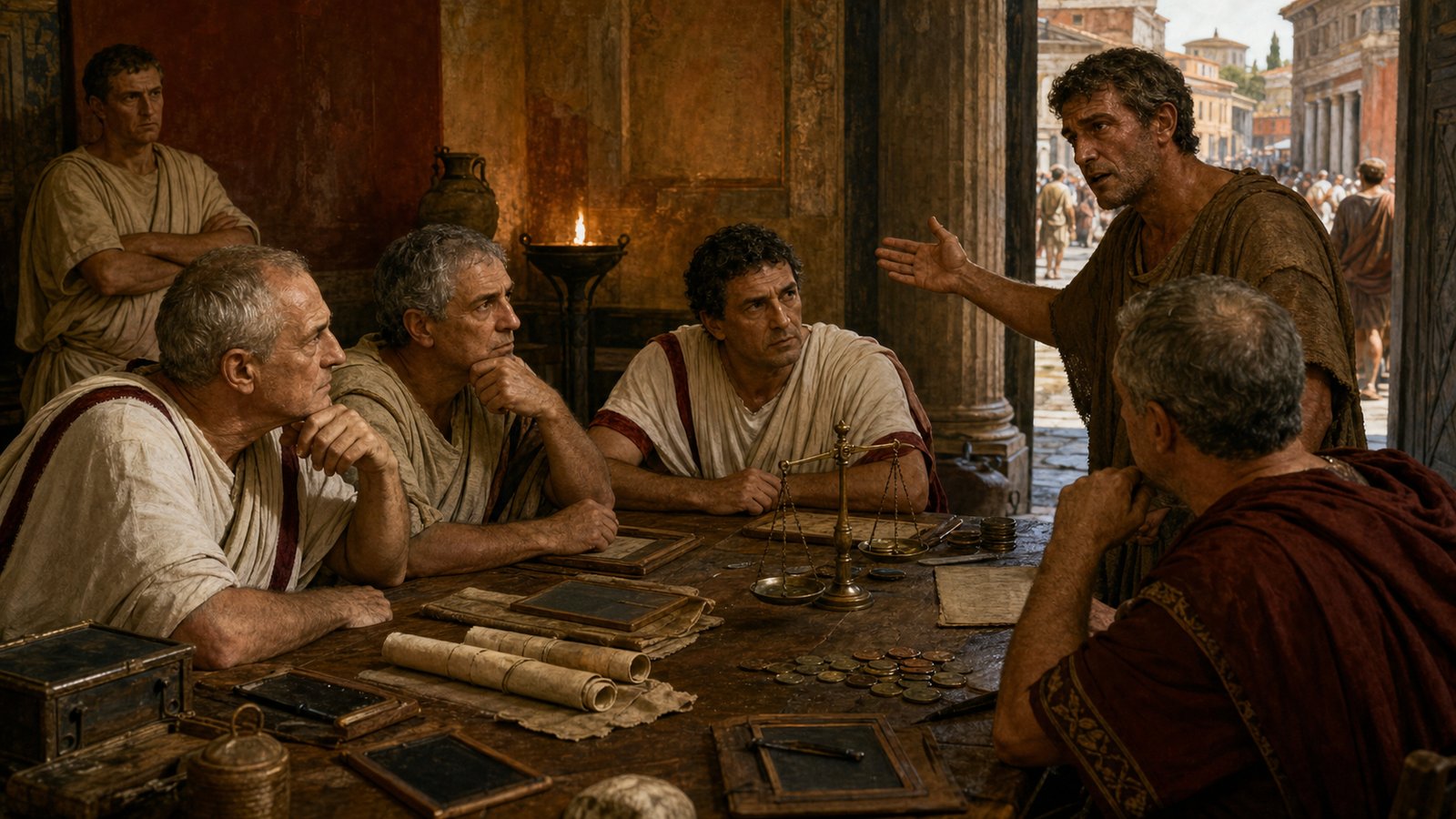
Gellius attributes the example to the jurist Sextus Caecilius, who is defending Roman law in a conversation with the philosopher Favorinus. The jurist asks what happens when an ancient fixed penalty becomes contemptible through changing values.
His answer is Lucius Veratius, described as exceptionally wicked and violently insolent. Veratius supposedly found pleasure in slapping free men. Behind him walked an enslaved attendant carrying a purse, ready to hand over twenty-five asses to each injured person.
The sequence matters. Blow and payment form one planned action. The attendant is not negotiating after an accident; he is completing a transaction the offender has budgeted in advance. Wealth removes uncertainty and turns the statute against its own purpose.
The injured citizen receives what the old words demand and still experiences the payment as another insult. A rich man has demonstrated that his amusement costs less than the victim’s dignity. Formal compliance therefore deepens the social injury.
We cannot reconstruct a police report for the episode, and Gellius wrote centuries after the Twelve Tables. The anecdote works as juristic illustration whether every slap occurred exactly as told. Its survival proves that Romans understood the policy problem instantly.
A Flat Fine Ignores Who, Where and How
Personal injury is not measured only by physical pain. A slap in private differs from a blow delivered before clients, neighbours or political rivals. Roman status culture made public humiliation especially consequential.
A flat payment cannot respond to repetition either. One impulsive act and a deliberate procession through the streets produce the same twenty-five asses per victim. Veratius’s attendant exploits that blindness with mechanical efficiency.
Nor can the old amount distinguish the offender’s means. A sum that disciplines an ordinary household may be trivial to a wealthy aristocrat. Once the penalty becomes predictable, the rich can purchase conduct that the poor still cannot afford.
The story therefore exposes three missing variables: circumstance, repetition and capacity. It also shows why simply multiplying the ancient number would not fully solve the problem. Any new fixed amount would begin ageing on the day it was chosen.
Roman law frequently evolved through the interaction of old civil rules and magistrates’ remedies. The Twelve Tables retained enormous prestige, but prestige did not require every remedy to remain administratively frozen.
The Praetor Replaced Price with Assessment
Gellius says the praetors later allowed injured people to seek an assessment rather than accept the obsolete sum. Recuperators could estimate damages, and the magistrate could frame the action according to the circumstances.
This change restored uncertainty for the offender. Veratius could no longer send an attendant with exact change because the social meaning of the act entered the judgment. The cost followed the wrong instead of the other way around.
Assessment did not produce modern equality. Roman courts remained deeply attentive to rank, reputation and citizenship. Yet the remedy could recognize facts the flat fine erased: where the insult happened, how it was delivered and whom it exposed to disgrace.
The shift also illustrates the practical creativity of praetorian law. Reform did not require Rome to destroy the Twelve Tables. Magistrates could preserve ancestral authority while supplying a remedy fitted to current life.
A related article on a stray ball and a barber’s razor follows jurists separating accident, setting and responsibility. Veratius’s slap posed the opposite problem: intention was obvious, but an inherited remedy made the intentional wrong too easy.
The Coins Became Part of the Insult
The purse is the most important object in Gellius’s scene. Without it, Veratius is merely violent. With it, he advertises a theory of law: whatever the statute names, he can pay.
His attendant’s presence also reveals the labor behind elite impunity. Someone must carry the bronze, witness the offence and complete each payment. The rich man turns another person into the moving apparatus of his legal strategy.
Twenty-five asses once translated injury into an enforceable settlement. In Veratius’s hands, the translation ran backward. Money authorized the next injury because the consequence had become small, immediate and final.
Roman jurists remembered the case because it refused an easy choice between ancient authority and practical justice. The old rule was not mocked as foolish when written. It had become foolish through the passage of time.
The durable point behind the outrageous walk is that law fails not only when nobody obeys it. It can fail when a powerful person obeys its words so exactly that its purpose disappears.
For the injured passer-by, immediate payment offered no real restoration. The public had seen the blow, the offender retained control of the scene, and the coins announced that repetition was affordable. The remedy closed the legal account while leaving the social account deliberately open.
That imbalance helps explain why Roman injury law came to weigh affront as well as bodily damage. Reputation was practical capital in a city organized through patronage, witnesses and public standing. Humiliation before a crowd could affect the victim long after redness left the cheek.
The anecdote also preserves a striking division of roles. Veratius chooses the victims and performs aristocratic aggression; the attendant handles consequence. By separating action from payment, the procession makes punishment look routine. The purse is replenished, the next citizen appears, and the system repeats without requiring the offender to pause.
Assessment interrupted that rhythm. A complaint could now open a dispute whose result depended on evidence and judgment rather than a coin count fixed centuries before. Uncertainty, usually treated as a defect in law, became part of deterrence because a wealthy offender could no longer calculate the full cost in advance.
Sources
Aulus Gellius, Attic Nights 20.1. The Twelve Tables, personal-injury fragments.