
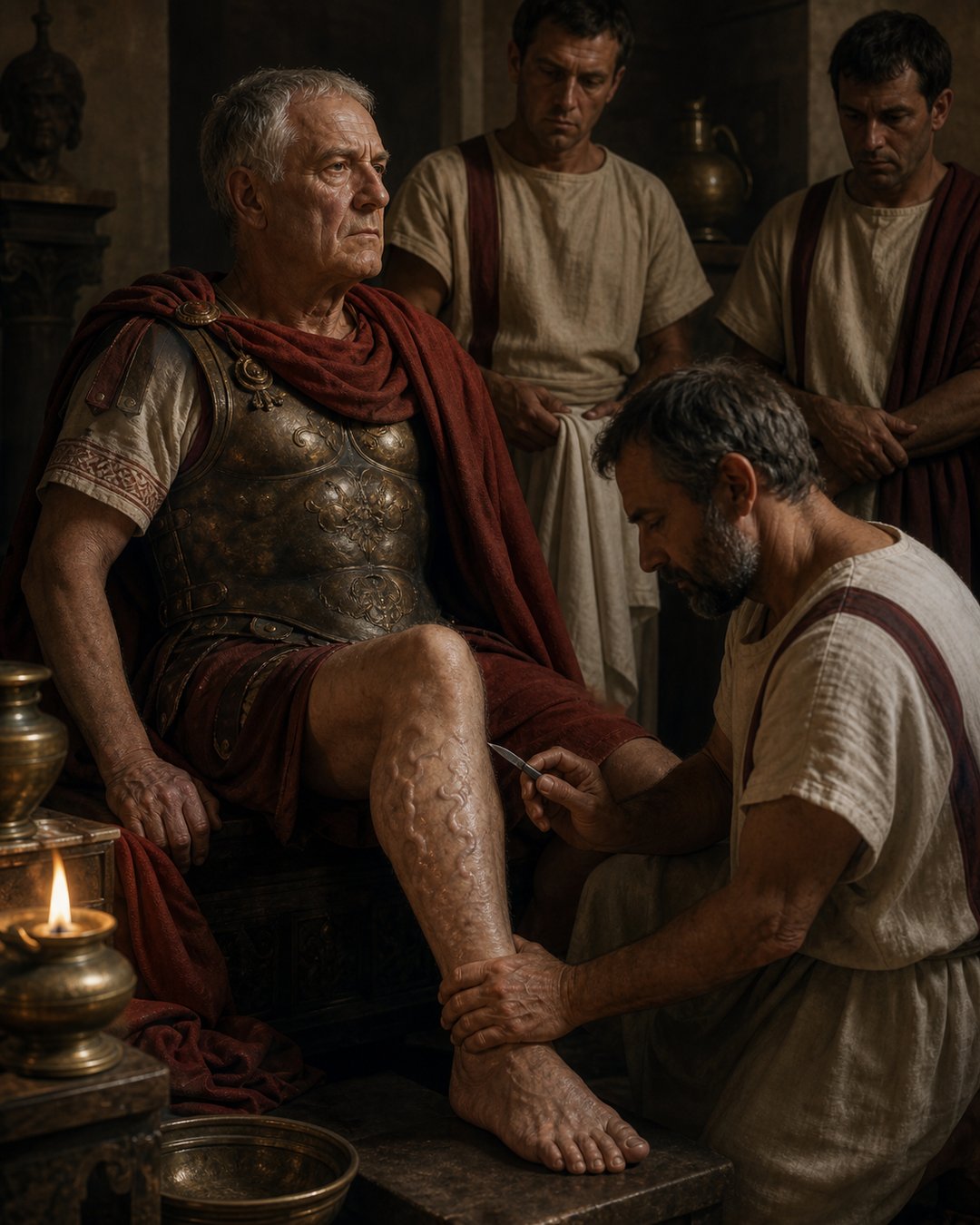
Gaius Marius placed one leg before a physician and refused to be tied down. Plutarch says the Roman endured the knife without movement, groan or change of expression.
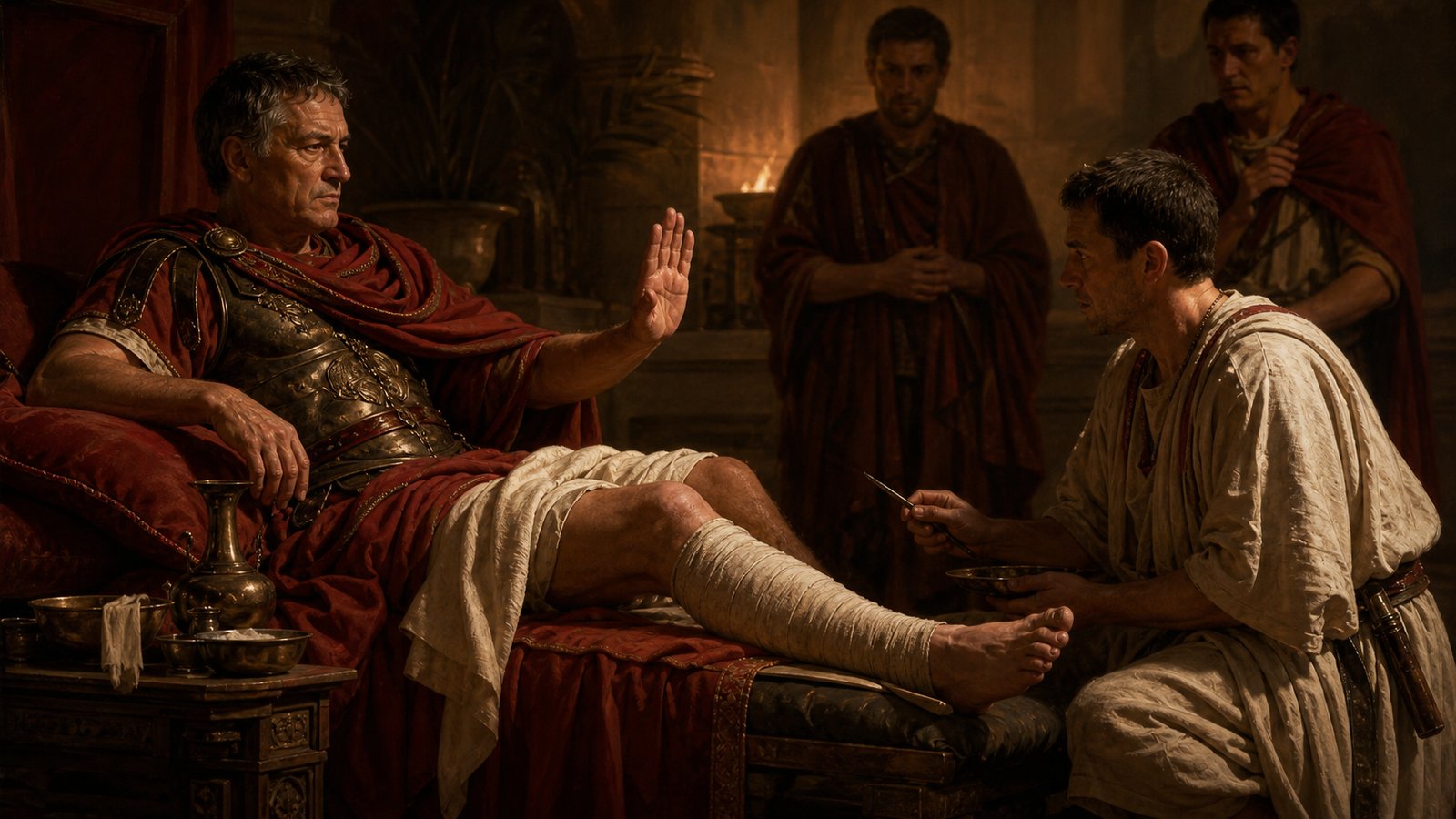
Then the physician approached the second leg. Marius stopped him. The cure, he decided, was not worth the pain.
The abrupt refusal completes the anecdote rather than spoiling it. Plutarch gives Marius both extraordinary endurance and a limit. Roman toughness appears not as an appetite for suffering but as control over when suffering serves a purpose.
Varicose Veins Put Reputation on the Body
Plutarch introduces the operation while discussing testimony to Marius’s temperance and fortitude. The body becomes evidence in a biography otherwise crowded with offices, campaigns, enemies and political reversals.
Both legs, Plutarch says, were affected by varicose veins. Marius disliked the deformity and placed himself in a physician’s hands. The stated motive is appearance rather than an emergency wound.
That detail matters. Elite Roman men were watched in public spaces where bearing, age and visible self-command shaped reputation. A condition on the legs could be physically uncomfortable, but Plutarch chooses the language of disfigurement.
The operation was therefore elective in the story’s logic. Marius sought a result he valued, accepted the danger of ancient surgery and then reassessed the exchange after experiencing it directly.
An article on Sulla’s march and a transformed Roman army places Marius within the violent politics of military loyalty. The surgery strips away armies and factions. Authority is reduced to one patient deciding what another man may do to his body.
Refusing Restraints Made Pain Public
Plutarch says Marius refused to be bound. Restraints would have protected the surgeon from a sudden movement and acknowledged that pain could overpower intention.
By rejecting them, Marius turned stillness into part of the treatment. He had to cooperate not only by presenting the limb but by keeping it usable under the blade.
The biographer emphasizes silence. No motion, no groan and a steady expression create three separate signs of control. Readers are invited to imagine the pain through the absence of visible reaction.
This is not a detailed medical case history. Plutarch does not give the instruments, duration, wound care or eventual cosmetic result. His selection serves character: the operation matters because Marius’s conduct under it can be remembered.
Ancient surgery lacked modern anaesthesia and antiseptic practice. It demanded speed, trained hands and a patient able to remain still. The source’s phrase “under the knife” makes the physical action central without supplying technical steps that cannot be recovered.
The Second Leg Changed the Meaning of Courage
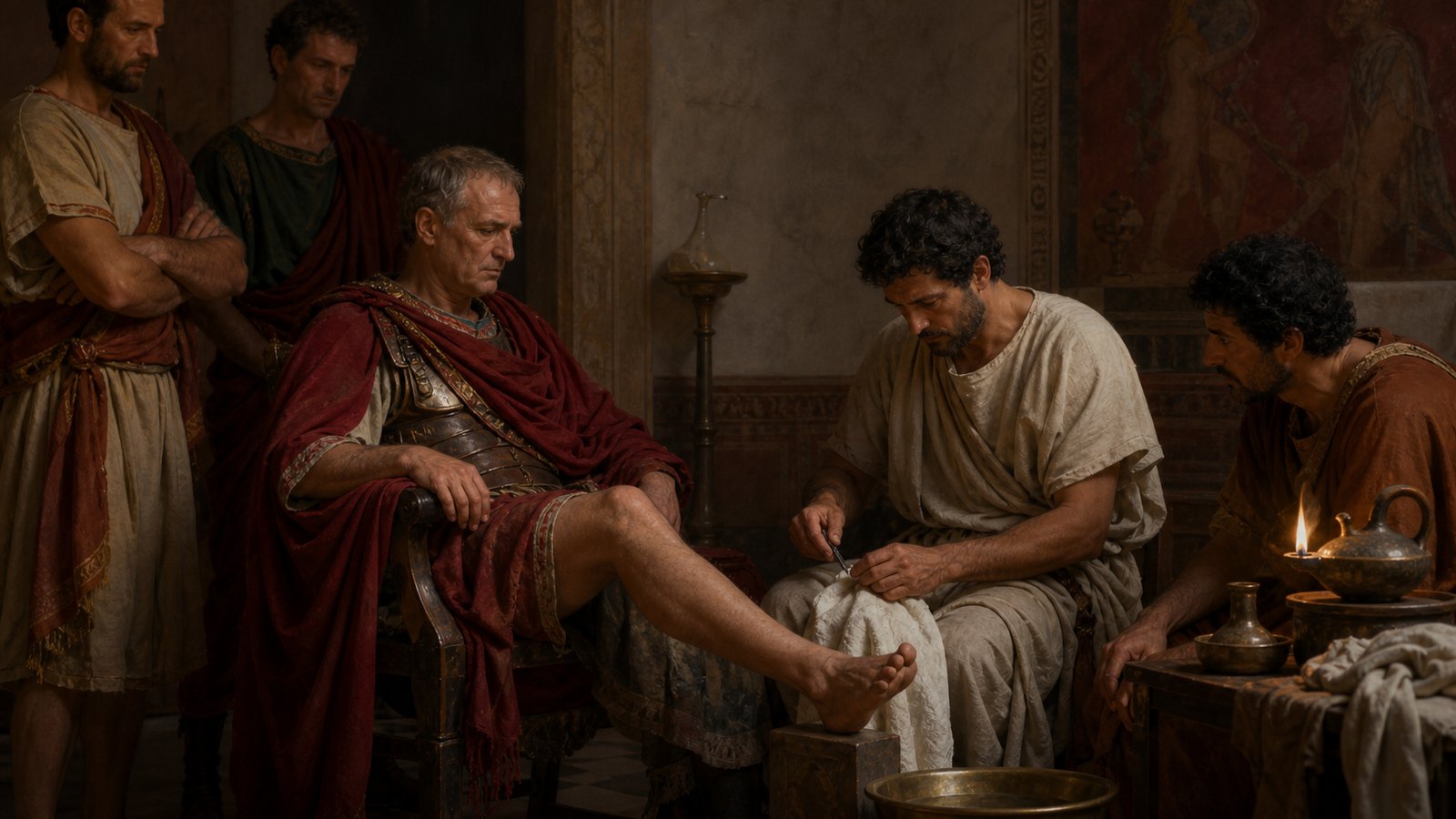
After the first operation, the physician prepared to treat the other leg. Marius refused. He said he now saw that the cure was not worth the pain.
A simpler heroic anecdote would have made him endure both procedures. Plutarch preserves a more complicated judgment. Marius proves that he can bear the operation and then chooses not to bear it again.
The decision separates capacity from obligation. Because he survived the first leg without complaint, his refusal cannot easily be dismissed as fear of an unknown pain. He knew the cost exactly.
The object of treatment was also limited. Plutarch had introduced deformity, not a wound that threatened immediate death. Once pain outweighed the desired correction, stopping became a calculation rather than collapse.
Marius’s sentence is dry enough to function as a verdict. The patient, not the physician, determines whether the promised benefit justifies another incision.
Plutarch Used Medicine to Judge a Public Man
Biography often turns private habits into explanations for public careers. Eating, sleeping, exercise, illness and pain offer scenes in which famous men cannot rely on formal office.
Marius’s operation fits that method. His steadfast face resembles the discipline expected of a commander, but the setting is intimate and asymmetric. He is exposed while the physician acts.
The anecdote also prevents courage from becoming a generic compliment. Plutarch supplies a test with a sequence: condition, decision, knife, silence, second approach and refusal. Character emerges through changing choices.
Readers who know Marius mainly through wars and civil conflict may be tempted to make the surgery predict every later act. The source does not support such a neat diagnosis. It offers one remembered demonstration, not a key to an entire life.
A different biographical portrait, Sertorius and his white fawn, shows a commander managing how followers interpreted intelligence. Marius’s operation manages an audience of physician, witnesses and later readers through bodily stillness.
The Patient Kept the Final Decision
The physician possessed specialized skill, but the patient controlled consent at both stages. Marius first offered the limb, then withdrew the second. The boundary appears through action rather than legal language.
His first choice exposed him to the knife without binding. His second prevented repetition. Together they show agency before, during and after the test.
Plutarch’s structure allows admiration without requiring imitation. The endurance is described as incredible, while the refusal receives Marius’s own practical explanation. There is no claim that suffering becomes valuable merely because a celebrated Roman can survive it.
The leg also carried more than appearance. Marius’s public identity rested on marching, campaigning and standing before soldiers and citizens. Choosing surgery on a limb risked the physical base of that identity for a correction he considered desirable.
Once he had measured the pain, the heroic pose gave way to arithmetic. One treated leg supplied all the evidence of fortitude the anecdote needed. A second could add pain without adding a proportionate benefit.
The result is an unusually human political portrait. Marius neither flees before the knife nor submits indefinitely to it. He endures, learns and stops.
That final refusal is why the story remains sharper than a stock tale of toughness. It lets a famous commander say that enough pain is enough, and it makes the judgment part of his strength rather than its defeat.
The order of decisions prevents the anecdote from becoming a simple contrast between bravery and weakness. Before the operation, Marius accepted an uncertain experience. During it, he maintained the stillness he had promised by refusing bonds. After it, he used new knowledge to reject repetition. Each stage answers a different question.
Appearance initiated the procedure, but sensation revised the value of appearance. The second leg still bore the condition Plutarch had named, yet Marius no longer treated correction as the overriding goal. Experience changed the ranking of outcomes.
The physician’s movement toward the second limb creates the decisive pause. Nothing in the account suggests that Marius lost consciousness or physical control. He remained able to speak, assess and end the treatment, which keeps the final choice inside the same portrait of self-command as the earlier silence.
Plutarch’s language also leaves the medical result modestly incomplete. He tells readers what Marius endured and why he stopped, not whether the first leg healed perfectly. The omission keeps attention on conduct under treatment rather than turning the episode into an advertisement for a technique.
The silence after the first cut and the spoken refusal before the second form deliberate opposites. While endurance was being tested, Marius communicated through stillness. When judgment became necessary, he used words. Plutarch lets the patient choose not only whether the physician continues, but also the form in which control is displayed at each moment. The remembered sequence therefore preserves both endurance and consent without forcing either one to cancel the other.
Sources
Plutarch, Life of Marius 6.